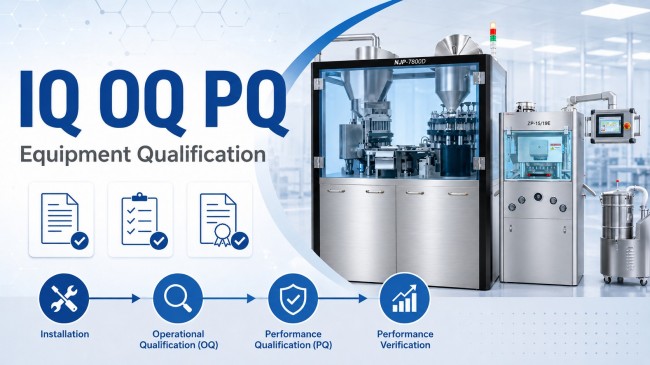
IQ, OQ, and PQ are core stages used to demonstrate that pharmaceutical equipment is installed correctly, operates as required, and can perform consistently under defined production conditions. They sit within a broader qualification lifecycle that begins with user requirements and design review and continues through acceptance testing, インストール, routine use, 変更制御, and requalification.
The scope is not identical for every project. A capsule filling machine, タブレットマシン, ブリスター包装機, and counting line present different functions, risks, 公共事業, and acceptance criteria. A useful qualification strategy therefore connects the equipment’s intended use with approved requirements, リスクアセスメント, applicable regulatory expectations, and the user’s pharmaceutical quality system.
What Are IQ, OQ, and PQ in the Pharmaceutical Industry?
Equipment qualification is the documented process used to show that equipment or systems are suitable for their intended purpose. EU GMP Annex 15 places qualification within a lifecycle approach for facilities, 装置, 公共事業, and systems.
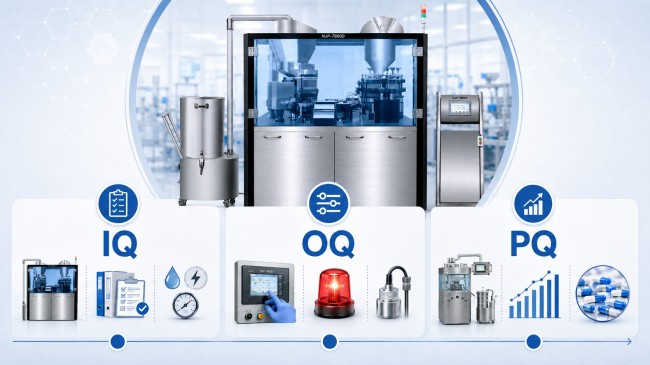
| Stage | Full Name | Main Purpose | Typical Evidence |
| IQ | 設置資格 | Confirm that equipment and supporting services are installed according to approved requirements | Installation checks, 図面, equipment records, calibration status, IQ report |
| OQ | 運用資格 | Verify that the installed equipment operates correctly across the defined operating range | Functional tests, アラーム, interlocks, operating limits, OQ report |
| PQ | パフォーマンス資格 | Demonstrate effective and reproducible performance under representative production conditions | Performance data, approved procedures, production or representative materials, PQ report |
The table is useful because the three stages are connected but do not prove the same thing. Completing installation checks does not establish operating capability, and successful functional testing does not by itself demonstrate stable performance in production.
Equipment qualification is also different from process validation. Qualification focuses on whether a machine or system is suitable for use. Process validation evaluates the manufacturing process more broadly, including qualified equipment, 材料, process parameters, 手順, 人員, and controls.
FDA process validation guidance follows the same general principle. Facilities, 公共事業, and equipment used for commercial manufacturing should be appropriately designed and qualified before Process Performance Qualification, or PPQ, is conducted. PPQ evaluates the commercial manufacturing process, so it should not be confused with equipment-level Performance Qualification terminology used in many qualification programs.
Where IQ OQ PQ Fit in the Equipment Qualification Lifecycle
Formal qualification does not begin in isolation. Earlier project stages define what later tests are expected to prove.
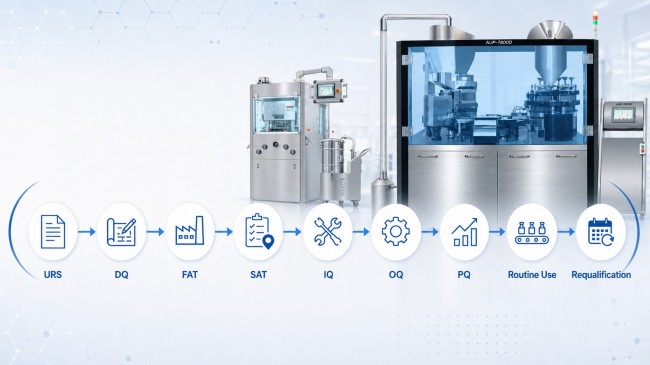
A typical equipment lifecycle can be represented as:
URS → DQ → FAT → Delivery and Installation → SAT → IQ → OQ → PQ → Routine Use and Requalification
The sequence can vary by project, and some activities overlap.
その User Requirements Specification (URS) defines what the user expects the equipment to do. プロジェクトに応じて, it can cover products and formats, 必要な出力, product-contact materials, クリーニング, safety functions, controls, アラーム, 検査システム, ドキュメント, and qualification support.
Requirements should be specific enough to verify later. 例えば, a URS can turn these general expectations into measurable requirements. A tablet counting machine can be specified to achieve a counting accuracy above 99.98% under defined test conditions. A capsule filling machine can require a modular changeover design that allows a complete set of format parts to be installed or removed within 30 分. For a tablet press, tooling can be required to support manual replacement without hammers, wrenches, or similar tools. Safety requirements can specify that opening an operating-area door beyond 20° triggers a machine stop and alarm. Material requirements can also state that all parts in direct contact with the product use 316L stainless steel.

設計適格性評価 (DQ) reviews whether the proposed design responds to those approved requirements. This stage is important because later testing should confirm a suitable design rather than compensate for missing or poorly defined requirements.
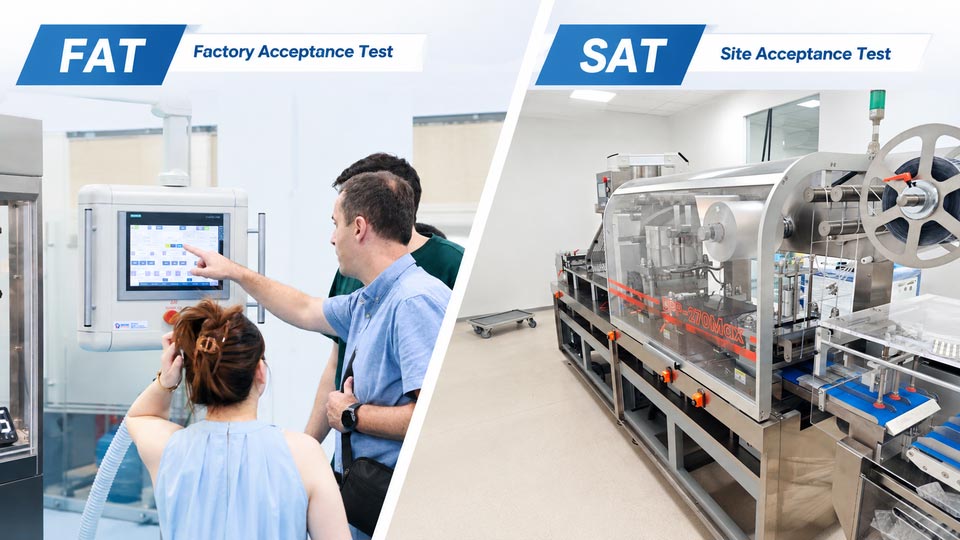
工場での受け入れテスト (脂肪) is normally performed at the supplier’s facility before shipment. Its scope is agreed for the project and can include machine configuration, major components, operating sequences, controls, safety functions, アラーム, フォーマット変更, and specified production tests.
After delivery and installation, Site Acceptance Testing (土) can be used where appropriate to check conditions that depend on the customer site, such as transport condition, reassembled components, 公共事業, and interfaces with upstream or downstream equipment.
These activities create traceable evidence for later qualification. They should not be treated as separate checklists with no connection to the URS, design review, or final qualification plan.
How IQ, OQ, and PQ Work in Practice
A strong qualification program links requirements, identified risks, test methods, predetermined acceptance criteria, and recorded results.
設置資格
Installation Qualification typically verifies:
- equipment model, serial number, main components, and accessories;
- electrical supply and applicable utilities such as compressed air or vacuum;
- installation against approved drawings or specifications;
- operating and maintenance documentation;
- instrument identification and calibration status;
- materials of construction where relevant;
- software or firmware version where applicable.
The checks should reflect the actual machine. A tablet press does not require the same utilities and installation records as a liquid filling system, while a standalone machine has different interfaces from an integrated pharmaceutical packaging line.
This is why generic protocol templates need review before use. Adding irrelevant checks does not make a qualification package stronger; it can make the document longer without producing useful evidence.
運用資格
Operational Qualification focuses on functions and operating limits. Typical tests can cover:
- start and stop sequences;
- relevant operating settings;
- alarms and safety interlocks;
- emergency stops;
- sensor response;
- 拒否システム;
- PLC and HMI functions;
- recovery after defined faults.
EU GMP Annex 15 states that OQ testing should be developed from knowledge of the process, system, and equipment and should include applicable upper and lower operating limits or justified worst-case conditions.
A worst-case test should relate to actual use and identified risk. It does not mean forcing every setting to the mechanical maximum.
For an 自動カプセル充填機, relevant tests can include defined speed ranges, vacuum-related alarms, door interlocks, センサー, and rejection functions. For a blister packaging machine, the focus can shift to forming and sealing controls, 温度設定, web movement, センサー, アラーム, and safety functions.

パフォーマンス資格
Performance Qualification moves closer to the conditions under which the equipment will be used in production. Depending on the process, the protocol can include:
- actual product or justified representative materials;
- trained operators;
- approved operating procedures;
- representative production settings;
- defined quality and performance criteria;
- sufficient run conditions to evaluate reproducibility.
For a capsule filling machine, the user can evaluate filling consistency, カプセルの取り扱い, rejection performance, and stable output against approved criteria. For a blister packaging machine, relevant performance measures can include forming, 製品供給, 封印, 切断, 検査, and package integrity where these functions apply.
The important point is that PQ should not be reduced to a short equipment demonstration. The test conditions need to represent the way the machine is expected to perform within the user’s approved process.
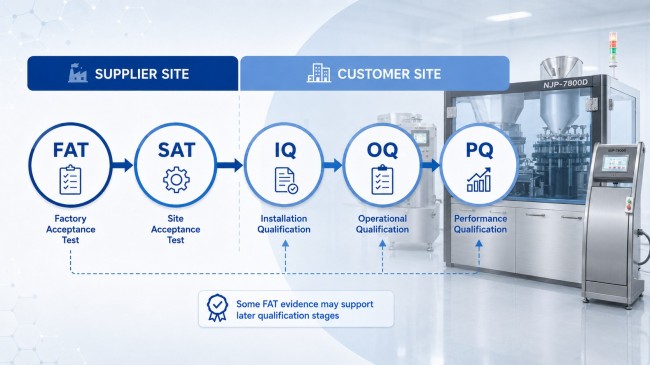
How FAT, 土, IQ, OQ, and PQ Connect
Qualification projects often become inefficient when the same test is repeated during FAT, 土, IQ, and OQ simply because similar items appear in several protocols.
More testing does not automatically produce stronger evidence. Each stage should have a defined purpose, and earlier results should be reviewed before deciding what needs to be repeated.
EU GMP Annex 15 allows certain checks or tests completed during FAT or earlier stages to be used later when this is justified and when transport and installation have not affected the relevant function.
例えば, a control function tested during FAT can remain useful evidence when:
- the test used predetermined acceptance criteria;
- results were properly recorded;
- the final configuration has not changed;
- transport and site installation do not affect the function;
- use of the earlier result is justified in the qualification strategy.
Site-specific conditions still need suitable verification. Electrical connections, 圧縮空気, 空の, installation position, local utilities, and final line interfaces depend on the manufacturing site. A factory test completed before shipment cannot establish those conditions.
SAT and IQ can therefore share some checks without being identical activities. SAT can confirm receipt, 組み立て, 公共事業, and basic operation at site, while IQ formally documents the applicable installation requirements within the user’s controlled qualification system.
The objective is not to eliminate repeated testing. It is to determine which evidence remains valid, what changed during shipment or installation, and which functions require additional challenge. A science- and risk-based approach keeps qualification focused on evidence that adds value rather than on duplicate paperwork.

Who Is Responsible, What Goes Wrong, and When Requalification Is Needed
Equipment qualification usually involves the supplier, user engineering team, production personnel, and quality or validation staff. The exact responsibilities depend on the project agreement and the user’s pharmaceutical quality system.
| Activity | Equipment Supplier | User Team / QA |
| Technical design information | Provides specifications and technical records | Reviews against approved requirements |
| 脂肪 | Prepares and executes or supports agreed tests | Reviews or witnesses as required |
| SAT and installation | Provides technical support | Coordinates site conditions and acceptance |
| IQ/OQ documentation | Provides technical data and templates when contracted | Adapts, executes, reviews, and approves under internal procedures |
| PQ | Provides technical support where required | Leads execution under representative operating conditions |
| Final qualification approval | Supplies supporting evidence | Remains within the user’s quality system |
Supplier documentation can reduce duplicated work, but it does not automatically qualify equipment for the customer’s process. Third-party protocols, templates, FATレコード, 図面, and technical documents still need to be reviewed for suitability within the user’s qualification program.
ルイダパッキング, 例えば, provides technical documentation and FAT support for pharmaceutical machinery and can assist with installation and commissioning. Those records can support later qualification activities, while the customer’s engineering and quality teams decide how they are incorporated into the approved qualification plan.
Several recurring problems weaken equipment qualification.
Vague requirements make acceptance criteria difficult to define. If a URS does not state what can be measured or verified, FAT and OQ results become more subjective.
Missing acceptance criteria create the same problem. A machine running without stopping does not automatically constitute a successful qualification result. The protocol should define acceptable outcomes before execution.
Unnecessary repetition adds documentation without necessarily adding evidence. FAT results should be reviewed for continued relevance before identical tests are repeated during OQ.
Weak PQ design can also reduce the value of the final evidence. Convenient materials or a short demonstration are not automatically representative of routine production.
Qualification also needs to remain current after the initial project. Equipment relocation, major modification, software changes, replacement of critical components, utility changes, or recurring performance problems should be assessed through change control to determine whether partial or broader requalification is required.

Periodic review can also confirm that equipment remains in a state of control. The scope and frequency should be justified according to equipment risk, 変化, performance history, applicable requirements, and the user’s pharmaceutical quality system rather than applying the same fixed interval to every machine.
製薬メーカー向け, the value of IQ OQ PQ comes from keeping the entire equipment lifecycle connected. Clear requirements support better design decisions, FAT and SAT provide useful acceptance evidence, formal qualification verifies the installed system, and later change control protects the qualified state. When each activity has a defined purpose, the project produces stronger evidence with less unnecessary repetition.
よくある質問
What is the difference between IQ, OQ, とPQ?
IQ verifies installation, OQ verifies operation across the defined range, and PQ verifies performance under representative production conditions. Each stage provides a different type of qualification evidence.
Is FAT the same as OQ?
No. FAT is normally an acceptance activity performed at the supplier’s facility before shipment. OQ is part of formal equipment qualification. Some properly documented FAT results can support later OQ activities when their continued validity is justified.
Can FAT replace IQ or OQ?
自動的ではありません. Relevant FAT evidence can sometimes be reused, but site-specific conditions and functions affected by transport, インストール, or configuration changes still require appropriate verification.
Who is responsible for IQ OQ PQ?
Suppliers often provide technical documentation, FATレコード, protocol templates, and engineering support. The pharmaceutical manufacturer remains responsible for ensuring that qualification is properly planned, executed, レビューしました, and approved within its own quality system.
When does pharmaceutical equipment need requalification?
Requalification can follow significant modifications, relocation, major repairs, critical component or software changes, performance concerns, or justified periodic review. The required scope depends on the impact of the change and the risk to the qualified state.
参考文献