
Stripverpakking is een verpakkingsmethode waarbij tabletten, capsules, of soortgelijke vaste producten zijn ingesloten tussen twee flexibele verpakkingsbanen. In farmaceutische toepassingen, deze banen zijn vaak folies of laminaten op aluminiumbasis. De twee lagen komen rond elk product samen en worden in de omgeving verzegeld, het creëren van afzonderlijke afgedichte eenheden langs een doorlopende strook.
Dit formaat wordt gebruikt wanneer fabrikanten afzonderlijk verpakte producten in een compact pakket nodig hebben. Het uiteindelijke beschermingsniveau is afhankelijk van de volledige verpakkingsstructuur, afdichtingskwaliteit, producteigenschappen, en opslagomstandigheden. De woorden ‘strippack’ alleen definiëren vocht niet, zuurstof, of fotocelprestaties.
Om een stripverpakking te maken, twee verpakkingsbanen worden afgewikkeld en door de machine geleid terwijl er tabletten of capsules tussen worden gevoerd. De webben worden samengebracht, rondom elk product verzegeld, in een gecontroleerde volgorde vooruit, en in de gewenste strookgrootte gesneden. Als u deze reeks begrijpt, wordt het ook gemakkelijker om te zien wat a stripverpakkingsmachine eigenlijk controleert en hoe stripverpakkingen daarvan verschillen blisterverpakking.
Wat is stripverpakking en hoe ziet een stripverpakking eruit??
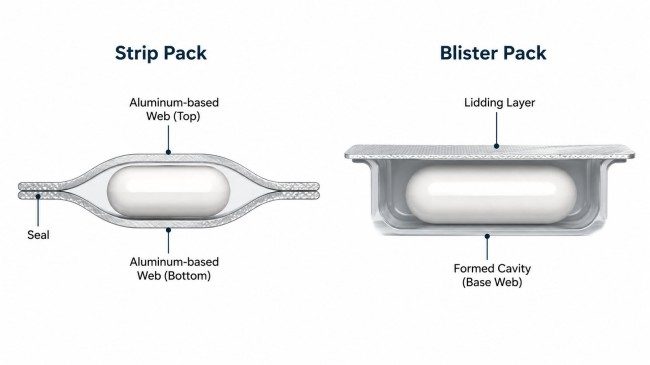
A strip pakket bestaat uit een tablet, capsule, of een soortgelijk vast product dat tussen twee flexibele verpakkingslagen is geplaatst. De lagen worden rond het product aan elkaar geseald, zodat elke eenheid individueel omsloten blijft.
In één langere strook kunnen meerdere units aangesloten blijven, of het materiaal kan in kleinere stroken worden gesneden volgens de vereiste verpakkingsconfiguratie. De verpakking is normaal gesproken relatief plat omdat de flexibele banen de algemene vorm van het omsloten product volgen.
Het belangrijkste structurele kenmerk is dat het product direct tussen de twee banen wordt ingesloten. Stripverpakking begint niet met het vormen van een apart vak voor elke tablet of capsule.
Dat is het belangrijkste verschil tussen een stripverpakking en een conventionele blisterverpakking. In blisterverpakking, een vormweb wordt eerst in holtes gevormd. In deze holtes worden de producten geplaatst, en er wordt vervolgens een afdekmateriaal overheen verzegeld. In stripverpakking, het product zit tussen twee banen terwijl het omringende materiaal is afgedicht.
Een kant-en-klaar strippakket combineert dus drie basiselementen:
- de tablet of capsule die wordt verpakt;
- twee flexibele verpakkingsbanen rondom het product;
- het afgesloten gebied dat elke eenheid scheidt en omsluit.
Deze structuur kan worden aangepast aan verschillende producten en verpakkingsindelingen, maar productafmetingen, verpakkingsmateriaal, ontwerp van de feeder, afdichtingsregeling, en machine-instellingen moeten nog steeds samenwerken.
Hoe worden strippakketten gemaakt? Het stripverpakkingsproces stap voor stap
Commercieel stripverpakking is meestal een continu proces. De twee verpakkingsbanen bewegen door de lijn terwijl de producten worden aangevoerd, ingesloten, verzegeld, geavanceerd, en snijd in een gesynchroniseerde volgorde.
1. Ontspan en geleid de verpakkingsbanen
Twee rollen verpakkingsmateriaal worden op de machine gemonteerd en naar het sealgebied geleid.
Stabiele baanspanning en tracking zorgen ervoor dat beide lagen op één lijn blijven voordat ze elkaar rond het product raken. Wanneer er gedrukt materiaal wordt gebruikt, registratiecontrole houdt het printpatroon uitgelijnd met de beoogde verpakkings- en snijposities.
2. Voer tabletten of capsules in positie
Het invoersysteem scheidt de producten en stuurt deze naar de juiste locaties tussen de twee banen.
Afmetingen tablet, capsulegrootte, oppervlakte conditie, fragmenten of stof, productie snelheid, en de indeling van de verpakking hebben allemaal invloed op het voedingsgedrag. Het doel is dat elk product het sealgebied in de juiste positie bereikt, zonder onnodige schokken of compressie.
Het ontwerp van de feeder moet daarom bij het product passen en niet elke tablet of capsule behandelen alsof deze zich op dezelfde manier zal gedragen.
3. Breng de twee netwerken rond het product
Na het voeden, de twee verpakkingsbanen komen samen rond de tablet of capsule.
Het product neemt de ruimte tussen de banen in beslag, terwijl het omringende materiaal het gebied biedt dat nodig is voor afdichting. De productafstand en de beoogde verpakkingsindeling bepalen hoeveel materiaal er tussen aangrenzende eenheden overblijft.
Er is geen apart vormstation dat vóór het vullen blarenholtes creëert. Dit is de stap die stripverpakkingen zijn karakteristieke structuur geeft.
4. Sluit de webs rond elk product af
De gepaarde banen gaan door het afdichtingsgedeelte, waar hitte en druk de afsluitbare lagen rond elk product activeren.
De kwaliteit van de afdichting is afhankelijk van verschillende op elkaar inwerkende factoren:
- verpakkingsmateriaal;
- afdichtingstemperatuur;
- druk;
- contacttijd;
- machinesnelheid;
- webconditie;
- productpositie.
Het verhogen van de sealtemperatuur alleen is geen betrouwbare oplossing voor een zwakke seal. Als drukverdeling, materiële compatibiliteit, contacttijd, of webuitlijning is niet geschikt, het probleem kan blijven bestaan of er kan een ander probleem optreden.
Voor flexibele barrièrematerialen, De afdichtingssterkte kan worden geëvalueerd met gevestigde testmethoden zoals ASTM F88/F88M, die de kracht meet die nodig is om een afgedichte interface te scheiden.
5. Koel en stabiliseer het afgedichte materiaal
Na verzegeling, het web gaat door de lijn terwijl de afgedichte gebieden afkoelen en stabiliseren.
De koelvereisten zijn afhankelijk van het verpakkingsmateriaal, afdichtingsomstandigheden, productie snelheid, en machineontwerp. Bij continue productie, warmtebeheer rond het afdichtingsgebied helpt ook bij het handhaven van stabiele bedrijfsomstandigheden over langere runs.
6. Voorschot, Register, en bereid de strip voor op snijden
Het gesealde web wordt in een gecontroleerde beweging naar voren getrokken.
De tractie moet gesynchroniseerd blijven met de stroomopwaartse en stroomafwaartse stations. Afhankelijk van het pakketontwerp, deze fase kan ook batchcodering omvatten, registratie van gedrukte merken, inkeping, of voorbereiding van scheuropeningsgebieden.
Nauwkeurige baanbeweging is belangrijk omdat stroomafwaartse stations werken vanuit de positie van het materiaal dat ze ontvangen. Als de baanpositie afwijkt, de uiteindelijke afdruk- of snijpositie kan ook afwijken.
7. Knip de strip af en verzamel de trim
Het continu gesealde materiaal wordt op de gewenste striplengte of verpakkingsformaat gesneden.
Trimmen gegenereerd door de geselecteerde lay-out kunnen afzonderlijk worden verzameld, zodat deze de voltooide pakketten niet hinderen. De voltooide strips zijn vervolgens klaar voor inspectie en verdere bewerkingen zoals kartonneren.
Het volledige proces kan worden samengevat als:
afwikkelen → aanvoeren → positioneren → sealen → koelen → tractie en registratie → snijden
Elke fase vervult een andere functie, maar het voltooide strippakket is afhankelijk van de samenwerking tussen deze fasen.
Hoe regelt een stripverpakkingsmachine het proces??
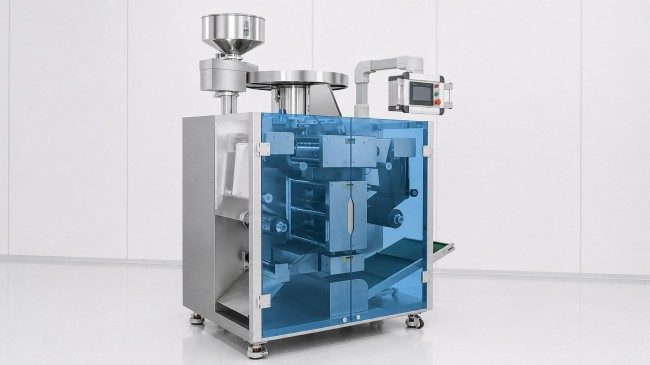
Een stripverpakkingsmachine, In sommige markten ook wel een dubbele zachte aluminium verpakkingsmachine genoemd, coördineert de mechanische en thermische bewerkingen die nodig zijn om losse tabletten of capsules en twee doorlopende verpakkingsbanen om te zetten in kant-en-klare stripverpakkingen.
Vier gebieden hebben een bijzonder sterke invloed op de productie.
Voeding en productpositionering
Het invoergedeelte bepaalt hoe producten het webpad binnenkomen.
Slechte voeding kan leiden tot producten die niet in het midden liggen, gemiste posities, of productschade vóór het verzegelen. Productstroom, aanpassing van de feeder, productafmetingen, fragmenten of stof, en bedrijfssnelheid moeten daarom samen worden bekeken als er zich een voedingsprobleem voordoet.
Afdichtingsomstandigheden
Het afdichtingsgedeelte past de warmte en druk toe die nodig zijn voor de geselecteerde materiaalstructuur.
Het juiste werkingsbereik is afhankelijk van de folie of het laminaat, machinesnelheid, contacttijd, druk, en pakindeling. Het doel is om een passende afdichting te creëren zonder het verpakkingsmateriaal of het ingesloten product onnodig te belasten.
Webtractie en synchronisatie
Door tractie wordt het afgedichte web door de stroomafwaartse stations verplaatst.
Consistente baanbeweging ondersteunt de productafstand, afgedrukte registratie, inkeping, en snijden. Een zichtbaar snijpositieprobleem kan daarom eerder in het materiaalpad ontstaan dan bij de frees zelf.
Koelen en snijden
Koeling ondersteunt het afgedichte materiaal vóór het definitieve snijden, terwijl het snijsysteem de doorlopende baan in het gespecificeerde verpakkingsformaat scheidt.
Servogestuurd snijden zorgt voor nauwkeurige controle over de snijactie, maar nauwkeurige positionering hangt nog steeds af van stabiele tractie en registratie stroomopwaarts.
Common symptoms can often be traced back to several related process areas rather than a single machine setting:
| Production symptom | Areas to check first |
| Product is off-center | Voeden, productstroom, timing, web position |
| Product is damaged | Feeding path, afhandeling, sealing-zone setup |
| Seal is weak or uneven | Materiaal, temperatuur, druk, contacttijd, webconditie |
| Print or cut position drifts | Registratie, tractie, web spanning, synchronisatie |
| Sealing changes during a long run | Heating balance, koeling, materieel gedrag, machinesnelheid |
Ruida Packing’s RD-SAP-300L automatic strip packing machine combines feeding, film traction, afdichting, registratie, snijden, and waste recovery in one continuous process. Its design also addresses practical issues such as product misalignment, zwakke afdichtingen, product damage, and cutting inconsistency during strip packaging production.
Strip Packaging Materials and Product Applications
Strip packaging is commonly used for tablets and capsules, but product type alone does not determine whether the format is suitable.
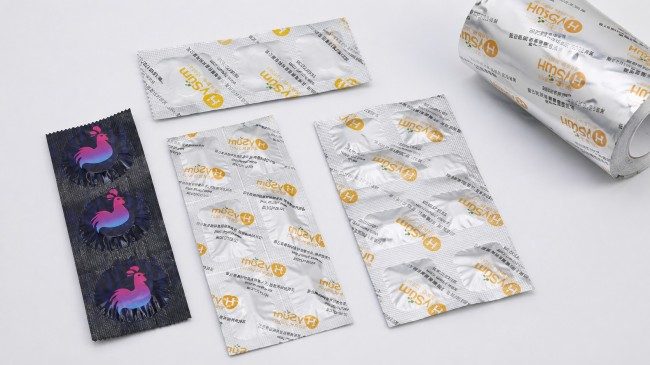
Product dimensions, fragility, sensitivity to moisture or light, required shelf life, opening method, bewaaromstandigheden, verpakkingsmateriaal, and production environment all influence the final specification.
Flexible strip packs can use heat-sealable polymer films, laminated structures, or aluminum-based laminates. The sealable layers need to work with the intended sealing process, while the complete structure needs to provide the barrier performance established for the packaged product.
Vocht, zuurstof, and light barrier performance depends on the complete material structure, dikte, seal design, manufacturing quality, en opslagomstandigheden.
Voor farmaceutische verpakkingen, the complete packaging system also needs to be compatible with the product. FDA guidance on container-closure systems addresses characteristics such as protection, verenigbaarheid, veiligheid, en prestaties, terwijl het USP Algemeen Kapittel <659> covers packaging and storage requirements.
Stripverpakking versus blisterverpakking: Wat is het verschil?
Stripverpakking en blisterverpakking kunnen beide individueel bijgevoegde tabletten of capsules leveren, maar hun pakketstructuren en productiesequenties zijn verschillend.
| Factor | Stripverpakking | Blisterverpakking |
| Basisstructuur | Product ingesloten tussen twee flexibele banen | Product geplaatst in een gevormde holte |
| Holtevorming | Geen aparte holtevormingsfase | Holten worden gevormd vóór het vullen |
| Typisch profiel | Relatief vlak | Verhoogde holtes |
| Zichtbaarheid van producten | Vaak beperkt met ondoorzichtige laminaten | Transparante vormbanen kunnen het product laten zien |
| Materiaal opties | Flexibele films en laminaten, inclusief op aluminium gebaseerde constructies | Thermogevormde kunststofconstructies of koudgevormde aluminiumsystemen |
| Kernproces | Feed → seal → vooruit → snijden | Vorm → voeding → seal → vooruit → snijden |
| Productaccommodatie | Flexibele banen omringen het product | De caviteitsgeometrie is rond het product ontworpen |
Geen van beide formaten is automatisch beter.
Stripverpakking is een praktische optie wanneer de vereiste productbescherming kan worden bereikt met een geschikte flexibele materiaalstructuur en het verpakkingsformaat past bij het productie- en verdere verpakkingsplan.
Blisterverpakking is handig als een gedefinieerde holte de voorkeur heeft, wanneer productzichtbaarheid waardevol is, of wanneer een thermogevormde of koudgevormde blisterstructuur beter aansluit bij de vereiste barrière- en presentatiebehoeften.
Voor producten die gevoelig zijn voor vocht of licht, de beslissing moet gebaseerd zijn op het volledige verpakkingssysteem en niet op de woorden strip, blaar, plastic, van aluminium. Materiële structuur, integriteit van de afdichting, productcompatibiliteit, bewaaromstandigheden, productiecontroles, en stroomafwaartse afhandeling dragen allemaal bij aan de prestaties van het pakket.
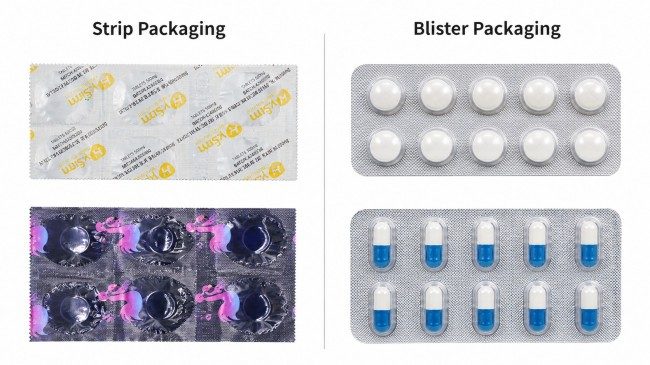
Ook de productieapparatuur verschilt. Een stripverpakkingsmachine richt zich op het aanvoeren van producten tussen twee banen, afdichting, tractie, en snijden. A blisterverpakkingsmachine voegt een vormingsfase toe vóór de producttoevoer, waardoor zowel de machine-indeling als de verpakkingsvolgorde veranderen.
Strokenverpakkingen worden daarom gezien als zowel een verpakkingsstructuur als een productieproces. Door middel van materiaalkeuze ontstaat een afgewerkt strippakket, productvoeding, afdichting, gecontroleerde webbeweging, koeling, en snijden samen werken.
Veelgestelde vragen
-
Wat is stripverpakking?
Stripverpakking omsluit een tablet, capsule, of een soortgelijk vast product tussen twee flexibele verpakkingsbanen. De banen worden rond elk product geseald, zodat er individueel omsloten eenheden langs een strook ontstaan.
-
Hoe worden stripverpakkingen gemaakt??
Twee verpakkingsbanen worden afgewikkeld en door een stripverpakkingsmachine geleid, terwijl er tabletten of capsules tussen worden gevoerd. De banen worden rondom de producten geseald, door de linie gevorderd, en in het gewenste strookformaat gesneden.
-
Wat is het verschil tussen stripverpakking en blisterverpakking?
Stripverpakkingen omsluiten het product direct tussen flexibele banen. Blisterverpakkingen vormen eerst een holte, plaatst het product erin, en sluit vervolgens de holte af met een afdekmateriaal.
-
Kunnen zowel tabletten als capsules in stripverpakkingen worden verpakt??
Ja. Tabletten en capsules kunnen beide in stripverpakking bij de feeder, productafstand, verpakkingsmateriaal, afdichtingsregeling, en verpakkingsformaat zijn geschikt voor het product.
-
Wat doet een stripverpakkingsmachine??
Een stripverpakkingsmachine coördineert de producttoevoer, webbeweging, afdichting, koeling, registratie of inspringing waar vereist, snijden, en verwerking van trimmen om afgewerkte stripverpakkingen te produceren.
-
Is stripverpakking geschikt voor vochtgevoelige tabletten??
Dit kan het geval zijn wanneer de geselecteerde materiaalstructuur en afdichting de vereiste vochtbarrière bieden voor het product en de beoogde opslagomstandigheden. De geschiktheid moet worden beoordeeld aan de hand van het volledige verpakkingssysteem en niet alleen aan de hand van het stripformaat.
Referenties
- ONS. Food and Drug Administration. Containersluitsystemen voor het verpakken van geneesmiddelen voor menselijk gebruik en biologische geneesmiddelen: Leidraad voor de industrie.
- Farmacopee van de Verenigde Staten. USP Algemeen Kapittel <659>, Verpakkings- en opslagvereisten.
- Wereldgezondheidsorganisatie. Richtlijnen voor verpakkingen voor farmaceutische producten, WHO technisch rapport serie nr. 902, Bijlage 9.
- ASTM Internationaal. ASTM F88/F88M, Standaardtestmethode voor de afdichtingssterkte van flexibele barrièrematerialen.