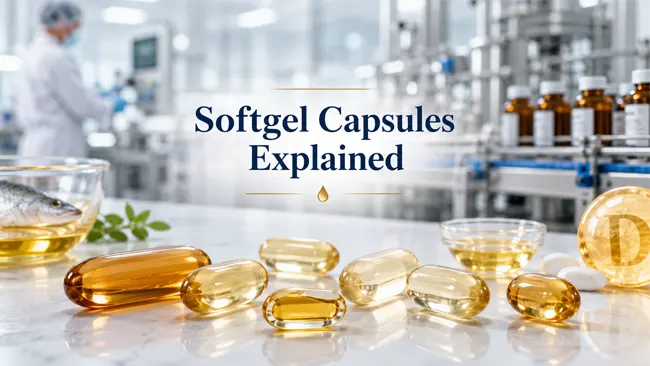
Les capsules Softgel sont des capsules d'une seule pièce formées autour d'un liquide, à base d'huile, suspension, ou remplissage semi-solide. Ils sont largement utilisés pour des produits tels que l'huile de poisson, vitamin D, oméga-3, CoQ10, vitamine E, et huiles botaniques, où la formulation est préparée et dosée sous une forme fluide.
Leur structure diffère de celle des gélules et des comprimés. Une coque softgel se forme, rempli, scellé, et coupé au cours du même cycle d'encapsulation. Les capsules passent ensuite au séchage, conditionnement, inspection, tri, et emballages avant qu'ils ne deviennent des produits finis pour la vente au détail.
Le résultat final dépend de la formulation de la coque, viscosité de remplissage, dimensions des capsules, conditions de séchage, propriétés de surface, et format d'emballage. Ces facteurs influencent également la manière dont les gélules finies se déplacent dans les canaux de comptage., mangeoires blister, bouteilles, postes de scellage, et équipement d'encartonnage.
L'huile de poisson et la vitamine D sont des exemples familiers, mais les mêmes principes de fabrication s'appliquent à de nombreux produits en gélules remplies de liquide. Les sections suivantes se concentrent sur la structure des formes posologiques, production, et l'emballage plutôt que les effets sur la santé, traitement, ou conseils posologiques.
Que sont les capsules molles?
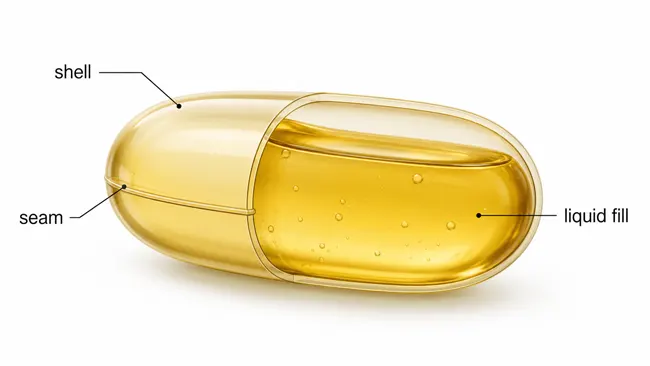
Gélules molles, également connu sous le nom de gélules ou capsules de gélatine molle, sont scellés, capsules monobloc conçues pour contenir du liquide, à base d'huile, suspension, pâteux, ou formulations semi-solides.
Contrairement aux gélules, qui sont normalement constitués d'un corps et d'un capuchon séparés, les gélules sont créées à partir de deux rubans de coque flexibles. Le matériau de remplissage est dosé entre les rubans tandis que les matrices rotatives façonnent, joint, et coupez chaque capsule. Ce processus enferme le remplissage à l'intérieur d'une seule unité avec une couture continue.
Une gélule finie se compose de deux composants principaux:
| Composant | Fonction | Principales considérations de production |
| Enveloppe de la capsule | Forme la structure extérieure scellée et contient le remplissage | Matériel, élasticité, épaisseur, niveau d'humidité, couleur, et comportement au séchage |
| Formulation de remplissage | Retient le liquide, huile, suspension, ou mélange semi-solide | Viscosité, uniformité, température, teneur en air, précision du dosage, et compatibilité shell |
Les coquilles de gélules traditionnelles sont généralement préparées à partir de gélatine, eau purifiée, et un plastifiant tel que la glycérine ou le sorbitol. Des colorants et des opacifiants peuvent également être inclus lorsque la conception du produit l'exige. Des systèmes sans gélatine sont disponibles pour les produits développés autour d'un positionnement végétarien ou de besoins de formulation spécifiques.
La coque a besoin de suffisamment de flexibilité pour former des rubans uniformes et de suffisamment de résistance pour sceller autour du remplissage.. Sa teneur en humidité doit également rester dans la plage requise pendant le séchage et le stockage.. L'épaisseur et l'élasticité de la coque influencent la qualité des coutures, fermeté de la capsule, et manutention en aval.
La formulation de remplissage est préparée séparément. Il peut s'agir d'une huile à faible viscosité, d'une suspension plus épaisse ou d'un mélange semi-solide.. Ses propriétés physiques affectent le pompage, dosage, scellage, et le volume de capsule requis.
Les formes courantes de gélules incluent les formes rondes, ovale, oblong, en forme de tube, et modèles twist-off. La taille et la géométrie sont sélectionnées en fonction du volume de remplissage, présentation du produit, exigences de production, et format d'emballage final.
Après séchage, forme de capsule, dimensions, frottement superficiel, et la fermeté de la coquille influence le mouvement à travers les trémies, compter les chaînes, cavités vésiculeuses, et systèmes de transfert. Les tests d'emballage doivent donc utiliser des échantillons finis plutôt que les seules dimensions nominales des capsules..
Pourquoi l'huile de poisson et la vitamine D sont-elles couramment trouvées sous forme de gélule?
Huile de poisson, vitamin D, oméga-3, CoQ10, vitamine E, et les huiles botaniques sont fréquemment vendues sous forme de gélules car ces catégories de produits utilisent généralement des formulations à base d'huile ou liquides..
Le processus softgel divise une formulation fluide en unités individuelles scellées. La coque est formée autour du remplissage lors de l'encapsulation au lieu d'être fabriquée d'abord et remplie plus tard..
Le terme remplissage de liquide couvre plus que les liquides fins. Il peut inclure:
- Huiles
- Mélanges liquides
- Suspensions
- Remplissages pâteux
- Formulations semi-solides
Le choix de la taille et de la forme de la gélule dépend du volume de remplissage requis et de ses propriétés physiques. Un volume de remplissage plus élevé nécessite généralement une capsule plus grande, tandis qu'une suspension plus épaisse nécessite un contrôle de pompage et de dosage approprié.
Les noms de produits familiers ne fournissent pas suffisamment d’informations pour la sélection de l’équipement. Les gélules d’huile de poisson de deux fabricants peuvent différer en taille, composition de la coquille, état de surface, viscosité de remplissage, et format d'emballage. Il en va de même pour les gélules de vitamine D et autres gélules remplies de liquide..
Les décisions de fabrication et d'emballage doivent donc être basées sur des spécifications confirmées du produit et des échantillons réels.. Avantages pour la santé, dosage, et l'adéquation individuelle sont des questions distinctes et doivent être déterminées à partir de l'étiquette du produit et des conseils d'un professionnel qualifié..
Capsules molles vs capsules dures et comprimés
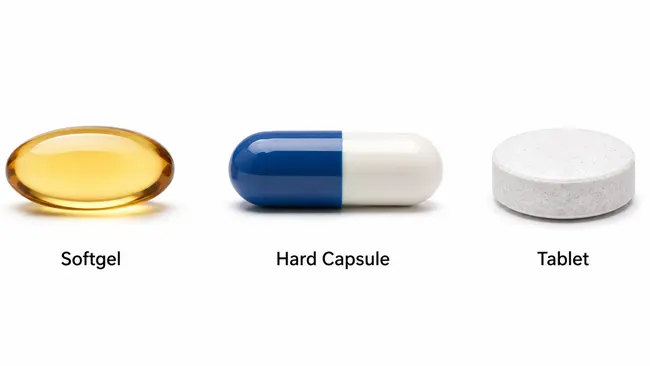
Softgels, gélules, et les comprimés peuvent contenir des formulations pharmaceutiques ou de suppléments, mais ils suivent des itinéraires de production différents.
Les gélules utilisent normalement une coque en deux parties composée d'un corps et d'un capuchon.. Les coquilles vides sont d'abord fabriquées puis remplies de poudre, granulés, pellets, ou une formulation liquide compatible.
Les comprimés sont formés en comprimant un mélange de poudre ou de granulés préparé avec des poinçons et des matrices.. Des capsules molles se forment, rempli, scellé, et coupé pendant un cycle d'encapsulation.
| Format | Contenu typique | Méthode de production de base | Emballage commun |
| Gélules | Huile, liquide, suspension, semi-solide | Des rubans flexibles se forment et scellent autour du remplissage | Bouteilles, ampoules, cartons |
| Gélule dure | Poudre, granulés, pellets, liquides sélectionnés | Le corps vide et le bouchon sont remplis et fermés | Bouteilles, ampoules, cartons |
| Comprimé | Poudre ou granulés compressés | Blend est compressé à l'aide des outils pour tablette | Bouteilles, ampoules, cartons |
Leurs machines en amont sont également différentes. La production de comprimés peut inclure la granulation, mélange, compression, revêtement, et dépoussiérage. La production de capsules dures utilise le remplissage de capsules, clôture, polissage, et inspection. La production de softgels nécessite une préparation de la coque, préparation de remplissage, encapsulation, séchage, conditionnement, et le tri.
Certains équipements d'emballage peuvent gérer les trois formats, mais les paramètres d'alimentation et de transfert ne sont pas identiques. Les gélules ont des surfaces incurvées et différents niveaux de friction. Les gélules sont légères et nécessitent une manipulation contrôlée. Les comprimés ont des surfaces rigides mais varient considérablement en forme et en revêtement.
Le format du colis, dimensions du produit, propriétés de surface, compter par paquet, et le résultat requis doit guider la configuration finale de la machine.
Comment sont fabriquées les capsules molles?
La fabrication commerciale de softgels suit normalement six étapes connectées.
Une ligne de production commerciale de gélules comprend généralement un réservoir de fusion de gélatine, une cuve de préparation de remplissage, une machine à capsules molles, équipement de séchage par culbutage, systèmes de séchage secondaires, et matériel d'inspection. L'unité centrale est la machine d'encapsulation de softgel, qui forme les rubans de coquille, mesure le liquide de remplissage, scelle chaque capsule, et le coupe en un cycle continu.
1. Préparation de la masse de coquille
La gélatine ou un autre matériau formant une coquille est mélangée à de l'eau, plastifiant, et tout composant de couleur ou d'opacité approuvé. Le mélange est traité dans des conditions de température et de mélange contrôlées..
La masse de coque préparée doit former des rubans cohérents et créer une couture fiable pendant l'encapsulation. Type de gélatine, rapport de plastifiant, température, humidité, et la compatibilité remplissage-coquille influence la coque finie.
Les systèmes de gélules végétariennes utilisent des matériaux de coque alternatifs tels que des amidons modifiés, carraghénane, ou d'autres polymères appropriés. Leurs températures de traitement, viscosités, et le comportement de séchage peut différer des systèmes de gélatine conventionnels.
2. Préparation du remplissage
Le remplissage liquide ou semi-solide est mélangé séparément jusqu'à atteindre l'uniformité requise. Les contrôles de production couvrent généralement:
- Viscosité
- Température
- Temps de mélange
- Contenu aérien
- Répartition des ingrédients
- Conditions de détention et de transfert
Séparation, air emprisonné, ou des changements importants de viscosité peuvent interférer avec la précision du dosage. Le remplissage doit également rester compatible avec la coque pendant la production et le stockage..
3. Machine d'encapsulation de Softgel à matrice rotative
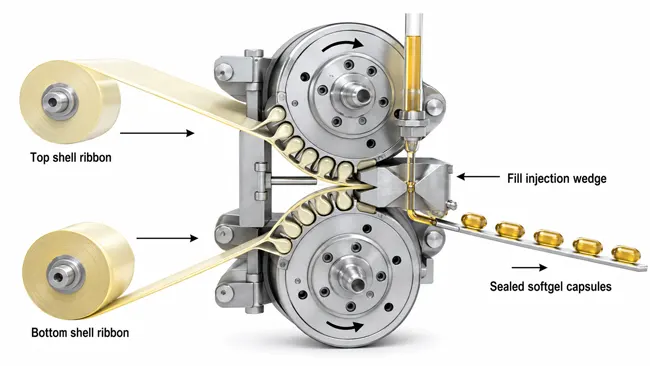
La plupart des productions commerciales utilisent une machine d'encapsulation de gélules à filière rotative. La masse de la coque est coulée en deux rubans continus et guidée vers des matrices rotatives.
Un coin d'injection chauffé délivre le remplissage entre les rubans. Les matrices forment la forme de la capsule, joindre le volume de remplissage requis, sceller la couture, et coupez la capsule du matériau environnant.
Épaisseur du ruban, alignement des matrices, température du coin, volume de remplissage, et la vitesse de la machine sont contrôlés ensemble. Une mauvaise coordination peut entraîner des dimensions irrégulières, coutures faibles, variation de remplissage, ou fuite.
4. Séchage et conditionnement
Les capsules fraîchement formées contiennent de l'humidité et ont une coque plus douce. Ils passent d'abord au sèche-linge, où l'air en mouvement élimine une partie de l'humidité pendant que les capsules continuent de tourner.
Le séchage secondaire s'effectue sur des plateaux, dans les tunnels, ou en température- et pièces à humidité contrôlée. Le séchage se poursuit jusqu'à ce que la coque atteigne l'état spécifié.
Le point final correct dépend de la formulation du shell, taille des capsules, composition de remplissage, flux d'air, température, et l'humidité. Les capsules qui restent trop molles peuvent se coller ou se déformer lors du conditionnement. Un séchage excessif peut réduire la flexibilité de la coque et affecter la manipulation.
5. Inspection et tri
Les capsules séchées sont vérifiées:
- Forme et dimensions
- État des coutures
- Défauts de surface
- Fuite
- Cohérence des couleurs
- Matière étrangère
- Qualité d'impression, le cas échéant
Les unités en dehors des spécifications acceptées sont retirées avant l'emballage. Des capsules cohérentes voyagent de manière plus fiable à travers les canaux de comptage et les distributeurs de blisters.
6. Emballage final
Les gélules acceptées sont transférées dans le flacon, cloque, ou emballage en carton selon la conception commerciale du produit.
Les spécifications de fabrication et d’emballage doivent être coordonnées dès le début. Les dimensions de la capsule doivent correspondre au goulot de la bouteille sélectionnée, canal de comptage, cavité blister, et carton. Une confirmation précoce réduit les changements d'outillage et les ajustements répétés de l'emballage.
Comment les capsules molles sont-elles emballées?
Le conditionnement en bouteilles et le conditionnement sous blister sont deux voies courantes. Le cartonnage peut suivre l’un ou l’autre format.
Emballage de bouteille
L'emballage en bouteille est largement utilisé pour les gélules d'huile de poisson, gels mous de vitamine D, produits oméga-3, et autres suppléments vendus en plus grandes quantités.
Un complet ligne de comptage et d'embouteillage de capsules peut inclure:
1. redresseur de bouteilles
2. machine à compter les capsules
3. trieuse pondérale
4. inséreur de dessicant
5. machine de capsulage
6. machine de scellage par induction
7. étiqueteuse et machine à coder
8. carton
La section de comptage doit être testée soigneusement. La forme et la surface de la gélule affectent la manière dont le produit se déplace dans la trémie et les canaux d'alimentation.. Les capsules rondes roulent différemment des produits oblongs, tandis que l'adhésivité de la surface peut réduire la consistance de l'alimentation.
Largeur du canal, vibration, position du capteur, moment de la décharge, et le diamètre du goulot de la bouteille doit être adapté au produit. La vitesse nominale d’une machine ne garantit pas le même rendement pour chaque taille de gélule.
Des échantillons de production réels permettent aux ingénieurs de vérifier la précision du comptage, mouvement de la capsule, stabilité stop-start, et l'état du produit après son passage dans la machine.
Emballage
L'emballage blister place les capsules individuelles dans des cavités formées et les scelle avec un matériau d'operculage.. La ligne effectue normalement le formage, alimentation, scellage, codage, perforation, et décharge.
La conception de la cavité doit correspondre à la largeur de la capsule, longueur, hauteur, et courbure. La cavité doit maintenir le produit en toute sécurité sans appuyer contre la coque.
La méthode d’alimentation est tout aussi importante. Les capsules ovales et oblongues peuvent nécessiter une orientation contrôlée avant d'entrer dans la cavité. Les capsules rondes nécessitent un transfert stable afin qu'elles ne s'éloignent pas de la position de remplissage.
En fonction de la barrière requise et de la conception du produit, les fabricants peuvent sélectionner des formats tels que les emballages blister Alu-PVC ou Alu-Alu. La sélection des matériaux doit suivre les exigences d'emballage validées du produit plutôt que l'hypothèse générale selon laquelle une structure convient à chaque gélule..
Cartonnage
Le cartonnage place une bouteille, carte blister, ou groupe de paquets dans un carton extérieur. La machine peut également gérer l’insertion de dépliants, codage, fermeture du carton, et inspection.
L'encartonneuse est sélectionnée une fois l'emballage primaire finalisé. Dimensions de la bouteille, format carte blister, carton, style de fermeture, format dépliant, et la sortie cible affectent tous la mise en page finale.
Une ligne correctement coordonnée maintient la sortie des bouteilles ou des blisters en amont dans la plage d'alimentation et de vitesse de l'encartonneuse..
Que doivent vérifier les acheteurs avant de choisir un équipement d'emballage Softgel?
La proposition d'équipement la plus utile commence par des échantillons de produits et des spécifications d'emballage confirmées..
Caractéristiques des capsules
Fournir des échantillons finis montrant le:
- Taille et forme
- Fermeté de la coque
- État des surfaces
- Tolérance dimensionnelle
- Exigences d’impression ou de couleur
Les échantillons prélevés directement à partir du processus de séchage et de conditionnement fini fournissent des résultats de test plus utiles que les coques prototypes ou les dimensions nominales..
Spécifications du flacon ou du blister
Pour l'emballage des bouteilles, confirmer la taille de la bouteille, diamètre du col, compter par bouteille, type de capuchon, déjouer, dimensions de l'étiquette, et position de codage.
Pour emballage blister, confirmer le matériau de formage, matériau de couverture, disposition de la cavité, profondeur de formage, format carte blister, et exigences en matière de codage par lots.
Sortie et changement
Une ligne exécutant un seul produit pour de longues campagnes de production a des priorités différentes d'une ligne passant entre plusieurs tailles de gélules et formats d'emballage..
Où des changements fréquents sont attendus, les acheteurs devraient examiner le temps d’ajustement, changer des pièces, accès nettoyage, stockage des recettes, et les exigences de l'opérateur.
Exigences d'inspection
Les points d'inspection peuvent inclure:
- Vérification du décompte
- Détection de bouteille vide
- Présence de la casquette
- Contrôles du joint d'aluminium
- Inspection des étiquettes et des codes
- Inspection des blisters
- Vérification des cartons et notices
Pour un projet de packaging softgel, Ruidapacking peut configurer compteuses automatiques de capsules, lignes de remplissage de bouteilles de capsules, machines d'emballage sous blister, et cartonneuses autour des échantillons de produits finis et des spécifications de l'emballage final.
L'objectif est de faire correspondre l'alimentation, compte, scellage, inspection, et les exigences de changement de produit au lieu de placer chaque gélule dans la même configuration de machine standard.
Conclusion
Les capsules Softgel sont des unités scellées d'une seule pièce conçues pour les liquides, à base d'huile, suspension, et remplissages semi-solides. L'huile de poisson et la vitamine D sont des exemples familiers, tandis que le même format est utilisé dans une gamme plus large de produits pharmaceutiques et de suppléments.
La production comprend la préparation des coques, préparation de remplissage, encapsulation par filière rotative, séchage, conditionnement, inspection, et le tri. Les capsules finies peuvent ensuite être comptées dans des bouteilles, placé dans des cavités blister, et transféré à équipement d'encartonnage.
L'emballage stable dépend du produit physique et de l'emballage sélectionné. Dimensions des capsules, forme, état de surface, fermeté de la coque, spécifications du flacon ou du blister, sortir, et les exigences d'inspection doivent toutes être confirmées avant la sélection de l'équipement. Les tests avec des échantillons finis constituent la base la plus solide pour configurer une ligne de conditionnement de gélules fiable..
FAQ
Les gélules molles sont-elles les mêmes que les gélules ??
Non. Les gélules sont des capsules scellées d'une seule pièce formées autour d'un remplissage liquide ou semi-solide.. Les gélules se composent normalement d'un corps et d'un capuchon séparés qui sont d'abord fabriqués et remplis ensuite..
Que contient une capsule molle?
Le remplissage peut être une huile, mélange liquide, suspension, coller, ou formulation semi-solide. Sa composition dépend du produit. Le terme « remplissage liquide » décrit le format physique plutôt qu’un effet sur la santé.
Pourquoi l'huile de poisson et la vitamine D sont-elles vendues sous forme de gélules?
Ces catégories de produits utilisent couramment des formulations à base d'huile ou liquides. La fabrication de Softgel divise le remplissage fluide en unités individuelles scellées. L'utilisation et le dosage du produit doivent suivre l'étiquette et les conseils d'un professionnel qualifié..
Comment sont fabriquées les gélules molles?
Les principales étapes sont la préparation des coques, préparation de remplissage, traitement sur une machine d'encapsulation de gélules à filière rotative, séchage, conditionnement, inspection, tri, et emballage final.
Les capsules molles peuvent-elles être comptées dans des bouteilles?
Oui. Une ligne d'embouteillage peut compter et remplir les capsules, boucher la bouteille, appliquer un sceau en aluminium, ajouter une étiquette et un code, inspecter le paquet, et placez-le dans un carton si nécessaire.
Les gélules molles peuvent-elles être emballées sous blister ??
Oui. La forme de la cavité, profondeur de formage, système d'alimentation, matériau d'étanchéité, et l'outillage doit être adapté aux dimensions et à l'état physique de la capsule finie.
Références
1. Naharros-Molinero A., et autres. «Formulation de coque dans des capsules de gélatine molle: Conception et développement. PMC / Produits pharmaceutiques.
https://pmc.ncbi.nlm.nih.gov/articles/PMC11468233/
2. GÉLITA. "Gélules: Entre tradition et tendance.
https://www.gelita.com/en/knowledge/blog/softgels-between-tradition-and-trend