Why can the same active pharmaceutical ingredient be supplied as a tablet, capsule, liquid, or injection? The answer depends on factors such as product stability, quantity control, release characteristics, intended use, and route of administration.
For manufacturers, the selected dosage form shapes the production process. Tablets require suitable powder preparation and compression, capsules need accurate filling and closing, and liquids involve different mixing and filling conditions. The finished product must also be packaged according to its sensitivity to moisture, oxygen, light, leakage, and physical damage.
This guide introduces the main pharmaceutical dosage forms and explains how they influence manufacturing processes, equipment selection, and packaging requirements.
1. What Are Pharmaceutical Dosage Forms?
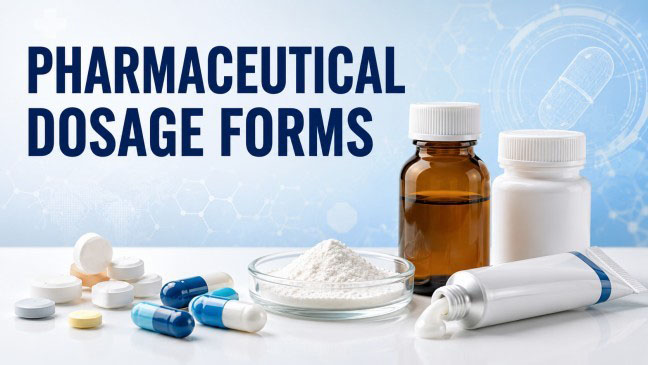
A pharmaceutical dosage form is the physical form in which a pharmaceutical product is produced and supplied. Common examples include tablets, capsules, powders, solutions, suspensions, creams, and injections. The selected form supports manufacturing, storage, quantity control, and the intended method of use.
Several related terms are often confused:
| Term | Meaning | Example |
| Active pharmaceutical ingredient (API) | The primary active component in a pharmaceutical product | Acetaminophen |
| Dose | The specified amount used at one time or during a defined period | 500 mg |
| Formulation | The designed combination of the API and other ingredients | API, filler, binder, and disintegrant |
| Dosage form | The finished physical form of the product | Film-coated tablet |
| Route of administration | The intended method of using the product | Oral administration |
Most finished pharmaceutical products contain one or more APIs together with excipients. Depending on the formulation, excipients may improve material flow, support tablet compression, maintain product stability, assist disintegration, mask an unpleasant taste, or adjust ingredient-release characteristics.
Dosage form and route of administration are related but are not the same concept. A tablet and an oral solution may both be intended for oral use, yet they require different formulations, manufacturing methods, process controls, and packaging systems. Products within the same category may also follow different processes. For example, one tablet formulation may be suitable for direct compression, while another may require granulation or coating.
Manufacturers should therefore define the dosage form, material properties, target quantity, stability considerations, and intended package before selecting production equipment. Equipment should be matched to the formulation and process instead of being expected to correct unsuitable material characteristics or packaging specifications.
2. What Are the Main Types of Pharmaceutical Dosage Forms?
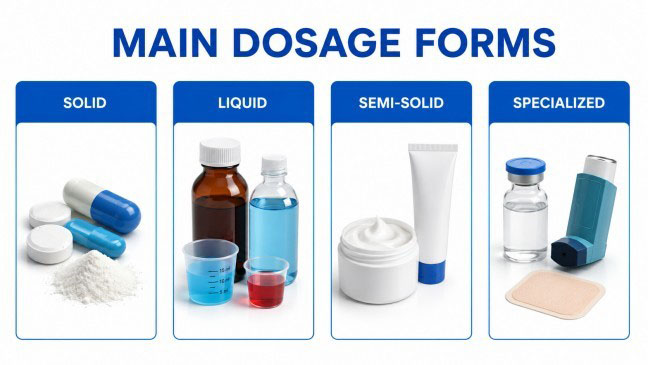
Dosage forms can be grouped by physical state, release characteristics, or route of administration. These systems overlap, so a product may belong to more than one group.
| Main group | Common examples | Typical manufacturing focus | Common package |
| Solid | Tablets, capsules, powders, granules | Flow, blending, compression or filling | Blisters, bottles, sachets |
| Liquid | Solutions, suspensions, emulsions, syrups | Mixing, uniformity, viscosity and filling | Bottles or unit containers |
| Semi-solid | Creams, ointments, gels, pastes | Mixing, homogenization and viscosity | Tubes, pumps or jars |
| Specialized | Injections, inhalation products, patches, suppositories | Product-specific processing and controls | Vials, ampoules, devices or sealed packs |
2.1 Solid Dosage Forms
Tablets are made by compressing a prepared powder or granule blend into a defined shape. Common formats include conventional tablets, chewable tablets, effervescent tablets, orally disintegrating tablets, and modified-release tablets. Their manufacturing behavior depends on powder flow, particle size, moisture level, compressibility, lubrication, and tooling design.
Capsules include two-piece hard capsules, soft capsules, and liquid-filled hard capsules. Hard capsules may contain powders, granules, pellets, or small tablets. Liquid-filled hard capsules require a compatible fill material and an appropriate shell-closing or sealing process. Soft capsules follow a different forming and filling method and normally use dedicated equipment.
Powders and granules may be supplied in multi-use containers or divided into individual sachets and stick packs. Their production requires attention to blend uniformity, segregation, dust, metering behavior, and the effect of humidity during filling and storage.
2.2 Liquid Dosage Forms
Liquid forms include solutions, suspensions, emulsions, and syrups. Solutions contain dissolved ingredients, suspensions contain dispersed solid particles, and emulsions contain separate liquid phases.
Manufacturing considerations include mixing order, temperature, filtration where applicable, viscosity, foam, and filling conditions. Suspensions and emulsions also require controls that address settling or phase separation during processing.
2.3 Semi-Solid and Specialized Dosage Forms
Creams, ointments, gels, and pastes are semi-solid forms commonly packed in tubes, pumps, or jars. Their viscosity affects mixing, transfer, filling, and container selection.
Other dosage forms include injections, inhalation products, transdermal patches, and suppositories. Their requirements differ substantially from conventional oral solids and should be evaluated within the relevant development framework.
3. How Are Different Pharmaceutical Dosage Forms Manufactured?
Most manufacturing processes begin with material receipt, identification, dispensing, and controlled preparation. Later steps depend on the dosage form and product specification.
3.1 Tablet Manufacturing
A typical tablet process includes:
Dispensing → Sieving or Milling → Blending → Granulation if Required → Drying → Lubrication → Compression → Optional Coating → Inspection → Packaging
Not every formula needs granulation. Direct compression uses a blend that already has suitable flow and compression behavior. Wet granulation introduces a liquid binder before drying and sizing, while dry granulation is a process that forms granules by mechanically compacting powdered material under high pressure without adding liquid. The selected route should come from formulation studies and production trials.
During compression, a tablet press machine fills the dies, compresses the material, and ejects the formed tablets. Fill depth and feeder performance mainly affect tablet weight, while compression force influences thickness and hardness. Turret speed changes filling time and compression dwell time, and worn or misaligned tooling may cause defects such as sticking, capping, or edge damage. Coating may then be applied for appearance, taste masking, environmental protection, or modified-release design.
3.2 Capsule Manufacturing
For two-piece hard capsules, the main sequence is:
Empty Capsule Feeding → Orientation → Cap-and-Body Separation → Filling → Reject → Closing → Ejection → Polishing → Inspection
A capsule filling machine must match the capsule size and filling material. Powders, granules, pellets, and liquids use different dosing arrangements. Material flow, bulk density, fill-weight range, shell condition, and closing quality are important when developing the process. Capsule polishing and inspection are normally positioned before blister or bottle packaging.
3.3 Powder and Granule Packing
Powder and granule products are blended and transferred to a suitable dosing system. Augers are commonly used for many powders, while volumetric cups or other feeders may suit free-flowing granules. A sachet packing machine can form the package from roll film, meter the product, seal the pack, and cut or separate the finished units.
3.4 Liquid and Semi-Solid Processing
Liquid and semi-solid production may include mixing, heating or cooling, homogenization, filtration, deaeration, holding, filling, and closing. The actual sequence depends on the formulation. Equipment contact materials, transfer methods, filling mechanism, and cleaning procedure should be selected around viscosity, foaming tendency, particle content, and required hygiene controls.
4. How Do Pharmaceutical Dosage Forms Affect Packaging Requirements?
Packaging is part of the product system, not a decorative step added after manufacturing. Its design should reflect the dosage form, formulation, stability information, transport conditions, and intended market.
Primary packaging directly contains the product, such as a blister cavity, bottle, sachet, tube, or vial. Secondary packaging includes items such as cartons, labels, and leaflets. Tertiary packaging supports storage and transportation through cases, dividers, and pallets.
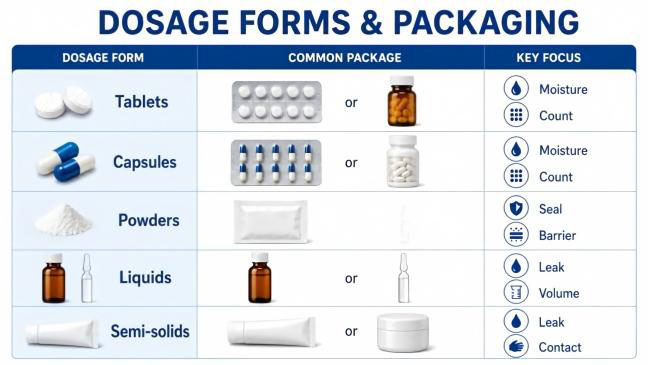
| Dosage form | Common primary package | Main considerations | Related equipment |
| Tablets | Blisters or bottles | Moisture, light, abrasion and unit count | Tablet blister machine or tablet counting line |
| Hard capsules | Blisters or bottles | Humidity, shell condition and unit count | Capsule blister machine or capsule counting line |
| Powders and granules | Sachets, sticks, pouches or bottles | Moisture, metering and seal condition | Sachet packaging machine or premade pouch packing machine |
| Liquids | Bottles or individual containers | Leakage, compatibility and fill volume | Liquid filling machine |
| Semi-solids | Tubes, pumps or jars | Viscosity, leakage and product contact | Tube, pump or jar filling equipment |
| Sterile products | Vials, ampoules or prefilled systems | Container-closure integrity and specialized controls | Product-specific filling and closing line |
For tablets and capsules, blister packs separate units into individual cavities. A blister packing machine forms or feeds the cavities, loads the product, seals the lidding material, codes the web, and cuts the final packs. The barrier structure should be selected from product data; a standard PVC blister and a cold-form aluminum blister do not provide the same protection profile.
Bottles are often selected for higher-count tablet and capsule packs. A typical automatic tablet and capsule counting line connect bottle unscrambling, counting, optional desiccant insertion, capping, induction sealing, labeling. The closure, liner, desiccant, and bottle material must be considered as parts of one packaging system.
Sachets and stick packs are common for measured quantities of powders and granules. Film structure, seal temperature, sealing pressure, product dust, tear design, and residual air can affect pack performance. Secondary packs may then move to a cartoning machine for carton forming, product insertion, leaflet handling, coding, and inspection.
No packaging format is automatically suitable for every product in the same dosage-form group. Package selection should be supported by compatibility work, package testing, and stability studies. For a wider format comparison, see this guide to pharmaceutical packaging types.
5. How to Select Pharmaceutical Manufacturing and Packaging Equipment
Equipment selection should start with product and process information rather than a machine model. A useful equipment specification normally covers:
- Material characteristics: powder flow, bulk density, particle size, moisture sensitivity, viscosity, foam, or stickiness.
- Product format: tablet diameter and shape, capsule size, fill range, bottle count, sachet dimensions, or blister layout.
- Required output: batch size, hourly target, shift pattern, planned changeovers, and expected expansion.
- Process controls: weight or count monitoring, rejection logic, metal detection, coding, and data recording.
- Cleaning and changeover: contact-part access, cleaning method, format-part replacement, and cross-product control.
- Line connection: upstream output, downstream speed, buffering, conveyor layout, and communication between machines.
Typical configurations include:
| Product and package | Example line configuration |
| Tablet blister pack | Tablet press → tablet deduster → metal detector → blister machine → cartoner |
| Capsule bottle | Capsule filler → capsule polisher → capsule counting and filling machine→ capper → induction sealer → labeler |
| Powder sachet | Blender → feeder → stick packing machine(or sachet packing machine) → checkweigher → cartoner |
The rated speed of one machine does not define the output of the complete line. Product feeding, inspection, stops, changeover, and downstream capacity also affect actual production. When several stages are connected, an integrated pharmaceutical line should be planned around a realistic line balance and the available factory layout.

Ruida Packing provides tablet presses, capsule filling machines, blister machines, counting lines, and cartoning equipment for solid dosage manufacturing and packaging projects. Based on the product format, target output, and factory layout, the team can help configure individual machines or an integrated production line.
6. Pharmaceutical Dosage Form Quality Control and GMP Considerations
Quality controls depend on the dosage form and approved product specification. Tablet checks may include weight variation, thickness, hardness, friability, disintegration, and dissolution where applicable. Capsule controls may cover fill weight, shell closure, appearance, and disintegration. Liquid and semi-solid controls can include fill quantity, uniformity, viscosity, and container closure.
Packaging checks may cover count or fill quantity, seal condition, leakage, print information, label verification, and rejection performance. These checks should be supported by written procedures, defined acceptance criteria, trained personnel, maintenance, calibration, and documented review.
GMP planning extends beyond the machine. Facility conditions, material control, cleaning, process validation, quality oversight, and production records all contribute to consistent operation. Equipment can support the required process, but regulatory status depends on the complete manufacturing and quality system used at the facility.
7. Pharmaceutical Dosage Forms: Frequently Asked Questions
What are the main pharmaceutical dosage forms?
The broad groups are solid, liquid, semi-solid, and specialized dosage forms. Tablets, capsules, powders, solutions, suspensions, creams, injections, and inhalation products are common examples. Classification may also consider route of administration and release characteristics.
What is the difference between a dose and a dosage form?
A dose is the specified quantity used at one time or during a defined period. A dosage form is the physical product, such as a tablet, capsule, solution, or cream, that carries that quantity.
Are tablets and capsules manufactured on the same equipment?
No. Tablets are formed by compression on a tablet press. Two-piece hard capsules are separated, filled, and closed on a capsule filling machine. They may later use similar blister or bottle packaging equipment if their size and handling characteristics are compatible with the selected line.
Which packaging formats are commonly used for solid dosage forms?
Tablets and hard capsules are commonly packed in blisters or bottles. Powders and granules may use sachets, stick packs, pouches, or bottles. The final choice depends on product characteristics, pack quantity, barrier requirements, and stability data.
What information is needed before choosing equipment?
Manufacturers should prepare details about the material, dosage form, dimensions, target quantity, output, packaging format, factory space, utilities, cleaning approach, and required documentation. Samples and trials may also be needed.
Conclusion: Matching Pharmaceutical Dosage Forms with Manufacturing and Packaging
Pharmaceutical dosage forms connect formulation, manufacturing, quality control, and packaging. A tablet, capsule, powder, or liquid presents different material behavior and therefore requires a different production route. Packaging must then be selected around the product’s stability profile, handling needs, and intended distribution conditions.
Before configuring a line, manufacturers should define the product and package first, then match each processing, filling, inspection, and packaging stage to those requirements. This approach produces a clearer equipment specification and reduces avoidable changes during project development.
References