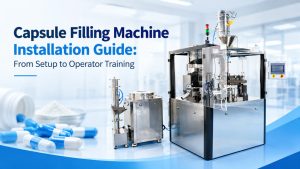

Stapsgewijze omschakeling van capsulevulmachine
Invoering
Nutraceutische fabrikanten en contractproductiebedrijven produceren vaak meerdere capsuleproducten voor verschillende klanten. Ze vereisen doorgaans frequente productiewisselingen tussen batches.
Farmaceutische fabrikanten voeren ook productwisselingen uit bij het wisselen tussen verschillende capsulespecificaties of formuleringen. Daarom, Het wisselen van capsulevulmachines is een veel voorkomende productieactiviteit geworden en een veelgestelde vraag van machinegebruikers.
Tijdens een overstap, Operators moeten identificeren welke componenten vervangen moeten worden, welke instellingen aanpassing behoeven, en welke gebieden moeten worden schoongemaakt voordat de productie opnieuw kan worden opgestart.
Voor een capsule vulmachine, onjuiste aanpassingen kunnen problemen met het scheiden van de capsules veroorzaken, variatie in vulgewicht, of poederlekkage. In dit artikel worden de onderdelen uitgelegd die tijdens het vervangen moeten worden vervangen capsulegrootte wijzigingen en de schoonmaakvereisten na het omschakelingsproces.
Belangrijkste opmerkingen
- Het wisselen van de capsulevulmachine omvat het vervangen van componenten, mechanische aanpassing, en reinigingsstappen voordat de nieuwe productie start.
- Veranderingen in de capsulegrootte vereisen aanpassing van de mal, voerstation, vulsysteem, en sluitsysteem met de nieuwe capsulespecificatie.
- Poederwisselingen vereisen voornamelijk aanpassing van de vulling, vooral de opening tussen de doseeronderdelen om poederlekkage te beheersen.
- De opvangbak schoonmaken, filterkern van de vacuümpomp, en poederopvangruimtes helpen het besmettingsrisico tijdens het werk te verminderen GMP-capsuleproductie.
- Een gestandaardiseerd opstelling van capsulevulmachine proces helpt operators bij het verminderen van aanpassingsfouten en het handhaven van stabiele productieomstandigheden.
1.Het veranderen van de capsulegrootte vereist vervanging van componenten
Vervanging van capsulevorm voor nieuwe maten
De capsulevorm is een belangrijk onderdeel van de capsulevulmachine. Het begeleidt lege capsules tijdens de scheiding, vulling, en afsluitingsproces. De mal bestaat uit een bovenmal en een ondermal. De bovenste mal houdt de capsuledop vast, terwijl de onderste mal het capsulelichaam ondersteunt tijdens het vullen.
Bij het wijzigen van de capsulegrootte, de volledige vervanging van de capsulevorm is vereist. De bestaande malset moet worden vervangen door een nieuwe mal die overeenkomt met de doelcapsulespecificatie.
Na het installeren van de nieuwe mal, operators gebruiken een kalibratiestaaf om de concentriciteit tussen de bovenste mal en de onderste mal te controleren. Deze stap bevestigt de juiste uitlijning voordat de capsulevulmachine opnieuw wordt opgestart. Een onjuiste uitlijning van de mal kan positioneringsfouten van de capsule veroorzaken, problemen met vullen, of vergrendelingsfouten tijdens de productie.

Capsulevulmachine Volledige vervanging van de malset
Vervanging en aanpassing van het capsulevoedingsstation
Het capsuletoevoerstation regelt de overdracht van lege capsules van de trechter naar het matrijssysteem van de capsulevulmachine. Het zorgt ervoor dat capsules de juiste positie ingaan voordat ze worden gescheiden en gevuld.
Bij het wijzigen van de capsulegrootte, de voedingscomponenten moeten overeenkomen met de nieuwe capsulespecificatie. De operator vervangt onderdelen zoals het draaibord, capsule zaaikam, en capsulehouder met geschikte componenten voor de nieuwe capsulegrootte.
Na vervanging van componenten, de operator past de voedingspositie aan en controleert de capsuleoverdracht tijdens het testen van de machine. De lege capsules moeten soepel bewegen zonder te blokkeren of te beschadigen.
Afstelling van vulstaaf en doseerschijf
De vulstaaf en doseerschijf werken samen in de capsulevulmachine om het vullen van poeder te regelen. De doseerschijf vormt het poedermeetgebied, terwijl de vulstaaf het poeder comprimeert en overbrengt naar het capsulelichaam.
Tijdens een verandering van capsulegrootte, de vulcomponenten moeten overeenkomen met de nieuwe capsulespecificatie. Traditionele ontwerpen vereisen dat operators de positie van de vulstang na vervanging aanpassen. Dit proces vereist extra insteltijd en ervaring van de operator.
Sommige capsulevullerontwerpen maken gebruik van een vulstaafstructuur met een vaste positie. De vulstaafhouder en het uittrekbare sleufontwerp stellen de staafpositie vóór installatie vooraf in. Het slot bepaalt de installatielocatie, terwijl de houder meerdere vulstaven horizontaal uitgelijnd houdt als één geheel.
Met dit ontwerp, operators can replace the filling rod group without repeated height adjustment. Machines from international manufacturers, inclusief Ruida-verpakking, Fette-verdichting, ER IS, and Syntegon use similar structural concepts to simplify capsule filling machine setup. The filling rod replacement process can be completed within 15 notulen.
Na installatie, operators still check the dosing disc adjustment and perform trial filling to confirm powder distribution and capsule weight. Proper alignment between the filling rod and dosing disc helps maintain stable filling results during production.

The filling rod holder can significantly reduce replacement time
Locking Station Adjustment and Outlet Replacement
The locking station completes the final step of capsule assembly on the capsule filling machine. It presses the capsule cap and body together after powder filling. De vergrendelpositie moet overeenkomen met de capsulelengte en -specificatie.
Tijdens een verandering van capsulegrootte, operators moeten het capsulevergrendelingsstation aanpassen aan het nieuwe capsuleformaat. Verschillende capsulegroottes hebben verschillende sluithoogtes, onjuiste instellingen kunnen dus losse doppen veroorzaken, onvolledige vergrendeling, of capsulevervorming.
De capsule-uitlaat moet ook worden vervangen bij het wijzigen van de capsulespecificaties. Elke capsulegrootte heeft een geschikte uitlaatopening nodig om een stabiele productafvoer te garanderen. Een onjuiste maat uitlaat kan verstopping van de capsule of onstabiele overdracht na vergrendeling veroorzaken.
Vacuümaanpassing voor capsulescheiding
Het vacuümsysteem scheidt de capsuledop van het capsulelichaam in de capsulevulmachine. Nadat de lege capsules de mal zijn binnengegaan, vacuümzuiging houdt de capsulekap vast en ondersteunt een stabiele scheiding.
Tijdens een verandering van capsulegrootte, de vacuüminstelling moet overeenkomen met de nieuwe capsulespecificatie. Verschillende capsulegroottes hebben verschillende gewichten, lengtes, en scheidingsomstandigheden. De operator past het vacuümniveau aan op basis van de daadwerkelijke beweging van de capsule.
Onvoldoende vacuüm kan ervoor zorgen dat de capsuledop niet goed loskomt. Overmatig vacuüm kan de capsule vervormen of de nauwkeurigheid van de positionering beïnvloeden.
Na voltooiing van de aanpassing van de capsulevulmachine, operators voeren testcapsules uit en controleren de scheidingsconditie. De capsulevuller moet een stabiele capsuleopening behouden voordat de reguliere productie wordt gestart. Een juiste vacuümafstelling helpt scheidingsfouten tijdens het vulproces te voorkomen.
2.Poederwissel vereist aanpassing van de vulling
De afstand tussen doseeronderdelen aanpassen
Bij het wisselen van poederproducten, de capsulevulmachine behoudt normaal gesproken dezelfde capsulespecificatie. De belangrijkste aanpassing betreft het doseersysteem dat aansluit bij de nieuwe poedereigenschappen.
De opening tussen de bovenplaat en de doseerschijf beïnvloedt de vulomstandigheden van het poeder. Operators passen deze afstand aan op basis van de poederkenmerken, inclusief vloeibaarheid, bulkdichtheid, en fijne deeltjesgehalte.
Poeders met een hoog gehalte aan fijne deeltjes, lage dichtheid, of een slechte vloeibaarheid hebben meer kans om kleine openingen binnen te dringen en overmatige lekkage te veroorzaken tijdens het vullen. Poeders met sterk elektrostatisch gedrag kunnen ook de poederhechting rond het doseergebied vergroten.
Operators passen de opening tussen de bovenste plaat en de afstelpositie van de doseerschijf aan om de poederbeweging te controleren. Een geschikte speling maakt een stabiele poedervulling mogelijk en vermindert overmatige poederlekkage.
Tijdens aanpassing, operators gebruiken een voelermaat om de opening op verschillende posities te controleren. Wanneer mogelijk, Op verschillende punten zijn meerdere voelermaten geplaatst om tegelijkertijd de speling te controleren en het afstelproces te versnellen.
Tijdens de inspectie beweegt de operator de voelermaat door de opening. Het zou met lichte weerstand moeten glijden. Een krappe positie duidt op onvoldoende speling, terwijl geen weerstand kan duiden op een overmatige speling.
Als de kloof te klein is, de bovenplaat en doseerschijf kunnen tijdens bedrijf met elkaar in contact komen, wat de mechanische weerstand kan verhogen of er zelfs voor kan zorgen dat de capsulevuller stopt. Als de kloof te groot is, poeder kan uit de doseerruimte ontsnappen, het creëren van overmatige lekkage en meer schoonmaakwerk.
Na aanpassing, de capsulevuller voert een testbatch uit. Operators check for abnormal friction noise and observe powder leakage during operation. The final setting is confirmed after checking filling weight and powder distribution.
3.Cleaning Requirements After Machine Changeover
After a omschakeling capsulevulmachine, operators need to clean the parts that contact capsules or powder. This includes components removed during size changes and areas exposed to the previous powder.
Cleaning Replaced and Product Contact Parts
The cleaning scope includes the hopper, doseerschijf, vulstaven, bovenste en onderste mallen, vergrendelstation, losstation, and powder collection trays.
The dosing disc and filling rods require careful cleaning because powder can remain around measuring holes and contact surfaces. The upper and lower molds also need inspection for powder trapped inside capsule positioning holes.
De reinigingssequentie begint met schoon water. Operators verwijderen zichtbaar poeder van elk onderdeel, blaas vervolgens de onderdelen droog. Een schone doek wordt gebruikt om het resterende vocht van de oppervlakken te vegen.
Na het drogen, operators vegen de gereinigde onderdelen af 95% alcohol van voedingskwaliteit. De operator controleert de oppervlakken opnieuw voordat de componenten opnieuw op de capsulevuller worden geplaatst.
Filterkern van vacuümpomp reinigen
Tijdens Reiniging van capsulevulmachines, operators moeten de filterkern van de vacuümpomp controleren op opgehoopt poeder. Fijn poeder kan tijdens het vacuümsysteem in het vacuüm terechtkomen capsule scheiding en verzamel op het filter.
Overmatige poederophoping kan de filterkern blokkeren en de vacuümzuiging verminderen. Een verminderde zuigkracht kan de capsulescheiding beïnvloeden tijdens het gebruik van de capsulevuller.
Voor het schoonmaken, operators verwijderen eerst de filterkern uit het vacuümsysteem. They use a vacuum cleaner to remove the accumulated powder from the filter surface.
After vacuum cleaning, operators use an air gun to blow away remaining powder from the filter core. The cleaned filter core can then be reinstalled for the next production batch.
Cleaning Material Recovery Bucket and Powder Collection Tray
The powder collection tray sits below the dosing disc on the capsule filling machine. It collects powder that falls through the gap around the dosing area. This prevents powder from spreading across the machine surface during filling.
Powder collected in the tray is transferred to the material recovery bucket through the vacuum system. This powder has not entered the capsule filling process and can be collected for reuse when production requirements allow.
De materiaalopvangbak en opvangbak moeten worden gereinigd tijdens elke wisseling van de capsulevulmachine. Dit voorkomt dat poeder van de vorige batch in de volgende productiebatch terechtkomt en vermindert het risico op kruisbesmetting.
Operators maken de poederopvangbak en de binnenwand van de materiaalopvangbak schoon met schoon water. Vervolgens blazen ze ze droog met een luchtpistool en nemen ze het resterende vocht weg met een schone doek.
Na het drogen, Operators vegen deze oppervlakken af 95% alcohol van voedingskwaliteit. De filterkern van de opvangbak wordt afzonderlijk gereinigd met een stofzuiger en een luchtpistool om opgehoopt poeder te verwijderen.
Voordat u de herstelcomponenten opnieuw installeert, operators controleren de capsulevuller op achtergebleven poeder en bevestigen dat de gereinigde onderdelen vrij zijn van zichtbare resten.

Maak de poederopvangemmer grondig schoon om kruisbesmetting te voorkomen
4.Smeervereisten na machinewissel
De machine smeren vóór productie
Na een omschakeling van de capsulevulmachine, Operators moeten de smeringsconditie controleren voordat de productie opnieuw wordt gestart. De machine kan dan opnieuw aan een lange periode van hoge intensiteit werken.
Voordat de productie begint, operators gebruiken een oliespuitpistool om de nokken en bewegende componenten in de machinebehuizing te smeren. Het gespecificeerde smeermiddel voor deze gebieden is nr. 00 vet.
Operators moeten het vet op de vereiste bewegende gebieden aanbrengen en controleren of de smering voldoende is voordat ze met het vullen van de capsules beginnen. Deze onderhoudsstap wordt uitgevoerd na de omschakeling en vóór de volgende productierun.
De machine beschermen tijdens langdurige stilstand
If the capsule filling machine will remain out of production for an extended period, operators need to protect exposed machine surfaces against rust.
The machine surface should be coated with No. 10 industrial white oil before extended shutdown. The oil forms a protective layer on exposed metal surfaces and helps prevent rust during storage.
Before restarting the capsule filler, operators should remove the protective oil from areas that may contact capsules or powder. The machine can then be cleaned, gesmeerd, and prepared for production according to the normal startup procedure.
Conclusie
Changeover Adjustment and Cleaning Checklist
| Changeover Item | Required Action | Main Check |
| Capsule mold | Replace matching upper and lower molds | Mold alignment |
| Feeding station | Replace turning board, sowing comb, and retainer | Capsule feeding |
| Filling rod | Vervang de bijpassende vulstaafgroep | Positie van de staaf |
| Doseerschijf | Vervang of pas aan afhankelijk van de capsulegrootte en het poeder | Vullen staat |
| Vergrendelingsstation | Pas aan voor de nieuwe capsulegrootte | Capsulevergrendeling |
| Capsule-uitlaat | Bijpassend stopcontact vervangen | Capsule-ontlading |
| Vacuümsysteem | Vacuümzuiging aanpassen | Capsule-scheiding |
| Poederwissel | Stel de doseerafstand af met voelermaten | Poeder lekkage |
| Productcontactonderdelen | Reinigen met water en 95% alcohol van voedingskwaliteit | Verwijdering van resten |
| Filterkern van vacuümpomp | Verwijderen, leeg, en schoonblazen | Vacuüm zuiging |
| Herstelemmer en poederbak | Reinigen met water en 95% alcohol van voedingskwaliteit | Kruisbesmetting |
| Interne nokken en bewegende delen | Smeren met nr. 00 vet | Staat van smering |
| Machineoppervlak tijdens uitschakelen | Solliciteer nr. 10 industriële witte olie | Roestpreventie |
Een omschakeling van een capsulevulmachine omvat verschillende acties, afhankelijk van de productieverandering. Het veranderen van capsulegroottes vereist vervanging en aanpassing van de capsulehanterings- en vulcomponenten.
Het wisselen van poederproducten met dezelfde capsulegrootte vereist voornamelijk aanpassing van de doseringsafstand. Operators kunnen tijdens de testproductie voelermaten gebruiken om de speling te controleren en de instelling te bevestigen.
De reiniging moet alle productcontactgebieden bestrijken, de filterkern van de vacuümpomp, materiaalopvangbak, en poederopvangbak. Na het schoonmaken, de capsulevuller moet vóór de volgende productierun worden gecontroleerd en gesmeerd.
Een duidelijke omschakelingsprocedure geeft operators een praktische volgorde voor het vervangen van componenten, aanpassing, schoonmaak, en smering.
FAQ
Welke onderdelen moeten worden vervangen bij het wijzigen van de capsulegrootte?
Bij het wijzigen van de capsulegrootte, operators moeten de bijpassende bovenste en onderste mallen vervangen. De nieuwe mallenset moet overeenkomen met de doelcapsulespecificatie.
Bij het capsuletoevoerstation is tevens een bijpassend draaibord vereist, capsule zaaikam, en capsulehouder. De vulstaaf, doseerschijf, vergrendelstation, and capsule outlet also require corresponding replacement or adjustment.
The vacuum suction needs adjustment for the new capsule size. Operators should run test capsules after setup and check capsule separation, vulling, vergrendelen, en ontslag.
What Needs Adjustment When Changing Powder Products?
When the capsule size remains unchanged, the main adjustment is in the dosing area. Operators adjust the gap between the upper plate and the dosing disc according to the new powder characteristics.
Operators use feeler gauges to check the gap at different positions. Multiple gauges can be used when possible to speed up the adjustment process.
The gap must not be too small or too large. Excessive contact may cause machine resistance or stoppage, while excessive clearance may cause heavy powder leakage.
Which Parts Need Cleaning After Changeover?
The cleaning scope includes the hopper, doseerschijf, vulstaven, bovenste en onderste mallen, vergrendelstation, losstation, en poederopvangbak.
De materiaalopvangbak en de filterkern van de vacuümpomp moeten ook worden gereinigd. Deze gebieden kunnen poeder van de vorige batch vasthouden.
Operators maken de relevante onderdelen schoon met schoon water, blaas ze droog, veeg ze af met een schone doek, en dan gebruiken 95% alcohol van voedingskwaliteit voor het laatste afvegen.
Hoe moet de filterkern van de vacuümpomp worden gereinigd??
Operators verwijderen eerst de filterkern uit het vacuümsysteem. Er wordt een stofzuiger gebruikt om het opgehoopte poeder uit het filter te verwijderen.
Het resterende poeder wordt vervolgens verwijderd met een luchtpistool. Poederophoping kan het filter verstoppen en de vacuümzuiging verminderen.
Verminderde zuigkracht kan de scheiding van de capsule op de capsulevuller beïnvloeden. De filterkern moet worden gereinigd voordat deze weer in gebruik wordt genomen.
Hoe moet de capsulevulmachine na de omschakeling worden gesmeerd??
Vóór productie, operators gebruiken een oliespuitpistool om de nokken en bewegende componenten in de machinebehuizing te smeren. Deze onderdelen gebruiken nr. 00 vet.
Als de capsulevulmachine voor langere tijd uitgeschakeld blijft, operators zijn van toepassing nr. 10 industriële witte olie op blootgestelde machineoppervlakken voor bescherming tegen roest.
De beschermende olie moet worden verwijderd uit de relevante productcontactgebieden voordat de productie wordt hervat.
Referenties
1. ONS. Food and Drug Administration – Huidige goede productiepraktijken
FDA — Huidige goede productiepraktijken (cGMP) Regelgeving
2. ONS. FDA – Inspecties van de productie van geneesmiddelen
FDA – Inspecties van de productie van geneesmiddelen
3. Europese Commissie — EudraLex-deel 4: EU-richtlijnen voor goede productiepraktijken
Europese Commissie — EudraLex-deel 4
4. WHO – Goede productiepraktijken voor farmaceutische producten
WHO – Goede productiepraktijken voor farmaceutische producten