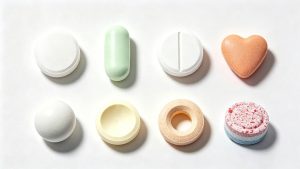
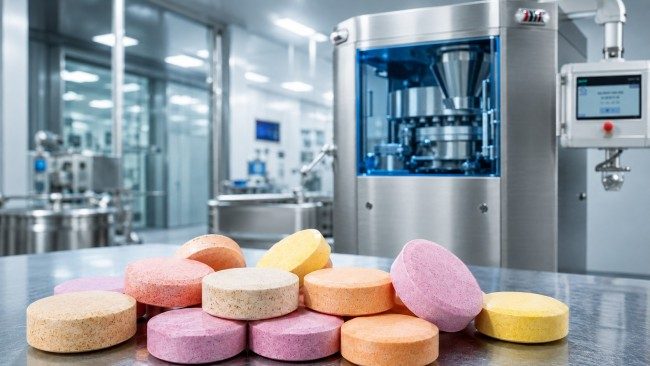
Kauwtabletten zijn vaste tabletten die zijn ontworpen om te worden gekauwd voordat ze worden doorgeslikt. Ze worden vaak gebruikt voor vitamines, mineralen, maagzuurremmers, Voedingssupplementen, en geselecteerde farmaceutische producten. Bekende voorbeelden zijn onder meer vitamine C-kauwtabletten, calciumkauwtabletten, en kauwbare multivitaminen.
Hoewel kauwtabletten kunnen worden geproduceerd met veel van dezelfde tabletproductieapparatuur die voor conventionele tabletten wordt gebruikt, de productvereisten zijn verschillend. Omdat de tablet gekauwd wordt en langer in de mond blijft, smaak, textuur, mondgevoel, tabletformaat, en kauwbaarheid worden veel belangrijker. Tegelijkertijd, de tabletten hebben nog steeds voldoende kracht nodig om compressie te weerstaan, ontstoffen, verpakking, verzending, en afhandeling.
These requirements affect the entire production process. Manufacturers need to consider the formulation, whether direct compression or korrel is more suitable, how the blend behaves during tablet compression, which quality attributes need to be controlled, and whether blister or bottle packaging is more appropriate.
This guide explains chewable tablet formulation, productie, productieapparatuur, quality considerations, and packaging in one complete production flow.
1. What Makes Chewable Tablets Different?
Het belangrijkste verschil tussen chewable tablets and regular tablets is how they are intended to be taken.
A conventional tablet is normally swallowed whole and then disintegrates after reaching the gastrointestinal tract. A chewable tablet is designed to be chewed into smaller particles before swallowing. Vanwege dit, the user directly experiences the tablet’s taste, textuur, hardheid, and aftertaste.
Dat verandert waar fabrikanten rekening mee moeten houden tijdens zowel de formulering als de productie.
Bijvoorbeeld, een conventionele tablet kan een onaangename smaak hebben die nauwelijks wordt opgemerkt als deze snel wordt doorgeslikt. Dezelfde smaak kan een groot probleem worden bij een kauwtablet, omdat het materiaal in de mond blijft terwijl erop wordt gekauwd. Zoetstoffen, smaken, vulstoffen, bindmiddelen, en andere hulpstoffen moeten daarom samenwerken om een aanvaardbare smaak en mondgevoel te produceren, terwijl ze nog steeds een betrouwbare tabletcompressie ondersteunen.
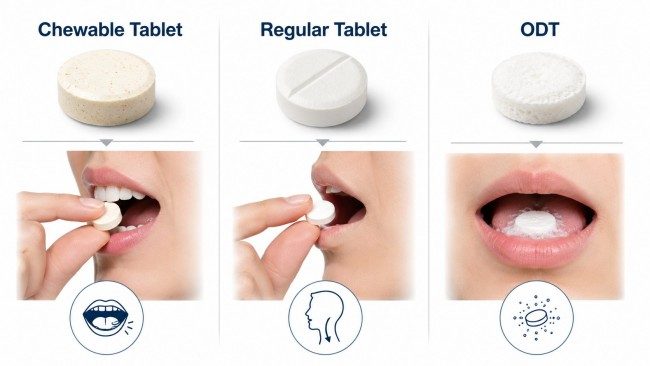
Kauwtabletten versus gewone tabletten versus ODT's
Kauwtabletten verschillen ook van oraal desintegrerende tabletten, gewoonlijk ODT's genoemd.
Een ODT is ontworpen om snel uit elkaar te vallen in de mond met weinig of geen kauwen. Op een kauwtablet wordt opzettelijk gekauwd voordat het wordt doorgeslikt. Een conventionele tablet, ter vergelijking, wordt normaal gesproken intact doorgeslikt.
| Tablettype | Hoe het normaal gesproken wordt ingenomen | Belangrijke productfocus |
| Kauwtablet | Gekauwd alvorens door te slikken | Smaak, mondgevoel, kauwbaarheid, kracht |
| Reguliere tablet | In zijn geheel doorgeslikt | Kracht, uiteenvallen, bedoelde vrijlating |
| ODT | Desintegreert snel in de mond | Snelle desintegratie en eenvoudige toediening |
Deze verschillen hebben ook invloed op de grootte en vorm van de tablet. Kauwtabletten worden vaak groot genoeg gemaakt om vitamines te bevatten, mineralen, maagzuurremmers, of andere ingrediënten, Daarom moeten het ontwerp van de gereedschappen en de tabletafmetingen comfortabel blijven om op te kauwen en praktisch voor de productie.
De tablet moet ook een evenwicht vinden tussen sterkte en kauwbaarheid. Het moet de ontlading uit de lucht overleven tabletpers, ontstoffen, inspectie, verpakking, vervoer, en normaal gebruik zonder overmatige breuk. Tegelijkertijd, het onnodig hard maken van de tablet kan het kauwen minder prettig maken.
Dit is de reden waarom de ontwikkeling van kauwtabletten zich niet alleen op smaak of compressie kan concentreren. De formulering moet zowel de beoogde eetervaring als stabiele productieprestaties ondersteunen.
2. Veel voorkomende kauwtablettoepassingen en voorbeelden
Kauwtabletten komen veel voor in producten die gemakkelijk kunnen worden toegediend, smaak, of een relatief grote tabletmassa is van belang.
Vitamine- en mineraalproducten zijn de meest bekende voorbeelden. Deze omvatten vitamine C kauwtabletten, kauwbare multivitaminen, calciumkauwtabletten, magnesium kauwtabletten, en andere voedingsproducten. Mineraalrijke formules kunnen kalkachtig veroorzaken, metalen, of bittere sensaties, dus smaak en textuur worden vaak belangrijke formuleringsdoelstellingen.
Antacidum kauwtabletten zijn een andere gevestigde toepassing. Ze kunnen relatief veel minerale ingrediënten bevatten en zijn ontworpen om te worden gekauwd voordat ze worden doorgeslikt.
Geselecteerde farmaceutische producten maken ook gebruik van kauwbare formaten, inclusief producten die bedoeld zijn voor gebruikers die moeite hebben met het doorslikken van conventionele tabletten. Pediatrische producten vereisen bijzondere aandacht voor de dosering, tabletformaat, selectie van hulpstoffen, en instructies voor gebruik in plaats van simpelweg een product voor volwassenen te verkleinen.
Kauwbare formaten worden ook gebruikt in nutraceutische en diergeneeskundige producten. Elke toepassing heeft zijn eigen smaak, dosis, stabiliteit, en productievereisten, Daarom bestaat er geen enkele standaardformule voor kauwtabletten.
3. Hoe wordt een kauwtablet samengesteld??
Een kauwtabletformulering moet zowel als een samengeperste tablet werken als als een product waarop doelbewust wordt gekauwd. Het actieve ingrediënt, hulpstoffen, smaak systeem, deeltjeseigenschappen, en productieroute hebben allemaal invloed op het eindresultaat.
Actief ingrediënt en dosis
Het benodigde actieve ingrediënt en de dosis staan voorop. Hooggedoseerde mineralen, sterk bittere actieve stoffen, vochtgevoelige materialen, en ingrediënten met een lage dosis kunnen zeer verschillende formuleringsproblemen veroorzaken.
De dosis heeft ook invloed op de tabletgrootte, en een tablet die gemakkelijk samen te drukken is, is niet automatisch prettig om op te kauwen.
Functionele hulpstoffen
Kauwtabletten kunnen vulstoffen of verdunningsmiddelen bevatten, bindmiddelen, smeermiddelen, glijdende dans, desintegratiemiddelen, zoetstoffen, smaken, en andere hulpstoffen.
Vulstoffen helpen bij het opbouwen van tabletmassa en kunnen de textuur beïnvloeden. Bindmiddelen ondersteunen deeltjesbinding. Smeermiddelen verminderen de wrijving tijdens compressie en uitwerpen. Glijmiddelen kunnen de poederstroom verbeteren, terwijl desintegratiemiddelen worden gebruikt wanneer dit door het productontwerp wordt vereist.
De formulering heeft nog steeds een geschikte vloei en verdichtbaarheid nodig, zodat het mengsel de matrijsholte consistent kan vullen en tabletten kan vormen zonder buitensporige defecten.
Smaak en mondgevoel
Smaak is een van de grootste verschillen tussen kauwtabletten en conventionele tabletformuleringen.
Zoetstoffen en smaakstoffen worden vaak gebruikt omdat het materiaal tijdens het kauwen in de mond blijft. Polyolen zoals mannitol worden vaak gekozen omdat ze zowel volume als een prettiger mondgevoel kunnen bijdragen.
Wanneer een actief ingrediënt sterk bitter of anderszins onaangenaam is, smaak alleen is misschien niet genoeg. Smaakmaskerende benaderingen kunnen coating omvatten, micro-inkapseling, of andere formuleringsstrategieën, op voorwaarde dat ze compatibel blijven met de rest van het productieproces.
De deeltjesgrootte is ook van belang. Grove of slecht gecontroleerde deeltjes kunnen een korrelig gevoel veroorzaken, terwijl grote verschillen in deeltjesgrootte of dichtheid het risico op segregatie tijdens het mengen en overbrengen kunnen vergroten.
4. Belangrijke kwaliteitskenmerken van kauwtabletten
Kauwtabletten moeten mechanisch betrouwbaar blijven tijdens de productie en verpakking, terwijl ze ook acceptabel zijn om op te kauwen. Bij kwaliteitsbeoordeling wordt daarom naar meerdere kenmerken tegelijk gekeken.
| Kwaliteitskenmerk | Waarom het ertoe doet |
| Tabletgewicht en consistentie van de inhoud | Ondersteunt een consistente samenstelling en dosering |
| Hardheid / breekkracht | Geeft mechanische sterkte aan en kan de kauwbaarheid beïnvloeden |
| Brosheid | Toont weerstand tegen slijtage en breuk |
| Grootte en dikte | Beïnvloed de bediening, verpakking, en kauwen |
| Desintegratie | Helpt karakteriseren hoe de doseringsvorm gaat kapot |
| Ontbinding | Evalueert de vrijgave van het actieve ingrediënt |
| Smaak en mondgevoel | Heeft directe invloed op de gebruikerservaring |
| Verschijning | Helpt bij het identificeren van fysieke defecten |
Hardheid is belangrijk, maar een hardere tablet is niet automatisch een betere kauwtablet. Als de kracht te laag is, tabletten kunnen tijdens het ontstoffen afbrokkelen of breken, overbrengen, verpakking, en vervoer. Als het onnodig hoog is, kauwen kan onaangenaam worden.
Brosheid biedt een tweede kijk op fysieke duurzaamheid, terwijl desintegratie en oplossing helpen bevestigen dat de doseringsvorm presteert zoals bedoeld. De juiste doelstellingen zijn afhankelijk van de formulering en productspecificatie en niet van één universele waarde.
5. Productie van kauwtabletten: Stap voor stap
Zodra de formulering en de procesroute zijn vastgesteld, De productie van kauwtabletten volgt een volgorde die vergelijkbaar is met die van andere gecomprimeerde tabletten.
Stap 1: Bereid de grondstoffen voor
Grondstoffen worden gedoseerd volgens de batchformule. Afhankelijk van hun toestand, poeders kunnen worden gezeefd of gemalen om agglomeraten te breken en een geschiktere deeltjesgrootteverdeling te verkrijgen voor mengen en toevoeren.
Stap 2: Meng de ingrediënten
Actieve ingrediënten en hulpstoffen worden gemengd om de vereiste verdeling te bereiken. Blender laden, mengtijd, deeltjesgrootte, dikte, en de volgorde van toevoeging kan de uniformiteit en stroom beïnvloeden.
Smeermiddelen worden gewoonlijk toegevoegd tijdens een latere mengfase, omdat overmatige smering de deeltjesbinding kan verminderen en de tableteigenschappen kan veranderen.
Stap 3: Gebruik directe compressie of granulatie
Een mengsel met directe compressie kan overgaan naar uiteindelijke smering en tabletcompressie zonder een afzonderlijke granulatiestap.
Wanneer granulatie vereist is, de route kan natte granulatie of droge granulatie omvatten, drogen waar van toepassing, frezen of op maat maken, en uiteindelijke vermenging. Het doel is om materiaal te creëren dat betrouwbaarder wordt ingevoerd en gecomprimeerd.
Stap 4: Comprimeer het mengsel op een roterende tabletpers
Het uiteindelijke mengsel wordt overgebracht naar een roterende tabletpers. Het toevoersysteem verdeelt materiaal in de matrijsholten, while the lower punch position determines the available die fill depth and therefore influences tablet weight.
The filled die then passes through compression. Precompression can be used when needed to remove part of the entrapped air and form an initial compact before main compression. Main compression forms the finished tablet, and the lower punch then raises it for ejection.
The required settings depend on the formulation, afmetingen van tablets, gereedschap, doelgewicht, press speed, feed conditions, and powder behavior. Compression force alone should not be treated as the only control for tablet hardness or chewability.
Stap 5: Dedust, Inspecteren, and Sample
After ejection, tablets commonly pass through a deduster to remove loose powder. Depending on the line and quality system, downstream steps can also include metal detection and in-process sampling.
Veelvoorkomende compressieproblemen kunnen verschillende oorzaken hebben:
| Probleem | Factoren om te onderzoeken |
| Plakken of plukken | Formulering vocht, smering, gereedschap oppervlak, temperatuur |
| Gewichtsvariatie | Poeder stroom, segregatie, feed conditions, de vulling, press speed |
| Chippen of afdekken | Ingesloten lucht, binding, compressie profiel, gereedschap |
| Overmatige hardheid | Compacteerbaarheid, compressie omstandigheden, afmetingen van tablets |
| Moeilijk uitwerpen | Smering, wrijving tussen de matrijzen, gereedschap conditie |
Dit zijn multifactoriële problemen. Machine-instellingen, formuleringseigenschappen, materiële toestand, en gereedschap moeten samen worden gecontroleerd.
6. Welke apparatuur wordt gebruikt bij de productie van kauwtabletten?
De exacte uitrusting hangt af van het feit of het product directe compressie of granulatie gebruikt, maar een typische regel kan bevatten:
| Apparatuur | Hoofdrol |
| Zeef of molen | Poederbereiding en deagglomeratie |
| Poeder blender | Meng actieve ingrediënten en hulpstoffen |
| Granulator | Vorm indien nodig korrels |
| Droger en maatmolen | Verwerk natte korrels vóór het definitieve mengen |
| Rotary Tablet Press | Pers het uiteindelijke mengsel tot tabletten |
| Tabletontstoffer | Verwijder los oppervlaktepoeder |
| Metaaldetector | Detecteer metaalverontreiniging wanneer deze in de lijn wordt opgenomen |
| Blisterverpakkingsmachine | Verpak tabletten in blisterverpakkingen |
| Tellijn voor tablets | Tel tabletten en vul ze in flessen |
| Kartonneermachine | Laad afgewerkte verpakkingen in dozen |

De roterende tabletpers is de centrale machine in de tabletcompressiefase. De machinekeuze is afhankelijk van de tabletdiameter en vorm, gereedschap, poeder eigenschappen, productiecapaciteit, en vereiste automatisering.
Kauwtabletten hebben geen speciale categorie tabletpers nodig, simpelweg omdat ze kauwbaar zijn. Het gaat erom of de machine, gereedschap, voer systeem, en werkingsbereik komen overeen met de formulering en het tabletontwerp.
Voor een complete productielijn, Ruida-verpakking kan tabletcompressie verbinden met stroomafwaartse blisterverpakkingen, tabletten tellen, hanteren van flessen, en kartonneerapparatuur volgens het vereiste verpakkingsformaat.
7. Verpakkingsoplossingen voor kauwtabletten
Kauwtabletten worden gewoonlijk verpakt in blisterverpakkingen of flessen. De betere optie hangt af van de vocht- en zuurstofgevoeligheid, afmetingen van tablets, aantal eenheden, markt formaat, en vereiste barrièreprestaties.
Blisterverpakking
In blisterverpakkingen worden afzonderlijke tabletten in individuele holtes verpakt en deze zijn handig wanneer presentatie in eenheidsdosis of het scheiden van afzonderlijke tabletten belangrijk is.
De prestaties van de barrière zijn afhankelijk van de volledige verpakkingsstructuur. Op PVC gebaseerde blisters, kunststofconstructies met een hogere barrière, En koudgevormde Alu-Alu-pakketten bieden niet hetzelfde beschermingsniveau.
De blisterverpakkingsmachine vormt en sluit de verpakking, maar de barrière zelf is afkomstig van de geselecteerde materialen en afdichtingskwaliteit.
Wanneer secundaire verpakking vereist is, afgewerkte blistervellen kunnen doorgaan naar een kartonneermachine.
Flesverpakking
Flesverpakkingen zijn gebruikelijk voor kauwbare vitamines, mineralen, en voedingsproducten die in grotere hoeveelheden worden verkocht.
Een typische geautomatiseerde tablettel- en bottellijn kan dit omvatten:
Flessen ontwarren → Tabletten tellen/vullen → Controleweging → Droogmiddel inbrengen → Katoen inleggen → Afdekken → Inductiesealen → Etiketteren → Coderen/inspecteren
Niet elk product heeft elke stap nodig. Droogmiddelen, Bijvoorbeeld, moet worden geselecteerd op basis van de vochtgevoeligheid van het product en het volledige pakketontwerp.

Blister of fles?
| Overweging | Blaar | Fles |
| Dosispresentatie | Individuele gaatjes | Meerdere tabletten per verpakking |
| Grote tablet telt | In veel gevallen minder handig | Vaak praktisch |
| Individuele tabletscheiding | Sterk voordeel | Gedeelde container |
| Barrièreprestaties | Afhankelijk van de blaarstructuur | Afhankelijk van de fles, sluiting, en zegel |
Verpakkingen moeten daarom vroeg in de lijnplanning worden overwogen. A large chewable tablet sold in a 90-count bottle needs a very different packaging process from a product packed into individual blister cavities.
Conclusie
Chewable tablets combine the advantages of compressed solid dosage forms with additional demands for taste, mondgevoel, tabletformaat, and chewability.
The best manufacturing route starts with the formulation. Material properties determine whether direct compression or granulation is more suitable, the tablet press must match the blend and tablet design, quality checks confirm finished-product performance, and the packaging format must provide the required protection and presentation.
A stable chewable tablet production line is therefore built by connecting formulation, compressie, kwaliteitscontrole, and packaging rather than optimizing any one step in isolation.
Frequently Asked Questions About Chewable Tablets
1.Wat is een kauwtablet?
Een kauwtablet is een vaste orale tablet die is ontworpen om te worden gekauwd voordat deze wordt doorgeslikt. Bij de formulering moet rekening worden gehouden met de smaak, mondgevoel, textuur, mechanische sterkte, en kauwbaarheid naast de normale productievereisten voor tabletten.
2.Hoe worden kauwtabletten vervaardigd??
Het typische proces omvat de voorbereiding van grondstoffen, vermengen, directe compressie of granulatie indien nodig, productie van tablets, ontstoffen, inspectie, en uiteindelijke blister- of flesverpakking.
3.Welke ingrediënten worden gebruikt in de formulering van kauwtabletten??
Typische formuleringen kunnen actieve ingrediënten bevatten, vulstoffen, bindmiddelen, smeermiddelen, glijdende dans, desintegratiemiddelen, zoetstoffen, smaken, en andere hulpstoffen. De exacte combinatie is afhankelijk van de dosis, smaak, materiaal eigenschappen, en productvereisten.
4.Waarom blijven kauwtabletten plakken aan tabletpersstoten??
Mogelijke oorzaken zijn onder meer vocht in de formulering, plakkerige ingrediënten, onvoldoende smering, gereedschap conditie, producttemperatuur, en compressieomstandigheden. De onderliggende oorzaak moet worden geïdentificeerd voordat de machine-instellingen worden gewijzigd.
5.Welke kwaliteitskenmerken zijn belangrijk voor kauwtabletten?
Gemeenschappelijke kenmerken zijn onder meer het tabletgewicht, consistentie van de inhoud, afmetingen, hardheid of breekkracht, brosheid, uiteenvallen, ontbinding, verschijning, smaak, mondgevoel, and chewability.
6.Welke apparatuur is nodig voor de productie van kauwtabletten??
Een lijn kan poedervoorbereidingsapparatuur omvatten, een blender, optionele granulatie- en droogapparatuur, een roterende tabletcompressiemachine, ontstoffing, metaaldetector, en stroomafwaartse tabletblistermachine of tabletbottellijn.
7.Welke verpakking is geschikt voor kauwtabletten?
Zowel blisterverpakkingen als flessen worden veel gebruikt. De keuze is afhankelijk van de tabletgrootte, graaf, barrière eisen, behoefte aan eenheidsdosis, bewaaromstandigheden, en marktformat.
Referenties
1. FDA – Overwegingen met betrekking tot kwaliteitskenmerken voor kauwtabletten: Leidraad voor de industrie
2. FDA / ICH Q6A-specificaties
3. Farmaceutische Technologie – Kauwbare tabletten: Een overzicht van formuleringsoverwegingen
4. PMC-onderzoek – Tableteerbaarheid en onderzoek naar natte granulatie