Das Hochgeschwindigkeitsverpacken stellt ein Problem dar, das leicht übersehen wird: Fertige Packungen verlassen die vorgeschaltete Maschine nicht immer in der Reihenfolge, in der sie für den nächsten Verpackungsschritt benötigt werden. Beutel, Beutel, Blisterpackungen, und andere klein verpackte Produkte können in großen Mengen ankommen, überlappen einander, Sitzen Sie in verschiedenen Winkeln, oder mit ungleichmäßigem Abstand vorwärts bewegen.
Dies wird zum Engpass, wenn die nächste Maschine einen kontrollierten Produktfluss benötigt. Bevor Pakete gruppiert werden können, in Kartons verpackt, in Fälle übertragen, oder einem anderen automatisierten Verpackungsprozess zugeführt werden, Sie müssen oft getrennt werden, arrangiert, beabstandet, überprüft, und gezählt.
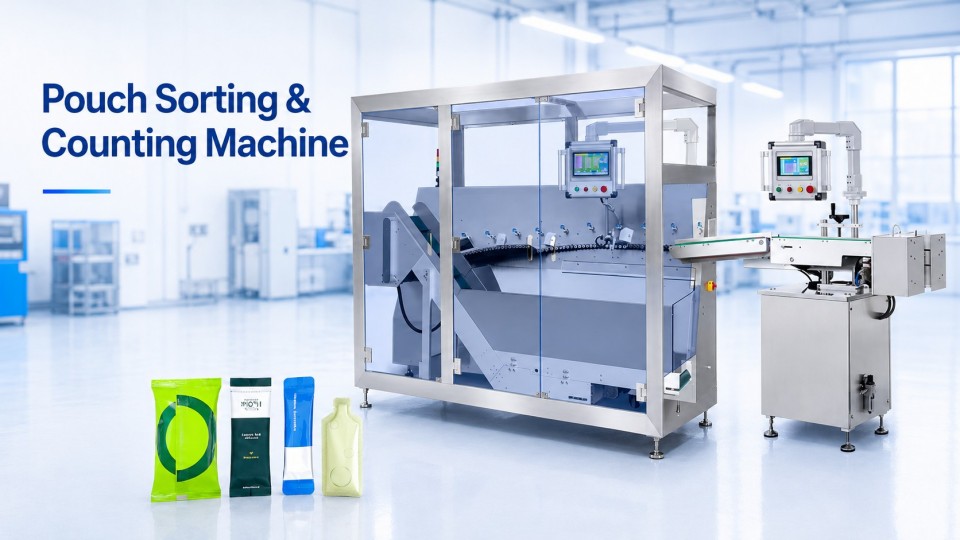
A Beutelsortier- und Zählmaschine automatisiert diese Zwischenbearbeitungsphase. Anstatt dass die Bediener manuell einen Stapel Pakete durchsuchen und sie einzeln anordnen, Die Maschine wandelt einen ungeordneten Vorrat in einen kontrollierten Strom einzelner Packungen um. Ein typischer Prozess ist die Akkumulation, Fütterung, Trennung, Ablehnung abnormaler Präsentationen, stabiler Abstand, Zählen, und kontrollierte Entladung.
Der Wert dieses Schrittes liegt nicht einfach nur in der schnelleren Zählung. Eine stabile nachgelagerte Verpackung hängt davon ab, dass jede Packung in einem vorhersehbaren Fluss mit genügend Abstand für Sensoren präsentiert wird, Förderer, und nachfolgende Ausrüstung, um es konsistent zu handhaben. Sortieren und Zählen arbeiten also zusammen: Die Maschine erstellt zunächst einen überschaubaren Produktfluss und verfolgt dann die angenommenen Packungen auf ihrem Weg zum nächsten Prozess.
1.Was macht eigentlich eine Beutelsortier- und Zählmaschine??
Eine Beutelsortier- und -zählmaschine befindet sich zwischen der Handhabung großer Mengen oder ungeordneter Produkte und dem nächsten automatisierten Verpackungsvorgang.
Wenn eine große Anzahl fertiger Packungen in einen Trichter oder Sammelbereich gelangt, Für eine genaue Zählung sind sie noch nicht geeignet. Zwei Packungen können sich überlappen. Es können mehrere gemeinsam anreisen. Einige können flach liegen, während andere schräg hineingehen. Wenn diese Packungen direkt zu einem Zählsensor gelangen, Ein einfacher Zähler kann nicht jeden einzelnen Artikel zuverlässig unterscheiden.
Die Maschine organisiert daher den Produktfluss, bevor mit dem Zählen begonnen wird. Eine typische Sequenz ist:
- Akkumulation: Pakete werden entgegengenommen und vorübergehend aufbewahrt.
- Kontrollierte Fütterung: Das Material wird nach und nach freigegeben, anstatt sich als großer Haufen vorwärts zu bewegen.
- Trennung: Überlappende oder dicht gruppierte Packungen werden in einzelne Einheiten aufgeteilt.
- Abfallverweigerung: Nach der Trennung, Überlappende Pakete und Pakete in unterschiedlicher Ausrichtung werden entfernt.
- Anordnung und Abstand: Angenommene Packungen erhalten einen stabileren Stand und ausreichend Abstand.
- Erkennung und Zählung: Sensoren identifizieren und zählen einzelne angenommene Packungen.
- Kontrollierte Entladung: Gezählte Pakete verlassen den Versand in einer definierten Fluss- oder Ausgabeanordnung.
A Beutelsortier- und Zählmaschine spielt daher eine andere Rolle als eine Stickpackmaschine oder eine Kartoniermaschine. A Beutelverpackungsmaschine Normalerweise formt oder handhabt er das Paket und füllt das Produkt ab. Eine Kartoniermaschine verpackt das fertige Produkt in Kartons. Zwischen diesen Stufen kümmert sich die Sortier- und Zählmaschine um die verpackten Artikel.
Seine Anwendung ist auch umfassender, als das Wort „Beutel“ vermuten lässt. Abhängig vom Maschinendesign und dem physikalischen Verhalten der Verpackung, Das gleiche Prinzip kann auch für Sachets angewendet werden, Stickpacks, weiche oder starre Beutel, und verpackte Blisterverpackungen. Ruida Packing’s RD-SS-450Pro Beutelsortier- und Zählmaschine, Zum Beispiel,eignet sich für Blisterverpackungen und Hart-/Weichbeutel oder Beutel, mit dokumentierten Verarbeitungsstationen, die alle Phasen von der Sammlung und Zuführung bis zur Trennung abdecken, waste removal, counting and discharging.
In der Praxis, counting is only one part of the process. The harder task is turning a random group of finished packs into separated, consistently spaced units that can be checked, gezählt, and transferred without continuous manual handling.
For a high-speed packaging operation, that orderly product flow is what allows the next machine to receive material at a predictable rate rather than dealing with piles, overlaps, and irregular gaps.
2.How Does a Pouch Sorting and Counting Machine Turn Random Packs Into an Orderly Flow?
The change from a random pile to a countable stream happens progressively. Each stage removes one source of disorder before the next stage begins.
Video: RD-SS-450Pro pouch sorting and counting machine in operation.
Accumulation and Controlled Feeding
Finished packs first enter a hopper or storage area. Controlled feeding then releases products in manageable quantities instead of sending the entire load forward at once.
On the RD-SS-450Pro, a matrix-type multi-stage feeding system and servo-driven feeding rollers are used in the early stages. A steady feed gives the separation section enough space to work and reduces sudden surges that can create new overlaps.
Separation Comes And Abfallverweigerung
The next task is to separate packs that are stacked, touching, or moving together.
Rollers and conveying mechanisms create controlled relative movement so that products can be pulled apart. Anti-overlap handling is important because a pack cannot be evaluated properly while it is hidden under or attached to another one.
Once packs have been separated enough to be individually presented, the waste-rejection stage can remove incorrectly presented items.
Accepted packs then continue toward stable spacing and counting.
Stable Spacing and Counting
Even after separation and rejection, products still need predictable gaps. If one pack follows another too closely, the sensor may not receive a clear interval between them.
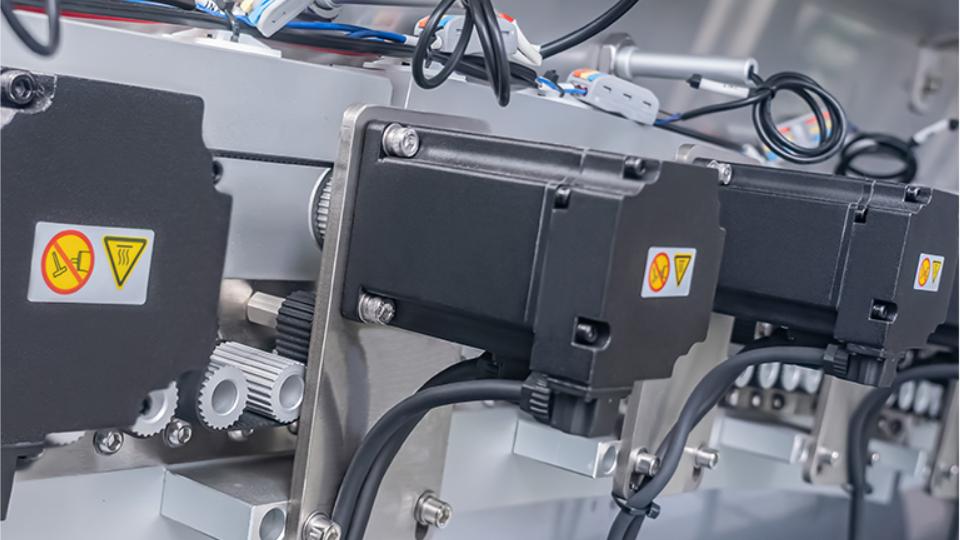
Servo-controlled rollers and synchronized belts adjust the flow so accepted packs move with more consistent spacing. Ruida Packing’s supplied documentation describes 11 direct-drive servo motors working with a multi-axis control system and coordinated high-, medium-, and low-speed zones.
Photoelectric sensors then detect accepted packs as they pass the counting point.
Controlled Output for the Next Packaging Step
Nach dem Zählen, the products need to leave in a form the next machine can accept.
In a wider line design, the discharging station can also be engineered around cartoners, Kofferpacker, overwrappers, or other Sekundärverpackung equipment when the interface matches the downstream process.
3.What Products Can Be Sorted and Counted?
A sorting machine should be selected around the actual pack, not only the name of the machine.
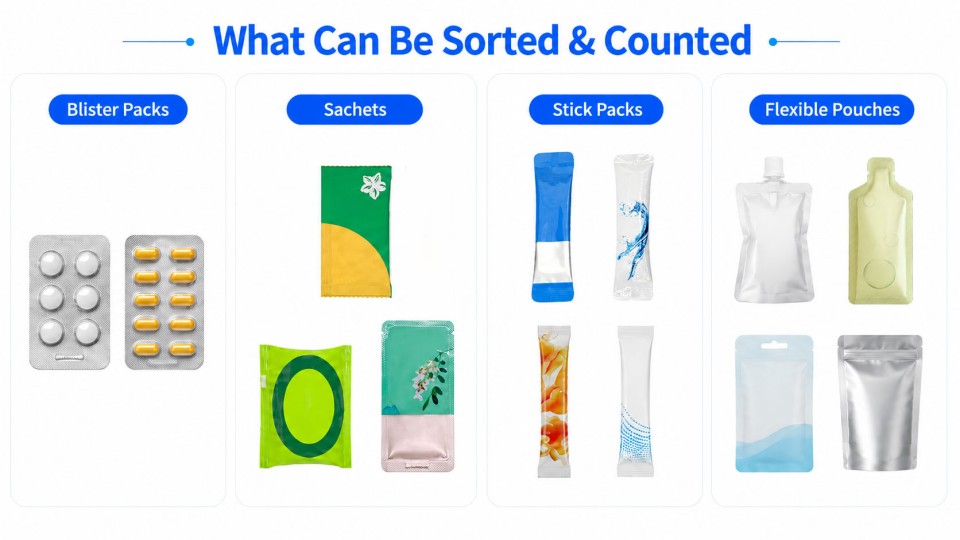
This pouch sorting and counting machine handles blister packs, Beutel, Beutel, and stick packs. That supports blister packs and a range of flexible packs, but it does not mean every pack within those dimensions will behave the same way.
| Pack Type | Typical Incoming Condition | Possible Downstream Step |
| Blisterpackungen | Stacked or overlapped | Cartoning or other secondary packaging |
| Beutel | Random orientation, uneven spacing | Kartonieren, Kartonverpackung |
| Stick packs | Clustered or closely spaced | Cartoning or multipack handling |
| Flexible pouches | Overlapping or irregular gaps | Case packing, Kartonieren, or overwrapping where applicable |
The physical behavior of the pack matters as much as its dimensions. A thin flexible sachet, a rigid blister packs, and a slippery laminated pouch respond differently to rollers, Führer, Vibration, and acceleration.
Bei der Bewertung von a pouch sorting machine oder sachet counting machine, check thickness, stiffness, Oberflächenreibung, static tendency, and how easily the package bends or overlaps. Testing with real product samples is more useful than relying on dimensions alone.
4.Why Sorting Matters Before Counting and Secondary Packaging
Counting accuracy starts with product presentation.
A sensor works best when each accepted pack reaches it as a separate event. When packs remain overlapped or gaps are inconsistent, the counting section receives a poor-quality input. Sorting and rejection correct that flow before counting begins.
The same principle applies to the next secondary packaging machine. A cartoner or case packer does not benefit from receiving the correct total quantity if those packs arrive as a pile. It needs products delivered in a repeatable arrangement that matches its infeed.
Without an automatic pouch sorting machine, operators may need to separate accumulated packs, remove abnormal items, recount groups, and reload them into the downstream process. That can be workable at low output, but manual rehandling becomes harder to keep consistent as production speed rises.
This is why a pouch sorting and counting machine should not be judged only by its maximum bags-per-minute figure. A high nominal speed has little value if the machine cannot maintain separation, Ablehnung, Zählen, and discharge with the actual pack being produced.
5.How to Choose a Pouch Sorting and Counting Machine
Start with the product rather than the machine catalogue.
Erste, confirm the size and handling characteristics of every pack that will run on the line. Record length, Breite, Dicke, stiffness, surface material, and how products normally leave the upstream equipment.
Zweite, define the real throughput requirement. The sorter should support the normal operating range of the upstream process while supplying the downstream machine at a stable rate.
Dritte, look at separation and rejection. Ask how the machine handles double packs, overlaps, irregular presentations, and rejected items.
Vierte, specify the required discharge format. A Kartoniermaschine may need flat or grouped packs, while another downstream process may require a different orientation.
Fifth, check line integration. Conveyor height, available floor space, upstream discharge position, downstream infeed, control signals, and maintenance access all affect the layout. The RD-SS-450Pro pouch sorting and counting machine is a comprehensive equipment that integrates storage, Fütterung, sorting and separation functions with a footprint of about 2.52 square meters and adjustable equipment height for line connection.
Endlich, treat performance figures as part of the decision, not the entire decision. The figures still need to be considered with the actual product and intended operating conditions.
6.Abschluss
A Beutelsortier- und Zählmaschine does more than count finished packs. Its main job is to turn a random incoming supply into a controlled product flow through accumulation, Fütterung, Trennung, Abfallverweigerung, stabiler Abstand, Zählen, and defined discharge. When the machine is correctly matched to the package and line layout, Blisterpackungen, Beutel, Stickpacks, and pouches can move from an irregular supply into a predictable flow for the next packaging operation.
7.FAQ About Pouch Sorting and Counting Machines
What is the difference between a pouch sorting machine and a pouch counting machine?
A sorting machine separates and organizes an irregular product flow. A counting machine detects how many individual products pass a defined point. A Beutelsortier- und Zählmaschine combines the two so that products are separated before counting.
Can a pouch sorting and counting machine handle blister packs?
It can handle compatible blister packs when the package dimensions and physical behavior suit the machine.
Can it connect directly to a cartoning machine?
Ja, when discharge orientation, Geschwindigkeit, Höhe, and control interface are designed to match the cartoner. Other downstream options can include case packing or overwrapping systems depending on line configuration.
What determines the operating speed of a pouch sorting and counting machine?
Pack size, stiffness, surface behavior, überlappen, required spacing, rejection conditions, counting method, and discharge format all affect practical speed. Maximum rated capacity should be checked with representative product samples.
Referenzen
- PMMI – ANSI/PMMI B155.1-2023: Safety Requirements for Packaging and Processing Machinery — Covers packaging machinery for primary, secondary and tertiary packaging, including conveying and coordinated line functions.
- OMAC – PackML — Industry automation framework for consistent machine states, behavior and data exchange across packaging equipment.
- ISO 11161:2007 + Amd 1:2010 – Safety of machinery — Integrated manufacturing systems — Basic requirements — Relevant to the integration of machinery into manufacturing systems and line-level safety considerations.
- PMMI – 2022 The Future of Automation in Packaging and Processing — Industry research covering packaging automation, productivity, flexible automation and line integration priorities.