...

>

Pharmaceutical Contract Manufacturing: CMO vs CDMO, Production Process, and Equipment Requirements

Pharmaceutical Contract Manufacturing: CMO vs CDMO, Production Process, and Equipment Requirements

目次

CMO and CDMO roles differ across development, technology transfer, commercial production, and the equipment needed for flexible batches and packaging.

Pharmaceutical contract manufacturing allows a product owner to outsource selected development, 生産, or packaging activities to a qualified manufacturing partner. The scope can range from producing an established formula to supporting technology transfer, process scale-up, commercial batches, そして最終梱包.

Two service models appear frequently in these projects: the contract manufacturing organization, or CMO, and the contract development and manufacturing organization, or CDMO. Their responsibilities often overlap, but they normally enter a project at different stages and provide different levels of technical support.

The success of either model depends on more than available production capacity. The manufacturing partner also needs suitable equipment, controlled changeovers, 反復可能なプロセス設定, effective cleaning procedures, inspection systems, and clear quality responsibilities.

CMO vs CDMO pharmaceutical contract manufacturing comparison

What Is Pharmaceutical Contract Manufacturing?

Pharmaceutical contract manufacturing is an arrangement in which a product owner hires an external facility to complete defined manufacturing or packaging activities. The product owner provides the product requirements, quality standards, 目標出力, and market specifications, while the manufacturing partner supplies the facilities, personnel, production systems, and technical capabilities needed to complete the agreed work.

The scope varies between projects. Some companies already have a stable formulation and established production parameters. They mainly need additional manufacturing capacity, qualified equipment, or access to packaging formats that are not available in their own facility.

Other projects require broader support before commercial production can begin. This can include formulation adjustment, process development, technology transfer, パイロット制作, parameter optimization, 検証バッチ, and scale-up from a smaller process to full production equipment.

Packaging can also form an important part of the contract manufacturing service. Depending on the product and facility, the manufacturing partner can handle:

  • Blister packaging for tablets and hard capsules
  • Tablet and capsule counting and bottling
  • Sachet or stick pack packaging for powders and granules
  • Bottle capping, 誘導シール, ラベリング, そしてコーディング
  • 箱詰め, チラシ挿入, 検査, and automatic rejection

Outsourcing production does not remove the product owner’s quality responsibilities. Both parties need clearly defined procedures for material approval, manufacturing records, テスト, deviations, process changes, product release, complaints, and recalls. These responsibilities are normally recorded in a written quality agreement before regular production begins.

For Ruida Packing’s main customer groups, pharmaceutical contract manufacturing is especially relevant to oral solid dosage products and their packaging. A contract facility producing tablets, ハードカプセル, パウダー, or granules often needs to support different batch sizes, 製品の特徴, tooling formats, container sizes, and packaging specifications across multiple customer projects. This makes production flexibility and equipment compatibility central parts of the manufacturing model.

CMO vs CDMO: What Is the Difference?

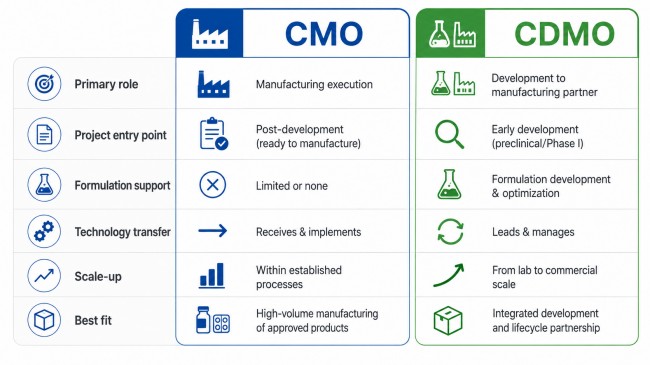
A CMO mainly provides manufacturing capacity and production execution. The client normally transfers an established formula, approved specifications, and a defined process. The CMO then adapts the project to its facility, completes the agreed production activities, records the batch, and delivers the finished product according to the contract.

A CDMO combines development support with manufacturing. It can join earlier, when the formula, production method, 分析的アプローチ, or scale-up plan still needs work. The same partner can then support pilot batches, process transfer, validation, commercial production, と包装.

The boundary is not absolute. Some CMOs provide development or scale-up support, while some CDMOs specialize in a limited range of dosage forms. The signed agreement and the facility’s actual capabilities matter more than the name used in its marketing.

比較最高マーケティング責任者CDMO
Primary roleManufacturing capacity and executionIntegrated development and manufacturing
Typical entry pointAfter the process is largely definedDuring formulation, development, or scale-up
Formulation supportDepends on the providerCommonly included
Technology transferReceives and applies an established processHelps optimize and transfer the process
Scale-upMoves production onto available equipmentConnects development with commercial production
Analytical supportVaries by facilityUsually broader
ベストフィットA defined product that needs capacityA product that needs development continuity
CMO vs CDMO comparison of development and manufacturing responsibilities

When a CMO Is the Better Fit

A CMO is often suitable when the product owner already has a stable formula, established specifications, and an experienced technical team. The main need is reliable capacity, consistent execution, qualified equipment, or access to a required packaging format.

It can also support mature products that need a second production source or additional output during periods of high demand.

When a CDMO Is the Better Fit

A CDMO is more suitable when the product still needs formulation work, プロセスの最適化, analytical support, パイロット制作, or commercial scale-up. Keeping development and manufacturing within one organization can reduce supplier handovers and preserve technical continuity.

The final choice should reflect the dosage form, batch range, ターゲット市場, packaging requirement, 装置, and project schedule.

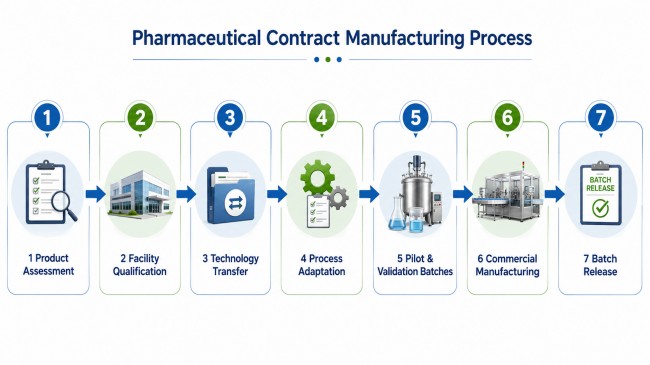
How Does the Pharmaceutical Contract Manufacturing Process Work?

The process starts before materials enter production. Both parties first confirm whether the project, facility, 装置, quality system, and schedule fit each other.

1. Product and Project Assessment

The manufacturing partner reviews the dosage form, formulation status, material characteristics, target batch size, annual demand, market requirements, および包装形態. This assessment identifies whether the available facility and equipment match the product.

2. Facility Qualification and Quality Agreement

The product owner evaluates the quality system, personnel, 装置, cleaning controls, ドキュメント, production history, and available capacity. The quality agreement then assigns responsibilities for materials, production records, テスト, deviations, changes, release decisions, complaints, and recalls.

3. Technology Transfer

The transfer package can include the master formula, manufacturing instructions, critical process parameters, analytical methods, 清掃要件, 仕様, and packaging details.

A successful transfer requires the receiving team to understand how the materials behave and how the process should be reproduced on different equipment. Sending documents alone is not enough.

4. Process Adaptation and Scale-Up

Settings often need adjustment when production moves from development equipment to commercial machinery. 混合時間, フィーダー速度, 圧縮力, capsule dosing settings, coating conditions, and sealing parameters can change with equipment size and design.

The objective is to protect critical product characteristics while establishing a repeatable commercial process.

5. Pilot and Validation Batches

Pilot or engineering batches test the transferred process, confirm equipment settings, evaluate yield, and identify operating limits. The project can also require packaging, クリーニング, or process validation batches before routine production.

6. Commercial Manufacturing and Packaging

For oral solid products, commercial production can include material preparation, blending or granulation, tablet compression or capsule filling, コーティング, 一次包装, 二次包装, 検査, and batch record completion.

The downstream process depends on the final pack. ブリスターパック, ボトル, 小袋, and stick packs require different feeding, 封印, 検査, and cartoning arrangements.

7. Batch Release and Change Control

Testing, 書類審査, release, ストレージ, and shipment complete the batch. Later changes to materials, 装置, ツーリング, software, 梱包, or process settings require formal assessment because they can affect the approved process.

Pharmaceutical contract manufacturing process from product assessment to batch release

What Equipment Requirements Matter for Pharmaceutical Contract Manufacturing?

Contract manufacturers often handle several formulas, customer specifications, batch sizes, tooling formats, and package types. Their equipment must support this variation without weakening process control.

Flexible Batch Sizes and Stable Output

Maximum speed is only one part of capacity planning. The facility should also consider the smallest practical batch, start-up loss, low-speed stability, 掃除の努力, and usable output range.

A rotary tablet press should operate consistently across the required speed range. A capsule filling machine should match the capsule sizes, 粉体の特徴, 投与方法, and batch volume. Oversized equipment can increase material loss, cleaning work, and operating cost on small orders.

Fast and Controlled Changeovers

Multi-product facilities replace tablet tooling, capsule dosing parts, blister molds, bottle guides, チャンネルを数える, and cartoning format parts more frequently.

A good changeover combines speed with control. Operators need clear part identification, 再現可能な設定, line-clearance checks, and documented approval before the next batch starts. Shorter changeover time has little value if previous labels, 部品, or settings remain on the line.

Cleanability and Powder Control

Equipment should provide accessible product-contact parts, 滑らかな表面, limited powder-retention areas, removable feeding components, and effective dust collection where required.

Stainless steel construction alone does not guarantee easy cleaning. シール, コーナー, ネジ, 投与部品, and transfer points all influence residue retention. Cleaning procedures must also match the product and the risk associated with the following batch.

Repeatable Parameters and Production Records

Operators need to control and record machine speed, 充填重量, 圧縮力, シール温度, シール圧力, rejection limits, and batch recipes.

PLC and HMI systems can support recipe management, ユーザーアクセス, アラーム, and production records. Data functions should match the facility’s documentation requirements and target markets rather than be added as unsupported compliance claims.

In-Line Inspection and Automatic Rejection

Depending on the product and package, a line can include weight monitoring, missing-product detection, bottle count verification, cap or foil inspection, coding checks, label inspection, 重量チェック, and automatic rejection.

The inspection plan should be risk-based. The purpose is to control defects that can affect product quality, トレーサビリティ, or package completeness, not to install every available module on every line.

Packaging Flexibility

Different clients can require blister packs, medicine bottles, 小袋, スティックパック, ラベル, チラシ, or cartons in several sizes. The packaging line should therefore be evaluated for format range, 給餌方法, コーディング位置, inspection compatibility, 切り替え時間, とラインの統合.

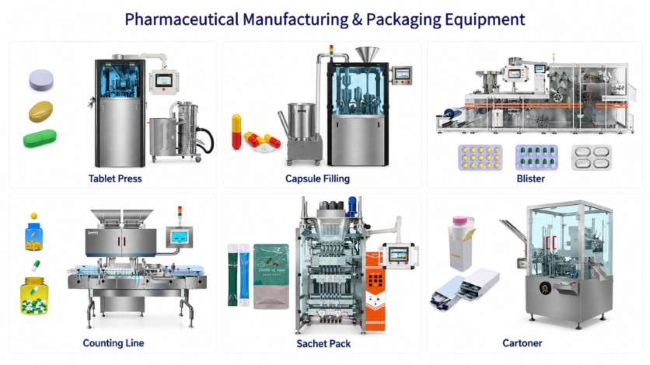
Product or ProcessCommon EquipmentKey Contract Manufacturing Requirement
タブレットミキサー, 造粒機, ロータリー打錠機, coating machineTooling flexibility, stable settings, and accessible cleaning
ハードカプセルカプセル充填機, カプセルポリッシャーCapsule-size changeover, dosing consistency, and powder control
ブリスター包装ブリスターパッケージングマシン, 視力検査, 箱詰め機Format changeover, seal control, and missing-product detection
Bottle packagingTablet and capsule counting line, 乾燥剤インサーター, capping and sealing equipmentCount accuracy, bottle flexibility, and line synchronization
Sachets and stick packsSachet pack machine or stick pack machineA dosing system matched to the material
Secondary packagingLabeling and cartoning equipmentCoding accuracy, leaflet control, and multi-format handling
Pharmaceutical manufacturing and packaging equipment for tablets capsules blisters bottles sachets and cartons

Ruida Packing supplies tablet press, hard-capsule filling machine, ブリスターマシン, tablet or capsule bottling machine , 小袋包装機, and cartoning equipment for pharmaceutical production and packaging projects. For a CMO or CDMO facility, equipment selection should begin with the dosage form, batch range, cleaning requirement, 切り替え頻度, and package specification rather than maximum advertised output alone.

How Should Companies Evaluate a Pharmaceutical Contract Manufacturing Partner?

A capable partner needs more than spare production capacity. Its technical experience, 装置, quality system, ドキュメント, and communication all affect project performance.

The evaluation should cover:

  • Dosage-form experience: Knowledge of the product type, 物質的な振る舞い, process risks, and packaging method.
  • Quality and documentation: Audits, deviation handling, change control, validation records, data management, and batch documentation.
  • Capacity and batch fit: Minimum batch size, available production slots, scale-up capability, リードタイム, and room for growth.
  • Equipment and packaging fit: Existing machines, ツーリング, inspection systems, format range, and any required investment.
  • Communication and responsibility: Project ownership, reporting frequency, approval workflow, deviation communication, and decision authority.

The best partner is not always the largest facility. The right CMO or CDMO has the product experience, 生産規模, equipment flexibility, quality controls, and project support required for the specific assignment.

結論は

Pharmaceutical contract manufacturing provides access to production capacity, technical support, and packaging systems without requiring every product owner to build a complete facility.

A CMO is generally suited to established products that mainly need reliable manufacturing. A CDMO supports a broader path from development and technology transfer to commercial production. In both models, success depends on clear responsibilities, a controlled production process, そして pharmaceutical equipment selected for the real batch, クリーニング, 切り替え, 検査, および梱包要件.

よくある質問

What is pharmaceutical contract manufacturing?

It is an arrangement in which a product owner assigns defined manufacturing, テスト, or packaging activities to an external qualified facility. The responsibilities are documented in service and quality agreements.

What is the main difference between a CMO and a CDMO?

A CMO mainly manufactures an established product. A CDMO also supports formulation work, プロセスの最適化, technology transfer, analytical activities, and scale-up. Actual service scopes vary between providers.

Does pharmaceutical contract manufacturing include packaging?

はい. Services can include blister packaging, 錠剤とカプセルの瓶詰め, sachet pack machine or stick pack machine, ラベリング, コーディング, 検査, and cartoning when the facility has the required equipment and approved procedures.

Who is responsible for product quality?

Both parties retain defined responsibilities. The quality agreement should state who controls materials, 生産, テスト, deviations, changes, release, complaints, and recalls.

What equipment is needed for oral solid dosage contract manufacturing?

A project can require mixing or granulation equipment, a rotary tablet press or capsule filling machine, coating equipment, blister or bottle packaging systems, ラベリング, 検査, および箱詰め機. The final configuration depends on the dosage form, バッチサイズ, material characteristics, and package type.

参考文献

欧州委員会, EudraLex ボリューム 4, Chapter 7: Outsourced Activities.

https://health.ec.europa.eu/document/download/58b5106a-cf6f-4352-9dca-1caf5d27d97e_en?filename=vol4-chap7_2012-06_en.pdf

共有:

メッセージを送信

関連記事

ご要望をお聞かせください

    見積もり依頼

      *当社はお客様の機密性を尊重し、すべての情報は保護されます。

      /*wpsi_fa907744*/