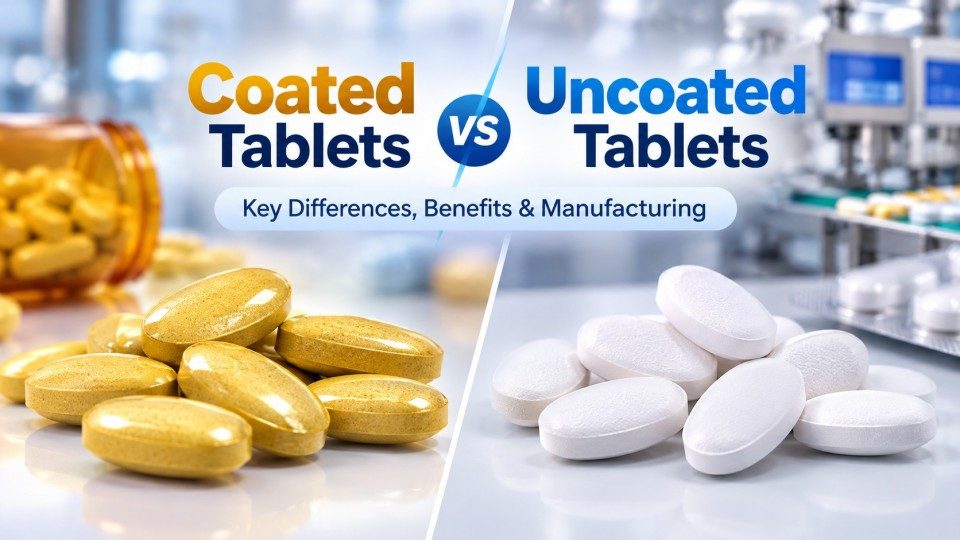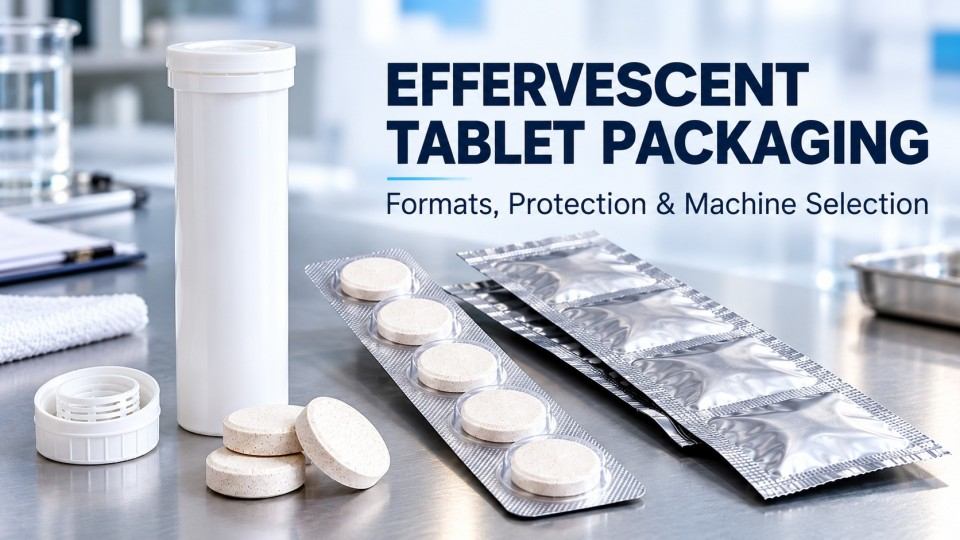
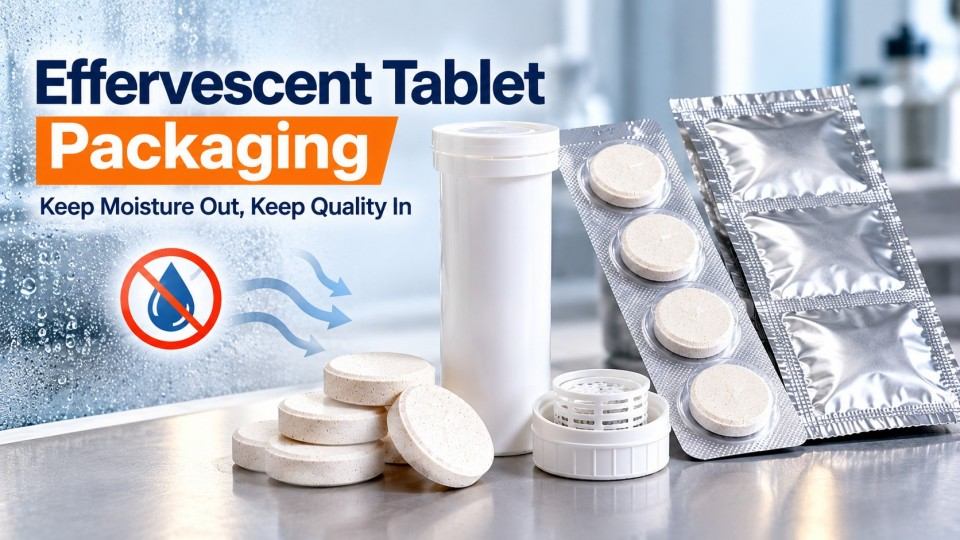
Effervescent tablet packaging has one demanding job: keeping moisture away from tablets that can begin reacting before use. It also needs to protect them from chipping or breaking during handling and transport. Tubes with desiccant caps, plaquettes thermoformées, and foil strip packs address these risks differently. Their suitability depends on the tablet formulation, matériaux d'emballage, seal quality, and how consumers will use the product.
Choosing a packaging format is only half the decision. The machine must handle the tablet size and fragility, achieve the required output, and produce consistent seals. This guide compares tubes, ampoules, and strips, explains how the corresponding machines work, and identifies the practical factors behind equipment selection. It also covers common packaging problems and what to check when testing a machine with actual tablets and packaging materials. By the end, you will know how to shortlist the right format and machine for your formulation.
Why Do Effervescent Tablets Need Special Packaging?
Contrairement aux tablettes classiques, comprimés effervescents contain acids and carbonates or bicarbonates that react when exposed to water, releasing carbon dioxide (CO₂). This reaction produces the familiar fizz when a tablet dissolves in a glass of water. Cependant, moisture absorbed during packaging, stockage, or distribution can start the reaction prematurely, affecting the tablet’s stability, désintégration, and dissolution performance.
Effective packaging must control three risks and deliver one outcome:
- Protection contre l'humidité: Water vapor can pass through packaging materials, commonly evaluated using water vapor transmission rate (WVTR), or enter through poorly sealed closures. Material WVTR alone does not describe the moisture protection of the finished package. Even limited moisture exposure may cause tablets to soften, gonfler, or begin reacting before use. Where gas accumulates within a sealed pack, premature CO₂ release may also cause visible swelling; this is not a reliable or universal indicator of moisture ingress. High-barrier materials, properly sealed foil, and desiccant closures help control this risk.
- Tablet Integrity: While all tablets are vulnerable to mechanical damage, some effervescent products are relatively large or friable. Their actual strength depends on formulation and compression conditions, so the handling risk must be assessed for the specific tablet. They may chip, fissure, or produce powder during feeding, remplissage, and transportation. Packaging must provide adequate physical protection, while the equipment must minimize impact, friction, and excessive compression.
- Protection After Opening: Opening a multi-tablet tube exposes the remaining tablets to ambient air. A properly fitted desiccant cap helps manage moisture between uses. Individually sealed blister or strip packs protect unopened doses without requiring the consumer to reseal the package.
The key is to control both moisture exposure and physical damage. The best packaging choice depends on the formulation’s sensitivity, the required shelf life, and how the product will be stored and used.
What Are the Main Types of Effervescent Tablet Packaging?
Effervescent tablets are commonly packaged in tubes, plaquettes thermoformées, or foil strip packs. Each format protects the tablets differently and requires a different packaging process.
1. Tube Packaging
Tube packaging holds multiple tablets inside a rigid plastic container, typically polypropylene (Pp). Many systems use a tightly fitted cap with an integrated desiccant—commonly silica gel or molecular sieve—to absorb moisture inside the tube. Alternative tube materials may be used, but suitability depends on the complete container-and-closure system.
Its main advantage is convenient multi-tablet storage. Consumers can remove one tablet and close the tube again, making it suitable for products such as vitamin C and electrolyte supplements.
Cependant, repeated opening introduces humid air. Tube diameter, ajustement de la casquette, desiccant capacity, and closure integrity all influence protection throughout use. The rigid tube also occupies more storage and shipping space than some flexible alternatives.
2. Emballage
Emballage sous blister places tablets into individual cavities sealed with a lidding material, généralement du papier d'aluminium. Two common material structures are:
- PVC/PVDC-Alu Blisters: Thermoformed plastic cavities provide product visibility. PVDC coatings improve moisture resistance compared with uncoated PVC, although protection depends on the material grade and thickness.
- Blisters Alu-Alu: Cold-formed aluminum laminate cavities provide a high barrier against moisture and light, particularly useful when the formulation requires stronger environmental protection. Excessive forming strain, unsuitable tooling, or laminate defects can create cracks or trous d'épingle, especially near heavily formed areas. Forming depth and cavity geometry therefore require suitable design and package-integrity checks.
The main benefit is individual-dose protection. Opening one cavity leaves the remaining sealed tablets unaffected by that opening.
The trade-offs include material costs, forming requirements, and packaging size. Cold-formed aluminum generally needs more forming space than thermoformed plastic for comparable cavity dimensions.
3. Emballage en bande
Tablet strip packaging seals individual tablets or small tablet groups between two layers of flexible, heat-sealable packaging material.
Unlike blister packs, traditional strip packs do not require preformed rigid cavities. The films are brought together around the tablets and sealed to create separate compartments. Aluminum foil laminates can provide effective moisture protection when the material structure and seals are suitable.
Strip packs are compact and convenient for individual doses. Cependant, film positioning, tablet clearance, and sealing pressure require careful control to prevent tablet damage or incomplete seals.
Surtout, tablet strip packaging is different from stick packaging used for powders or granules. The machines should not be treated as interchangeable.
Tube vs. Blister vs. Emballage en bande: Différences clés
| Facteur | Tube Packaging | Emballage | Emballage en bande |
|---|---|---|---|
| Packaging structure | Rigid multi-tablet container | Individual formed cavities | Flexible sealed compartments |
| Typical materials | PP tube, desiccant closure | PVC/PVDC-Alu or Alu-Alu | Heat-sealable foil laminates |
| Protection contre l'humidité | Closure seal and desiccant system | Forming web and lidding barrier | Film barrier and heat-seal quality |
| After opening | Remaining tablets exposed briefly | Other cavities remain sealed | Other compartments remain sealed |
| Consumer convenience | Reclosable, multi-tablet use | Individual-dose access | Portable individual portions |
| Équipement principal | Tablet tube filling machine | Machine d'emballage sous blister | Tablet strip packing machine |
| Main limitation | Repeated opening; cap and desiccant capacity | Tooling cost; forming space and pinhole risk | Film registration; seal clearance |
No packaging format is automatically superior. A properly designed desiccant tube may perform better than a low-barrier blister, while an Alu-Alu blister may be preferable when individual-dose protection is essential. Actual performance must be demonstrated through packaging and stability testing.
What Machines Are Used for Effervescent Tablet Packaging?
Once the packaging format is selected, the next decision is the machine. The three main equipment categories differ in how they feed tablets, form or load packages, and complete the closure.
Machine de remplissage de tubes de comprimés effervescents
Un machine de remplissage de tubes de comprimés effervescents automatically arranges tablets, loads the required quantity into tubes, and applies the closures. Typical functions include tablet feeding, counting and loading, tube handling, and capping with compatible desiccant closures. Its suitability depends on tablet diameter, épaisseur, tube dimensions, tablet count, and feeding stability.
Tablet Blister Packaging Machine
ET machine d'emballage sous blister pour comprimés forms cavities, feeds tablets into them, applies lidding material, seals the packs, and cuts them into finished units. Different configurations support thermoformed plastic blisters or cold-formed aluminum packaging. Cavity dimensions and feeding accuracy are particularly important for effervescent tablets, especially when the tablets are large or easily damaged.
Tablet Strip Packing Machine
ET tablet strip packing machine places tablets between flexible packaging webs and seals the material around them. Depending on the equipment design, the process can produce individual packs or connected strips containing multiple compartments. The machine must maintain accurate tablet positioning and sufficient clearance between the product and sealing areas.
Machine compatibility cannot be determined by packaging format alone. Actual tablet and packaging-material samples are needed to confirm whether a specific machine can process the product reliably.
How Do Effervescent Tablet Packaging Machines Work?
Although these machines use different mechanisms, they share three essential tasks: controlled tablet feeding, accurate product placement, and reliable package closure.
Comment un Machine de remplissage de tubes de comprimés effervescents Works
A typical automatic tube filling process involves:
- Tablet Feeding: Tablets enter a feeding system that arranges them for transfer.
- Counting or Grouping: The required quantity is separated according to the machine’s feeding and counting design.
- Chargement du tube : The grouped tablets are transferred into an empty tube.
- Placement du capuchon: A compatible cap is positioned and pressed or screwed into place, depending on the closure design.
- Décharge: Filled tubes leave the machine for inspection and subsequent packaging.
Tablet orientation and loading impact are critical. An unstable feeding path may cause tablets to tilt, Confiture, or break before entering the tube. The capping station is equally important because an incorrectly fitted desiccant closure can compromise moisture protection.
How a Blister Packaging Machine Works
Blister machines generally follow five stages:
Forming → Tablet Feeding → Lidding/Sealing → Coding → Cutting
En thermoformage, the forming film is heated and shaped into cavities using suitable forming equipment. Cold-form Alu-Alu packaging instead uses mechanical forming of an aluminum laminate. Tablets are then placed into the cavities. A compatible lidding foil is applied and heat-sealed to the forming material before the finished blister sheets are cut.
Température de scellage, pression, and dwell time must match the packaging materials. Poor settings can cause weak seals, films endommagés, or inconsistent package quality.
How a Tablet Strip Packing Machine Works
Traditional tablet strip packing uses two flexible packaging webs. The machine feeds the materials, positions tablets between them, and brings the webs together through heated sealing components. The sealed strip is then cut or perforated into the required arrangement.
Tablet positioning is essential because a tablet or loose powder caught in the sealing area can interfere with seal formation.
These processes explain why different packaging machines require different feeding mechanisms, outillage, and quality checks, even when handling the same effervescent tablet.
How to Choose the Right Effervescent Tablet Packaging Machine
Selecting an effervescent tablet packaging machine starts with the product and its intended packaging, not the machine’s advertised maximum speed.
Use the following table to shortlist a format and the corresponding machine, then confirm the choice with package stability studies and equipment trials.
| Product requirements | Format to evaluate | Corresponding machine | Why consider it / what to confirm |
|---|---|---|---|
| Highly moisture-sensitive, single-dose, longue durée de conservation | Alu-Alu blister | Machine d'emballage sous blister | Strong barrier for unopened doses; confirm forming quality, intégrité du joint, et stabilité |
| Daily multi-tablet use with repeated opening | Desiccant-cap tube | Effervescent tablet tube filling machine | Reclosable storage with active moisture management; validate closure and in-use exposure |
| Portable single-dose, moderate moisture sensitivity | Foil strip pack | Tablet strip packing machine | Compact individual portions; verify laminate barrier and seal clearance |
The following factors have the greatest influence on final equipment suitability.
1. Packaging Format and Moisture Protection
Start with the required level of protection. For repeated daily use, a desiccant-capped tube may offer convenient storage. If individual-dose protection is important, a blister or foil strip pack may be more suitable. The choice should consider the formulation’s moisture sensitivity, propriétés barrières, closure quality, conditions de distribution, and intended shelf life.
2. Taille de la tablette, Forme, and Fragility
Tablet dimensions determine feeding and packaging compatibility. For tube filling, tablet diameter must match the tube’s internal dimensions and the feeding mechanism. Excessive clearance can allow tablets to move or tilt, while insufficient clearance may cause jams. Pour emballage blister, cavity dimensions must accommodate the tablet without excessive contact or movement. For strip packaging, adequate space around each tablet is necessary to form reliable seals without crushing the product. Fragile tablets require particular attention to feeding height, transfer impact, friction, and machine acceleration.
3. Production Capacity and Operating Speed
Compare actual production output rather than advertised machine speed alone. A effervescent tablet tube filling machine’s output depends on both the number of tubes produced and the number of tablets loaded into each tube. Blister output depends on cavity arrangement, machine cycles, and tablets per finished pack. Strip packing capacity depends on packaging lanes and compartments. The machine must also maintain acceptable tablet integrity and packaging quality at the required operating speed.
4. Packaging Materials and Seal Compatibility
A machine must work with the selected matériaux d'emballage, not merely the intended packaging format. For blister and strip packaging, check film thickness, structure matérielle, température de scellage, and sealing pressure requirements. For tube packaging, verify tube dimensions, cap compatibility, and closure consistency. Changing packaging materials may require different tooling or operating settings. Even materials that look similar can behave differently during forming and sealing.
5. Coût de l'équipement, Passage, and Line Integration
Purchase price is only one part of packaging cost. Consider tube, capuchon, film, and foil consumption, together with labor, entretien, outillage, déchets, et temps d'arrêt.
Frequent product changes make passage flexibilité important. Machines requiring extensive tooling adjustments may be less suitable for facilities handling many tablet sizes or packaging specifications. The selected machine should also connect effectively with downstream inspection, étiquetage, mise en carton, or case packing systems.
The best machine is the one that consistently produces acceptable packages at the required output and operating cost. A higher theoretical speed is not useful if tablet damage, poor seals, or frequent stoppages reduce usable output.
Not sure which format fits your formulation? Send your tablet dimensions, matériaux d'emballage, and target output to our team — our team can review suitable equipment options and discuss a packaging trial.
What Are the Most Common Effervescent Tablet Packaging Problems?
Even suitable machines can experience packaging defects when tablet properties, matériaux d'emballage, or operating conditions change.
- Broken or Chipped Tablets: Excessive vibration, alimentation instable, sharp transfer points, or insufficient clearance can damage fragile tablets. Inspect the feeding path and transfer points before increasing machine speed.
- Incorrect Tablet Counts: Tablets may overlap, Confiture, or pass through a counting system irregularly. Check feeding consistency, sensor condition, and the counting mechanism. Verify finished pack contents through representative sampling.
- Poorly Fitted Tube Caps: Misaligned caps, incorrect tube dimensions, or inconsistent insertion force can prevent proper closure. Inspect tube and cap compatibility, positioning components, and the capping mechanism.
- Weak Blister or Strip Seals: Incorrect sealing temperature, pression, temps de séjour, or incompatible materials can produce incomplete seals. Product dust or misplaced tablets in the sealing area may cause additional defects.
- Moisture-Related Deterioration: Tablets that soften, bulge, or react during storage may indicate excessive moisture exposure before packaging, inadequate barriers, or closure defects. Investigate both environmental conditions and package integrity rather than assuming the machine alone is responsible.
Repeated defects should be investigated at their source. Increasing sealing temperature will not correct contaminated sealing surfaces, just as increasing feeding speed will not solve unstable tablet orientation.
How to Test an Effervescent Tablet Packaging Machine Before Purchase
A machine demonstration using standard sample tablets cannot fully establish compatibility with a different effervescent formulation.
A meaningful trial should use actual production tablets, intended packaging materials, and representative operating conditions. The following checks help identify potential problems before equipment acceptance.
| Test Item | Que vérifier | How to Verify |
|---|---|---|
| Tablet feeding | Smooth movement without frequent jams | Observe feeding at the intended speed |
| Tablet integrity | Écaillage, fissuration, and powder generation | Inspect representative finished samples |
| Précision du comptage | Correct quantity per tube or pack | Manually verify sampled packages |
| Closure or seal quality | Proper cap fit or consistent heat seals | Perform appropriate inspection and package tests |
| Actual output | Acceptable packages produced per hour | Record good output and rejected packages |
| Continuous operation | Stability during sustained production | Record stoppages, faults, and rejected products |
| Changeover and cleaning | Accessibility and adjustment requirements | Perform representative changeover and cleaning tasks |
For reclosable multi-tablet tubes, packaging-system validation should also consider repeated opening and reclosing under realistic use and humidity conditions. This is a separate question from the machine acceptance trial and must follow the product’s stability and packaging validation plan.
What Determines a Successful Machine Trial?
Qualité du produit: Finished tablets must remain within the manufacturer’s established quality requirements. Repeated cracking or powder generation may indicate unsuitable feeding conditions or excessive mechanical stress.
Package Integrity: Tube closures must fit correctly, while blister and strip seals require suitable inspection and testing. ASTM F88/F88M-23 provides a method for evaluating flexible seal strength, but seal strength alone does not establish leak-free packaging.
Production Performance: The machine should achieve the required acceptable output during representative operation. Actual productivity must account for rejected packages and stoppages, not just mechanical cycle speed.
Acceptance Criteria: Précision du comptage, allowable tablet damage, seal performance, and trial duration should be agreed upon before testing. There is no single universal acceptance threshold suitable for every effervescent tablet and packaging configuration.
A successful trial demonstrates more than whether the machine can run. It shows whether the complete combination of tablets, matériaux d'emballage, and equipment can produce consistent, acceptable packages.
Conclusion: Choosing the Right Effervescent Tablet Packaging Solution
The right effervescent tablet packaging combines moisture protection, tablet integrity, consumer convenience, and reliable machine performance. Tubes, ampoules, and strip packs each have advantages, but their suitability depends on the actual product and production requirements.
Ruida Packing offers équipement d'emballage pharmaceutique for tube filling, emballage blister, and tablet strip packing, designed to support GMP-compliant production, with qualification documentation available on request. Manufacturers evaluating these options can share their tablet dimensions, matériaux d'emballage, sortie cible, and product samples to discuss machine compatibility and arrange a suitable packaging trial.
Questions fréquemment posées
How can manufacturers verify moisture protection for effervescent tablet packaging?
Start with material barrier data, but evaluate the finished package as well. Depending on the format, testing may address water vapor transmission, closure or seal integrity, and stability in the intended storage conditions. A low WVTR result alone does not establish the product’s shelf life.
Does effervescent tablet packaging require humidity control during production?
Moisture exposure before sealing can affect sensitive formulations, so manufacturers should control environmental conditions and the time tablets remain unpackaged. The appropriate humidity limit depends on product stability data and the validated manufacturing process; there is no single RH limit for every formulation.
Can one machine package different effervescent tablet sizes?
Many packaging machines support different tablet dimensions through adjustable components or tooling changes. Cependant, compatibility depends on the machine’s operating range, feeding mechanism, et spécifications d'emballage. Actual samples should be tested before confirming suitability.
What should be supplied for an effervescent tablet packaging machine trial?
Provide representative tablets with their dimensions and handling characteristics, intended tubes or films and closures, pack count or layout, and target output. Agree on checks for breakage, compte, seal or cap quality, and acceptable output before running the trial.
What is the difference between tablet strip packing and stick pack packaging?
Tablet strip packing seals tablets between layers of flexible packaging material, often creating individually sealed compartments. Stick pack machines typically form narrow sachets for powders, granulés, ou des liquides. Their feeding and packaging mechanisms differ, so equipment designed for one format should not automatically be assumed suitable for the other.
Références
1. NOUS. Administration des aliments et des médicaments (FDA). Systèmes de fermeture de conteneurs pour le conditionnement de médicaments et de produits biologiques à usage humain: Orientation pour l'industrie.
2. Pharmacopée des États-Unis. USP <671> Containers—Performance Testing.
3. Conseil international pour l'harmonisation (je). Je Q1A(R2): Stability Testing of New Drug Substances and Products.
4. ASTM International. ASTM F88/F88M-23: Méthode d’essai standard pour la résistance du joint des matériaux de barrière flexibles.
5. European Aluminium Foil Association (EAFA). Alufoil for Pharmaceutical Packaging. Technical webpage.