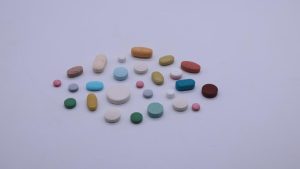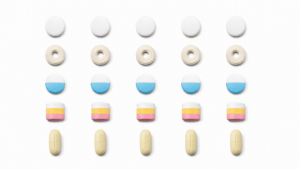
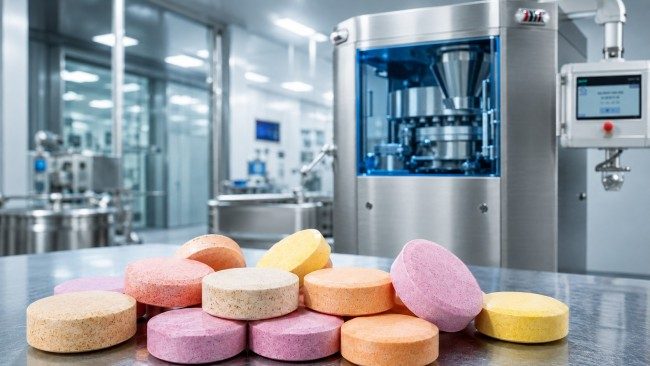
Chewable tablets are solid tablets designed to be chewed before swallowing. They are commonly used for vitamins, mineraller, antiasitler, diyet takviyeleri, and selected pharmaceutical products. Familiar examples include vitamin C chewable tablets, calcium chewable tablets, and chewable multivitamins.
Although chewable tablets can be produced with much of the same tablet manufacturing equipment used for conventional tablets, the product requirements are different. Because the tablet is chewed and stays in the mouth longer, tatmak, texture, mouthfeel, tablet boyutu, and chewability become much more important. Aynı zamanda, the tablets still need enough strength to withstand compression, tozsuzlaştırma, ambalajlama, Nakliye, ve taşıma.
These requirements affect the entire production process. Manufacturers need to consider the formulation, whether direct compression or granülasyon is more suitable, how the blend behaves during tablet compression, which quality attributes need to be controlled, and whether blister or bottle packaging is more appropriate.
This guide explains chewable tablet formulation, üretme, production equipment, quality considerations, and packaging in one complete production flow.
1. What Makes Chewable Tablets Different?
The main difference between chewable tablets and regular tablets is how they are intended to be taken.
A conventional tablet is normally swallowed whole and then disintegrates after reaching the gastrointestinal tract. A chewable tablet is designed to be chewed into smaller particles before swallowing. Bundan dolayı, the user directly experiences the tablet’s taste, texture, sertlik, and aftertaste.
That changes what manufacturers need to consider during both formulation and production.
Örneğin, a conventional tablet can have an unpleasant taste that is barely noticed if it is swallowed quickly. The same taste can become a major problem in a chewable tablet because the material remains in the mouth while it is being chewed. Sweeteners, lezzetler, fillers, binders, and other excipients therefore need to work together to produce acceptable taste and mouthfeel while still supporting reliable tablet compression.
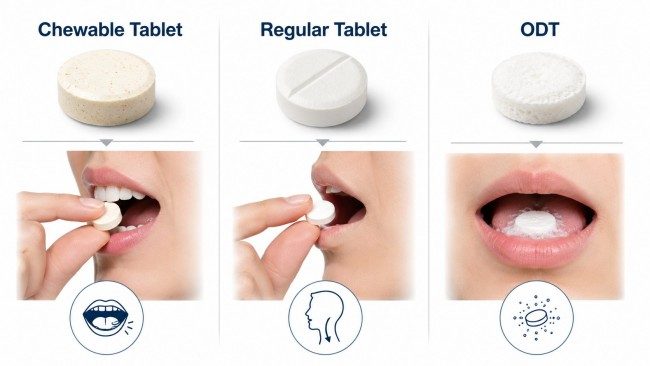
Chewable Tablets vs Regular Tablets vs ODTs
Chewable tablets are also different from orally disintegrating tablets, commonly called ODTs.
An ODT is designed to break apart rapidly in the mouth with little or no chewing. A chewable tablet is intentionally chewed before swallowing. A conventional tablet, karşılaştırmalı olarak, is normally swallowed intact.
| Tablet Tipi | How It Is Normally Taken | Key Product Focus |
| Chewable tablet | Chewed before swallowing | Taste, mouthfeel, chewability, kuvvet |
| Regular tablet | Swallowed whole | Strength, parçalanma, intended release |
| ODT | Disintegrates rapidly in the mouth | Fast disintegration and easy administration |
These differences also affect tablet size and shape. Chewable tablets are often made large enough to carry vitamins, mineraller, antiasitler, or other ingredients, so tooling design and tablet dimensions need to remain comfortable for chewing as well as practical for production.
The tablet must also strike a balance between strength and chewability. It needs to survive discharge from the basın tableti, tozsuzlaştırma, denetleme, ambalajlama, ulaşım, and normal handling without excessive breakage. Aynı zamanda, making the tablet unnecessarily hard can make it less pleasant to chew.
This is why chewable tablet development cannot focus on taste or compression alone. The formulation has to support both the intended eating experience and stable manufacturing performance.
2. Common Chewable Tablet Applications and Examples
Chewable tablets are common in products where ease of administration, tatmak, or a relatively large tablet mass matters.
Vitamin and mineral products are the most familiar examples. These include vitamin C chewable tablets, chewable multivitamins, calcium chewable tablets, magnesium chewables, and other nutritional products. Mineral-rich formulas can create chalky, metalik, or bitter sensations, so taste and texture often become important formulation targets.
Antacid chewable tablets are another established application. They can contain relatively high levels of mineral ingredients and are designed to be chewed before swallowing.
Selected pharmaceutical products also use chewable formats, including products intended for users who have difficulty swallowing conventional tablets. Pediatric products require particular attention to dose, tablet boyutu, excipient selection, and instructions for use rather than simply scaling down an adult product.
Chewable formats are also used in nutraceutical and veterinary products. Each application has its own palatability, doz, istikrar, and manufacturing requirements, which is why there is no single standard chewable tablet formula.
3. How Is a Chewable Tablet Formulated?
A chewable tablet formulation has to work as both a compressed tablet and a product that is deliberately chewed. The active ingredient, yardımcı maddeler, taste system, particle properties, and manufacturing route all influence the final result.
Active Ingredient and Dose
The required active ingredient and dose come first. High-dose minerals, strongly bitter actives, neme duyarlı malzemeler, and low-dose ingredients can create very different formulation problems.
Dose also affects tablet size, and a tablet that is easy to compress is not automatically comfortable to chew.
Functional Excipients
Chewable tablets can contain fillers or diluents, binders, lubricants, glidants, disintegrants, tatlandırıcılar, lezzetler, and other excipients.
Fillers help build tablet mass and can influence texture. Binders support particle bonding. Lubricants reduce friction during compression and ejection. Glidants can improve powder flow, while disintegrants are used when required by the product design.
The formulation still needs suitable flow and compactability so that the blend can fill the die cavity consistently and form tablets without excessive defects.
Taste and Mouthfeel
Taste is one of the biggest differences between chewable and conventional tablet formulation.
Sweeteners and flavors are commonly used because the material stays in the mouth while it is chewed. Polyols such as mannitol are often selected because they can contribute both bulk and a more pleasant mouthfeel.
When an active ingredient is strongly bitter or otherwise unpleasant, flavor alone may not be enough. Taste-masking approaches can include coating, microencapsulation, or other formulation strategies, provided they remain compatible with the rest of the manufacturing process.
Particle size also matters. Coarse or poorly controlled particles can create a gritty sensation, while large differences in particle size or density can increase the risk of segregation during blending and transfer.
4. Important Quality Attributes of Chewable Tablets
Chewable tablets need to remain mechanically reliable during production and packaging while also being acceptable to chew. Quality assessment therefore looks at several attributes together.
| Quality Attribute | Neden Önemlidir? |
| Tablet weight and content consistency | Supports consistent composition and dose |
| Sertlik / breaking force | Indicates mechanical strength and can affect chewability |
| Kırılganlık | Shows resistance to abrasion and breakage |
| Size and thickness | Affect handling, ambalajlama, and chewing |
| Disintegration | Helps characterize how the dozaj formu breaks down |
| Çözünme | Evaluates release of the active ingredient |
| Taste and mouthfeel | Directly affect the user experience |
| Dış görünüş | Helps identify physical defects |
Hardness is important, but a harder tablet is not automatically a better chewable tablet. If strength is too low, tablets can chip or break during dedusting, taşıma, ambalajlama, ve ulaşım. If it is unnecessarily high, chewing can become unpleasant.
Friability provides a second view of physical durability, while disintegration and dissolution help confirm that the dosage form performs as intended. The appropriate targets depend on the formulation and product specification rather than on one universal value.
5. Chewable Tablet Manufacturing: Adım adım
Once the formulation and process route are established, chewable tablet manufacturing follows a sequence similar to other compressed tablets.
Adım 1: Prepare the Raw Materials
Raw materials are dispensed according to the batch formula. Depending on their condition, powders can be sieved or milled to break agglomerates and obtain a more suitable particle-size distribution for blending and feeding.
Adım 2: Blend the Ingredients
Active ingredients and excipients are mixed to achieve the required distribution. Blender loading, karıştırma süresi, parçacık boyutu, yoğunluk, and the order of addition can influence uniformity and flow.
Lubricants are commonly added during a later blending stage because excessive lubrication can reduce particle bonding and change tablet properties.
Adım 3: Use Direct Compression or Granulation
A direct-compression blend can move to final lubrication and tablet compression without a separate granulation step.
When granulation is required, the route can include wet granulation or dry granulation, drying where applicable, milling or sizing, and final blending. The purpose is to create material that feeds and compresses more reliably.
Adım 4: Compress the Blend on a Rotary Tablet Press
The final blend is transferred to a döner tablet presi. The feed system distributes material into the die cavities, while the lower punch position determines the available die fill depth and therefore influences tablet weight.
The filled die then passes through compression. Precompression can be used when needed to remove part of the entrapped air and form an initial compact before main compression. Main compression forms the finished tablet, and the lower punch then raises it for ejection.
The required settings depend on the formulation, tablet boyutları, takımlama, hedef ağırlık, press speed, feed conditions, and powder behavior. Compression force alone should not be treated as the only control for tablet hardness or chewability.
Adım 5: Dedust, İncelemek, and Sample
After ejection, tablets commonly pass through a deduster to remove loose powder. Depending on the line and quality system, downstream steps can also include metal detection and in-process sampling.
Common compression problems can point to different causes:
| Sorun | Factors to Investigate |
| Yapışma veya toplama | Formulation moisture, yağlama, tooling surface, sıcaklık |
| Ağırlık değişimi | Toz akışı, ayrışma, feed conditions, doldurma, press speed |
| Chipping or capping | Entrapped air, bonding, sıkıştırma profili, takımlama |
| Excessive hardness | Compactability, compression conditions, tablet boyutları |
| Difficult ejection | Yağlama, die-wall friction, takım durumu |
These are multi-factor problems. Machine settings, formulation properties, maddi durum, and tooling should be checked together.
6. What Equipment Is Used in Chewable Tablet Manufacturing?
The exact equipment depends on whether the product uses direct compression or granulation, but a typical line can include:
| Teçhizat | Main Role |
| Sifter or mill | Powder preparation and deagglomeration |
| Powder blender | Mix active ingredients and excipients |
| Granülatör | Form granules when required |
| Dryer and sizing mill | Process wet granules before final blending |
| Döner tablet presi | Compress the final blend into tablets |
| Tablet toz giderici | Remove loose surface powder |
| Metal dedektörü | Detect metallic contamination when included in the line |
| Blister ambalaj makinesi | Pack tablets into blister cavities |
| Tablet counting line | Count and fill tablets into bottles |
| Kartonlama makinesi | Load finished packs into cartons |

The rotary tablet press is the central machine in the tablet compression stage. Machine selection depends on tablet diameter and shape, takımlama, powder properties, üretim kapasitesi, and required automation.
Chewable tablets do not need a special category of tablet press simply because they are chewable. What matters is whether the machine, takımlama, feed system, and operating range match the formulation and tablet design.
For a complete production line, Ruida Paketleme can connect tablet compression with downstream blister packaging, tablet sayma, bottle handling, and cartoning equipment according to the required packaging format.
7. Chewable Tablet Packaging Solutions
Chewable tablets are commonly packed in blister packs or bottles. The better option depends on moisture and oxygen sensitivity, tablet boyutları, unit count, pazar formatı, and required barrier performance.
Blister Ambalaj
Blister packs separate tablets into individual cavities and are useful when unit-dose presentation or individual tablet separation is important.
Barrier performance depends on the complete packaging structure. PVC-based blisters, higher-barrier plastic structures, Ve cold-form Alu-Alu packs do not provide the same level of protection.
The blister packaging machine forms and seals the pack, but the barrier itself comes from the selected materials and seal quality.
When secondary packaging is required, finished blister sheets can continue to a cartoning machine.
Şişe Ambalajı
Bottle packaging is common for chewable vitamins, mineraller, and nutritional products sold in larger counts.
A typical automated tablet counting and bottling line can include:
Bottle unscrambling → Tablet counting/filling → Checkweighing → Desiccant insertion → Cotton insertion → Capping → Induction sealing → Labeling → Coding/inspection
Not every product needs every step. Desiccants, Örneğin, should be selected according to the product’s moisture sensitivity and complete package design.

Blister or Bottle?
| Düşünce | Kabarcık | Şişe |
| Doz sunumu | Individual cavities | Multiple tablets per container |
| Large tablet counts | Less convenient in many cases | Often practical |
| Individual tablet separation | Strong advantage | Shared container |
| Barrier performance | Depends on blister structure | Depends on bottle, kapanış, and seal |
Packaging should therefore be considered early in line planning. A large chewable tablet sold in a 90-count bottle needs a very different packaging process from a product packed into individual blister cavities.
Çözüm
Chewable tablets combine the advantages of compressed solid dosage forms with additional demands for taste, mouthfeel, tablet boyutu, and chewability.
The best manufacturing route starts with the formulation. Material properties determine whether direct compression or granulation is more suitable, the tablet press must match the blend and tablet design, quality checks confirm finished-product performance, and the packaging format must provide the required protection and presentation.
A stable chewable tablet production line is therefore built by connecting formulation, sıkıştırma, kalite kontrol, and packaging rather than optimizing any one step in isolation.
Frequently Asked Questions About Chewable Tablets
1.What is a chewable tablet?
A chewable tablet is a solid oral tablet designed to be chewed before swallowing. Its formulation needs to consider taste, mouthfeel, texture, mechanical strength, and chewability in addition to normal tablet manufacturing requirements.
2.How are chewable tablets manufactured?
The typical process includes raw-material preparation, harmanlama, direct compression or granulation when required, tablet imalatı, tozsuzlaştırma, denetleme, and final blister or bottle packaging.
3.What ingredients are used in chewable tablet formulation?
Typical formulations can include active ingredients, fillers, binders, lubricants, glidants, disintegrants, tatlandırıcılar, lezzetler, and other excipients. The exact combination depends on dose, tatmak, malzeme özellikleri, ve ürün gereksinimleri.
4.Why do chewable tablets stick to tablet press punches?
Possible causes include formulation moisture, sticky ingredients, inadequate lubrication, takım durumu, product temperature, and compression conditions. The underlying cause should be identified before changing machine settings.
5.What quality attributes are important for chewable tablets?
Common attributes include tablet weight, content consistency, boyutlar, hardness or breaking force, kırılganlık, parçalanma, çözünme, dış görünüş, tatmak, mouthfeel, and chewability.
6.What equipment is needed for chewable tablet manufacturing?
A line can include powder preparation equipment, a blender, optional granulation and drying equipment, a rotary tablet compression machine, deduster, metal dedektörü, and downstream tablet blister machine or tablet bottling line.
7.What packaging is suitable for chewable tablets?
Both blister packs and bottles are widely used. Selection depends on tablet size, saymak, bariyer gereksinimleri, unit-dose needs, saklama koşulları, ve pazar formatı.
Referanslar
1. FDA – Quality Attribute Considerations for Chewable Tablets: Endüstriye Yönelik Rehberlik
2. FDA / ICH Q6A Specifications
3. Farmasötik Teknoloji – Çiğnenebilir Tabletler: A Review of Formulation Considerations
4. PMC Research – Tabletability and Wet Granulation Study