How can you ensure your alu-alu blister packs provide reliable product protection?
Tablets and capsules that are sensitive to moisture or light require packaging with strong barrier properties. Compared with PVC-based options, alu alu blister packaging can provide enhanced protection against environmental exposure. Tuttavia, defects such as pinholes, deformed cavities, and faulty seals may reduce its protective performance. This article explores common blister defects, relevant FDA cGMP and EU GMP requirements, and machine features that help maintain package integrity. In pharma blister packaging, protecting product quality through consistent pack integrity is just as important as achieving high production speeds.
Punti di forza
- How to match Alu-Alu and PVC formats to product needs.
- Why forming, allineamento, and sealing faults occur.
- How FDA and EU requirements relate to packaging controls.
- Which machine features and tests support package integrity.

1.Why Seal Integrity Matters in Alu-Alu Blister Packaging
Not every tablet needs the same barrier. Some products may be stable in PVC blister packaging, while moisture or light sensitive medicines need more protection. Alu Alu blister packaging combines a cold-formed aluminum bottom web with aluminum lidding foil. Aluminum blister packaging is opaque and can provide an effective barrier when the materials and process are suitable.
A study found that after six months at 40°C and 75% relative humidity, tested cold-form aluminum blisters retained 100% of active ingredient versus 84% in blister in PVC. Moisture permeation was 0.001 mg per blister per day for cold-form aluminum and 0.259 mg for PVC. These results are specific to one formulation and pack design, but show the value of stability evidence.

Even high-barrier alu alu foil may fail to protect tablets and capsules if the finished blister has pinholes or defective seals. WHO guidance emphasizes that pharmaceutical packaging must “protect against all adverse external influences that can alter the properties of the product,” including moisture, leggero, ossigeno, e variazioni di temperatura. This means selecting the right barrier material is only part of the solution. In pharma blister packaging, cavity integrity and sealing quality also play a critical role in maintaining product protection throughout storage and distribution.
2.What Causes Sealing and Forming Defects in Alu-Alu Blister Packaging?
Defects can start with the material, appear during forming, or develop at the sealing station. Key causes include unsuitable lidding foil; uneven forming force or poor tooling geometry; sideways web movement; temperatura di saldatura, pressione, or dwell time that do not suit the material; and roller misalignment or product fragments in the sealing area.

Forming and sealing are related but distinct. A pinhole may exist before lidding, while another leak may form at the final seal. Investigate difetti di confezionamento in blister by cause. Good blister sealing quality starts with finding where the error begins, not simply turning up the heat; assess the blister sealing process using the actual foil and product format. Record recurring blister packaging defects by their likely cause.
3.What Do FDA cGMP and EU GMP Expect from Pharmaceutical Packaging Controls?
The rules focus on suitable packaging, controlled materials, written procedures, and evidence, not a mandatory machine layout.
FDA 21 CFR 211.94: Container and Closure Protection
FDA 21 CFR 211.94 requires pharmaceutical packaging to protect products from damage and contamination caused by external factors. It also requires written specifications and testing methods. This means choosing the right foil is not enough. The finished blister packs must also be tested to ensure they provide adequate protection.
FDA 21 CFR 211.122: Packaging Material Control
FDA 21 CFR 211.122 requires written procedures for checking packaging and labeling materials. These checks may include sampling, ispezione, e test, with records showing whether materials are accepted or rejected. This helps prevent unsuitable materials from being used in production. Negli Stati Uniti, dietary supplements generally follow 21 CFR parte 111, rather than Part 211.

EU GMP Pharmaceutical Packaging: Production Control and Qualification
EU GMP pharmaceutical packaging controls are addressed in EudraLex Volume 4, including Chapter 5 and EU GMP Annex 15 on Qualification and Validation. Applicability depends on product and risk. A machine feature does not guarantee compliance; document pharmaceutical packaging validation and apply EU GMP Annex 15 ove rilevante.
4.How Can an Alu-Alu Blister Packaging Machine Maintain Consistent Forming and Sealing Quality?
UN macchina confezionatrice blister farmaceutica should be judged by trial results, not brochure claims. A blister packaging machine for the pharmaceutical industry must control forming, allineamento, traction, e sigillatura. For pharma blister packaging projects, repeatable controls matter more than a top-speed claim.
Stable Forming Pressure for Consistent Cavities
A dual-shaft, dual-cam mechanism, where fitted, supports repeatable forming force. DPH-190Ultra, the alu alu blister packing machine model designed for medium scale production, is specified with up to 11 tons of forming force with servo control. But confirm cavity quality using cold form blister packaging trials with the actual foil, utensileria, and product dimensions.

Automatic Web Guiding to Prevent Misalignment
Automatic web guiding can correct lateral movement in supported PVC, PTP, or CFF webs. Registration helps cavities meet sealing areas, but sensor placement, tensione, and setup still matter. Ask for a trial with your material.
Servo Traction for Accurate Positioning
Servo traction indexes each card to the sealing station. Coordinated traction and guiding can reduce crushed cavities, card distortion, and inconsistent contact. Recheck the blister sealing process after format changes.
Roller Heat Sealing with HMI Control
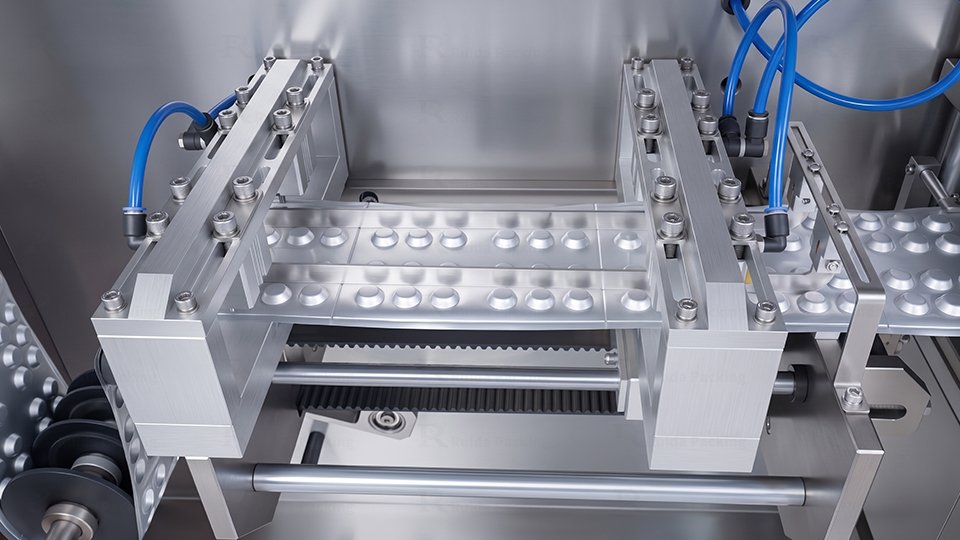
HMI-controlled roller engagement can simplify setup, but it does not prove seal quality. Check roller alignment, contact pressure, foil compatibility, and settings through material-specific trials. Track blister sealing quality across repeat runs. For Alu-Alu blister sealing, record the setup and acceptance checks.
Qingyu Zeng, PhD, also highlights the need to use compatible packaging components and set up the sealing process correctly. Although his article discusses other types of container-closure systems, the same principle applies to blister packaging: both the materials and sealing conditions affect package integrity.
PID Temperature Control for Applicable Thermoforming Stations
PID control can stabilize heating on applicable PVC thermoforming stations. Alu-Alu cold forming is different; if both PVC blister packaging and cold form blister packaging are needed, confirm where PID applies and how settings are verified.
5.How to Detect Forming Defects and Verify Alu-Alu Blister Seal Integrity
Inspection should match the defect. A check before sealing cannot prove every aspect of the finished package.
Optional Pinhole Detection for the Formed Aluminum Web
Optional vacuum-based pinhole detection may identify certain holes in the formed aluminum web before lidding. Questo blister pack inspection does not prove the finished pack is leak-free; sensitivity depends on defect size, foil structure, and test criteria.

Testing Finished Blister Packs
Visual inspection can reveal visible defects, but seal-strength and leak tests are needed to check other aspects of package quality. ASTM F3169-16(2024) outlines a vacuum-deflection test for suitable packaging. The method was evaluated on four pack designs using defects measuring 15 μm and 50 µm. Tuttavia, test results may vary depending on the package design, so the same detection level cannot be assumed for every pack.
University of Ulster researcher Dr. Dorian Dixon highlighted the “nonsubjective nature” of laser-based blister testing, a method-specific observation to assess against each pack’s needs. Blister seal integrity testing needs defined criteria and follow-up after failures; FDA and EU GMP do not mandate one universal method.
6.What Should You Check When Choosing a Pharma Blister Packaging Machine?
For a blister packaging machine for the pharmaceutical industry, check foil compatibility, profondità della cavità, formando, web guiding, indicizzazione del servo, sigillatura, e ispezione. Select a pharmaceutical blister packaging machine based on trials, not speed claims. Compare real output, sciupare, tempo di cambio, FAT/SAT, formazione, and spare parts. Pharmaceutical packaging validation and blister seal integrity testing should match intended use.
A line may be configured for 120–250 cards per minute, but output depends on layout, dimensione del prodotto, and conditions. Trial the intended foil. Blister serialization is separate from integrity testing; acceptance tests should define the defects inspection can detect. For pharma blister packaging, use trial data and blister pack inspection results rather than speed claims alone.
7.Alu-Alu Blister Packaging Solutions from Ruida Packing
Ruida Packing supplies production and packaging equipment, including Alu-Alu blister packaging solutions and the DPH-190Ultra for medium-scale cold-form applications with capacity range among 120–250 sheets/min. Formazione, traction, and cutting use servo-driven control; selected configurations may add automatic feeding, web guiding for supported PVC/PTP/CFF, PID heating for applicable thermoforming stations, and camera-based pinhole inspection.
For EU GMP pharmaceutical packaging projects, customers should confirm the machine configuration before ordering, including SUS 316L contact parts, interblocchi di sicurezza, accesso per la pulizia, and any MES/OEE or 21 CFR Part 11-related data functions required. The project should also assess whether EU GMP Annex 15 applies to equipment qualification or validation. Applicable CE documents can be provided, but CE marking does not replace GMP qualification or process control. For Alu-Alu blister packaging, it is also important to confirm the Alu-Alu foil, Alu Alu blister format, and blister serialization requirements in advance.

Ruida Packing provides comprehensive after-sales support, compreso FAT/SAT, installazione, messa in servizio, formazione, documentazione, and free one-to-one online technical consultation to support customers throughout equipment setup and operation.
Conclusione
Reliable pharma blister packaging depends on more than barrier material. Formazione, allineamento, traction, sigillatura, and inspection all matter. FDA cGMP and EU GMP provide a framework, but manufacturers must verify controls for their products. When assessing Alu-Alu blister packaging, request a trial with your foil, documented results, and a clear service scope. A suitable line can reduce defects and protect product quality during storage and distribution.
Domande frequenti
Q1: Does FDA Require Alu-Alu Blister Packaging for All Pharmaceutical Products?
NO. FDA 21 CFR 211.94 requires suitable packaging and adequate protection, not Alu-Alu for every medicine. Choose based on sensitivity, stability data, condizioni di conservazione, and pack performance.
Q2: What Causes Seal Defects in Alu-Alu Blister Packaging?
Common causes include wrong foil, uneven forming force, disallineamento, unsuitable settings, roller errors, e contaminazione. Forming pinholes and seal leaks need separate investigation.
Q3: Can Pinhole Detection Guarantee the Integrity of Finished Alu-Alu Blister Packs?
NO. Pinhole detection finds some pre-sealing defects but cannot prove the finished pack is leak-free. Use a suitable finished-pack test when required by risk assessment.
Q4: Does PID Temperature Control Improve Alu-Alu Blister Sealing?
PID can stabilize heat on applicable PVC thermoforming stations. Alu-Alu cold forming is different; final heat sealing is separate. Material-specific trials remain necessary.
Q5: Does a GMP-Oriented Blister Packaging Machine Guarantee Regulatory Compliance?
NO. Documentation helps, but compliance also depends on site procedures, formazione, record, valutazione del rischio, and verification.
Riferimenti
[1] PubMed, “The Effects of Packaging on the Stability of a Moisture Sensitive Compound.”
[3] Codice elettronico dei regolamenti federali, 21 CFFR§ 211.94 — Drug Product Containers and Closures.