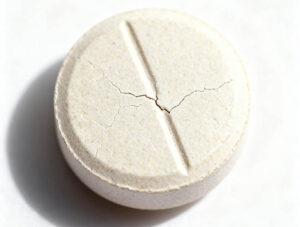
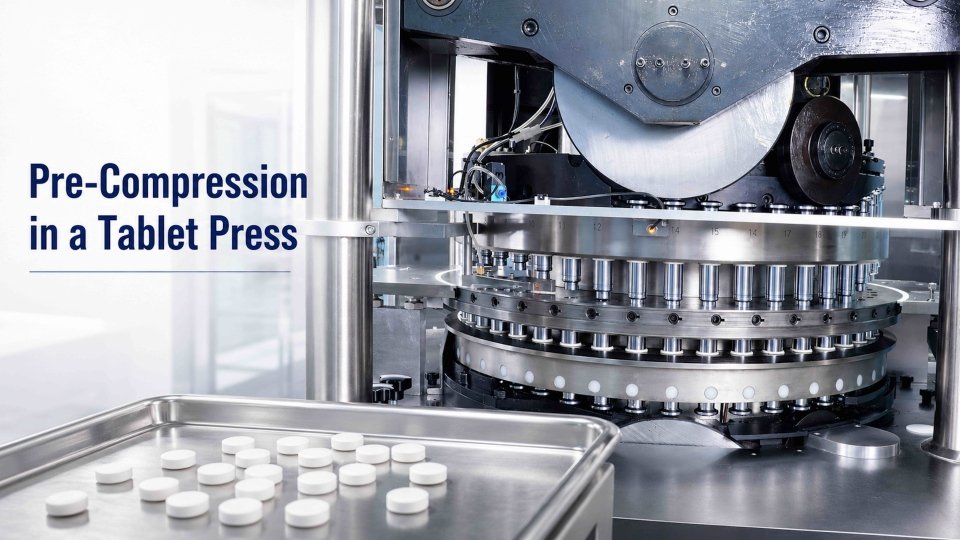
Pre-compression in a tablet press is an initial compression event that takes place before the main compression stage. It begins compacting the powder bed, encourages particle rearrangement, and reduces trapped air before the material receives the higher force that forms the final tablet.
This stage matters because the condition of the powder entering main compression affects how the compact responds to force and how it recovers after the pressure is released. Poor deaeration or an unsuitable compression profile can contribute to tablet defects and unstable compression performance, especially as production speed increases. Pre-compression gives manufacturers another way to control what happens before the main compression event.
Not every tablet press includes an independent pre-compression stage. Pre-compression is an event that can be included between die filling and main compression. For products that are sensitive to air entrapment, pemulihan elastis, or high-speed compression, pre-compression capability can therefore become an important consideration when selecting a mesin tablet putar.
What Is Pre-Compression in a Tablet Press?
On a rotary tablet compression machine equipped with pre-compression, the material normally passes through the following sequence:
Die filling → Metering → Pre-compression → Main compression → Decompression → Ejection
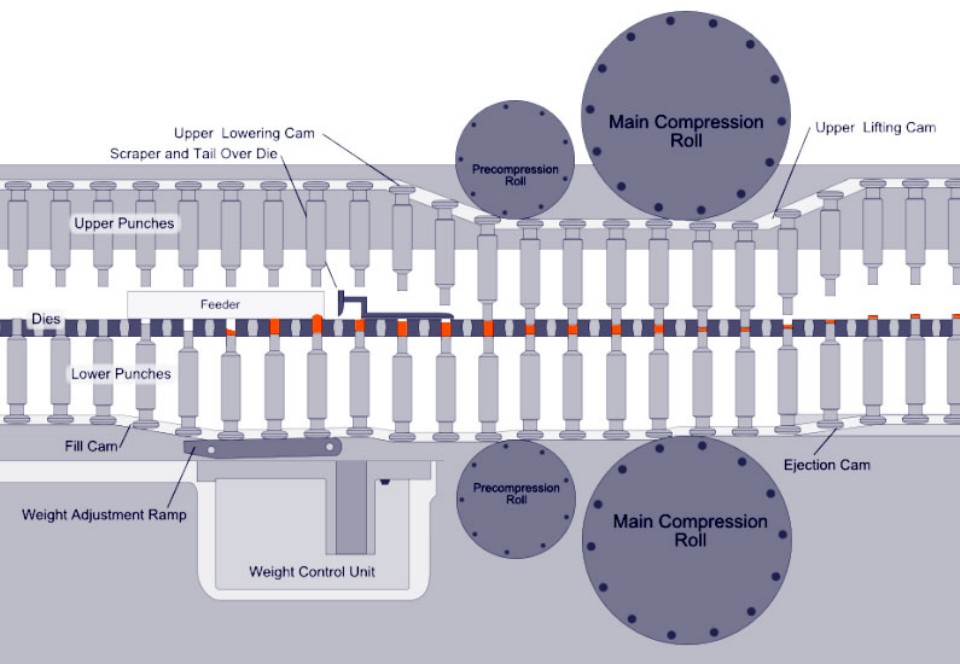
After the die cavity is filled and the required fill volume is established, the upper and lower punches move toward each other as the tooling passes through the pre-compression zone. A set of pre-compression rollers applies the first controlled load to the powder or granules inside the die.
The material is only partially compacted at this stage. The main compression rollers then apply a higher load to form the final compact. After maximum compression, the pressure falls, the tablet recovers to some extent, and the lower punch moves upward for ejection.
The value of pre-compression comes from creating a separate compression event before the main one. USP <1245> describes this stage as a way to reduce entrapped air. In practical production, the initial load also gives particles time to rearrange and allows the powder bed to become denser before the higher main compression force is applied.
How the Pre-Compression Rollers Work
Dalam mesin tablet putar, punches move vertically as the turret rotates through cams and compression rollers. In a machine equipped with pre-compression, the tooling first passes between the pre-compression rollers and later reaches the main compression rollers.
The distance between the punches decreases as they pass through the pre-compression station. This applies pressure to the material without immediately subjecting it to the full main compression load.
The result depends on more than the peak pre-compression force. The material’s deformation behavior, the available time under load, kecepatan menara, and the following main compression event all influence how the powder bed responds. Pre-compression therefore needs to be considered as part of the complete compression profile rather than as an isolated setting.
What Happens to the Powder During Pre-Compression?
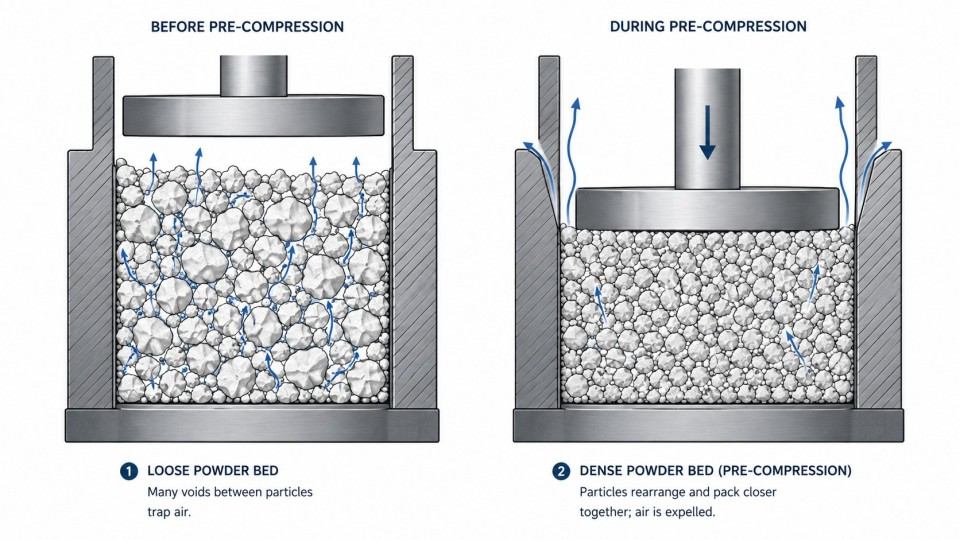
The powder bed inside a filled die contains particles, void spaces, dan udara. When compression begins, several physical changes occur together.
Pertama, particles rearrange. They move into available spaces and form a denser packing structure. As pressure increases, particles can deform or fracture depending on the formulation and material properties. The void volume within the powder bed decreases.
Pada saat yang sama, air is forced out of the shrinking spaces between particles. If compression occurs too rapidly for the material and air cannot escape effectively, some air can remain trapped inside the compact.
Pre-compression creates an earlier, lower-force compression event that gives the powder bed more opportunity to densify and release air before the higher-force main compression stage. This is especially useful when the formulation contains a large amount of interparticulate air or responds poorly to rapid compression.
Air entrapment also affects what happens after pressure is released. A compact expands slightly when the compression load is removed; this response is known as pemulihan elastis. Research on air entrapment during tablet compression has shown that trapped air can increase elastic recovery. In one study, adding pre-compression reduced this effect and produced stronger tablets with lower porosity. The result was formulation-specific, but it demonstrates why deaeration is an important function of pre-compression.
Why Compression Speed Matters
Powders and granules respond not only to force but also to how quickly that force is applied.
At higher tablet press speeds, the available time for deformation, particle rearrangement, and air escape becomes shorter. Faster compression reduces the time available for time-dependent deformation under otherwise similar conditions.
This is one reason pre-compression becomes more relevant in high-speed rotary tablet production. A suitable first compression event creates a more gradual compression history before main compression. Namun, increasing pre-compression force alone cannot compensate for every effect of higher press speed.
Pre-Compression vs Main Compression
Pre-compression and main compression are two separate stages of the tablet compression process. Both apply force to the material inside the die, but they serve different purposes and act on the powder bed at different points in the compression cycle.
| Faktor | Pra-Kompresi | Kompresi Utama |
| Position in the cycle | Before main compression | After pre-compression |
| Primary purpose | Initial densification, particle rearrangement, and deaeration | Form the final tablet compact |
| Relative force | Umumnya lebih rendah | Generally higher |
| Powder condition | Partially compacted | Converted into the final compact |
| Key process concern | Air escape and preparation of the powder bed | Final compact formation and mechanical properties |
During pre-compression, the punches apply an initial load that partially compacts the material and gives trapped air more opportunity to escape. The powder then enters the main compression stage in a denser condition.
Main compression performs a different job. The higher main compression force brings the particles into much closer contact and develops the final compact structure and mechanical properties of the tablet.
This explains why pre-compression is not simply a weaker substitute for main compression. The two stages work in sequence. Pre-compression prepares the powder bed, while main compression completes tablet formation.
Their relationship also means that pre-compression force should not be considered independently from main compression force. Changing the first compression event alters the condition of the material entering the second one. The final result therefore depends on the complete compression profile, including material behavior, kekuatan pra-kompresi, gaya kompresi utama, waktu tinggal, and tablet press speed.
For the same reason, there is no universal percentage of main compression force that can be applied as the correct pre-compression setting for every formulation. The appropriate balance between pre-compression and main compression needs to match the actual material and production conditions.
How Pre-Compression Affects Tablet Capping and Lamination
Pembatasan tablet occurs when the top or bottom portion of a tablet separates from the main body. Tablet lamination occurs when the compact separates into two or more layers. Both defects can develop during decompression or ejection when stresses inside the compact exceed its ability to remain intact.
Air entrapment is one possible contributor. When too much air remains in the powder bed during compression, the compact can experience greater elastic recovery after the load is removed. A well-adjusted pre-compression stage can reduce this risk by improving deaeration before main compression.
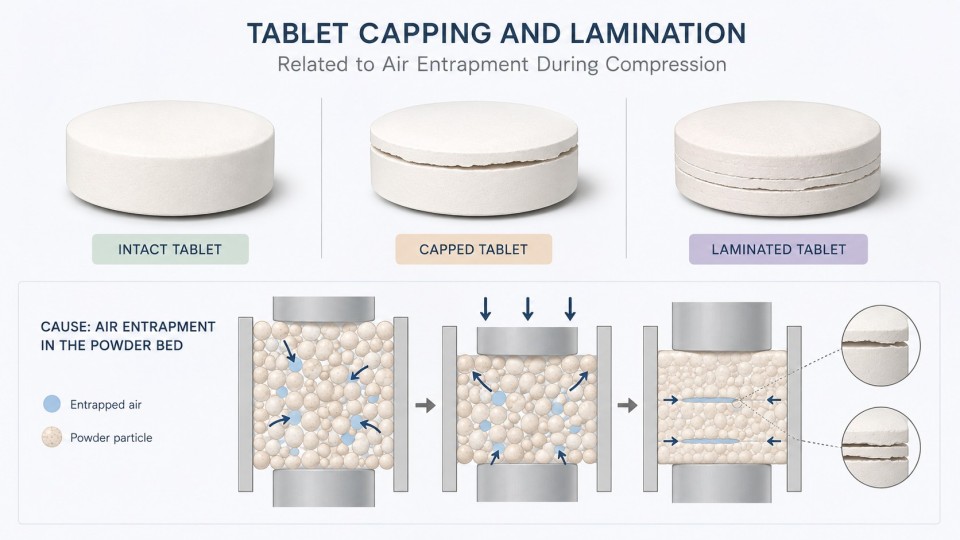
Namun, tablet capping and tablet lamination do not have one single cause. Formulation properties, granule structure, pelumasan, kondisi perkakas, compression rate, gaya kompresi utama, and elastic recovery can all contribute. Increasing pre-compression force without checking these factors can therefore leave the real problem unresolved.
This distinction is important in production. If capping appears after operating conditions change, the complete compression process needs to be reviewed rather than treating pre-compression as the only adjustment. Likewise, lamination that persists despite adequate deaeration can indicate that formulation or compaction behavior also needs attention.
Pre-compression is therefore most useful as part of a broader compression strategy. It can reduce defects associated with air entrapment and compression history, but it should not be treated as a universal correction for every capping or lamination problem.
How to Evaluate Pre-Compression When Selecting or Setting a Tablet Press
A buyer comparing automatic rotary tablet presses should not evaluate pre-compression by asking only whether the machine has this function. The more useful question is whether the available pre-compression system provides enough control for the intended formulations and production speeds.
1. Independent Pre-Compression Capability
Confirm whether the machine has a separate pre-compression station rather than only a single main compression event. An independent station gives the operator another part of the compression profile to adjust when the product requires it.
This becomes more relevant for manufacturers running different formulations because materials can respond differently to repeated compression and changing production speeds.
2. Adjustable Pre-Compression Force
Pre-compression force should be considered together with the formulation and main compression conditions. A stronger first compression is not automatically better.
A 2024 study on air-entrapment-related lamination found that the most effective pre-compression pressure for the model blend corresponded to the point of minimum in-die elastic recovery. The useful setting changed with the compression conditions, supporting a formulation-specific approach instead of a fixed force ratio.
3. Dwell Time and Turret Speed
Dwell time is the period during which the punches remain under significant compression load. As turret speed rises, the available compression time generally becomes shorter.
Untuk produksi berkecepatan tinggi, this interaction matters because force and time cannot be considered separately. A machine can offer substantial pre-compression force, but the formulation still has to respond properly within the available compression time.
Research on tablet capping demonstrates this interaction. In a model formulation, a longer dwell time during low pre-compression helped particle rearrangement and air escape before main compression. The same study found that a high rate of force application contributed to air entrapment, uneven force distribution, and capping.
When comparing a high-speed rotary tablet press, buyers should therefore look beyond maximum output. The compression system, roller geometry, perkakas, turret speed range, and available process controls all influence the flexibility available during scale-up and routine production.
4. Relationship With Main Compression
Pre-compression and main compression need to be evaluated together. The first stage changes the condition of the powder before it reaches the second stage, so changing one stage can alter the response in the other.
A practical setup starts with the product’s compression behavior and target tablet properties, then evaluates pre-compression, kompresi utama, press speed, and other relevant process variables together. This is more reliable than applying a standard force ratio copied from another formulation.
5. Kebutuhan Produksi
Not every tablet application requires the same level of pre-compression capability. For straightforward products running at moderate speeds, an advanced pre-compression system can provide less additional value than it does in more demanding production.
The feature becomes more important when production involves high press speeds, materials that retain air easily, formulations with significant elastic recovery, recurring air-related capping or lamination, or a broad product range that requires greater compression flexibility.
Untuk pembeli peralatan, the key point is to match the pre-compression capability to real production requirements rather than treat it as an isolated specification.
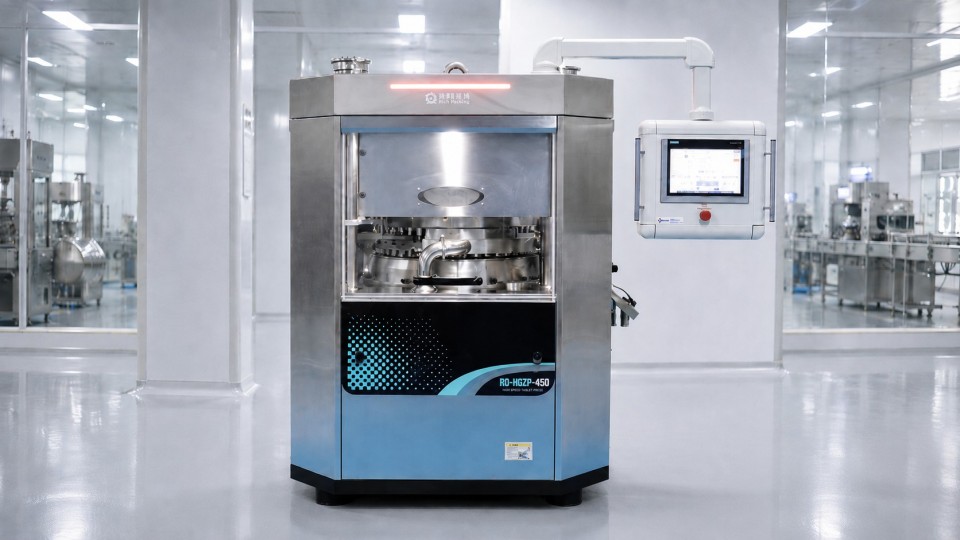
Ruida Packing can provide tablet presses equipped with pre-compression to meet different produksi tablet persyaratan.
FAQ About Pre-Compression in Tablet Presses
1.What is pre-compression in a tablet press?
Pre-compression is a controlled compression event before main compression. It partially compacts the powder bed and helps reduce trapped air before the final high-force compression stage.
2.Does every tablet press need pre-compression?
TIDAK. Not every tablet press has an independent pre-compression stage, and not every product requires the same compression profile. Its value depends on formulation behavior, kecepatan produksi, and process requirements.
3.What is the difference between pre-compression and main compression?
Pre-compression prepares the powder bed through initial compaction and deaeration. Main compression applies the higher load that forms the final tablet compact.
4.How much pre-compression force should be used?
There is no universal force or fixed percentage of main compression that suits every product. The setting depends on formulation behavior, tablet press speed, waktu tinggal, main compression conditions, and required tablet properties.
5.Can pre-compression prevent tablet capping and lamination?
It can reduce capping or lamination when air entrapment and the compression profile are important contributing factors. Defects caused by formulation, perkakas, pelumasan, or other process conditions require the underlying cause to be addressed as well.
Pre-compression in a tablet press is valuable because it gives manufacturers more control over what happens before the powder reaches main compression. Its importance increases when air removal, compression speed, pemulihan elastis, or defect control becomes challenging. For equipment selection, the useful question is not simply whether a tablet press includes pre-compression, but whether its pre-compression capability matches the material behavior, kecepatan produksi, and process flexibility the manufacturer actually needs.
Referensi
- Farmakope Amerika Serikat. Kapitel Umum <1245>, Compaction Simulation.
- Vreeman GW, Sun CC. Air entrapment during tablet compression – Diagnosis, impact on tableting performance, and mitigation strategies. International Journal of Pharmaceutics. 2022;615:121514.
- Vreeman G, Sun CC. A strategy to optimize precompression pressure for tablet manufacturing based on in-die elastic recovery. International Journal of Pharmaceutics. 2024;654:123981.