El acero inoxidable no es un solo material. Es una familia de aleaciones con diferentes composiciones químicas., resistencia a la corrosión, comportamiento de soldadura, y costos. Estas diferencias son importantes en la fabricación farmacéutica porque los equipos pueden estar expuestos a polvos., liquidos, agentes de limpieza, humedad, calor, y ciclos de producción repetidos.
Un grado que funciona bien en un proceso seco puede comportarse de manera diferente en un sistema húmedo o en condiciones de limpieza que contienen cloruro.. Acabado superficial, calidad de soldadura, geometría del equipo, y el acceso para la limpieza también influyen en el rendimiento a largo plazo.
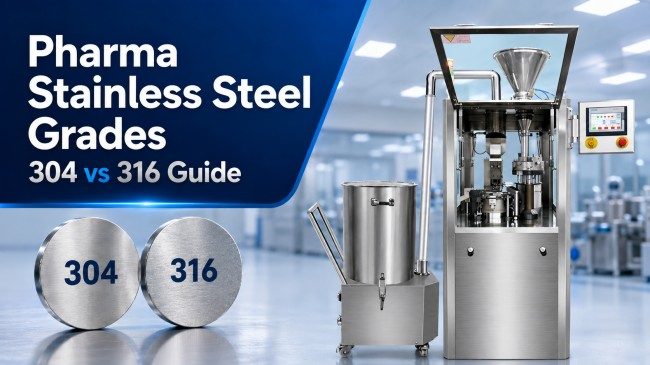
Los grados de acero inoxidable utilizados con mayor frecuencia en la industria farmacéutica pertenecen a la 304 y 316 familias, incluyendo 304L y 316L. Esta guía explica por qué el acero inoxidable se utiliza ampliamente, en qué se diferencian estos grados, donde aparecen en equipo farmaceutico, y como elegir entre 304 y 316 para un proceso específico.
Por qué se utiliza el acero inoxidable en la fabricación farmacéutica
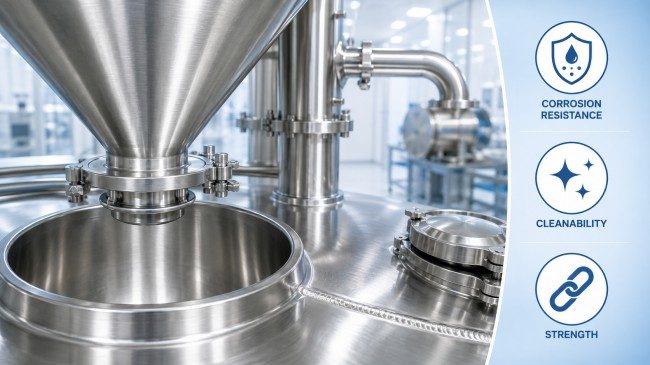
Los equipos farmacéuticos deben permanecer estables durante la producción., limpieza, inspección, y mantenimiento. Sus materiales deben resistir la corrosión., evitar interacciones dañinas con el producto, apoyar una limpieza eficaz, y mantener la resistencia mecánica.
Resistencia a la corrosión
El acero inoxidable contiene cromo., que forma una fina capa pasiva en la superficie. Esta capa ayuda a proteger el metal subyacente de la humedad y el ataque químico..
Su eficacia depende de la aleación y del entorno operativo.. Sales, ácidos, productos quimicos de limpieza, temperatura, humedad, y el tiempo de contacto pueden afectar la resistencia a la corrosión. Por esta razón, Las palabras "acero inoxidable" por sí solas no proporcionan una especificación completa del equipo..
Capacidad de limpieza
El acero inoxidable con el acabado adecuado proporciona una dureza, Superficie no absorbente que favorece la limpieza y la inspección.. Las superficies lisas dan a los polvos y residuos menos irregularidades en las que permanecer..
La facilidad de limpieza también depende del diseño y la fabricación.. soldaduras rugosas, brechas estrechas, hilos expuestos, esquinas internas afiladas, Y los espacios inaccesibles pueden retener material incluso cuando el componente circundante utiliza una aleación resistente a la corrosión..
Resistencia y fabricación
El acero inoxidable puede soportar el llenado repetido, prensado, transmitir, sellando, y ciclos de envasado que se encuentran en la producción farmacéutica.. También se puede cortar, formado, mecanizado, soldado, y pulido en marcos, tolvas, vasos, tubería, guardias, y piezas de manipulación de productos.
A NOSOTROS 21 CFR 211.63 Requiere que los equipos farmacéuticos estén adecuadamente diseñados., tamaño, y ubicado para el uso previsto, limpieza, y mantenimiento. Sección 211.65 Requiere que las superficies en contacto con el producto no sean reactivas., aditivo, o absorbente de una manera que altere la calidad del producto.. Capítulo GMP de la UE 3 De manera similar, requiere equipos que se adapten al propósito previsto y permitan una limpieza profunda..
Estos requisitos se centran en el rendimiento del equipo y la protección del producto en lugar de nombrar un grado universal de acero inoxidable..
Grados comunes de acero inoxidable utilizados en la industria farmacéutica
Los grados austeníticos de la serie 300 se utilizan ampliamente porque combinan resistencia a la corrosión, formabilidad, y soldabilidad.
304 Acero inoxidable
Calificación 304 Es un acero inoxidable al cromo-níquel utilizado en seco., interior, y entornos ligeramente corrosivos. En equipos farmacéuticos, aparece comúnmente en:
- Bastidores de máquinas
- Cubiertas y paneles exteriores
- Guardias de seguridad
- Soportes y soportes
- Armarios electricos
- Estructuras transportadoras sin contacto.
304 también puede adaptarse a aplicaciones seleccionadas de contacto con materiales cuando la compatibilidad, condiciones de limpieza, acabado superficial, y el diseño del equipo han sido evaluados.
304Acero inoxidable
304L es la versión baja en carbono de 304. Su menor contenido de carbono reduce el riesgo de precipitación de carburo de cromo durante ciertos ciclos de calor de soldadura., ayudando a preservar la resistencia a la corrosión intergranular alrededor de soldaduras fabricadas adecuadamente.
Es útil para tolvas soldadas., tanques, tubería, y conjuntos fabricados donde la resistencia a la corrosión del 304 la familia es suficiente.
316 Acero inoxidable
Calificación 316 contiene cromo y níquel como 304, pero también contiene molibdeno. Esta adición mejora la resistencia a la corrosión por picaduras y grietas., especialmente en condiciones que contienen cloruro o químicamente más exigentes.
316 Se considera comúnmente cuando los componentes se enfrentan a líquidos salinos., limpieza húmeda frecuente, humedad retenida, o agentes de limpieza más fuertes.
316Acero inoxidable
316L es la versión baja en carbono de 316. Combina la resistencia a la corrosión mejorada con molibdeno de 316 con menor susceptibilidad a la corrosión intergranular después de la soldadura.
Esto hace que el 316L sea una opción común para recipientes soldados., tuberías sanitarias, valvulas, colectores, boquillas de llenado, y otros conjuntos en contacto con materiales expuestos a condiciones húmedas o de limpieza exigentes.
Grados especiales como 316Ti, 904l, y 2205 El acero inoxidable dúplex sirve específicamente para altas temperaturas., altamente corrosivo, alta presión, o aplicaciones de alta resistencia. No son actualizaciones automáticas para máquinas farmacéuticas estándar..
| Calificación | Característica principal | Dirección general de aplicación |
| 304 | Grado general de cromo-níquel | Marcos, cubre, guardias, y ambientes templados |
| 304l | Bajo en carbono 304 | Piezas soldadas donde la resistencia de nivel 304 es suficiente |
| 316 | Grado de aleación de molibdeno | Húmedo, expuesto al cloruro, o áreas más corrosivas |
| 316l | Bajo en carbono 316 | Sistemas soldados que requieren resistencia de 316 familias. |
| Grados especiales | Mayor resistencia química o fuerza. | Equipos de proceso especializados |
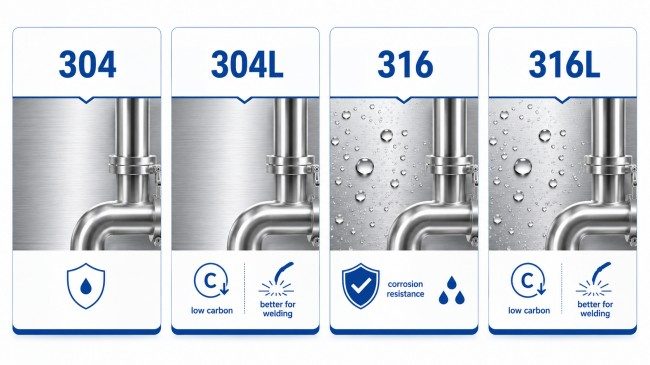
304 VS 316 Acero inoxidable: Diferencias clave
La principal diferencia entre 304 y 316 El acero inoxidable es el molibdeno en 316. Esto mejora la resistencia a la corrosión localizada en entornos que contienen cloruro y químicamente exigentes..
Resistencia a la corrosión
304 Funciona bien en muchas condiciones secas y levemente corrosivas.. A menudo es adecuado para estructuras de máquinas y áreas expuestas principalmente a la limpieza rutinaria de la sala..
316 Proporciona protección adicional cuando los componentes se enfrentan a soluciones salinas., lavado repetido, detergentes más fuertes, o humedad prolongada. El proceso de limpieza debe evaluarse junto con el producto porque a una formulación suave y seca puede seguirle un ciclo de limpieza más exigente..
Riesgo de costo y ciclo de vida
El 316 La familia generalmente cuesta más que la 304 familia debido a su contenido de aleación adicional. Sin embargo, elegir solo por el precio de compra puede aumentar el mantenimiento, dificultad de limpieza, reemplazo de componentes, trabajo de inspección, y tiempo de inactividad si el grado no coincide con el entorno operativo.
Usando 316 o 316L en cada cuadro, panel, y la protección también puede agregar costos sin mejorar la protección del producto.. Por lo tanto, es común un diseño de materiales mixtos.: utilizar el grado más resistente cuando la exposición lo requiera y 304 donde las condiciones son menos exigentes.
Qué significa la “L”
La “L” significa baja en carbono. Bajo ciertos ciclos de calor de soldadura, La precipitación de carburo de cromo puede ocurrir cerca de los límites de los granos y reducir la resistencia a la corrosión en el área afectada por el calor..
304L y 316L reducen este riesgo, pero no corrigen una mala soldadura. Método de soldadura, blindaje, entrada de calor, geometría de soldadura, molienda, limpieza, y el tratamiento posterior a la soldadura aún afectan el componente terminado.
| Comparación | 304/304l | 316/316l |
| Molibdeno | Normalmente no se agrega | Agregado |
| Resistencia al cloruro | Más bajo | Mejor |
| Costo típico | Más bajo | Más alto |
| Rol común | Áreas estructurales y de servicio suave. | Áreas húmedas y de mayor corrosión. |
| Base de selección | Menor exposición | Química o humedad más exigentes |
La elección correcta depende del producto., medios de limpieza, humedad, fabricación, y la función de cada área del equipo.
Dónde se utilizan los grados de acero inoxidable en equipos farmacéuticos
Normalmente, una máquina farmacéutica no necesita un grado para cada componente.. Una especificación clara separa las piezas en contacto con el material., piezas de la zona de producción cercana, partes estructurales, y componentes seleccionados principalmente por su resistencia al desgaste o carga mecánica.
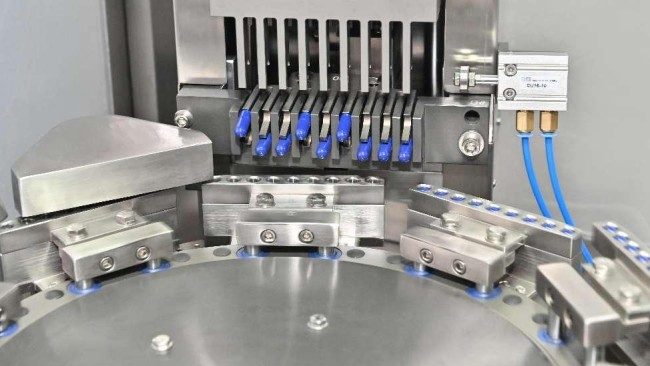
Piezas estructurales y de contacto con materiales
Tolvas, canales de alimentación, piezas de dosificación, tubos de transferencia, boquillas de llenado, y los conductos de descarga necesitan mucha atención porque entran en contacto con material expuesto.. Marcos, cubre, guardias, paréntesis, y los gabinetes eléctricos generalmente enfrentan una menor exposición a químicos.
En embalaje Ruida, Piezas de acero inoxidable que entran en contacto con el uso del material. 316L acero inoxidable, mientras que otras piezas de acero inoxidable utilizan 304 acero inoxidable. Esta configuración separa los requisitos de contacto con el material de las funciones estructurales en lugar de aplicar un grado a toda la máquina..
Ejemplos de equipos
en un máquina llenadora de cápsulas, la tolva, sección de dosificación, y polvo o gránulos de contacto de ruta de transferencia, mientras el marco, gabinete, y las guardas realizan funciones estructurales o protectoras.
A maquina para comprimir tabletas Contiene piezas en contacto con el material, así como herramientas y componentes de alta carga.. Golpes, muere, torretas, aspectos, y otras piezas de desgaste se seleccionan por su dureza, resistencia a la fatiga, y función operativa, por lo que su selección de materiales va más allá de una simple 304 VS 316 comparación.
en un máquina contadora electrónica de cápsulas de tabletas, la tolva, canales vibratorios, camino de conteo, y salida de descarga contacte con la forma farmacéutica. Una máquina envasadora de blister también incluye alimentadores y guías que tocan tabletas o cápsulas no envasadas..
Una máquina estuchadora normalmente manipula productos que ya están dentro del embalaje primario.. Sus estructuras de acero inoxidable son de uso común. 304, a menos que el entorno de producción o el acuerdo técnico requieran otro material.
Acabado superficial y diseño higiénico
La selección de materiales debe estar respaldada por un acabado adecuado y un diseño de equipos.. Donde la rugosidad de la superficie afecta la limpieza, el requisito debe aplicarse a la zona de contacto relevante y verificarse mediante medición en lugar de una descripción general como "acabado de espejo".
Las soldaduras en contacto con el material deben ser accesibles y estar acabadas según los requisitos acordados.. Esquinas afiladas, brechas estrechas, hilos expuestos, placas superpuestas, y los canales inaccesibles pueden dificultar la limpieza.
La pasivación elimina la contaminación de hierro libre y soporta la superficie pasiva después de la fabricación.. El electropulido puede mejorar la suavidad en sistemas seleccionados de alta pureza, pero ninguno de los dos tratamientos es un requisito universal para todas las máquinas farmacéuticas..
Cómo elegir el grado de acero inoxidable adecuado
La selección de materiales debe seguir las condiciones reales del proceso y la función de cada área del equipo..
1. Identificar productos y medios de limpieza
Enumere todas las sustancias que entran en contacto con el equipo., incluyendo polvos, liquidos, sales, ácidos, detergentes, desinfectantes, y enjuague con agua. Los productos químicos de limpieza pueden crear un mayor riesgo de corrosión que el propio producto..
2. Zonas de equipos separadas
Solicite al proveedor que identifique las piezas que entran en contacto directo con el material., piezas de la zona de producción cercana, partes estructurales, componentes de desgaste, y materiales de contacto no metálicos. Evite aceptar una afirmación general de que la máquina es simplemente “acero inoxidable”.
3. Revisar las condiciones de exposición
Considere si el contacto es seco o húmedo, intermitente o continuo, y si calor, cloruros, humedad retenida, o un drenaje deficiente aumentan el riesgo de corrosión.
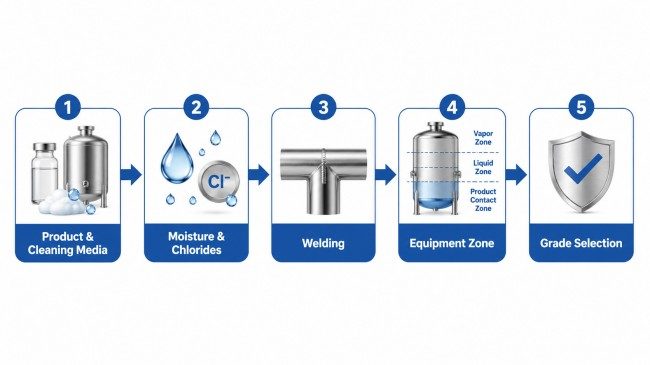
4. Evaluar el acceso a la fabricación y la limpieza
Verificar el estado de la soldadura, esquinas internas, acabado superficial, drenaje, componentes removibles, y acceso para limpieza e inspección.. Definir pasivación, electropulido, o requisitos de rugosidad sólo cuando el proceso los justifique.
5. Confirmar estándares y documentos
La designación del grado debe estar vinculada a una norma de material aplicable., como ASTM, EN, o JIS, y respaldado por el certificado de material acordado o registro de trazabilidad.
Dependiendo del proyecto, la documentación puede incluir:
- Listas de piezas en contacto con materiales
- Certificados de materiales
- Requisitos de acabado superficial
- Registros de tratamiento de soldadura.
- Registros de pasivación
- Criterios de inspección FAT
| Condiciones de funcionamiento | Dirección de selección práctica. |
| Seco, leve, servicio sin contacto | 304 a menudo proporciona un equilibrio adecuado |
| Piezas soldadas en condiciones suaves. | Considere 304L |
| Exposición húmeda o que contiene cloruro | Evaluar 316 o 316L |
| Sistema soldado que requiere resistencia de 316 familias. | Considere 316L |
| Proceso altamente corrosivo o inusual | Complete una revisión de ingeniería dedicada |
Los requisitos de la FDA y las GMP de la UE no establecen que todas las piezas en contacto con el material deban utilizar 316L.. Requieren materiales y superficies de equipos que se adapten al uso previsto., limpieza de apoyo, y evitar interacciones dañinas con el producto..
El fabricante y el usuario deben definir la configuración del material requerida en la especificación del equipo y el acuerdo técnico..
Conclusión
Los principales grados de acero inoxidable utilizados en la industria farmacéutica son 304, 304l, 316, y 316L. Calificación 304 se adapta a muchas aplicaciones estructurales y de servicio leve, mientras 316 Ofrece una mayor resistencia en los que contienen cloruro., húmedo, o entornos químicamente más exigentes. Las versiones bajas en carbono reducen el riesgo de corrosión intergranular asociada a determinadas condiciones de soldadura..
El 304 VS 316 La decisión sobre el acero inoxidable debe basarse en la exposición real., fabricación, y requisitos del ciclo de vida. Una especificación útil identifica el grado utilizado en cada área importante y también define el acabado superficial., tratamiento de soldadura, acceso de limpieza, y documentos de respaldo.
Preguntas frecuentes
¿Qué grados de acero inoxidable se utilizan habitualmente en la industria farmacéutica??
304, 304l, 316, y 316L son los grados de uso general más comunes. Los procesos especializados pueden requerir materiales dúplex o de mayor aleación.
¿Cuál es la principal diferencia entre 304 y 316 acero inoxidable?
316 contiene molibdeno, que mejora la resistencia a la corrosión por picaduras y grietas relacionada con el cloruro.
¿Por qué se utilizan 304L y 316L para equipos soldados??
Su menor contenido de carbono reduce el riesgo de precipitación de carburo de cromo durante ciertos ciclos de calor de soldadura y ayuda a preservar la resistencia a la corrosión alrededor de soldaduras fabricadas correctamente..
¿La calidad del acero inoxidable es suficiente para determinar el rendimiento higiénico??
No. Acabado superficial, calidad de soldadura, geometría, acceso de limpieza, drenaje, sellos, y los requisitos de fabricación documentados también afectan el rendimiento higiénico..
¿Las GMP requieren que todas las piezas en contacto con el material utilicen 316L??
Ninguna norma general de la FDA o las GMP de la UE exige que todos los componentes en contacto con el material utilicen 316L.. El material debe adaptarse al producto., proceso de limpieza, y uso previsto del equipo.
Referencias
- Código Electrónico de Regulaciones Federales, 21 Parte CFR 211, Subparte D—Equipo, especialmente §§211.63, 211.65, y 211.67.
- Comisión Europea, Directrices de la UE para buenas prácticas de fabricación, Volumen 4, Capítulo 3: Locales y Equipos, especialmente las secciones 3.34–3.39.
- ASME, BPE—Equipo de bioprocesamiento.