...

>

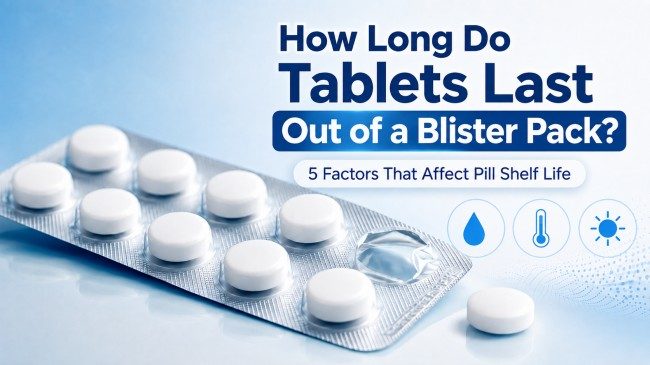
How Long Do Tablets Last Out of a Blister Pack? 5 Factors That Affect Pill Shelf Life

How Long Do Tablets Last Out of a Blister Pack? 5 Factors That Affect Pill Shelf Life

목차

How long do tablets last out of a blister pack? See how formulation, exposure time, 보관 조건, pill boxes, and blister seals affect shelf life.

The question “How long do tablets last out of a blister pack?” does not have one universal answer. A tablet removed for immediate use is not in the same situation as one stored for several days in a pill box or left inside a blister with torn foil. The labeled expiration date is established for a specific formulation, 패키지, and storage condition. Once the package or storage environment changes, that date alone cannot confirm how long an individual tablet will retain the same quality.

Tablets inside and outside a blister pack with moisture, 열, and light factors

The answer depends mainly on five factors: 공식화, time outside the blister, 보관 조건, the replacement container or original pack condition, and the blister’s barrier and seal quality. 그만큼 FDA guidance on pharmaceutical container-closure systems explains that packaging should protect a dosage form from relevant causes of deterioration, including moisture, 빛, 산소, 오염, 그리고 물리적 손상. This is why the package is part of the shelf-life condition rather than a simple holder.

How Long Can Tablets Stay Out of a Blister Pack?

A tablet does not expire the moment it is pushed through the foil. The more accurate distinction is between brief exposure and continued storage outside the original cavity.

A tablet taken shortly after removal has only a short exposure period. A tablet left loose on a bedside table, carried in a pocket, or stored for several days outside its blister remains under a different set of conditions for much longer.

There is also no reliable 24-hour, 72-시간, or one-week rule for every tablet. Conventional film-coated tablets, 발포성 정제, 구강붕해정, and moisture-sensitive formulations do not respond to exposure in the same way. One tablet can remain physically unchanged for a period that causes another to soften, 금이 가다, absorb moisture, or lose coating integrity.

For a specific medicine, the package label and patient leaflet take priority. Statements such as “protect from moisture,” “protect from light,” or “keep in the original package” show that the packaging is part of the required storage condition. When those instructions are present, general experience with another tablet is not a reliable substitute.

요인 1: Tablet Formulation and Dosage Form

Tablets that look similar can contain different active ingredients, 부형제, coatings, and moisture levels. These differences affect how they respond to air, 습기, 열, 그리고 빛.

A film coating provides some physical protection, but it does not replace a sealed blister. Moisture can still pass through the coating and reach the tablet core. 제형에 따라, exposure can influence hardness, 용해, chemical stability, or the physical form of the ingredients.

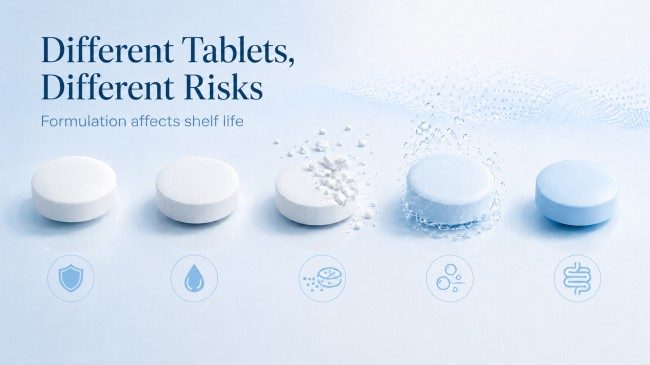
Several dosage forms need particular attention:

  • Hygroscopic tablets absorb moisture from surrounding air more readily.
  • 발포성 정제 are designed to react in water and therefore depend strongly on moisture-resistant packaging.
  • 구강붕해정 break down rapidly and can be more vulnerable to humidity and handling damage.
  • Enteric-coated tablets rely on an intact functional coating, but that coating is not a long-term storage package.
  • Light-sensitive tablets can depend on foil, opaque materials, or an outer carton.

에이 Journal of Pharmaceutical Sciences review on moisture-protective packaging explains that package selection for solid oral products should account for chemical and physical stability, 수분 민감도, 보관 조건, and the moisture barrier provided by the package. A storage arrangement that works for one tablet should not become a general rule for another.

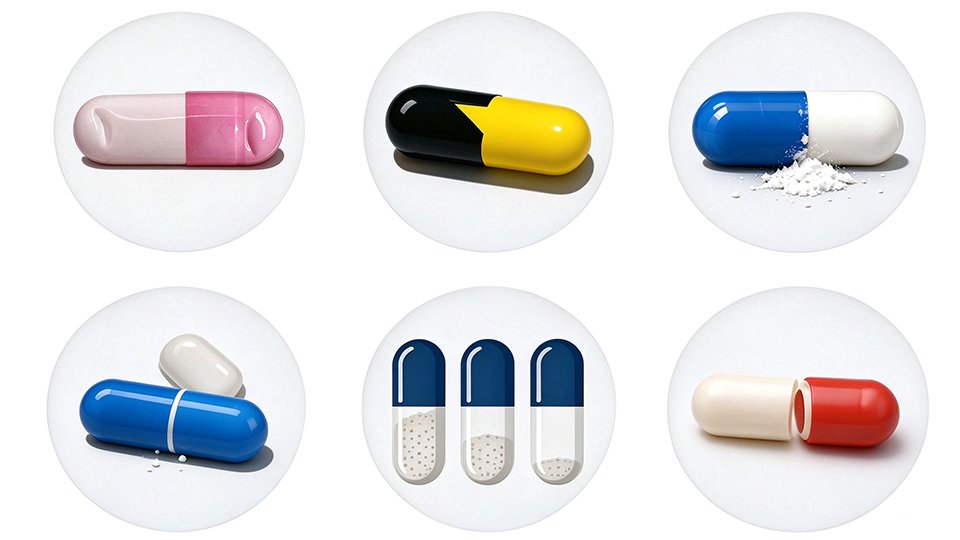
Different tablet formulations with varying sensitivity to moisture and storage conditions

요인 2: Time Outside the Blister

Time matters because the longer a tablet remains outside its cavity, the longer it stays under conditions that were not part of its marketed package.

The first few minutes after removal are different from extended storage. A tablet taken promptly has only brief contact with room air, 빛, and handling. Once the same tablet is left outside the blister for hours or days, the effect of the environment becomes more important.

Time alone, 하지만, does not determine the answer. One night in a cool, dry cupboard is not equivalent to one night in a hot car or humid bathroom. A moisture-sensitive tablet and a conventional film-coated tablet also cannot be judged by the same clock.

This means the level of uncertainty generally increases with longer exposure, but that principle cannot be converted into one universal deadline. The relevant question is not only “How long has the tablet been outside?” It is also “What type of tablet is it, where was it stored, and what protection remained around it?”

That distinction keeps the time factor in perspective. Brief exposure does not create instant expiration, while prolonged storage outside the blister moves the tablet further away from the conditions used to support its labeled shelf life.

요인 3: 습기, Heat, 빛, and Handling

Once a tablet is outside a sealed cavity, the surrounding room and handling conditions have greater influence.

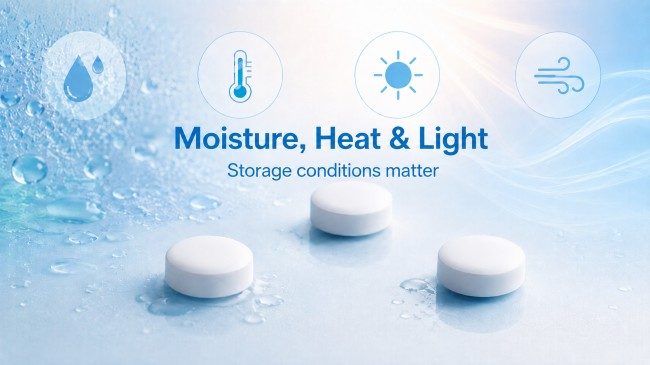
Tablets exposed to moisture, 열, 빛, and air outside blister packaging

습기

Water vapor can enter a tablet or its coating. 제품에 따라, moisture exposure can contribute to softening, stickiness, 열분해, altered hardness, changes in dissolution, or chemical degradation. Bathrooms, areas beside sinks, and shelves above heat-producing appliances can expose tablets to conditions that differ from a cool, dry cupboard.

Heat

Higher temperatures can speed up physical and chemical changes. Cars, direct sunlight, radiators, and areas with large temperature swings differ from ordinary labeled room storage.

Light and Air

Some formulations require protection from light, supplied by aluminum foil, opaque materials, or the outer carton. A transparent organizer does not automatically provide the same protection.

Contact with air also changes exposure to oxygen and water vapor, although the significance varies by formulation. It would be inaccurate to assume that every tablet responds at the same rate once removed from its blister.

Handling and Identification

Loose tablets can rub together, 칩, collect dust, or become mixed with other products. A tablet separated from its packaging can also lose essential identification. 색상, 모양, and markings alone are not enough to confirm what a loose tablet is.

Visible changes such as cracking, unusual softness, discoloration, or an abnormal odor deserve attention, but a normal appearance cannot prove that every quality attribute remains unchanged. 그만큼 NHS guidance on storing medicines at home advises keeping medicines in their original packaging, following product-specific instructions, and avoiding warm or humid storage areas.

요인 4: The Replacement Container and Original Pack Condition

The storage condition changes in two common ways: the tablet is moved into another container, or the original blister is damaged.

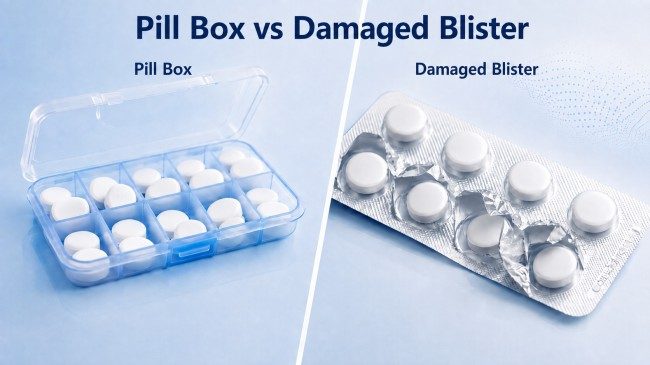
A pill box can make a dosing schedule easier to follow, but its main function is organization rather than pharmaceutical barrier protection. Its performance depends on the container material, lid fit, opening frequency, light transmission, and storage location.

Some medicines are professionally repackaged under controlled procedures. That does not mean every tablet can be transferred casually into any organizer. Products with specific moisture, 빛, or original-package instructions require particular care.

The second situation is a tablet that remains inside the formed pocket while the foil or seal is damaged. Torn foil, a pinhole, a lifted edge, crushing, or incomplete bonding can connect the cavity to the surrounding air. The key question is not whether the tablet has fallen out. It is whether the individual cavity still functions as a closed package.

Relevant defects include:

  • punctures or tears in the lidding foil;
  • wrinkles crossing the sealed area;
  • particles trapped in the seal;
  • incomplete bonding around a cavity;
  • edge lifting, crushing, or bending that opens the seal.

Some defects are difficult to judge visually. Small channels or pinholes can change the internal environment even when most of the blister appears intact. For a damaged pack or a tablet stored under uncertain conditions, product-specific advice from a pharmacist or manufacturer is more reliable than guessing from elapsed time or appearance.

Pill box compared with a damaged blister pack containing tablets

요인 5: Blister Materials and Sealing Quality

Different formulations require different levels of resistance to moisture, 산소, 그리고 빛. Blister structures are therefore selected according to stability data, 장벽 요구 사항, forming performance, and distribution conditions.

Blister structureGeneral barrier profileCommon selection logic
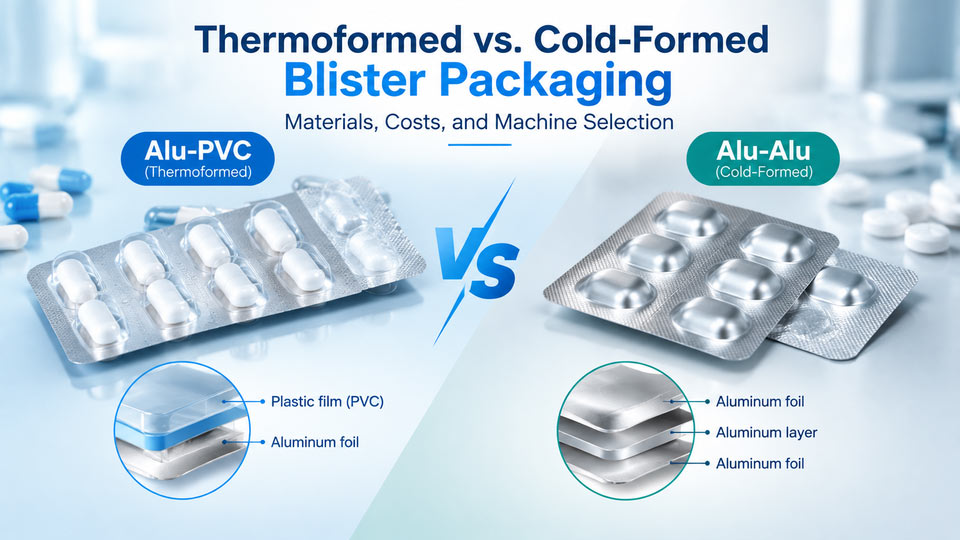
PVC/AluminumBasic unit-dose protection with product visibilityTablets with moderate barrier needs
PVC/PVDC/AluminumBetter resistance to water-vapor transmissionProducts needing stronger moisture protection
PCTFE laminate/AluminumHigher moisture barrier with a transparent cavityMore moisture-sensitive formulations
Cold-form Alu-AluStrong moisture, 산소, and light barrierHighly sensitive products or demanding climates

Material choice is only part of the result. 에이 블리스터 포장기 must form consistent cavities, place each tablet correctly, align the lidding foil, and maintain stable sealing conditions.

온도, 압력, 체류 시간, web tension, and contamination in the seal area can all affect package quality. Even a high-barrier material cannot provide its intended protection if a cavity is poorly formed or the lidding foil is not sealed consistently.

Cameras can identify empty cavities, misplaced or damaged tablets, and visible foil defects. Seal-integrity testing is still needed when leakage cannot be confirmed by appearance alone.

루이다 패킹의 물집 포장기 support pharmaceutical applications involving thermoformed Alu-PVC and cold-form Alu-Alu formats. Depending on the selected configuration, the process can combine material feeding, 형성, tablet or capsule loading, 열 밀봉, 코딩, 펀칭, 해고하다, and vision inspection.

The machine does not determine a medicine’s shelf life. Its role is to reproduce the validated packaging process consistently so that the selected materials and seal design can provide their intended protection.

What to Check Before Storing Tablets Outside a Blister Pack

Before removing tablets in advance or using a tablet from a damaged pack, 확인하다:

  1. Does the label require the medicine to stay in its original package?
  2. Is the tablet moisture-sensitive, light-sensitive, 흥분한, or rapidly disintegrating?
  3. How long has it been outside an intact cavity?
  4. Was it exposed to heat, 습기, direct light, or repeated handling?
  5. Was it placed in another container, and does that container close securely?
  6. Is the original foil torn, punctured, lifted, crushed, or partly open?
  7. Can the tablet still be matched confidently to its name, 힘, 및 지침?

These checks do not calculate a new expiration date. They show when the original storage conditions have changed and when product-specific guidance is needed.

자주 묻는 질문

Does a Tablet Expire Immediately After Leaving a Blister Pack?

아니요. Removal does not create instant expiration. It changes the storage condition. The importance of that change depends on the formulation, exposure time, environment, and replacement container.

Can I Take Pills Out of a Blister Pack in Advance?

That depends on the product. A pill box can help organize doses, but it is not automatically equivalent to the original blister. Check the patient leaflet and pharmacy label, especially when the product requires protection from moisture or light.

Can Tablets Stay in a Pill Box for One Week?

There is no one-week rule for all medicines. Suitability depends on the tablet, the organizer, and the storage environment. Advance transfer is a product-specific decision rather than a universal practice.

Is a Tablet Still Protected If the Blister Foil Is Torn?

Not reliably. A tear, puncture, or open edge can expose the cavity to the surrounding environment even when the tablet remains inside. A damaged cavity should not be treated as an intact sealed blister.

Why Are Some Tablets Packed in Alu-Alu Blisters?

Alu-Alu packaging is selected when a product needs strong protection from moisture, 산소, or light. It removes direct product visibility and generally uses more packaging material than a transparent thermoformed blister, so the choice should be based on stability and production requirements.

결론

How long tablets last out of a blister pack depends on more than the clock. 공식화, exposure time, humidity and heat, the replacement container, and the blister’s barrier and seal integrity all affect the level of protection.

A tablet removed for immediate use is different from one stored loose for days, and a torn cavity is different from a sealed blister. Keeping tablets in their labeled packaging until use preserves the conditions used to support their shelf life. When those conditions change, the product label, pharmacist, or manufacturer should guide the next decision.

참조

1. 우리를. 식품의약품안전청. Container Closure Systems for Packaging Human Drugs and Biologics.

2. 세계보건기구. Guidelines on Packaging for Pharmaceutical Products.

3. United Lincolnshire Hospitals NHS Trust. Storing Medicines at Home.

4. Waterman KC, MacDonald BC. Package Selection for Moisture Protection for Solid, Oral Drug Products. 제약 과학 저널.

5. Márton A, 외. Promising Advancements to the Blue Dye Ingress Test—Quantification of Blister Integrity by Leakage Rate. European Journal of Pharmaceutics and Biopharmaceutics.

공유하다:

메시지를 보내주세요

관련 기사

귀하의 필요 사항을 알려주세요

    견적 요청

      *귀하의 비밀을 존중하며 모든 정보는 보호됩니다.

      /*wpsi_fa907744*/