
A pharmaceutical packaging line is an integrated system of connected machines that packages pharmaceutical products through feeding, counting or dosing, imballaggio primario, ispezione, serialization, imballaggio secondario, and data collection. For solid oral dosage forms such as tablets and capsules, the line configuration depends mainly on the packaging format—blister, bottiglia, pacchetto di bastoncini, or sachet—and on production capacity, livello di automazione, and regulatory requirements.
This guide explains what a pharmaceutical packaging line includes, come funziona, how it differs from a standalone packaging machine, and how manufacturers can evaluate equipment for GMP-compliant production.
Che cos'è una linea di confezionamento farmaceutico?
A pharmaceutical packaging line combines product handling, confezione, ispezione, and downstream operations within a connected production setup. Instead of operating each machine independently, an integrated line manages material transfer, machine control, ispezione, serialization, and production data across the packaging workflow.
Pharmaceutical packaging must do more than place products into containers. It must protect the product, maintain identification and labeling information, support traceability, ridurre i rischi di contaminazione, and meet applicable quality requirements. A typical pharmaceutical packaging line may include:
- Product feeding and handling systems
- Conteggio, dosaggio, or product-loading equipment
- Primary packaging equipment
- Inspection and reject systems
- Etichettatura, serialization, and aggregation systems
- Attrezzature per l'imballaggio secondario
- Data management and traceability functions
The exact configuration depends on packaging format, caratteristiche del prodotto, velocità di produzione, dimensione del lotto, changeover requirements, and market regulations. Tablets and capsules, Per esempio, can be packaged in blisters or bottles, but the equipment selected for each format is different.
Pharmaceutical Packaging Machine vs Pharmaceutical Packaging Line
A packaging machine and a pharmaceutical packaging line represent different levels of system integration. A packaging machine performs one dedicated packaging function. A packaging line integrates multiple machines into one coordinated production system.
| Aspetto | Macchina per l'imballaggio | Pharmaceutical Packaging Line |
| Funzione | Performs one specific packaging operation | Connects multiple packaging processes |
| Operazione | Usually works as standalone equipment | Multiple machines operate as one coordinated system |
| Material transfer | May require manual or semi-manual transfer | Uses integrated feeding, trasferire, and interlocking systems |
| Controllare | Focuses on individual machine operation | Coordinates machine operation and production information |
| Applicazione | Suitable for specific packaging tasks | Suitable for complete packaging workflows |
Per esempio, UN macchina confezionatrice blister can perform forming, product loading, sigillatura, codifica, e taglio. When integrated with feeding equipment, sistemi di ispezione, UN macchina astucciatrice, etichettatura, serialization, and case packing, it becomes part of an integrated pharmaceutical packaging line.
Which Machines Make Up a Pharmaceutical Packaging Line?
A pharmaceutical packaging line usually consists of several equipment categories working together from product loading to final packaged output. The exact configuration varies by product type, formato di imballaggio, capacità produttiva, and regulatory requirements.
| Fase di confezionamento | Attrezzatura comune | Scopo principale |
| Product handling | Feeding system, trasportatore, sorter, orientation unit | Transfer products smoothly between processes |
| Conteggio, dosaggio, Riempimento | Contatore di compresse, capsule counter, sistema di dosaggio, product loader | Load products accurately into packages |
| Imballaggio primario | Macchina confezionatrice per blister, bottle packaging line, stick/sachet machine | Provide immediate product protection |
| Ispezione | Vision inspection system, selezionatrice ponderale, rilevatore di metalli, reject system | Verify packaging quality and remove defects |
| Serializzazione | Codifica, etichettatura, aggregation, track & trace | Provide product identification and traceability |
| Imballaggio secondario | Macchina astucciatrice, case packer, shrink wrapper, palletizer | Prepare products for distribution |

Product Feeding and Handling Systems
Product feeding is the first stage of many pharmaceutical packaging lines. Feeding systems ensure that tablets, capsule, or other products enter downstream equipment at a stable and controlled rate. Common components include hoppers, vibratory feeders, ascensori, trasportatori, sorters, orientation units, and transfer mechanisms.
Stable product handling is important because irregular feeding can affect counting, dosaggio, Riempimento, blister loading, and line efficiency. For solid oral dosage products, feeding systems should be designed according to product size, forma, peso, polvere, fragility, statico, and moisture sensitivity.
Conteggio, Dosaggio, and Product-Loading Equipment
Dopo l'alimentazione, products move to equipment responsible for loading them into the selected package format. The correct term depends on the format:
- Confezione di bottiglie: tablet or capsule counting before bottle filling
- Confezione in blister: product loading into blister cavities
- Stick or sachet packaging: dosing or filling into flexible packages
This distinction matters because a bottle line, blister line, and stick/sachet line do not use the same loading principle. UN tablet counting machine or capsule counting machine is central to bottle packaging, while blister packaging depends on controlled product loading into formed cavities.
Primary Packaging Equipment
Primary packaging is the stage where pharmaceutical products receive their first protective package. This stage directly affects product protection, condizioni di conservazione, and user handling. Common primary packaging formats include blister packaging, confezione di bottiglie, and stick or confezione in bustina.
Macchina confezionatrice blister
A blister packaging machine forms cavities, carica i prodotti, seals packaging materials, codes, perforates, and cuts finished blister packs. Common applications include tablets, capsule, softgel, chewables, and other solid oral dosage forms.
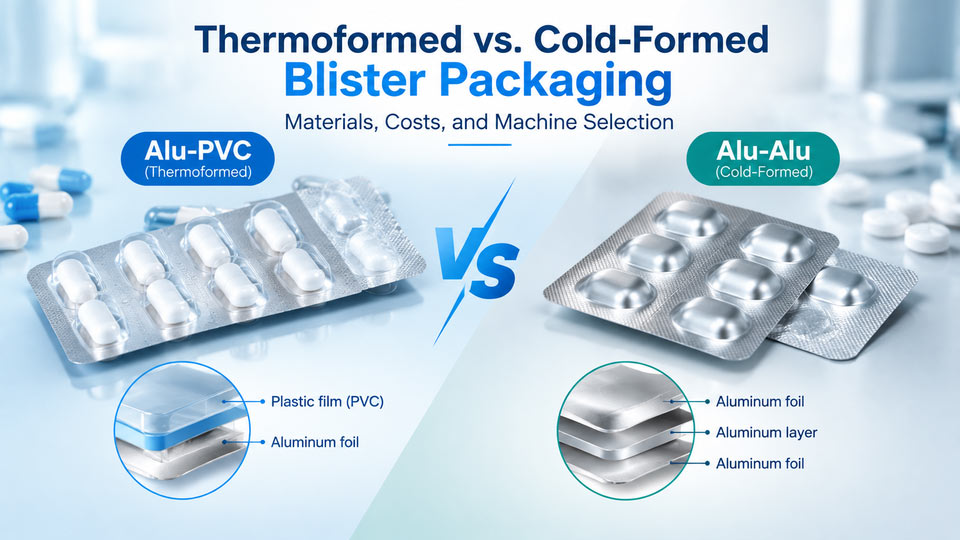
Common material combinations include Alu/PVC, Pestello / Pestello, PVC/PVDC, and PVC/PE/PVDC. Blister packaging is widely used because it provides individual product protection and supports unit-dose identification.
Bottle Packaging System
A bottle packaging line is commonly used for tablets and capsules that require container-based packaging. A typical bottle packaging process may include tablet or capsule counting, riempimento delle bottiglie, desiccant or cotton insertion, tappatura, sigillatura a induzione, etichettatura, ispezione, serialization, e astucciamento.
Unlike liquid filling systems, solid oral dosage bottle packaging focuses on accurate counting, controlled filling, and reliable container handling.
Stick and Sachet Packaging Machines
Stick pack packaging machines and sachet packaging machines are used for flexible single-dose packaging formats. They are commonly applied to powders, granuli, pellet, and products requiring portable individual packages. These systems combine dosing, Riempimento, sigillatura, codifica, perforante, and cutting processes.
Inspection and Quality Control Equipment
Inspection systems help manufacturers monitor packaging conditions and identify products that do not meet predefined requirements. Common inspection equipment includes:
- Vision inspection system for printed information, label placement, package appearance, componenti mancanti, codice a barre, QR, and DataMatrix verification
- Checkweigher for package weight verification and missing-component detection
- Metal detector or X-ray system where applicable
- Print and label inspection system
- Automatic reject system to remove non-conforming products from the production flow
Inspection can be integrated at multiple stages, such as after primary packaging, after labeling, after cartoning, or before case packing. The correct inspection strategy depends on product risk, package format, velocità della linea, and regulatory requirements.
Etichettatura, Serializzazione, and Aggregation
Modern pharmaceutical packaging lines increasingly include labeling, serialization, and aggregation functions. Serialization provides unique identification information for individual packages. Aggregation creates parent-child relationships between blister packs, cartoni, cases, and pallets to support serialization and track & trace requirements.
Depending on market regulations and line design, serialization and aggregation may be integrated at different stages of the packaging process. These functions support product identification, authentication, recall management, and regulatory reporting.
Secondary Packaging Equipment
After primary packaging and inspection, products move to secondary packaging equipment. This stage may include cartoning, inserimento volantino, etichettatura, serialization, imballaggio della cassa, shrink wrapping, and palletizing.
A cartoning machine automatically loads primary packages into cartons and may perform carton forming, product loading, inserimento volantino, codifica, serialization, chiusura del cartone, and batch information handling. A case packer then prepares cartons for storage, trasporto, and distribution.
Data Management and Traceability
Data management functions connect machine control, inspection results, serialization records, and production reporting. These functions help manufacturers maintain batch records, support audit trails, and improve visibility across the packaging line.
How Does a Pharmaceutical Packaging Line Work?
A pharmaceutical packaging line works by connecting multiple machines and processes into a coordinated workflow. Each stage performs a specific function, while the complete system manages product transfer, packaging operations, ispezione, and data collection.
A typical workflow may include:
- Product feeding and preparation
- Conteggio, dosaggio, or product loading
- Imballaggio primario
- In-process inspection
- Etichettatura, serialization, and aggregation
- Cartoning and leaflet insertion
- Case packing and palletizing
- Uscita del prodotto finito

Inspection and serialization may be integrated at multiple stages depending on line design and market regulations. The workflow should not be treated as a fixed linear sequence for every product.
Product Feeding and Preparation
The packaging process begins when pharmaceutical products enter the packaging system through feeding equipment. The purpose of this stage is to provide a stable product supply for downstream machines.
Conteggio, Dosaggio, or Product Loading
Dopo l'alimentazione, products move to equipment responsible for loading them into the selected package format. Examples include tablet and capsule counting before bottle packaging, product loading into blister cavities, and dosing or filling for stick and sachet packaging.
Imballaggio primario
Primary packaging provides the first protective layer for pharmaceutical products and directly contacts the product. Common processes include blister packaging, confezione di bottiglie, and stick or sachet packaging.
Ispezione, Serializzazione, e Tracciabilità
Modern pharmaceutical packaging lines increasingly include inspection and traceability functions. Serialization systems provide unique identification information for individual packages and support product tracking requirements. Depending on market regulations and line design, serialization and aggregation functions may be integrated at blister, cartone, caso, or pallet level.
Secondary Packaging and Final Product Handling
After primary packaging and inspection, products move to secondary packaging equipment. This stage may include cartoning, imballaggio della cassa, etichettatura, inserimento volantino, serialization, and product transfer for storage or distribution.
Types of Pharmaceutical Packaging Lines
Pharmaceutical packaging lines can be classified by product type and by packaging format. These two perspectives should be considered separately because the same product may use different packaging solutions depending on manufacturing requirements.
Pharmaceutical Packaging Lines by Product Type
Solid Oral Dosage Packaging Lines
Solid oral dosage forms, including tablets and capsules, are among the most common applications for pharmaceutical packaging lines. Although tablets and capsules have different physical characteristics, they often share similar packaging workflows. The final equipment configuration depends mainly on packaging format, velocità di produzione, product handling requirements, dimensione del lotto, frequenza di cambio, and regulatory expectations.
Typical equipment may include feeding systems, counting or product-loading equipment, macchine confezionatrici in blister, bottle packaging systems, inspection and reject systems, labeling and serialization systems, macchine astucciatrici, and case packers.
Powder and Granule Packaging Lines
Powder and granule products may require specialized filling and flexible packaging solutions. Common equipment includes powder filling systems, granule dosing systems, stick packaging machines, sachet packaging machines, selezionatrici ponderali, e macchine astucciatrici.
Pharmaceutical Packaging Lines by Packaging Format
Blister Packaging Line
Blister packaging is a common primary-packaging route for tablets and capsules. Typical processes include forming packaging cavities, alimentazione del prodotto, product loading, sigillatura, codifica, perforante, taglio, ispezione, serialization, e astucciamento.
Bottle Packaging Line
Bottle packaging lines are designed for products packed into containers. A typical process includes counting, riempimento delle bottiglie, desiccant or cotton insertion, tappatura, sigillatura ad induzione, etichettatura, ispezione, serialization, e astucciamento.

Stick and Sachet Packaging Line
Stick and sachet packaging lines are used for flexible single-dose packaging formats. They are commonly applied to powders, granuli, pellet, and products requiring convenient individual packages.
Automazione, Conformità, and Digital Requirements
Modern pharmaceutical packaging lines combine mechanical equipment with automation, digital monitoring, and regulatory support functions.
Automation in Pharmaceutical Packaging Lines
Important automation technologies include:
- Controllo PLC: Programmable Logic Controllers coordinate machine operation, interblocchi, ricette, allarmi, and communication between equipment.
- SCADA monitoring: SCADA systems provide production monitoring, trends, allarmi, and operational information.
- Ispezione della vista: Machine vision systems support automated packaging quality checks.
- Serialization and track & trace: Serialization systems provide product identification and support traceability requirements in different markets.
- OEE monitoring: Overall Equipment Effectiveness monitoring helps manufacturers evaluate production performance.
Advanced packaging systems may also exchange information with higher-level manufacturing systems such as MES, ERP, or warehouse management systems.
GMP Compliance and Validation Requirements
Pharmaceutical packaging lines must be designed and operated according to applicable quality requirements. Important considerations include GMP-compliant equipment design, facile pulizia, appropriate product-contact material selection, controlled product handling, and reduced contamination risks.
Validation activities may include Factory Acceptance Testing (GRASSO), Test di accettazione del sito (SAB), Qualifica di progettazione (DQ), Qualificazione dell'installazione (QI), Qualificazione operativa (OQ), and Performance Qualification (PQ).
Data Integrity and Documentation
Modern pharmaceutical packaging projects may require controlled user access, piste di controllo, registri di produzione, technical documentation, registrazioni elettroniche, and electronic signatures. Depending on market requirements, systems may need to support principles such as 21 CFR parte 11, Allegato GMP dell'UE 11, and ALCOA+.
For pharmaceutical packaging line projects, this also means that documentation support should be considered as part of the equipment scope. Ruida Packing can provide FAT/SAT documentation and DQ/IQ/OQ/PQ support to help manufacturers complete equipment qualification and project documentation.
Key Factors When Selecting a Pharmaceutical Packaging Line
Selecting the right pharmaceutical packaging line requires evaluating product requirements, obiettivi di produzione, automation needs, compliance requirements, and long-term operating considerations.
Product Type and Characteristics
Manufacturers should evaluate product form, physical characteristics, handling requirements, forma di dosaggio, misurare, forma, peso, polvere, fragility, statico, sensibilità all'umidità, and containment needs.
Packaging Format
Common formats include blister packaging, confezione di bottiglie, confezione in stick, confezione in bustina, confezione a strisce, e confezione in busta.
Capacità produttiva
Important factors include required output, production schedule, dimensione del lotto, frequenza di cambio, OEE target, e futuri piani di espansione.
Livello di automazione
Automation level should consider machine communication, material transfer, data collection, inspection requirements, serialization integration, and MES/ERP connectivity.
Validation and Documentation Support
Important supplier capabilities include equipment documentation, FAT/SAT support, GMP validation assistance, DQ/IQ/OQ/PQ support, formazione, pezzi di ricambio, and after-sales service.
Costo totale di proprietà
A pharmaceutical packaging line investment includes more than equipment purchase. Consider equipment investment, tooling and change parts, installazione e messa in servizio, convalida, documentazione, formazione, pezzi di ricambio, manutenzione, utilità, cambio, conformità, e tempi di inattività.
Conclusione
The value of a pharmaceutical packaging line comes from how its individual machines work together as a system. It is a coordinated system where equipment selection, process flow, livello di automazione, inspection strategy, serialization, and compliance requirements work together.
For solid oral dosage products, the right line configuration depends on whether the product is packaged in blisters, bottiglie, pacchetti di bastoncini, o bustine. Manufacturers should evaluate product characteristics, formato di imballaggio, capacità produttiva, automation needs, validation requirements, and total cost of ownership before selecting equipment.
For manufacturers planning a solid oral dosage packaging line, Ruida Packing can help evaluate product characteristics, formato di imballaggio, capacità, automazione, and compliance requirements.
Domande frequenti
What is a pharmaceutical packaging line?
A pharmaceutical packaging line is an integrated system that connects multiple machines and processes for feeding, conteggio, dosaggio, or filling, imballaggio primario, ispezione, serialization, e imballaggio secondario.
Which Machines Make Up a Pharmaceutical Packaging Line?
A pharmaceutical packaging line may include feeding systems, attrezzature per il conteggio, macchine confezionatrici in blister, bottle packaging systems, stick or sachet packaging machines, sistemi di ispezione, labeling and serialization systems, macchine astucciatrici, and case packers depending on product requirements.
How is a packaging line different from a standalone packaging machine?
A packaging machine performs one specific packaging operation, while a pharmaceutical packaging line integrates multiple machines into a coordinated production system.
How does an automatic pharmaceutical packaging line work?
An automatic pharmaceutical packaging line coordinates product feeding, counting or dosing, imballaggio primario, ispezione, serialization, and secondary packaging through integrated control systems such as PLC and SCADA.
What should I evaluate before selecting a pharmaceutical packaging line?
The selection depends on product type, formato di imballaggio, capacità produttiva, livello di automazione, validation requirements, supporto documentale, and total cost of ownership.
What is serialization in pharmaceutical packaging?
Serialization assigns unique identification information to individual packages and supports track & trace, aggregation, authentication, recall management, and regulatory reporting.
What validation is required for a pharmaceutical packaging line?
Validation may include FAT, SAB, DQ, QI, OQ, e PQ, depending on project scope, rischio, and regulatory requirements.
Riferimenti
1. NOI. FDA — Container Closure Systems for Packaging Human Drugs and Biologics
2. NOI. FDA — 21 CFR parte 11 Documenti elettronici; Firme elettroniche
3. Commissione Europea – Allegato GMP dell’UE 11: Sistemi computerizzati
4. WHO — Good Manufacturing Practices for Pharmaceutical Products
5. USP – Capitolo Generale <659> Packaging and Storage Requirements