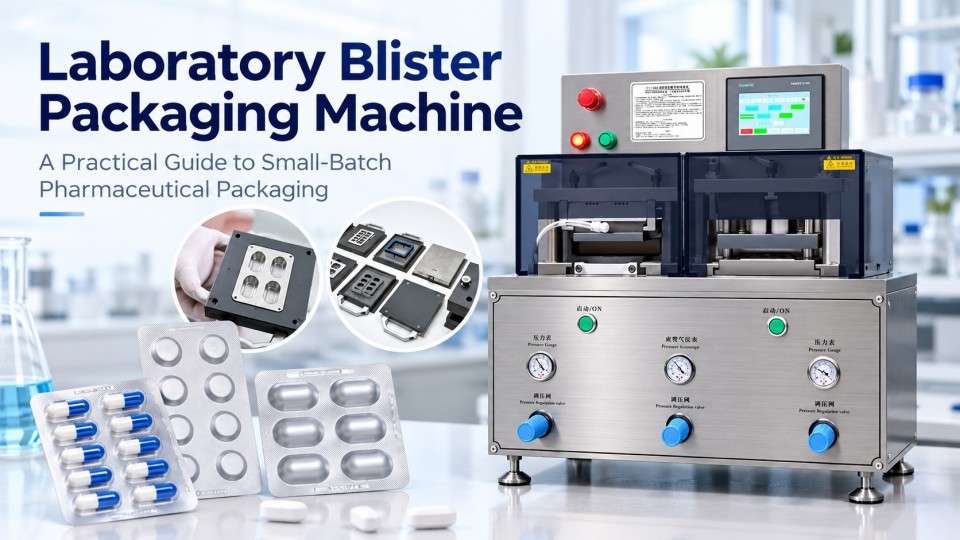
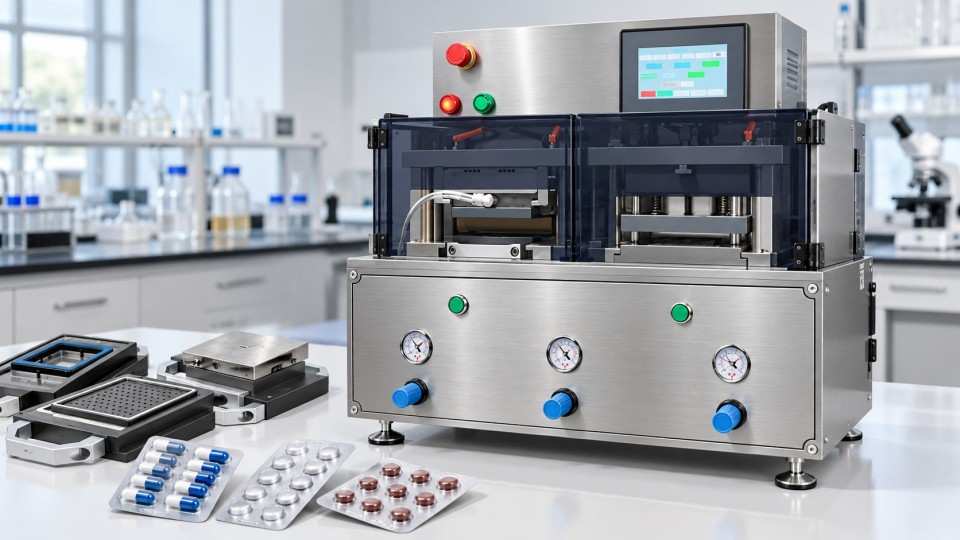
ET laboratory blister packaging machine produces small batches of sealed tablet and capsule blisters for pharmaceutical R&D, packaging development, et études de stabilité. Unlike industrial blister packaging lines, laboratory machines prioritize flexible tooling, controlled test conditions, and low material consumption.
These machines support thermoformed plastic blisters with aluminum lidding (PVC/Alu) et, where equipped, cold-formed aluminum blisters (Pilon / Pilon). Key variables include cavity dimensions, forming conditions, température de scellage, pression, et temps de séjour. Material barrier properties, seal strength, and package integrity determine whether the finished packs meet the intended testing requirements.
This guide explains laboratory blister machine types, operating principles, matériaux d'emballage, pharmaceutical applications, quality testing, and equipment selection. It also examines why laboratory packaging results cannot be transferred directly to commercial production without further process evaluation.
Why Do Pharmaceutical Labs Need Blister Packaging Machines?
Pharmaceutical laboratories use blister packaging machines to produce small, controlled batches for formulation development, packaging material evaluation, stability testing, and clinical trial preparation. These applications require reproducible packaging conditions, flexible tooling, and efficient material use rather than high production speeds.
A laboratory blister packaging machine allows technicians to evaluate dimensions de la cavité, profondeur de formage, paramètres d'étanchéité, compatibilité des matériaux, and finished-pack quality without occupying a commercial blister packaging line.
What Makes Laboratory Blister Packaging Different?
Industrial blister packaging machines prioritize continuous operation, automated feeding, high throughput, and consistent production output. Laboratory machines prioritize process flexibility, smaller batch sizes, and repeatable testing conditions.
Par exemple, evaluating PVC/Alu against Alu/Alu packaging requires more than producing two blister formats. Both configurations must be assessed against the intended product’s moisture sensitivity, cavity geometry, seal performance, and stability requirements.
Laboratory equipment also helps manufacturers evaluate packaging changes before larger production trials, reducing unnecessary line changeovers and material consumption.
Manuel, Benchtop, and Pilot-Scale Blister Machines
These categories describe different equipment characteristics rather than three mutually exclusive machine types.
| Machine category | Caractéristique principale | Typical application |
| Machine d'emballage sous blister manuelle | Operator performs one or more packaging steps | Sample preparation and limited packaging trials |
| Benchtop blister machine | Compact equipment footprint | Laboratory R&D, essai de matériaux, and small-batch packaging |
| Pilot-scale blister machine | Equipment used to investigate process feasibility before commercial manufacturing | Packaging development and process scale-up studies |
A benchtop machine can use manual product loading while controlling forming, scellage, or cutting operations. De la même manière, pilot-scale equipment does not necessarily reproduce the mechanical behavior of an industrial blister line.
What Should a Laboratory Packaging Trial Measure?
A useful packaging trial evaluates measurable quality attributes, not simply the number of finished blisters. Depending on the study objective, these include cavity formation, material deformation, seal strength, intégrité du joint, dimensional consistency, and protection against moisture.
The laboratory must also document the packaging materials, tooling configuration, paramètres de processus, sampling method, et critères d'acceptation. These records help distinguish a repeatable packaging process from a successful one-off sample.
How Does a Laboratory Blister Packaging Machine Work?
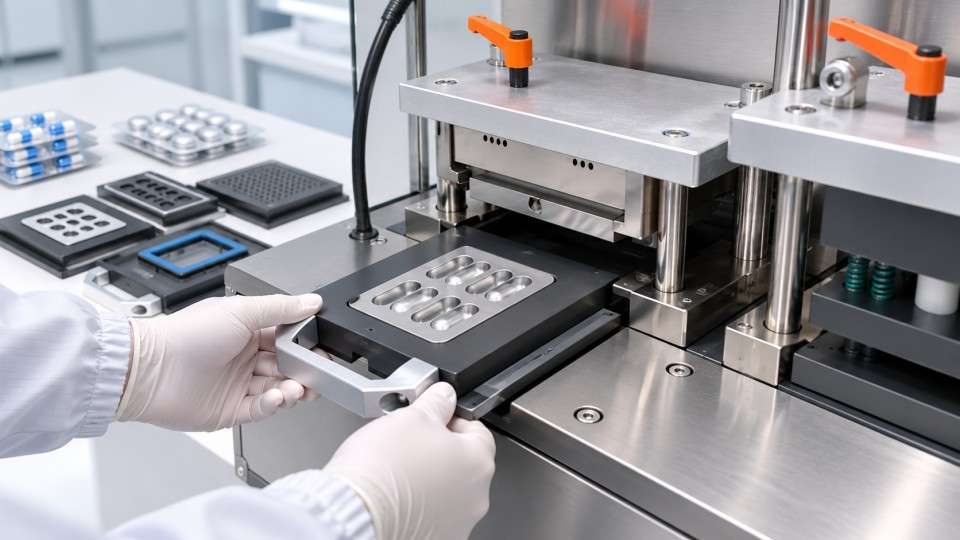
A laboratory blister packing machine forms individual cavities, receives tablets or capsules, seals a lidding material over the filled pockets, and cuts the web into sample packs. Some operations are manually assisted; others are machine-controlled.
Thermoforming and Cold Forming
Dans thermoform blister packaging, a plastic film such as pharmaceutical-grade PVC is heated until it can be shaped against a mold. Vacuum or pressure shapes cavities; cooling fixes them. Film thickness, draw depth, and tooling geometry influence wall thinning at corners.
Formage à froid instead mechanically presses a multilayer aluminum laminate into the forming tool without heating the forming web as a thermoplastic. Cold forming often needs larger cavity footprints. “Cold-formed” describes cavity formation; the subsequent sealing operation still uses heat when the materials require it.
Chargement, Scellage, and Cutting
Après avoir formé, an operator or feeder places each tablet or capsule inside a cavity. A compatible, coated aluminum lidding foil covers the forming web. Heat and pressure seal the web for a defined dwell time; the web is cut into blister cards.
Le sealing window depends on the foil coating, the forming web’s seal layer, contact conditions, et conception de machines. Too little effective heat or contact can leave weak bonds; excessive heat, pression, or misalignment can distort pockets, wrinkle foil, or damage the seal region. Powder on the sealing land can create leak paths.
How Is Blister Seal Quality Checked?
Visual inspection detects wrinkles, incomplete forming, misplaced tablets, and obvious sealing defects. It does not establish that every cavity is leak-free. Seal-strength testing measures resistance to separation; integrity testing investigates leakage or package tightness.
ASTM F88/F88M describes the measurement of seal strength for flexible barrier materials. Suitable leak-detection methods—selected and qualified for the specific blister construction—provide different evidence about integrity. Define sampling and acceptance criteria before comparing trial settings.
Research by Mühlfeld and colleagues illustrates the distinction: increasing heat-seal lacquer weight raised measured seam strength in the studied blister materials, but changes in helium leak-tightness were small, and the higher-coating configurations showed greater moisture uptake. A stronger seal did not automatically give better moisture protection.
PVC/Alu vs. Pilon / Pilon: Which Is Better for Laboratory Testing?
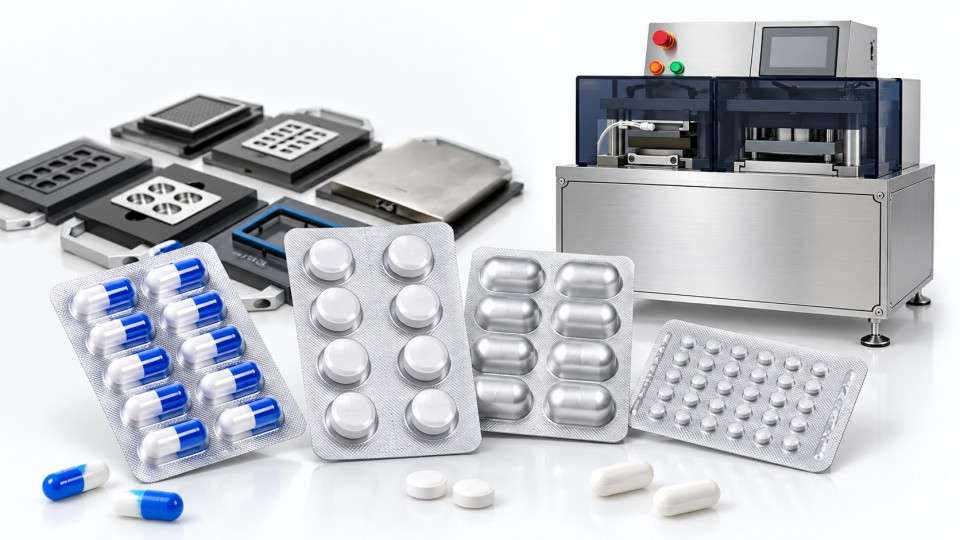
PVC/Alu is useful when visibility, forming flexibility, and cost matter; Alu/Alu is often selected when the dosage form requires a stronger barrier against moisture and light. Neither should be selected solely from a material label. Drug sensitivity, seal performance, géométrie, and storage period determine the configuration.
| Blister format | Forming method | Visibilité | Barrier and practical trade-off |
| PVC/Alu | Heated PVC film is thermoformed; aluminum lidding is sealed over it | Transparent forming side | Common, economical option; moisture protection depends on film thickness, seal and storage conditions |
| High-barrier thermoform/Alu | Laminated or specialized films such as PVC/PVDC, PCTFE (Aclar), or cyclic olefin structures are thermoformed when compatible | Often transparent or translucent | Can improve moisture protection while retaining some visibility; requires suitable tooling and forming conditions |
| Pilon / Pilon | Aluminum-based laminate is cold-formed and sealed with aluminum lidding | Opaque | Strong moisture and light barrier when intact; typically needs more forming space and careful cold-form tooling |
What Do Stability Data Actually Show?
A published study by Allinson, Dansereau, and Sakr tested a specific moisture-sensitive tablet formulation under accelerated storage at 40°C and 75% relative humidity for six months. The remaining drug assay was 84% in PVC blisters, 91% in cyclic olefin blisters, 97% in Aclar blisters, et 100% in cold-form aluminum blisters. Measured container-permeation values were 0.259, 0.040, 0.008, et 0.001 mg per blister per day, respectively, for the studied configurations.
The figures are product- and test-specific—not universal material ratings, predicted shelf lives, or performance claims for any particular blister machine. They support comparing packaged-product stability, not only film specifications.
Forming Quality Is Part of Barrier Performance
Excellent foil barrier properties cannot compensate for cracked cavities or contaminated seals. Transparent films can lose wall thickness during deep thermoforming; cold-form laminates can be stressed at sharp corners. Inspect cavities and flanges; verify integrity or stability. Packaging material selection and process development must be evaluated together.
Where Are Laboratory Blister Packaging Machines Used?
The principal applications are pharmaceutical R&D, packaging material screening, stability studies, clinical trial preparation, and small-batch packaging development. Documentation requirements differ by application.
Formulation and Packaging Development
Development teams compare cavity dimensions for round or oblong tablets, evaluate whether a capsule fits without compression, and screen film and lidding combinations. Use a defined experiment instead of changing mold depth, matériel, and sealing temperature without tracking their effects. Record defects, rejette, material use, and settings.
Stability Studies and Clinical Trial Packs
Stability studies investigate how the drug product in its proposed container-closure system behaves over time. Je Q1A(R2) provides a framework for formal stability data supporting registration of applicable drug products. Short bench trials cannot replace a defined stability protocol.
Clinical trial packaging introduces additional controls for product identity, batch traceability, étiquetage, contamination prevention, et conformité réglementaire. A laboratory machine can help develop or prepare trial formats, but its size or stainless-steel construction does not itself establish GMP suitability for investigational medicinal products.
Comprimés, Gélules, and Specialized Small Batches
Verser tablet blister packaging, verify that cavity clearance, alimentation, and sealing protect the tablet edges and coating. Pour capsule blister packaging, consider shell dimensions, orientation, heat exposure, and the risk of deformation or trapping a capsule in the seal area. Small batches may also support packaging development for unusual dosage-form dimensions, à condition que l'outillage, matériels, and process controls are appropriate.
Can Laboratory Blister Packaging Results Be Used in Mass Production?
Laboratory results can guide commercial blister packaging development, but they cannot replace production-line trials, equipment qualification, or process validation. Material comparisons, preliminary cavity designs, defect observations, and suitable test methods are transferable knowledge. Machine setpoints are not automatically transferable.
| Facteur | Laboratory equipment | Industrial blister packaging line | What must be checked during scale-up |
| Objectif principal | Flexible trials and limited samples | Repeated commercial output | Whether trial findings remain relevant at production speed |
| Heating and sealing | Smaller tools, often intermittent operation | Different tooling mass, contact and heat transfer | Actual seal temperature distribution, pression et temps de séjour |
| Forming and web transport | Short runs, assisted handling possible | Higher-speed film feeding and tension control | Cavity consistency, thinning, rides, inscription |
| Quality evidence | Feasibility tests and documented samples | Routine controls and qualified inspection | Sampling strategy, defects, integrity and approved limits |
What Should Be Transferred—and Retested?
A practical transfer package contains the selected forming and lidding materials, cavity drawing, development settings, identified failure modes, trial sample results, and test methods. Production engineers must establish a new operating window for forming, scellage, web speed, et inspection.
BPF de l'UE Annexe 15, sections 7.1–7.2, specifically recognizes that packaging-machine parameters can affect package integrity and calls for qualification across the defined ranges of relevant parameters such as temperature, vitesse de la machine, and sealing pressure. The conclusion is operational: keep the laboratory evidence, but qualify the commercial process on its own equipment.
How to Choose the Right Laboratory Blister Packaging Machine?
Choose a laboratory blister packaging machine by test purpose, compatibilité des matériaux, and required quality evidence—not footprint or advertised output.
Check Materials, Formats, and Tooling First
Confirm the exact forming webs and lidding foils, y compris PVC/Alu, Pilon / Pilon, and any specialized laminates. Cold forming needs suitable molds and material feeding. Check forming area, card layout, profondeur de la cavité, flange width, and tablet or capsule clearance. Nominal forming area is not usable pocket area.
Multiple cavity designs require tooling changes. Ask whether forming, scellage, and cutting tools can be exchanged independently, and whether changeover claims include alignment, chauffage, test seals, and quality checks. Fast mold replacement does not guarantee rapid sample approval.
Verify Sealing Control and Test Repeatability
Check which parameters are genuinely adjustable and recorded: temperature setpoint and measurement location, sealing pressure or force, temps de séjour, and recipe handling. Verify uniform contact across the seal. Test intended films and foils for seal defects, force, fuite, or moisture protection. Repeatability matters more than one attractive sample.
Also examine cleaning, guarding, utilitaires, outillage, et IQ/OQ/PQ documentation where required. Clinical-use suitability must be established against the site’s actual quality system and regulatory obligations.
A Compact Machine Example
Emballage Ruida LDPP-140H laboratory blister packing machine supports PVC/Alu and Alu/Alu packaging for tablets and capsules. It offers a maximum forming area of 110 × 120 mm and modular tooling for quick format changes.
When evaluating laboratory blister equipment, prioritize material compatibility, dimensions de la cavité, seal quality, and repeatable test results over machine size or advertised speed.
A suitable laboratory machine should produce reliable packaging samples and useful process data before larger-scale production trials.
Questions fréquemment posées
What is a laboratory blister packaging machine?
It is a small-batch machine used to form, remplir, joint, and cut blister packs for pharmaceutical development and testing. Automation levels differ, and some product-loading steps are manual.
Is a manual blister packing machine the same as a benchtop machine?
Non. Manuel describes operator participation; benchtop describes physical size. A compact machine can still control forming and sealing while an operator loads tablets or capsules.
Can laboratory blister machines package capsules as well as tablets?
Oui, if the cavity dimensions, outillage, méthode d'alimentation, and sealing configuration suit the capsule. Verify shell clearance and deformation risk with the actual capsule format.
Is Alu/Alu always better than PVC/Alu?
Non. Cold-form Alu/Alu provides strong light and moisture protection when the package is correctly formed and sealed, but material costs, visibilité, forming space, and product stability also matter.
Does a strong blister seal prove that the pack is leak-free?
Non. Seal strength measures resistance to separation; seal integrity concerns leakage. Use suitable, qualified integrity testing when that property must be demonstrated.
Can a laboratory blister machine make clinical trial packs?
It can support clinical packaging activities if the equipment, facilité, documentation, processes, and applicable GMP controls meet the project’s requirements. Benchtop size alone does not establish compliance.
Can laboratory sealing settings be copied to an industrial machine?
Not without evaluation. Tool geometry, heat transfer, pression d'étanchéité, vitesse de la machine, and film transport differ. Develop and qualify a production-specific operating range.
Références
- Agence européenne des médicaments. Je Q1A(R2): Stability Testing of New Drug Substances and Products.
- Commission européenne. Annexe BPF de l'UE 15: Qualification et Validation, section 7.
- ASTM International. ASTM F88/F88M-23: Seal Strength of Flexible Barrier Materials.
- Allinson, J. G., Dansereau, R.. J., and Sakr, UN. (2001). The effects of packaging on the stability of a moisture sensitive compound. Journal international de pharmacie.
- Mühlfeld, L., et autres. (2012). Influences of heat seal lacquer thickness on the quality of blister packages. European Journal of Pharmaceutical Sciences.