การแนะนำ
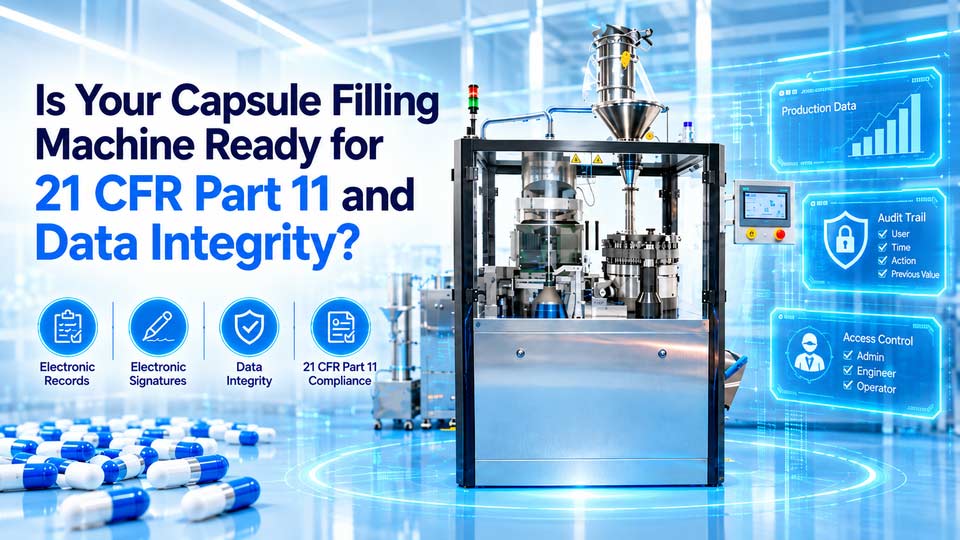
You are selecting a เครื่องบรรจุแคปซูล for a pharmaceutical production line. The supplier shows you an HMI with login functions, production counts, สัญญาณเตือน, and machine parameters. But one question remains: Can this capsule filler actually support your 21 ส่วนซีเอฟอาร์ 11 and data integrity requirements?
A machine may generate large amounts of electronic data during production. An HMI can display machine data, but this alone does not prove that the system meets Part 11 ความต้องการ.
This article explains what 21 ส่วนซีเอฟอาร์ 11 means for capsule filling machines, what data the equipment generates, which functions should be included, and how the PLC, เอชเอ็มไอ, and data storage system work together to support data integrity.
ประเด็นสำคัญ
- 21 ส่วนซีเอฟอาร์ 11: Electronic records require controlled access, reliable records, เส้นทางการตรวจสอบ, and appropriate system controls.
- Machine functions: User permissions, parameter management, เส้นทางการตรวจสอบ, บันทึกอิเล็กทรอนิกส์, timestamps, data retrieval, and backup may be required.
- Data sources: Capsule filling machines generate data from operator inputs, เซ็นเซอร์, drives, PLC, and system events.
- PLC and HMI: The PLC controls and collects machine data, while the HMI manages operator interaction and displays production information.
- System architecture: ส่วนหนึ่ง 11 readiness depends on the complete data system, not the PLC or capsule filling machine alone.
Why Electronic Records Matter in Capsule Filling
From Paper Records to Machine Data
ในการผลิตยา, production records once depended heavily on handwritten entries and manual checks. A capsule filling machine now generates electronic data throughout the production process. Operators may enter batch numbers, filling parameters, and recipe settings through the HMI. Sensors and the PLC can also collect actual production conditions and machine status.
This creates more than simple machine data. For a capsule filler, production counts, parameter values, สัญญาณเตือน, and operating events can become part of the electronic records used to document a batch. The same principle applies to other อุปกรณ์บรรจุแคปซูล connected to digital production systems.
When Machine Data Becomes a GMP Record
Not every data point generated by a capsule filling machine automatically becomes a regulated record. Its significance depends on how the data is used within the pharmaceutical manufacturing process and the applicable ข้อกำหนด GMP.
When electronic records from capsule filling machines are relied upon to document production or quality-related activities, data integrity becomes important. The system should preserve accurate production data and allow appropriate access, review, and retrieval.
This is why data integrity in capsule filling machines cannot be separated from the way electronic data is created, เก็บไว้, and managed. This raises another question: what controls does 21 ส่วนซีเอฟอาร์ 11 place on electronic records?
Key Requirements for Electronic Records Under Part 11?
A clear understanding of Part 11 requirements should come before evaluating a capsule filling machine. ส่วนหนึ่ง 11 addresses electronic records and electronic signatures used in activities subject to FDA requirements.
Understanding 21 ส่วนซีเอฟอาร์ 11
CFR stands for the Code of Federal Regulations, which contains U.S. federal regulatory requirements. Title 21 covers products regulated by the FDA. Within Title 21, ส่วนหนึ่ง 11 is titled “Electronic Records; Electronic Signatures.”
ในแง่การปฏิบัติ, ส่วนหนึ่ง 11 establishes controls intended to make electronic records dependable and trustworthy, while addressing electronic signatures as an alternative to traditional handwritten signatures and paper-based records.
21 ส่วนซีเอฟอาร์ 11 Requirements at a Glance
The main requirements for electronic records and electronic signatures include:
| Requirement | ส่วนหนึ่ง 11 Reference | Key Requirement |
|---|---|---|
| System validation | §11.10(อัน) | “Accuracy, ความน่าเชื่อถือ, consistent intended performance” |
| Accurate and complete records | §11.10(ข) | “Accurate and complete copies” |
| Record protection | §11.10(ค) | Retrieval throughout the retention period |
| Authorized access | §11.10(d) | Access limited to “authorized individuals” |
| Audit trails | §11.10(จ) | “Secure, computer-generated, time-stamped audit trail” |
| Operational checks | §11.10(ฉ) | Controls for permitted operations and sequences |
| Authority checks | §11.10(ก) | Controls for authorized operations |
| Device checks | §11.10(ชม.) | Verification of input or operational instructions |
| การฝึกอบรมบุคลากร | §11.10(ฉัน) | Required education, การฝึกอบรม, and experience |
| Accountability | §11.10(j) | Accountability for electronic signatures |
| System documentation | §11.10(k) | Controls over system documentation and changes |
| Electronic signatures | §§11.50, 11.70 | Signature information and linkage to records |
What Functions Should a Capsule Filler Provide?
Knowing the requirements of 21 ส่วนซีเอฟอาร์ 11 is only the starting point. The next step is to check what functions a capsule filling machine should provide when electronic production data is used in a regulated process.
User Login and Permission Management
A capsule filling machine may be used by several people during production. Their responsibilities are different, so the system should separate users by role.
Common roles may include:
- Operator — runs the capsule filling machine and monitors production.
- Maintenance Engineer — performs maintenance and checks equipment conditions.
- Quality Personnel — reviews production data and relevant records.
- System Administrator — manages users, permissions, and system settings.
Why separate these roles?
Because not every person should perform the same actions. An operator may need to run the machine, while a maintenance engineer may need access to maintenance settings. A system administrator may need to manage user accounts.
Role separation also helps with traceability. If several people use the same account, the system cannot clearly identify who changed a parameter or modified a recipe.
ดังนั้น, the next question is: How can the system know who actually performed an action?
Each user should have an individual account. The account identifies the person using the system and allows machine actions to be linked to a specific user.
But individual accounts alone are not enough. If one person can simply log in with another person’s account, the traceability becomes meaningless.
This is why password management is also important. Each user should have their own password, with appropriate controls for account access. The system may also record login and logout events.
There is another important point. A login account establishes a user’s identity, but it does not mean that the same person should have unrestricted access to every machine function.
An operator may run an automatic capsule filling machine, but may not be allowed to change system settings. A maintenance engineer may have access to maintenance functions, while a system administrator can manage users and permissions.
This is where user permissions become important. They define what each account can view, enter, change, or approve.
For pharmaceutical capsule filling machines, these controls should match the project’s validation and data integrity requirements. When reviewing capsule filling equipment data management, buyers should therefore check three things:
Who can log in? What can each user change? Can the system identify who performed the action?
Parameter and Recipe Management
A capsule filling machine runs with a set of production parameters. These can include filling weight, ความเร็วเครื่อง, การตั้งค่าการจ่ายยา, ขนาดแคปซูล, and other process values.
A capsule filling machine parameter management system can organize these settings and keep the required values available for production. Instead of entering every value manually, the machine can use predefined production parameters for a specific product or capsule size.
The same idea applies to recipes. A capsule filling machine recipe management function can store a complete group of production settings for a particular product. When production changes, the corresponding recipe can be selected instead of rebuilding the settings from the beginning.
But what happens when a recipe or parameter is changed after it has been used?
The system also needs to preserve information about parameter changes so that the current value can be compared with its earlier state. Relevant changes should remain traceable where required, rather than simply replacing the previous value.
This is important for capsule filler parameter control because production records may need to show which settings were used during a specific batch. It also helps connect machine settings with the corresponding electronic records.
Audit Trails and Alarm History
A production parameter can change during a batch. A useful change record should show who made the modification, when it occurred, what value was entered, และ, ในกรณีที่เกี่ยวข้อง, which value existed before the change.
This is where an audit trail becomes important. ส่วน 11.10(จ) ของ 21 ส่วนซีเอฟอาร์ 11 refers to a “secure, computer-generated, time-stamped audit trail” for applicable electronic records.
For a capsule filling machine audit trail, the record can be presented in a simple table on the HMI or connected data system:
| Date & Time | ผู้ใช้ | พารามิเตอร์ | Previous Value | New Value | Action |
|---|---|---|---|---|---|
| 10:32:15 | John | Filling Weight | 300 มก | 320 มก | Changed |
| 10:45:08 | Sarah | Machine Speed | 50 รอบต่อนาที | 45 รอบต่อนาที | Changed |
| 11:06:42 | John | ขนาดแคปซูล | 0 | 00 | Changed |
Now the purpose of the audit trail becomes easier to understand. If someone asks why the filling weight was changed from 300 mg to 320 มก, the record can show when the change happened and which user made it.
The audit trail is different from an alarm history.
An alarm history records machine events, เช่น:
| Date & Time | Alarm | Status |
|---|---|---|
| 10:28:10 | Low Vacuum Pressure | Cleared |
| 10:51:32 | Capsule Shortage | Cleared |
| 11:12:06 | Motor Overload | Cleared |
The alarm history tells you what happened to the machine. The audit trail tells you what happened to relevant electronic records or settings.
When evaluating a capsule filler, buyers should therefore check whether the system can provide a clear audit trail, including the relevant user, เวลา, previous value, and new value.
This helps make electronic records easier to review and supports data integrity in capsule filling machines.
Electronic Records and Data Retrieval
A capsule filling machine can generate a large amount of data during production. This may include batch numbers, production counts, พารามิเตอร์ของเครื่อง, alarm records, and relevant audit trail records.
But displaying this information on an HMI does not mean the data is safely stored.
If a client needs to review a batch produced three months ago, the system should be able to find the required records. This is why capsule filling machine electronic records need proper storage and retrieval methods.
ตัวอย่างเช่น, a production data screen may allow a user to select a date or batch number:
| Date | หมายเลขแบทช์. | Production Count | Filling Weight | Status |
|---|---|---|---|---|
| 2026-10-01 | B26001 | 120,500 | 300 มก | สมบูรณ์ |
| 2026-10-02 | B26002 | 118,900 | 300 มก | สมบูรณ์ |
| 2026-10-03 | B26003 | 121,300 | 320 มก | สมบูรณ์ |
The user can select a batch and review its available production data. This is the basic idea behind capsule filling machine data retrieval.
Data export can also be important. Depending on the system design, production records may be exported for review, reporting, or use in another system.
Data backup is another part of capsule filling equipment data management. If important production records exist only on the machine’s local computer, a hardware failure could make those records difficult to recover. An appropriate backup method can reduce this risk.
Data storage, retention, and backup arrangements should be defined according to the equipment configuration and the requirements of the specific project. It may involve an industrial PC, database, server, or another approved storage system.
The key point is simple: electronic records should not only be generated. They should also be stored, found, ตรวจสอบแล้ว, and backed up when required.
When evaluating electronic records for capsule filling machines, ask:
Can I find an old batch record, review the relevant data, export it when needed, and recover it if the original data is lost?
Electronic Signatures and Record Approval
Logging into a capsule filling machine and signing an electronic record are not the same thing.
A login tells the system who is using the machine. An electronic signature shows that a person has taken responsibility for a specific electronic record or action.
ตัวอย่างเช่น, after a batch is completed, a review screen may show:
| Date & Time | ผู้ใช้ | Action | Signature Meaning |
|---|---|---|---|
| 14:20:15 | Sarah Lee | Signed | Production Record Reviewed |
| 14:22:08 | David Chen | Signed | Production Record Approved |
The record can also be linked to the corresponding batch:
Batch No.: B26003
Production Date: October 3, 2026
Record Status: Approved
This makes the purpose of the electronic signature clear. The system is not simply recording that Sarah or David logged in. It is recording that they reviewed or approved a specific electronic record.
ดังนั้น, when evaluating capsule filling equipment, buyers should ask:
Can an electronic signature be linked to the correct record, and can the system show who signed it, when they signed it, and what the signature meant?
This helps connect electronic signatures with electronic records and overall data integrity.
Why Does the PLC Matter for Data Integrity?
What Role Does the PLC Play?
The PLC functions as the central control unit of the capsule filling machine.
The machine data flow can be simplified into several stages:
Sensors and Machine Components → PLC → HMI / Data System
The PLC receives signals from different machine components, processes this information, and sends control instructions back to the equipment.
ตัวอย่างเช่น, when a sensor detects a machine condition, the PLC can process the signal and control the corresponding operation. The HMI presents relevant information to the user, allowing production status and machine conditions to be monitored.
For capsule filling equipment, the PLC provides the basic control and data processing foundation. This architecture provides a consistent method for collecting and processing machine signals.
อย่างไรก็ตาม, a PLC alone does not determine whether a system meets 21 ส่วนซีเอฟอาร์ 11 ความต้องการ. Data integrity depends on the complete system, including the PLC, เอชเอ็มไอ, ซอฟต์แวร์, data storage, user management, and validation process.
This is why many pharmaceutical packaging equipment manufacturers pay close attention to the PLC platform used in their machines.
Why Do Manufacturers Choose Siemens PLC?
Many capsule filling machine manufacturers choose Siemens PLC because it provides advantages beyond basic machine control.
Compared with basic PLC platforms, Siemens PLC systems usually provide stronger system integration capabilities. They can communicate more easily with HMIs, เซ็นเซอร์, servo drives, and higher-level factory systems, which is important for complex อุปกรณ์บรรจุภัณฑ์ยา.
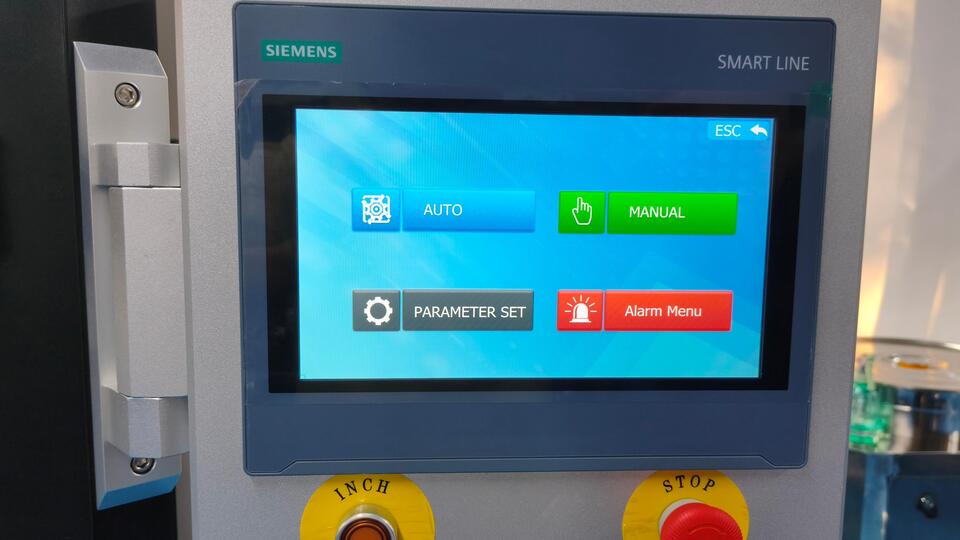
Another difference is diagnostic capability. Siemens PLC platforms provide detailed system information that can help engineers identify equipment conditions and troubleshoot problems more efficiently.
Scalability is also an important factor. As production requirements increase, a Siemens-based control system can be expanded with additional modules or connected devices without completely changing the automation architecture.
For international pharmaceutical projects, global availability is another advantage. Many engineers around the world have experience with Siemens systems, which can make technical support, การซ่อมบำรุง, and future upgrades easier.
Because of these advantages, Siemens PLC is widely selected for industrial automation applications, including Siemens PLC for pharmaceutical equipment.
In the pharmaceutical machinery industry, manufacturers such as Fette, คอร์ช, บ๊อช, อูลมานน์, โรมาโก, มี, มาร์เชซินี, Ruida Packing, and Syntegon operate in demanding production environments covering กดแท็บเล็ต, capsule equipment, บรรจุภัณฑ์แบบพุพอง, การบรรจุกล่อง, and other pharmaceutical processes.
อย่างไรก็ตาม, the PLC brand alone does not determine 21 ส่วนซีเอฟอาร์ 11 readiness. A reliable data integrity system depends on the complete equipment design, including software configuration, การจัดการข้อมูล, user control, พื้นที่จัดเก็บ, and validation.
บทสรุป
A capsule filling machine can generate a large amount of electronic data during production. อย่างไรก็ตาม, creating electronic data is only the beginning of the compliance process. The machine also needs appropriate controls for user access, การเปลี่ยนแปลงพารามิเตอร์, เส้นทางการตรวจสอบ, บันทึกอิเล็กทรอนิกส์, ลายเซ็น, พื้นที่จัดเก็บ, and data retrieval.
21 ส่วนซีเอฟอาร์ 11 should therefore be considered as a complete system requirement, rather than a single machine function. The PLC, เอชเอ็มไอ, application software, database, user management, and validation process all have a role in the final data integrity architecture.
When selecting a capsule filler, do not ask only whether the machine uses a Siemens PLC or has a digital HMI. Ask how the complete system handles electronic records and who can access or change them.
A practical review should cover three areas: machine functions, การจัดการข้อมูล, และ validation support. This approach helps pharmaceutical manufacturers determine whether a capsule filling machine can fit their electronic record and data integrity requirements before the equipment enters production.
คำถามที่พบบ่อย
What should be included in a Part 11-ready capsule filling machine?
The system should support appropriate user access controls, parameter management, เส้นทางการตรวจสอบ, บันทึกอิเล็กทรอนิกส์, and signatures where required. Data storage, backup, retrieval, and validation should also be addressed at the project level.
What should the audit trail record on a capsule filling machine?
For relevant electronic records, the audit trail should capture changes in a secure, computer-generated, time-stamped format. Typical information includes the user, date and time, action, previous value, and new value.
FAT Checks for Part 11-Related Functions?
FAT should verify the agreed functions before shipment, including user permissions, parameter controls, audit trail behavior, บันทึกอิเล็กทรอนิกส์, สัญญาณเตือน, and other specified data functions. The exact FAT scope should follow the approved URS and validation plan.
Which Compliance and Technical Documents Should the Manufacturer Provide?
The project may require documents covering functional specifications, software and hardware architecture, การเข้าถึงของผู้ใช้, เส้นทางการตรวจสอบ, data handling, ไขมัน/วันเสาร์, and validation support. The exact documentation package should be defined by the URS and quality agreement.