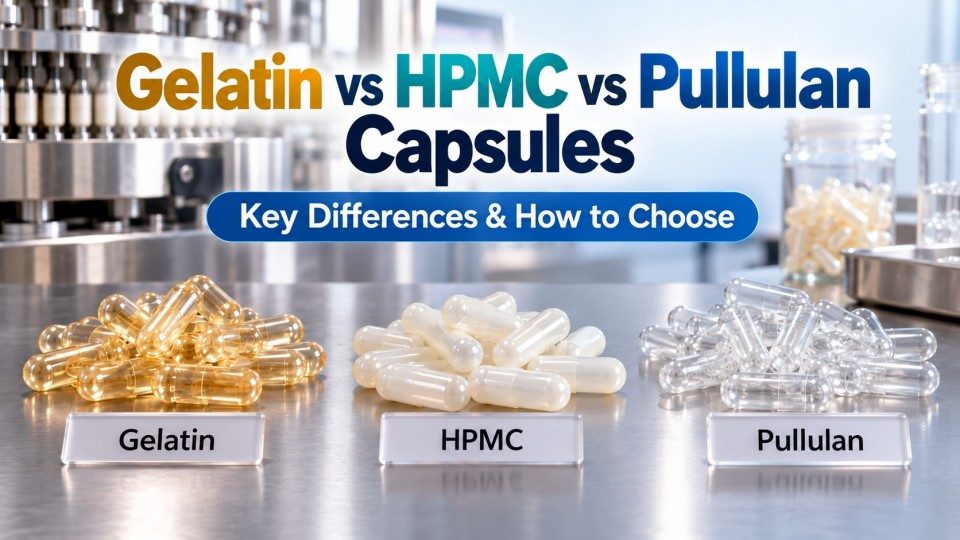
Choosing between gelatin, HPMC, and pullulan capsules is not simply a question of animal-based versus vegetarian materials. Dla producentów farmaceutycznych, nutraceutical manufacturers, dietary supplement producers, and contract development and manufacturing organizations (CDMO), the shell must suit the formulation, production conditions, filling process, i ostateczne opakowanie.
Quick answer: Gelatin is often the economical starting point for conventional powders and granules. HPMC generally has lower inherent shell moisture, making it worth evaluating for hygroscopic ingredients and vegetarian products. Pullulan is a fermentation-derived alternative with promising oxygen-barrier properties demonstrated in laboratory film studies. No material is universally best: finished-capsule performance must be tested with the actual formulation.
Shell choice also matters on an automatyczna maszyna do napełniania kapsułek. Differences in moisture, elastyczność, wymiary, and surface behavior can affect capsule separation, zamknięcie, and rejection rates. This guide connects material properties to formulation stability and practical production checks.
1. What Are Gelatin, HPMC and Pullulan Capsules Made Of?
All three materials can form two-piece hard capsules consisting of a body and cap. They differ from one-piece softgel capsules, which require a different encapsulation process. Understanding the broader types of capsules helps distinguish shell composition from capsule structure.
Żelatyna is a collagen-derived protein, typically sourced from bovine or porcine materials. It has a long history of pharmaceutical use, broad availability, and well-established filling experience. Its animal origin may limit suitability for certain dietary requirements.
HPMC, or hypromellose, is a cellulose-derived polymer. It is commonly used for non-animal hard capsules and generally contains less inherent water than conventional gelatin shells. Commercial HPMC grades may differ in their gelling systems and other ingredients.
Pullulan is a polysaccharide produced through microbial fermentation. It forms films with interesting oxygen-barrier properties, but a finished capsule is not identical to a laboratory film.
For pharmaceutical and dietary supplement manufacturers, check the complete capsule specification—not only the polymer name. Barwniki, processing aids, dimensional tolerances, certyfikaty, and supplier documentation can affect product suitability.
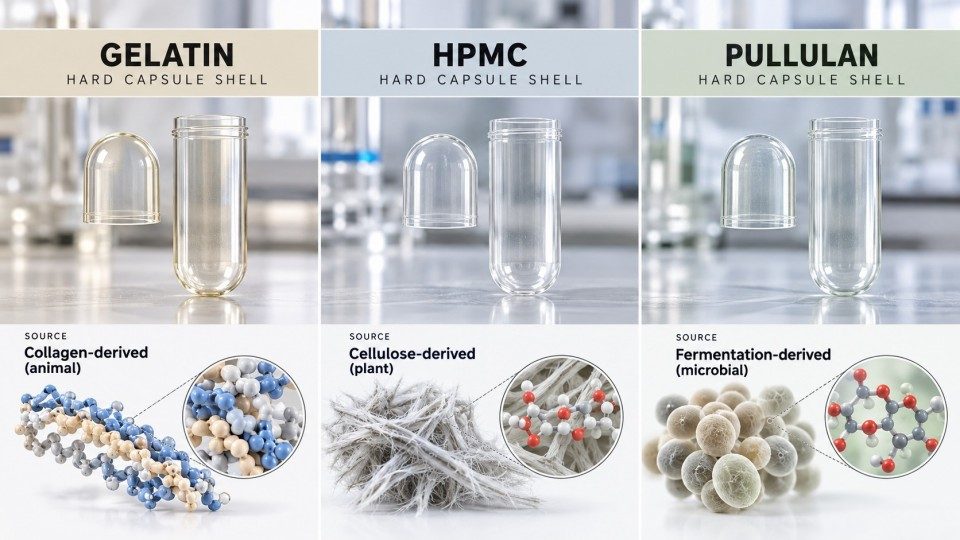
2. Gelatin vs HPMC vs Pullulan: What Are the Key Differences?
Najważniejsze różnice dotyczą zachowania się pod wpływem wilgoci, ochrona tlenu, obsługa mechaniczna, rozpuszczenie, wymagania dietetyczne, i koszt.
| Nieruchomość | Żelatyna | HPMC | Pullulan |
|---|---|---|---|
| Pochodzenie | Białko kolagenowe pochodzenia zwierzęcego | Polimer na bazie celulozy | Polisacharyd powstały w procesie fermentacji |
| Wrodzona wilgoć | Często około 13–16% w konwencjonalnych twardych skorupach | Generalnie niższe; niektóre specyfikacje komercyjne wynoszą około 3–8% | Zależne od klasy; brak niezawodnego asortymentu uniwersalnego |
| Obsługa przy niskiej wilgotności | Nadmierne suszenie może zwiększyć łamliwość | Często rozważany do zastosowań o niższej wilgotności | Wymaga weryfikacji specyficznej dla klasy |
| Sorpcja wilgoci | Stosunkowo wysoki | Najniższy w opublikowanym porównaniu trzech materiałów | W tym badaniu poniżej żelatyny, ale powyżej HPMC |
| Bariera tlenowa | Zależy od warunków i konstrukcji skorupy | Zależy od warunków i konstrukcji skorupy | Duży potencjał w badaniach czysto filmowych; potrzebne dane na poziomie kapsułki |
| Rozpuszczenie | Sieciowanie żelatyny może wpływać na uwalnianie | Formuła i system żelowania mogą wpływać na uwalnianie | Finished-product testing needed |
| Dietary suitability | Animal-derived | Generally non-animal | Generally non-animal |
| Relative cost | Zwykle niższy | Often moderately higher | Often premium-priced |
| Filling experience | Extensive | Established on compatible equipment | Confirm with supplier and filling trials |
Values are indicative rather than universal purchase specifications. Shell grade, wilgotność, temperatura, test method, and supplier formulation matter.
Moisture content is not moisture-barrier performance
A direct comparison by Yang and colleagues found that HPMC hard capsules had lower moisture sorption and equilibrium moisture content than gelatin and pullulan under the tested conditions. Pullulan showed less moisture sorption than gelatin [1].
Yet lower starting water content does not necessarily mean lower water-vapor permeability. Barham and colleagues found greater moisture uptake in gelatin than HPMC, but higher calculated diffusion and permeability parameters for HPMC at 0–40% relative humidity in their experimental system [2].
For a hygroscopic formulation, these are two separate questions: how much water is initially present in the shell, and how much moisture may enter during storage? Both deserve attention.
Mechanical behavior changes with humidity
Gelatin shells can become brittle when they lose too much moisture, increasing the risk of cracked caps or bodies during handling. Excessive moisture can also alter shell dimensions and flexibility. HPMC may offer advantages in some lower-humidity applications, but neither HPMC nor pullulan is immune to handling problems.
Compare actual capsule samples under the intended manufacturing environment instead of assuming one material will always run better.
Pullulan oxygen-barrier claims need context
Xiao and colleagues measured low oxygen permeability in pure pullulan films within a study of pullulan–alginate film systems [4]. That supports pullulan’s barrier potential; it does not establish an oxygen transmission rate for every commercial two-piece pullulan capsule.
Capsule wall thickness, sformułowanie, wilgotność, and the cap-body joint may change the result. Ask the shell supplier for product-specific data and verify the finished product’s stability. Avoid unsupported claims that pullulan is a fixed number of times more protective than HPMC.
3. How Does Capsule Shell Material Affect Product Stability?
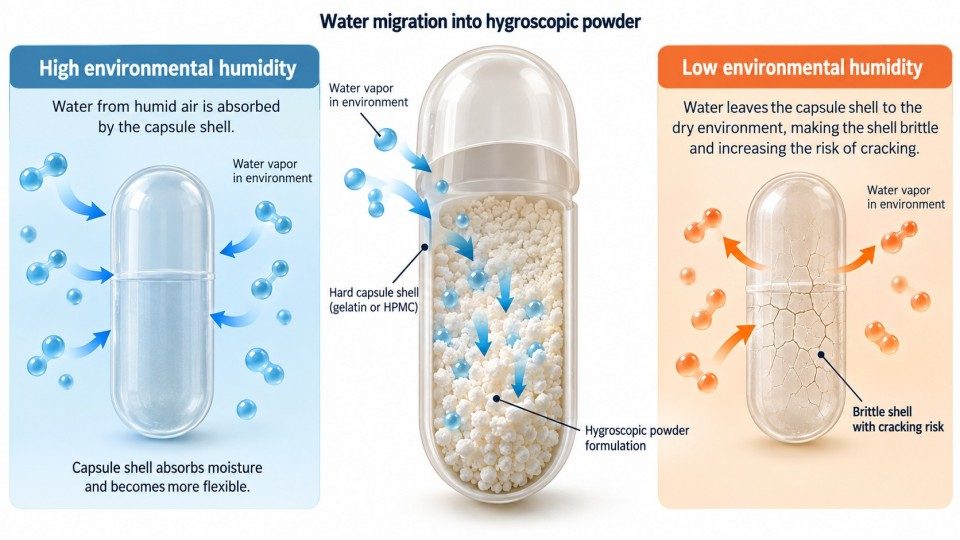
A capsule shell interacts with its contents and the surrounding environment. Water migration, oxygen exposure, chemical interactions, and release behavior can all influence product quality.
Moisture migration and shell brittleness
A strongly hygroscopic powder may draw moisture from a gelatin shell. This can change the powder’s flow properties and leave the shell more vulnerable to cracking. HPMC’s lower inherent moisture makes it a useful screening option for some moisture-sensitive formulations.
In the three-material study, HPMC and pullulan capsules reduced external moisture uptake by several model fill materials compared with gelatin under the tested conditions [1]. Jednakże, the result should not be generalized to every active ingredient or storage condition.
Assess shell moisture, fill-material water activity where appropriate, exposure during processing, and the selected package together.
Oxidation and packaging protection
Certain vitamins, botanical ingredients, obrazy olejne, and probiotic products may be oxygen-sensitive. Pullulan deserves consideration when its actual shell grade has documented barrier performance.
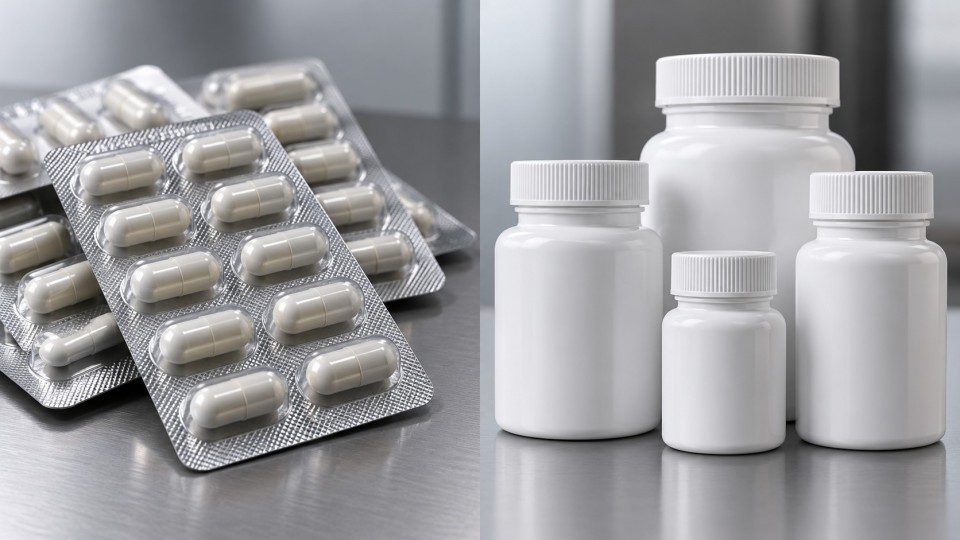
Nevertheless, oxygen exposure during blending, wypełnienie kapsułki, and packaging also matters. A suitable high-barrier blister or bottle may contribute more to shelf life than a shell change alone. Do produktów wrażliwych na wilgoć, compare bottle and blister packaging options by their actual barrier materials and sealing performance.
Desiccants require validation: overly aggressive drying may increase the brittleness of gelatin shells. The correct design is a complete fill–shell–packaging system, not a polymer chosen in isolation.
Sieciowanie, rozpad, and dissolution
Gelatin may cross-link in the presence of certain reactive compounds or after unfavorable storage, potentially slowing shell dissolution [3]. HPMC avoids gelatin-specific protein cross-linking, but its release behavior still depends on shell formulation and fill interactions.
A green tea extract study found that the tested gelatin and HPMC capsules met disintegration criteria, yet some HPMC combinations released the extract more slowly in particular dissolution media [5].
This distinction is critical for pharmaceutical manufacturers: disintegration and dissolution are not interchangeable quality measures. Validate the finished dosage form using the applicable pharmacopoeial methods and product requirements. USP General Chapter <1094> discusses capsule-related attributes affecting dissolution [8].
4. Which Capsule Material Is Best for Different Fill Materials?
Begin with the formulation’s principal risk rather than a generic ranking of capsule materials.
| Fill or product type | Practical starting point | Critical checks |
|---|---|---|
| Conventional dry powders | Żelatyna | Koszt, wahania wagi, shell integrity |
| Proszki higroskopijne | Evaluate HPMC; consider pullulan | Moisture migration, kruchość, stabilność |
| Probiotyki | Evaluate HPMC | Viability, water activity, oxygen exposure |
| Oxygen-sensitive ingredients | Consider pullulan if grade-specific data support it | Oxidation, shell barrier, final packaging |
| Botanical extracts | Gelatin or HPMC | Shell–fill interactions, rozpuszczenie |
| Pellets and granules | Any compatible hard shell | Dosing mechanism, particle integrity |
| Poorly flowing powders | Choose shell for stability needs | Przepływ, tamping or dosing settings, wahania wagi |
Hygroscopic powders and probiotics
Hygroscopic powders may absorb water, kępa, lose flowability, or degrade. HPMC is often worth evaluating because its lower inherent moisture can reduce the shell’s initial contribution of water. Pullulan may also be suitable, but environmental humidity and packaging remain important.
For probiotics, shell moisture is only one variable. Nutraceutical and dietary supplement manufacturers should measure viable counts after filling and during shelf-life studies, while controlling oxygen exposure and water activity. A material marketed as vegetarian is not automatically optimal for every microbial formulation.
Vitamins and botanical extracts
Vitamin formulations differ: some are mainly moisture-sensitive, while others are vulnerable to oxidation. Botanical extracts may interact with capsule polymers or gelling systems.
The green tea extract findings show why formulation-specific dissolution testing is valuable before switching from gelatin to HPMC [5]. The best shell is the one that maintains the required quality attributes—not simply the one with the lowest advertised moisture content.
Pelety, Granulki, and difficult powders
For pellets and granules, the dosing station and particle properties can matter more than the shell polymer. Poorly flowing powders may require changes in particle engineering, powder-bed height, or dosing settings. When determining dose capacity, the capsule size and fill-volume relationship also needs attention.
Jakiś automatic capsule filler cannot compensate for unsuitable powder flow merely by changing from gelatin to HPMC. Shell compatibility and dosing performance should be optimized together.
5. Can Gelatin, HPMC and Pullulan Run on the Same Automatic Capsule Filling Machine?
Często, Tak, provided the specific shell grade, wymiary, and machine configuration are compatible. Gelatin and HPMC are routinely processed on modern hard capsule filling equipment. Pullulan should be checked against the capsule supplier’s requirements and a representative filling trial.
Typowy maszyna do napełniania kapsułek twardych feeds and orients empty capsules, separates caps and bodies, doses the fill and locks the capsules, and discharges the finished units. Ten capsule manufacturing and filling process follows the same basic sequence regardless of shell polymer, although the operating window may change.
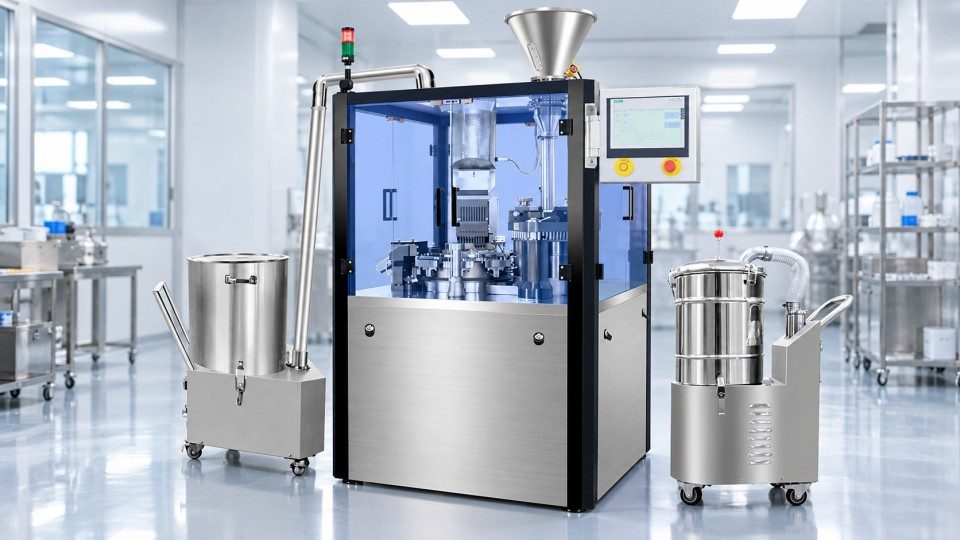
What shell changes can cause on the machine
| Shell or process condition | Possible symptom | Co sprawdzić |
|---|---|---|
| Gelatin loses excessive moisture | Pęknięte lub rozdzielone pokrywy i korpusy | Wilgotność skorupy, składowanie, radzenie sobie z ciśnieniem |
| Skorupa staje się zbyt wilgotna lub miękka | Odkształcenie, problemy z karmieniem lub zamykaniem | Wilgotność względna, czas narażenia, wymiary |
| Różna elastyczność lub tolerancje | Niekompletne zamknięcie | Sformatuj części, głębokość zamknięcia, specyfikacje powłoki |
| Słaba separacja nasadki od korpusu | Nieotwarte lub odrzucone kapsułki | Próżnia, wyrównanie, jakość skorupy |
| Ładowanie elektrostatyczne | Przyczepność proszku, niespójne postępowanie | Wilgotność, grunt, powierzchnie proszkowe i skorupowe |
| Wyższy współczynnik odrzuceń po zmianie | Spękanie, przeciek, luźne czapki | Partia powłoki, ustawienia, zamierzoną prędkość roboczą |
Oto możliwości rozwiązywania problemów, nie są to uniwersalne wady związane z konkretnymi polimerami.
Karmienie, rozdzielenie, i blokowanie
A maszyna do napełniania kapsułek farmaceutycznych należy otworzyć każdą kapsułkę bez jej deformacji, a następnie bezpiecznie zamknąć po zażyciu. Kruche łupiny mogą pękać podczas oddzielania lub blokowania. Różnice wymiarowe między dostawcami mogą również wpływać na dopasowanie, nawet jeśli kapsułki mają ten sam rozmiar nominalny.
Kiedy wydajność separacji spada, sprawdzić przechowywanie kapsułek, ustawienia próżni, wyrównanie, i oprzyrządowanie przed zwiększeniem siły mechanicznej. Podczas zamykania zmienia się jakość, sprawdzić głębokość ryglowania i stan skorupy. Są to częste przyczyny problemy z oddzielaniem i blokowaniem kapsułek.
Dokładność wypełnienia i elektryczność statyczna
Materiał kapsułki ma tylko jeden wpływ na konsystencję wypełnienia. W badaniu automatycznego napełniania kapsułek, Nair i współpracownicy odkryli ten przepływ proszku, ustawienia ubijaka, i wysokość złoża proszkowego wpływały na masę i zmienność wypełnienia kapsułki [6]. Wyniki z jednego urządzenia i receptury nie powinny stać się uniwersalnymi stwierdzeniami dotyczącymi żelatyny lub HPMC.
Kolejnym sprawdzeniem jest zachowanie elektrostatyczne. A 2025 badanie kapsułek do inhalatorów suchego proszku wykazało w badanych warunkach wyższy ładunek po napełnieniu HPMC niż żelatyny. Znaczenie miały także właściwości powierzchni i warunki procesu, i ładowanie nie wydają się być głównym wyznacznikiem wydajności napełniania [7]. Wyniki te nie powinny być uogólniane na każdą linię kapsułek doustnych.
Zmiany oprzyrządowania i akceptacja próbna
Zmiana materiału powłoki nie wymaga automatycznie części w nowym formacie. Kapsułki o tym samym nominalnym rozmiarze mogą wykorzystywać kompatybilne narzędzia, należy jednak sprawdzić wymiary i geometrię blokowania. Strukturalny zmiana maszyny do napełniania kapsułek obejmuje również wyrównanie, modyfikacja, i sprzątanie.
Przed zatwierdzeniem nowej powłoki na a maszyna do napełniania kapsułek, rekordowy sukces separacji, popękane lub rozdzielone skorupy, niepełne zamknięcia, zmienność ciężaru wypełnienia, przeciek, i odrzucone jednostki. Dokumentuj dostawcę powłoki i partię, rozmiar kapsułki, wilgotność, ustawienia maszyny, i zamierzoną prędkość.
Krótka próba przy niskiej prędkości nie jest dowodem niezawodności na pełną skalę. Evaluate performance at representative production conditions and confirm the requirements of the applicable quality system.
If you are comparing capsule shells for a new production line, Opakowanie Ruida can help review your capsule size, fill material, and target output against suitable automatic capsule filling machine configurations. Discuss your capsule filling requirements with the team.
6. How Should You Choose the Right Capsule Shell?
A practical selection process moves from formulation requirements to manufacturing validation.
1. Identify the principal risk. Is the fill hygroscopic, wrażliwy na wilgoć, oxygen-sensitive, chemically reactive, or difficult to dose?
2. Confirm market requirements. Review animal-origin restrictions, vegetarian claims, certyfikaty, regulatory specifications, and all relevant shell ingredients. A plant-derived polymer does not automatically establish halal, koszerny, or pharmaceutical approval.
3. Compare commercial shell grades. Obtain moisture specifications, dimensional tolerances, storage guidance, and relevant dissolution or barrier data. Compare supplier quotes using the same capsule size, kolor, quality grade, and order volume.
4. Conduct a representative filling trial. Test the chosen formulation and shell on the intended automatic capsule filling machine. Verify separation, dawkowanie, zamykający, szkoda, and rejects. Do planowania sprzętu, compare the types and specifications of capsule filling machines with the required batch size, capsule format, and production rate.
5. Validate the finished package. Confirm stability and, tam, gdzie ma to zastosowanie, disintegration and dissolution in the final packaging configuration.
Bottom line: Choose gelatin for many conventional, cost-sensitive products; evaluate HPMC when lower shell moisture or non-animal origin is important; and consider pullulan when its documented properties address a specific product need. The final choice must perform consistently from filling through shelf life.
Często zadawane pytania
Is HPMC better than gelatin capsules?
Not universally. HPMC generally has lower inherent moisture and is non-animal, while gelatin remains economical and widely used. Formulation requirements determine the better choice.
What is the difference between HPMC and pullulan capsules?
HPMC is cellulose-derived and often selected for lower shell moisture. Pullulan is fermentation-derived and has demonstrated strong oxygen-barrier potential in pure-film studies.
Which capsule is best for hygroscopic powders?
HPMC is often a useful starting point. Compare moisture migration, stabilność, and packaging performance before selecting a shell.
Are HPMC capsules suitable for probiotics?
They may be, but viability also depends on oxygen exposure, water activity, filling conditions, i opakowanie.
Do gelatin capsules become brittle in low humidity?
Tak. Excessive drying can increase cracking risk. Follow the shell supplier’s storage specifications.
Can gelatin capsules cross-link?
Tak. Certain reactive ingredients and storage conditions can affect gelatin dissolution.
Can one automatic capsule filling machine process all three materials?
Potentially, but confirm the machine’s compatibility with each shell grade and run representative trials.
Does switching to HPMC require new tooling?
Nie zawsze. Confirm actual dimensions, format-part compatibility, rozdzielenie, i blokowanie.
Do HPMC capsules create more static?
Some specific studies observed higher charge after filling, but behavior varies with surface properties and process conditions.
Should capsules use bottles or blisters?
Choose according to moisture and oxygen sensitivity, shelf-life targets, and finished-product stability data.
Referencje
[1] Yang et al. (2020). Moisture sorption and desorption properties of gelatin, HPMC and pullulan hard capsules. PubMed.
[2] Barham et al. (2015). Moisture diffusion and permeability characteristics of hydroxypropylmethylcellulose and hard gelatin capsules. PubMed.
[3] Digenis et al. (1994). Cross-linking of gelatin capsules and its relevance to their in vitro-in vivo performance. PubMed.
[4] Xiao et al. (2015). Barrier Properties and Microstructure of Pullulan–Alginate-Based Films. Wiley.
[5] Glube et al. (2013). Capsule shell material impacts the in vitro disintegration and dissolution behaviour of a green tea extract. PMC full text.
[6] Nair et al. (2004). Investigation of various factors affecting encapsulation on the In-Cap automatic capsule-filling machine. PMC full text.
[7] Stankovic-Brandl et al. (2025). Filling process-induced tribo-charging of lubricated and non-lubricated gelatine and HPMC capsules. PubMed.
[8] Farmakopea Stanów Zjednoczonych (2023). USP General Chapter <1094>: Capsules—Dissolution Testing and Related Quality Attributes. USP official source.