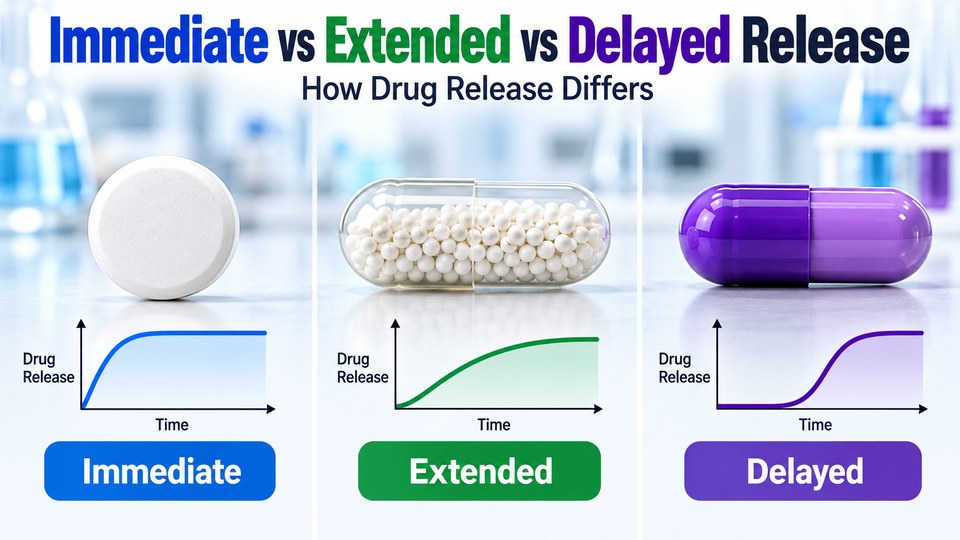
Cuando una tableta o cápsula se describe como liberación inmediata, liberación extendida, o liberación retrasada, el término se refiere a cuándo y cómo se libera su ingrediente activo. Un liberación inmediata (Y) La forma farmacéutica no tiene ningún mecanismo intencional para retrasar o prolongar la liberación.. Un liberación prolongada (ES) La formulación prolonga la liberación durante un período más largo., mientras un liberación retardada (DR) La formulación pospone la liberación hasta un momento posterior o hasta que se alcancen condiciones específicas..
Los productos de liberación prolongada y de liberación retardada pertenecen a la familia más amplia de formas farmacéuticas de liberación modificada.. Sus perfiles de liberación se pueden crear a través de sistemas matriciales., recubrimientos funcionales, formulaciones multipartículas, sistemas osmóticos, y otras tecnologías de formulación.
Comprender estas diferencias básicas también hace que términos como XR, SR, CR, SEÑOR, liberación prolongada, y la liberación sostenida es más fácil de interpretar, y explica por qué diferentes perfiles de liberación requieren diferentes enfoques de formulación y fabricación..
¿Qué significa la liberación inmediata?, Media de liberación extendida y liberación retrasada?
La distinción más clara se basa en dos cuestiones.: cuando comienza el lanzamiento, y su liberación se prolonga intencionalmente después de que comienza?
Liberación inmediata (Y)
Liberación inmediata significa que la forma farmacéutica no está diseñada intencionalmente para retrasar o extender la liberación del ingrediente activo.. Es el patrón de liberación convencional con el que se comparan muchas formulaciones de liberación modificada..
Muchas tabletas convencionales de liberación inmediata primero se desintegran en partículas más pequeñas, después de lo cual el ingrediente activo se disuelve en los fluidos gastrointestinales.. Solubilidad API, características de las partículas, excipientes, estructura de la tableta, y el desempeño desintegrante pueden influir en este proceso.. Tratamientos de orientación de la FDA disolución Las pruebas como una forma importante de evaluar el rendimiento de la liberación de formas farmacéuticas orales sólidas de liberación inmediata..
Sin embargo, La liberación inmediata no significa que la dosis completa se libere instantáneamente.. La desintegración y la disolución aún requieren tiempo. “Inmediata” significa principalmente que no se ha introducido ningún mecanismo de formulación deliberado para posponer o prolongar la liberación..
Lanzamiento extendido (ES)
Una forma farmacéutica de liberación prolongada está diseñada para que el ingrediente activo esté disponible durante un período más prolongado que una formulación convencional de liberación inmediata.. La FDA describe las tabletas de liberación prolongada como formulaciones que hacen que el fármaco esté disponible durante un período prolongado después de la ingestión..
La versión extendida no es una tecnología específica. Dependiendo del producto, the release profile can be produced by a polymer matrix, functional coating, multiparticulate system, osmotic mechanism, or another engineered formulation.
This distinction matters because extended release describes the intended release behavior, not a particular tablet structure or manufacturing machine.
Delayed Release (DR)
Delayed release intentionally postpones the start of release. The dosage form remains intact or restricts release until a defined time or environmental condition is reached.
The most useful distinction between DR and ER is:
Delayed release controls when release begins; extended release primarily controls how long release continues.
A delayed-release formulation therefore does not have to release slowly once the delay ends. Release can proceed relatively rapidly after the intended trigger is reached.
Comprimidos con cubierta entérica, cápsulas, bolitas, and granules are common delayed-release designs. Their functional coating is intended to resist release under one set of gastrointestinal conditions and allow it under another. FDA dosage-form terminology separately recognizes delayed-release and extended-release tablets, cápsulas, bolitas, and granules.
Lanzamiento inmediato versus lanzamiento extendido versus lanzamiento retrasado: Diferencias clave
The three release types differ in both release onset and release duration.
| Factor | Liberación inmediata | Lanzamiento extendido | Delayed Release |
|---|---|---|---|
| Main objective | Release without intentional delay or extension | Prolong release over time | Postpone the start of release |
| Release onset | Begins without a programmed delay | Often begins without a long delay, depending on design | Begins after a programmed lag or trigger |
| Release duration | Generally shorter | Intentionally prolonged | May be short or prolonged after the delay |
| Common formulation approaches | Conventional tablets and capsules | Matrix systems, recubrimientos funcionales, multipartículas, sistemas osmóticos | Enteric coatings, delayed-release pellets or granules |
| Common dosage forms | tabletas, cápsulas | tabletas, cápsulas, bolitas, gránulos | tabletas, cápsulas, bolitas, gránulos |
| Key performance question | Does the product release as intended without deliberate modification? | Is the intended release profile maintained over time? | Does the product resist release before the intended trigger and release afterward? |
This is why delayed release and extended release are not interchangeable. A product can delay release and then release quickly, while an extended-release system can begin releasing earlier but continue for a longer period.
What Do ER, XR, SR, CR, MR and PR Mean?
Release terminology becomes confusing because pharmaceutical products use several abbreviations and naming conventions.
MR — Modified Release is the broadest useful concept. It describes dosage forms in which the timing, rate, or location of active-ingredient release has been intentionally changed from conventional release. Both extended-release and delayed-release dosage forms fall within this broader concept. FDA and EMA both use modified-release frameworks, although their preferred terminology is not identical.
ER — Extended Release refers to release prolonged over an extended period.
XR — Extended Release is frequently used as a product suffix associated with extended-release formulations. Sin embargo, FDA notes that suffix naming conventions such as “XR” are not governed by one universally recognized naming standard.
SR — Sustained Release generally describes formulations intended to sustain release for longer than conventional immediate release. It is often used in contexts similar to extended release, but the terms should not automatically be treated as identical for every product.
CR — Controlled Release usually implies deliberate control of the release rate or pattern. En la práctica, the term is sometimes used broadly, but a truly controlled release profile is a more specific formulation objective than simply making release last longer.
PR — Prolonged Release is widely used in European terminology. EMA guidance on oral modified-release products specifically covers prolonged-release and delayed-release dosage forms.
Slow release is a plain-language expression rather than a precise universal regulatory category.
Para fabricantes, the important point is not to assume that ER, XR, SR, CR, and PR are interchangeable labels. The actual formulation design, release specification, perfil de disolución, approved product terminology, and applicable market requirements define the product more accurately than the abbreviation alone.
How Do Different Pharmaceutical Formulations Control Release?
Release behavior is created mainly by the formulation and dosage-form architecture. Several different technologies can produce modified release.
Matrix Systems
In a matrix tablet, the active ingredient is distributed through a release-controlling material, often a polymer.
When gastrointestinal fluid penetrates a hydrophilic matrix, the polymer can hydrate and form a gel layer. The active ingredient then moves through the hydrated structure by processes such as diffusion, while polymer swelling and erosion can also influence the release rate.
Hydrophobic or insoluble matrices rely on different combinations of pore formation, diffusion, and matrix structure.
The important relationship is:
polymer properties + matrix structure + fluid penetration + diffusion/erosion → release profile
This is why changing formulation composition or physical tablet structure can alter performance even when the tablet contains the same amount of active ingredient.
Functional Coatings
A coating can do more than improve appearance or mask taste. Functional coatings can become part of the release-control system.
An extended-release coating can regulate the movement of water and dissolved active ingredient through a polymer film. A delayed-release or recubrimiento entérico instead creates a barrier intended to remain intact under defined conditions before allowing release later.
Coating formulation, film integrity, uniformidad del recubrimiento, condiciones de secado, and the properties of the tablet core or pellet all matter. A functional coating therefore cannot be reduced to a simple rule such as “a thicker coating always means slower release.”
Pellets, Beads and Multiparticulate Systems
Modified release can also be built into many small units instead of one tablet matrix.
Pellets, beads, or granules can receive individual functional coatings and then be filled into cápsulas duras or compressed into multiparticulate tablets. Different pellet populations can even carry different coating structures to create more complex release patterns.
This connects release design directly with several pharmaceutical manufacturing operations:
pellet formation → functional coating → blending → llenado de cápsulas or tablet compression
Para la producción de cápsulas, the capsule shell itself may simply contain the multiparticulate system; the release-controlling function can reside mainly in the coated pellets inside it.
Osmotic and Reservoir Systems
More specialized products use reservoir systems or osmotic delivery.
A reservoir dosage form surrounds the active ingredient with a release-controlling membrane. An osmotic system uses water entering through a semipermeable membrane to generate pressure that drives material out through a defined delivery path.
These approaches demonstrate why “extended release” should not be treated as a single type of tablet. Different dosage-form architectures can produce similar overall objectives through very different mechanisms.
How Pharmaceutical Manufacturing Influences Release Performance
The formulation establishes the intended release mechanism, but manufacturing must reproduce that design consistently from development batches to commercial production.
Material Preparation and Granulation
Before compression or capsule filling, properties such as particle-size distribution, densidad aparente, fluidez, humedad, granule strength, and blend uniformity affect how material feeds and distributes during production.
Granulación húmeda, granulación seca, o compresión directa can produce different material structures. Granulation can improve flow and compressibility, but it can also change particle porosity, surface area, disintegration behavior, and subsequent dissolution.
The manufacturing route must therefore match the formulation rather than being selected only around available equipment.
Compresión de tabletas
Durante compresión de tabletas, powder or granules are filled into dies and compacted between punches. Peso de la tableta, fuerza de compresión, tiempo de permanencia, densidad, dureza, porosidad, and mechanical integrity are connected process and product attributes.
These properties do not control every release formulation in the same way. In some matrix systems, changes in porosity or compact structure can influence fluid penetration and diffusion. In coated tablets, compression first needs to produce mechanically consistent cores capable of surviving subsequent coating and handling.
Precompresión can also affect deaeration and powder-bed densification before main compression, particularly for formulations sensitive to trapped air or high-speed compression.
The correct conclusion is therefore not that the tablet press “determines” extended release. Compression is one part of a larger formulation and manufacturing system that must maintain the physical properties required by the validated release design.
Tablet and Pellet Coating
Functional coating adds another group of process variables:
tasa de pulverización, atomización, coating-solution properties, inlet air, temperatura del producto, drying rate, mezclando, coating weight gain, and film uniformity.
Poor coating distribution can produce units with different barrier properties. Overwetting, insufficient drying, damaged films, or unstable spray conditions can also affect coating integrity.
For delayed-release systems, manufacturers need both resistance before the intended release condition and reliable release afterward. For extended-release coatings, the coating process has to reproduce the barrier characteristics established during formulation development.
Capsule Filling and Multiparticulate Handling
Hard capsules can contain powder, gránulos, bolitas, mini-tablets, or combinations of multiparticulates.
When coated pellets provide the release function, filling accuracy matters, but so does gentle material handling. Excessive mechanical damage to functional coatings can change the behavior of the multiparticulate system even if the capsule’s total fill weight remains acceptable.
This is an example of why equipment performance should be evaluated against the dosage-form design rather than considered in isolation.
Dissolution Testing
The finished dosage form ultimately has to demonstrate its intended release behavior.
Dissolution testing measures how the active ingredient is released into defined test media over time and is used in pharmaceutical development, control de calidad, presupuesto, and evaluation of manufacturing changes. FDA maintains guidance and dissolution resources for both immediate-release and modified-release solid oral dosage forms.
For an immediate-release product, the test focuses on appropriate release within the specified conditions. A modified-release product usually requires a release profile evaluated at multiple time points or conditions appropriate to its design.
This creates an important manufacturing loop:
formulation → production process → dosage-form structure → dissolution profile → batch verification
No single formulation ingredient or machine replaces this complete control strategy.
Packaging Protects the Finished Release System
Embalaje primario does not turn an immediate-release tablet into an extended-release product, but it helps preserve the dosage form produced by the manufacturing process.
Humedad, oxígeno, physical abrasion, or storage conditions can affect certain tablet cores, polymers, revestimientos, cápsulas, and other formulation components. Embalaje tipo blíster or sealed bottle systems therefore form part of the finished product’s protection strategy when their barrier properties match the product’s stability requirements.
Para fabricantes farmacéuticos, this means release performance, physical stability, and packaging cannot always be evaluated as completely separate subjects.
Ruida Packing supplies pharmaceutical equipment for solid-dosage manufacturing and packaging, including a máquina de compresión de tabletas, máquina de recubrimiento de tabletas, máquina llenadora de cápsulas, máquina de envasado en blíster, y tablet counting bottling line. These machines support processes such as tablet compression, functional coating, capsule and pellet filling, embalaje primario, and tablet capsule bottling, while the final release profile still depends on the validated formulation, process parameters, dosage-form structure, and dissolution testing.
Conclusión
The difference between immediate release, liberación extendida, and delayed release comes down primarily to the timing and duration of active-ingredient release.
Immediate release introduces no deliberate delay or extension. Extended release prolongs release over time. Delayed release postpones the start of release until a defined point or condition is reached.
Behind these terms is a much larger pharmaceutical system involving modified release, matrix polymers, recubrimientos funcionales, bolitas, diffusion, erosion, granulación, compresión de tabletas, llenado de cápsulas, dissolution testing, and protective packaging.
Understanding those relationships is more useful than treating IR, ES, DR, SR, CR, XR, or PR as isolated labels. Each release profile is the result of a specific dosage-form design that manufacturing must reproduce consistently.
PREGUNTAS FRECUENTES
1. Is extended release the same as sustained release?
The terms are often used in similar contexts, but they should not automatically be treated as universally interchangeable. Extended release is established terminology for dosage forms designed to prolong release, while sustained release is also widely used to describe longer-duration release. The product’s approved terminology and release specification are more important than assuming every abbreviation has exactly the same meaning.
2. Is delayed release the same as extended release?
No. Delayed release postpones when release begins, while extended release prolongs release over time. A delayed-release product can release relatively quickly after its programmed delay ends.
3. What does XR mean on a tablet or capsule?
XR is commonly used to indicate extended release, although suffix conventions vary by product and manufacturer. The dosage-form description and approved product labeling should be used to identify the actual release design.
4. Are all modified-release tablets extended release?
No. Modified release is a broader category. It can include extended-release products as well as delayed-release products and other designs in which the timing or rate of release has been intentionally altered.
5. What makes a tablet extended release?
An extended-release profile can be created through technologies such as polymer matrices, release-controlling coatings, sistemas multipartículas, reservoir structures, or osmotic systems. The appropriate approach depends on the active ingredient, excipientes, target release profile, manufacturing process, y especificaciones del producto.
6. Can tablet compression affect drug release?
Sí, depending on the formulation. Compression changes physical properties such as tablet density, dureza, porosidad, and internal structure. These changes can influence fluid penetration, desintegración, diffusion, or coating performance in some formulations. Compression is therefore one manufacturing factor rather than the sole determinant of the release profile.
Referencias
- A NOSOTROS. Food and Drug Administration — Dosage Forms. FDA Structured Product Labeling terminology includes immediate-, extended-, and delayed-release dosage-form classifications.
- A NOSOTROS. Food and Drug Administration — Dissolution Testing of Immediate Release Solid Oral Dosage Forms. Guidance covering dissolution testing and specifications for IR solid oral dosage forms.
- A NOSOTROS. Food and Drug Administration — Orange Book Preface. Includes FDA discussion of extended-release dosage forms and formulation differences.
- European Medicines Agency — Guideline on Quality of Oral Modified-Release Products. Covers pharmaceutical development and quality considerations for prolonged-release and delayed-release oral dosage forms.
- A NOSOTROS. Food and Drug Administration — Dissolution Methods Database and Guidance Resources. Provides dissolution resources for immediate- and modified-release solid oral dosage forms.