การแนะนำ
As a decision-maker purchasing a เครื่องบรรจุแคปซูล, you need to evaluate more than its price and rated output. A purchase involves multiple technical and operational factors. Do you know which specifications deserve the most attention before you choose a supplier?
ตัวอย่างเช่น, can the machine maintain consistent fill weight at your target speed? How long does a capsule size changeover take when cleaning and adjustment are included?
This guide explains what to check before buying a capsule filling machine, helping pharmaceutical manufacturers and purchasing teams focus on the questions that matter during equipment selection. Use these questions to compare suppliers, review technical proposals, and define your requirements before placing an order.
ประเด็นสำคัญ
- ความแม่นยำในการเติม: Test fill weight using the intended powder, ขนาดแคปซูล, และความเร็วในการผลิต.
- กำลังการผลิต: Compare rated speed with actual output of acceptable capsules.
- Daily operation: Confirm capsule changeover time, ขั้นตอนการทำความสะอาด, and routine maintenance needs.
- Compliance and installation: Check user permissions, บันทึกอิเล็กทรอนิกส์, GMP documentation, and factory utilities before ordering.
1. How Can You Verify Capsule Filling Accuracy?
What Fill Weight and Variation Limits Does Your Product Require?
Before purchasing a capsule filling equipment, define these requirements in your สสส:
- Target fill weight: ตัวอย่างเช่น, 300 mg per capsule.
- Individual weight limits: Specify the acceptable fill weight variation for each capsule.
- Batch consistency: Set limits for average fill weight and RSD.
- Acceptance criteria: State the required capsule filling accuracy and test conditions.
These capsule filling machine specifications give the supplier clear targets for equipment selection and acceptance testing.
How Can You Verify Filling Accuracy During Factory Testing?
Most capsule filling accuracy checks take place during FAT and SAT. FAT checks the machine before shipment, while SAT verifies its performance after installation. To understand how to verify capsule filling accuracy, check the following items during both tests:
- Test material: Use the intended production powder.
- Capsule size and target weight: Match the requirements in your URS.
- ความเร็วเครื่อง: Test at the agreed production speed.
- Sampling intervals: Collect samples at startup, every 15–30 minutes during continuous operation, and near the end of the test. Agree on the schedule before testing.
- Weight records: Record individual capsule weights, average weight, standard deviation, and RSD.
- Acceptance criteria: Compare results with the agreed limits for fill weight variation.
- Test report: Keep the test conditions, raw data, and results for review.
These checks help confirm whether the capsule filling equipment meets the agreed accuracy requirements under actual production conditions.
Which Machine Design Features Affect Filling Consistency?
When choosing capsule filling equipment, buyers should examine the optical indexing head and the filling mechanism’s adjustment design. These components are important factors affecting capsule filling accuracy.
The optical indexing head controls the turntable’s rotation and positioning at each filling station. It ensures that capsule holders stop at the correct positions for each processing step. Accurate indexing helps align capsules with the dosing mechanism, reducing positioning errors and supporting consistent filling.
ZEISS is a German brand known for precision optics and measurement technology. Ruida Packing, ชิ้น, มี, and Bosch use ZEISS optical indexing heads in their capsule filling machines.
The filling mechanism’s levelness also affects capsule filling consistency. If one side sits higher than the other, powder may enter capsules unevenly, causing differences in fill weight. Ruida Packing’s patented three-dimensional adjustable filling mechanism allows adjustments in multiple directions. It helps technicians correct the mechanism’s levelness and positioning, supporting more consistent powder dosing.
When comparing capsule filling machine specifications, check the indexing system, filling mechanism adjustment, and actual test results to understand how to improve capsule filling consistency.
2. What Production Capacity Can the Machine Deliver?
Is Rated Output the Same as Actual Output?
The rated output of an เครื่องบรรจุแคปซูลอัตโนมัติ refers to its specified production speed, often expressed as capsules per hour. อย่างไรก็ตาม, the capsule filling machine actual production capacity may be lower during routine production.
Powder feeding interruptions, capsule loading problems, adjustment time, and rejected capsules can reduce actual output.
When comparing capsule filling equipment rated output vs actual output, ask the supplier to confirm:
- Rated speed: What is the maximum specified output in capsules per hour?
- Test conditions: Which capsule size, filling material, and operating settings were used?
- ผลผลิตจริง: How many acceptable capsules can the machine produce during a defined test period?
- หยุดทำงาน: Are stoppages, การปรับเปลี่ยน, and rejected capsules included in the calculation?
These details help you evaluate capsule filling machine production capacity per hour and compare different suppliers using consistent criteria.
Can the Machine Maintain Output During Long Shifts?
A short speed test cannot confirm capsule filling machine production efficiency during long shifts. Ask the supplier for continuous operation data or conduct a test lasting over one hour during FAT. These checks help evaluate capsule filling machine continuous operation performance under sustained production conditions.
3. How Much Time Does Capsule Changeover Require?
Which Parts Must Be Changed Between Capsule Sizes?
ก่อนที่จะซื้อ, confirm the capsule filling machine compatibility with different capsule sizes. List all capsule sizes you currently produce and any sizes you may need in the future. If one machine must handle multiple sizes, ask the supplier to confirm its compatibility with each size.
ขึ้นอยู่กับการออกแบบตัวเครื่อง, capsule filling machine changeover parts may include:
- Capsule feeding components: Parts that separate and orient capsules according to their size.
- Upper and lower capsule holding molds: Molds that hold and position capsule caps and bodies separately during separation and filling.
- Dosing discs: Discs matched to the capsule size and dosing setup.
- Filling pins or tamping pins: Components that may need replacement or adjustment for different dosing configurations.
- Capsule closing components: Parts that support capsule joining after filling.
Ask the supplier for a model-specific list of parts required for capsule filling machine size changeover. Confirm which parts must be replaced, which can be adjusted, and whether special tools are needed.
Ruida Packing Packing’s modular turntable design supports access to machine components. Its pull-out filling rod holder simplifies filling rod removal and installation.
ในที่สุด, confirm whether change parts can be purchased separately. Ask about spare part prices, ความพร้อมใช้งาน, and delivery times before ordering the machine.
How Do You Measure Total Changeover Time?
When evaluating capsule filling machine changeover time, measure the entire process, not just mold replacement. Include disassembly, ทำความสะอาด, part installation, machine adjustment, and first-piece inspection.
Ask the supplier to define the capsule filling machine size changeover procedure and specify when timing starts and ends. Confirm whether the quoted time includes cleaning, filling rod replacement, mold alignment checks, test runs, and first-piece approval.
Ruida Packing Packing’s pull-out filling rod holder helps simplify component removal and installation. For applicable models, complete cleaning and changeover can take around 30 minutes under specified conditions. Confirm the exact model and process covered by this time estimate.
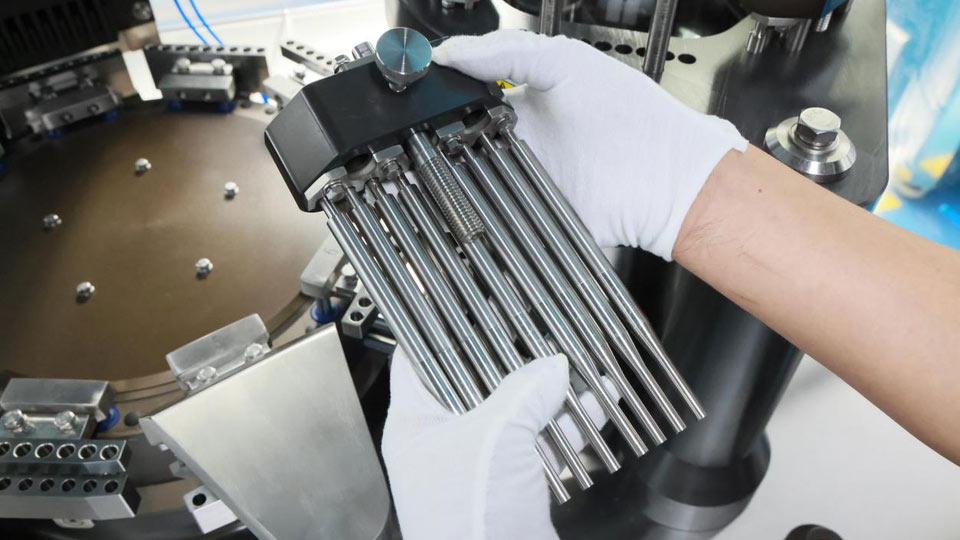
Pull-out spot design
After changing capsule sizes, ask how the supplier verifies mold concentricity and alignment. This check helps reduce the risk of capsule scratches, การเสียรูป, or damage during production. Also confirm whether the filling mechanism requires additional adjustment before restarting production.
4. What Cleaning and GMP Requirements Apply?
When selecting capsule filling equipment, consider product changeovers, การเข้าถึงการทำความสะอาด, and cross-contamination risks. The machine design should support your cleaning procedures and applicable capsule filling machine GMP requirements.
Can Product Contact Parts Be Cleaned Thoroughly?
If you produce different drugs, formulations, or capsule colors, confirm how the machine must be cleaned between products. Ask the supplier whether full disassembly is required and which parts can be removed quickly.
Check whether operators can access dosing discs, เติมหมุด, mold holes, turntable gaps, and areas where powder may accumulate. These details affect capsule filling machine cleaning and help determine whether your cleaning procedure can reach all relevant surfaces.
Manufacturers such as Ruida Packing, ชิ้น, มี, and Bosch use modular designs on their capsule filling machines to simplify component removal and cleaning. For applicable models, complete disassembly can take around 15 นาที, depending on the machine structure and cleaning procedure.
Also confirm whether compressed-air mold cleaning is available and which residues it can remove. Compressed air is an auxiliary cleaning method, not necessarily a replacement for disassembly, wiping, or other required cleaning steps.
How Does the Machine Help Prevent Cross-Contamination?
If the machine will process different drugs, formulations, or capsule colors, assess its design for cross-contamination prevention between products and batches.
Check whether the lubrication and sealing systems help prevent oil leakage into product areas and powder from entering bearings. Ruida Packing, ชิ้น, มี, and Bosch use sealing designs on their capsule filling machines to help protect internal components from powder ingress. Double-seal structures provide an additional barrier against dust entering protected areas, supporting cross-contamination prevention and cleaner machine operation.
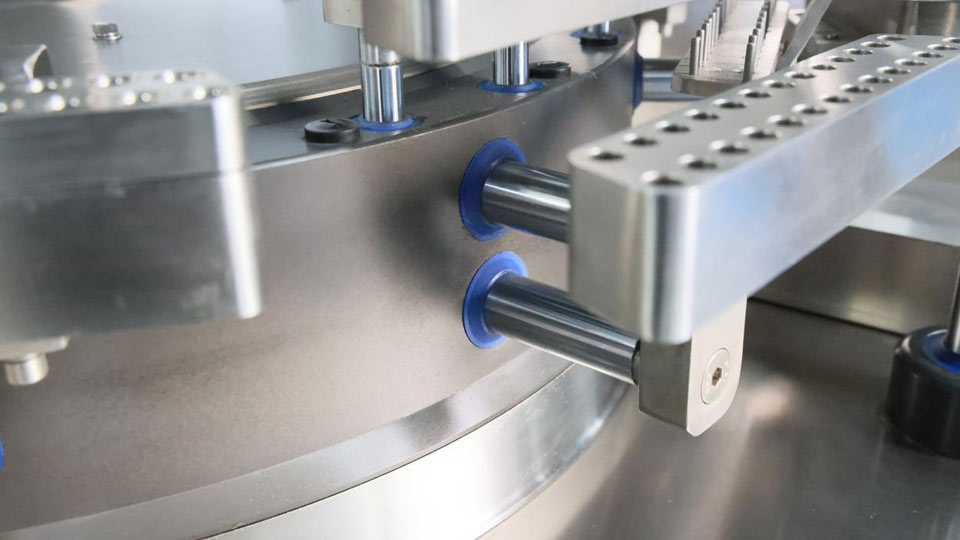
The double-seal design effectively prevents oil and powder from entering the bearings.
Do Product Contact Parts Meet Your Material Requirements?
Check whether the capsule filler uses materials suitable for your formulation and production requirements. Ruida Packing, ชิ้น, มี, and Bosch use 316 stainless steel for product-contact parts to support hygienic production and meet applicable GMP requirements.
ก่อนที่จะซื้อ, request material certificates and supporting documentation to verify that the selected machine meets your specifications. These checks help you compare capsule filling machine GMP requirements across suppliers and assess the machine’s suitability for your production process.
5. How Do Material Properties Affect Capsule Filling Machine Performance?
How Do Powder Properties Affect Capsule Filling?
Before choosing a capsule filling equipment, identify the material you plan to process. Is it ordinary powder, ผงละเอียด, เม็ด, เม็ด, or a sticky mixture? Each material has different flow and adhesion characteristics, which can affect the filling process.
Flowability is one of the first factors to assess. Poor-flowing powder may bridge in the hopper, form lumps, or enter the dosing mechanism unevenly. These problems can interrupt the powder feeding system and cause inconsistent filling weights. If your product has poor flowability, ask the supplier to test whether the proposed machine can maintain stable feeding at your target production speed.
Adhesion also matters. Hygroscopic or sticky materials may cling to filling rods or leave residue inside mold holes. Accumulated material can interfere with dosing consistency and increase cleaning time. For a capsule filling machine for sticky powder, ask the supplier to check for sticking, การสะสมของสารตกค้าง, and blockage during continuous operation.
Pellets require a different filling arrangement. If you plan to fill capsules with pellets or micro-pellets, confirm that the capsule filling machine can be equipped with a dedicated pellet filling device. Ask the supplier to confirm the required device, its compatibility with your pellet size and properties, and the achievable filling accuracy.
Which Feeding Mechanism and Surface Treatment Does Your Material Require?
The right powder feeding system depends on your material’s flowability and adhesion. Conventional feeding mechanisms may work well with free-flowing powders, while difficult materials may require a different configuration.
สำหรับ sticky materials, Ruida Packing, ชิ้น, มี, and Bosch use pneumatic feeding mechanisms in their capsule filling machines. This design helps move material into the dosing area and supports more stable feeding.
อย่างไรก็ตาม, pneumatic feeding cannot solve every material-handling problem. If the material is too sticky for reliable processing on a fully automatic capsule filling machine, a semi-automatic capsule filling machine may be the more suitable choice.
Surface treatment is another factor when evaluating capsule filling machine product contact parts. Powder sticking to filling pins can directly affect capsule filling accuracy. It may cause unstable fill weight, underfilled capsules, or even empty capsules in severe cases. Excessive powder adhesion can also make cleaning more difficult and increase the risk of machine stoppages caused by material buildup or component blockage.
Electropolishing the dosing disc, แท่งเติม, and mold holes improves surface smoothness and can help reduce material residue.
สำหรับสูตรที่มีความยึดเกาะสูง, ask whether electropolishing is sufficient or whether another treatment, such as a suitable PTFE coating, should be evaluated. Confirm that the proposed surface treatment is compatible with your formulation and meets the requirements for product-contact materials.
ก่อนที่จะซื้อ, ask the supplier to test your actual material. Check feeding stability, blockage risk, การเปลี่ยนแปลงน้ำหนักเติม, and residue after operation. These results help determine the appropriate feeding mechanism and surface treatment for your production requirements.
6. What Should You Check About the Capsule Filling Machine Control System?
Which PLC, เอชเอ็มไอ, and Electrical Components Does the Machine Use?
When comparing capsule filling machines, check the brands and models of the PLC, เอชเอ็มไอ, and main electrical components. These components control machine movements, process operating signals, and display production information.
Siemens PLCs are among the most widely recognized choices in pharmaceutical packaging machinery. They are also one of the PLC brands frequently requested by clients evaluating a pharmaceutical capsule filling machine.
Siemens automation technology offers integrated engineering tools, industrial diagnostics, and communication options for connecting controllers, ไดรฟ์, and HMI devices. These capabilities can simplify commissioning, การแก้ไขปัญหา, and integration with other automation equipment.
รุยด้า แพ็คกิ้ง, มี, and other established machinery manufacturers use Siemens automation technology in their equipment. For buyers who prefer Siemens controls, confirming the PLC configuration before ordering helps ensure that the selected capsule filling machine PLC meets their technical requirements.
Can You Control User Access and Track Machine Operations?
A capsule filling machine with three-level password protection can assign different permissions to operators, supervisors, and administrators.
Operators may run the machine and monitor production, while authorized technical staff can adjust specified parameters. Administrators can manage user accounts and access rights. Ask the supplier to demonstrate which functions each permission level can access or modify.
Also check whether the system stores capsule filling equipment parameter change records. ตัวอย่างเช่น, when an authorized user changes a filling parameter or modifies a production recipe, does the system record the user identity, timestamp, and details of the change? These records help production teams investigate unexpected changes and review machine settings.
สำหรับผู้ผลิตยา, ฟิลเลอร์แคปซูล การควบคุมการเข้าถึงของผู้ใช้ may also form part of a broader data integrity strategy. If your project requires compliance with 21 ส่วนซีเอฟอาร์ 11, password protection alone is not sufficient. Confirm whether the proposed system supports the required electronic records, เส้นทางการตรวจสอบ, and electronic signature functions. You should also verify the system configuration, validation documentation, and procedures against your specific regulatory requirements.
Can You Export Production Data and Print Batch Information?
A capsule filler production data interface may display real-time production counts and other operating information. อย่างไรก็ตาม, viewing data on the HMI does not automatically mean the data can be exported. Ask the supplier whether the machine supports capsule filling machine data export, which data fields are available, and which formats or communication interfaces the system supports.
If your factory uses a Manufacturing Execution System (MES) or Supervisory Control and Data Acquisition (SCADA) ระบบ, confirm the available capsule filling machine MES integration and capsule filling machine SCADA integration options. Ask whether the machine can exchange the required production data with your existing systems, which communication protocols are supported, and whether additional software, hardware, or customization is needed.
Printing requirements also need to be confirmed before ordering. If your production process requires batch numbers, วันที่ผลิต, or product codes, ask whether the machine can connect to a suitable printer. Check the available capsule filling machine printer options and whether the printer is included in the standard configuration or supplied as an optional accessory.
For capsule filler batch number printing, specify the required information, print format, and intended printing location. Also confirm whether the printing function is integrated with the machine controls or requires a separate system.
7. Is Your Facility Ready for Capsule Filling Machine Installation?
Before purchasing a capsule filling machine, confirm that your facility meets the space, environmental, and utility requirements for installation. The checklist below helps purchasing teams and facility engineers identify key requirements before equipment delivery.
| Inspection item | Requirements and details to confirm |
|---|---|
| Machine footprint | Obtain the machine layout drawing and overall dimensions. Include the space required for the main machine, loading systems, and auxiliary equipment. |
| Side clearance | For applicable Ruida Packing models, allow at least 800 mm of side clearance for cleaning, การตรวจสอบ, และการบำรุงรักษา. Confirm the required clearance for your selected model. |
| Overhead clearance | For applicable Ruida Packing models, allow at least 500 mm above the machine, plus additional height for the capsule loader and other accessories. Check the total installed height before finalizing the room layout. |
| Floor and foundation | For applicable Ruida Packing models, floor levelness should be within 1 mm/m. Confirm floor load capacity and whether the installation surface can support the machine and auxiliary equipment. |
| Cleanroom classification | Confirm the required ISO cleanroom class or EU GMP grade according to the product, production process, and applicable regulations. Do not assume every capsule filling machine requires the same classification. |
| Temperature and humidity | Check the permitted operating conditions for the machine and your materials. Moisture-sensitive powders may require tighter environmental control to maintain material properties and stable filling. |
| Power and compressed air | Confirm the required power supply, ความถี่, and compressed air pressure. Applicable Ruida Packing capsule filling machines may require clean, dry compressed air at 0.5–0.7 MPa; verify the exact specification for your model. |
| Auxiliary equipment | Reserve space and utility connections for the powder loader, capsule loader, เครื่องขัดแคปซูล, ตัวเก็บฝุ่น, and other accessories included in the configuration. |
| Ventilation and dust control | Evaluate powder dust generation and determine whether local extraction or a dedicated dust collector is required. Confirm how dust-control equipment will connect to the production line. |
| Delivery and maintenance access | Check door widths, corridors, ลิฟต์, and equipment access routes before delivery. Ensure technicians can reach key components for disassembly, ทำความสะอาด, การตรวจสอบ, and replacement. |
บทสรุป
Choosing the right capsule filling machine requires evaluating more than price and rated output. Buyers should compare filling accuracy, actual capacity, เวลาการเปลี่ยนแปลง, ข้อกำหนดในการทำความสะอาด, ความเข้ากันได้ของวัสดุ, control system functions, and installation conditions.
Before ordering, define your requirements in the URS and confirm machine performance during FAT and SAT. For pharmaceutical production, also clarify qualification documents and data integrity requirements. A structured comparison of capsule filling machine specifications helps you select equipment that meets your production needs and future plans.
คำถามที่พบบ่อย
How do I choose the right capsule filling machine?
Evaluate target output, เติมน้ำหนัก, ขนาดแคปซูล, คุณสมบัติของวัสดุ, ข้อกำหนดในการทำความสะอาด, and automation level. Confirm these requirements with the supplier before requesting a quotation.
How much does a capsule filling machine cost?
The capsule filling machine price depends on capacity, การกำหนดค่า, ระบบอัตโนมัติ, optional equipment, and service requirements. Request an itemized quotation.
How can I verify capsule filling accuracy?
Test the machine during FAT using your intended material, ขนาดแคปซูล, และความเร็วในการผลิต. Compare recorded fill weights and variation against your agreed acceptance criteria.
Is rated output the same as actual production capacity?
เลขที่. Material feeding, stoppages, การปรับเปลี่ยน, and rejected capsules can reduce actual output. Request production data under representative operating conditions.
How long does capsule size changeover take?
It depends on the machine design and cleaning procedure. Include disassembly, ทำความสะอาด, part replacement, การปรับตัว, and first-piece inspection when measuring total changeover time.