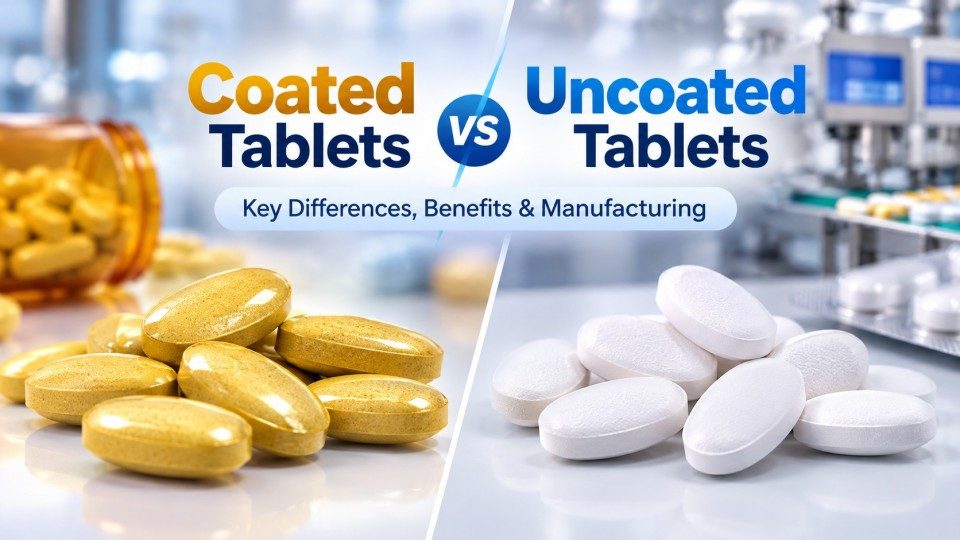
Coated tablets and uncoated tablets both start as compressed cores containing an active pharmaceutical ingredient (เอพีไอ) and excipients. Uncoated tablets retain their original surface, while coated tablets receive an additional layer, such as a polymer film, เคลือบน้ำตาล, หรือเคลือบลำไส้. Depending on its formulation, this layer can mask bitterness, improve swallowability, reduce surface abrasion, ป้องกันความชื้นหรือแสง, or modify drug release. อย่างไรก็ตาม, not every coated tablet is designed for delayed or extended release.
ในการผลิตยา, this difference affects production steps, อุปกรณ์, และการควบคุมคุณภาพ. ก แท่นกดแท็บเล็ต forms the core, while a tablet coating machine applies the coating through controlled spraying, tablet movement, and hot-air drying. Both tablet types must meet mechanical strength and quality requirements before counting, การบรรจุขวด, or blister packaging. Their manufacturing costs and processing requirements also differ.
What Are Coated and Uncoated Tablets?
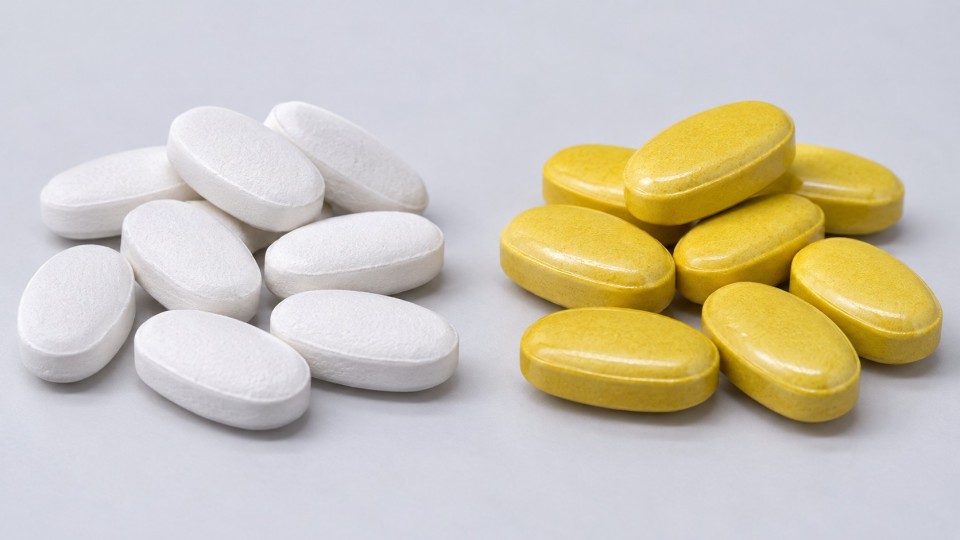
Coated and uncoated tablets are two common forms of compressed pharmaceutical tablets. Both contain an active pharmaceutical ingredient (เอพีไอ) and excipients, but they differ in surface structure, ขั้นตอนการผลิต, and potential functions.
- Uncoated Tablets: These tablets have no external coating applied after compression. Their exposed surfaces are often matte or slightly rough, depending on the formulation and tablet press settings. They are generally simpler and less expensive to manufacture because no coating process is required. อย่างไรก็ตาม, their taste, ความแข็งแรงทางกล, ความมั่นคง, and drug-release behavior depend on the tablet formulation rather than the absence of a coating.
- เม็ดเคลือบ: These tablets receive an additional layer after compression, typically a thin polymer film, sugar-based coating, or functional coating such as an enteric layer. Coating can improve appearance, mask bitterness, reduce surface abrasion, protect sensitive ingredients, or modify drug release. The actual function depends on the coating materials, ความหนา, and formulation.
ตัวอย่างเช่น, a conventional film coating often uses polymers such as hydroxypropyl methylcellulose (HPMC) to form a smooth outer layer. Sugar coating builds up multiple layers, typically producing a thicker, เคลือบเงา. Enteric coating uses pH-sensitive polymers to resist gastric conditions and release the drug at a suitable intestinal pH.
Key Differences Between Coated and Uncoated Tablets
| คุณสมบัติ | Uncoated Tablets | เม็ดเคลือบ |
|---|---|---|
| Surface | Exposed compressed core | Additional outer layer |
| รูปร่าง | Often matte or rough | Often smooth, colored, or glossy |
| รสชาติ | Bitter ingredients may be noticeable | Can mask unpleasant tastes |
| Drug protection | Relies on formulation and packaging | Suitable coatings can provide additional protection |
| Drug release | Immediate or modified release | Immediate, delayed, or extended release |
| การผลิต | No coating step | Requires additional coating operations |
| Production cost | Generally lower processing cost | Usually higher due to materials and processing |
โต๊ะ 1. Key differences between coated and uncoated tablets.
A coated tablet does not necessarily dissolve more slowly than an uncoated tablet. Conventional film coatings may dissolve rapidly, while some uncoated tablets use modified-release formulations. The drug-release profile depends on the complete tablet design, not simply whether a coating is present.
What Are the Main Types of Tablet Coating?
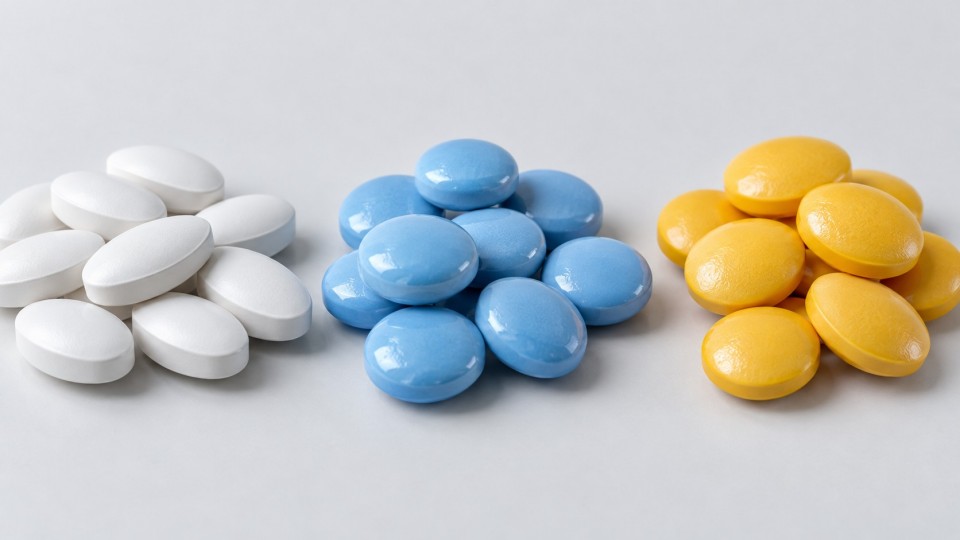
Tablet coatings are commonly described as film, น้ำตาล, ลำไส้, or controlled-release coatings, but these labels do not all describe the same thing.Film coating describes how a layer is formed; enteric and controlled-release describe what the layer is designed to do. An การเคลือบลำไส้, ตัวอย่างเช่น, can itself be a polymer film.
การเคลือบฟิล์ม
In conventional film coating, a water-based solution or dispersion containing a film-forming polymer is sprayed onto moving tablet cores. Hypromellose (HPMC), polyvinyl alcohol (PVA), and hydroxypropyl cellulose (HPC) are among the materials used in different coating systems. Plasticizers improve film flexibility, while pigments or opacifiers can provide color and light protection. Once the solvent evaporates, a thin continuous film remains.
An immediate-release film may improve appearance and handling without intentionally delaying drug release. A different polymer system, such as one based on ethylcellulose, can be designed to limit drug transport through the film.
เคลือบด้วยน้ำตาล
Sugar coating builds multiple layers around a core using syrup-based preparations. It is useful for taste masking and a smooth, เคลือบเงา, but typically adds more weight and processing time than conventional film coating. The thicker shell can also change the finished tablet’s dimensions, which matters when specifying blister cavities and feeding parts.
Enteric and Other Functional Coatings
Enteric coatings use pH-dependent polymers that remain sufficiently intact in acidic gastric conditions and release the drug under the specified higher-pH conditions. They are used when an API requires protection from stomach acid or when the release location matters. Extended-release coatings have a different objective: limiting drug release over time. Their performance must be demonstrated by appropriate dissolution testing, not inferred from appearance.
How Does Coating Affect Tablet Performance?
The practical benefits of tablet coating fall into three groups: ประสบการณ์ของผู้ป่วย, protection during storage and handling, and drug-release performance.
รสชาติ, Swallowability, and Surface Strength
A well-designed coating can separate a bitter API from the tongue and create a smoother swallowing surface. Color and consistent appearance can also support product identification. These are useful benefits, but tablet diameter, รูปร่าง, ความหนา, and surface finish still influence how easy a tablet is to swallow.
A film can reduce scuffing and powder generation as tablets move through bins, น้ำตก, and packaging feeders. It cannot reliably compensate for a weak core. If the tablet breaks or its edges erode in a coating pan, compression and core friability need attention before the coating formula is adjusted.
ความชื้น, แสงสว่าง, and Shelf-Life Protection
Some coatings reduce contact with moisture or include pigments that screen light. That does not mean every coated tablet has a longer shelf life. Protection depends on the polymer, film integrity, ความหนา, the API’s sensitivity, and conditions established by stability studies.
Final packaging remains important for both tablet types. A moisture-sensitive coated tablet may still require a high-barrier blister or a sealed bottle with an appropriate desiccant. Coating and packaging provide different layers of protection; neither should automatically replace the other.
การสลายตัว, การละลาย, and Release
Disintegration is the tablet’s breakup into smaller particles. การละลาย describes the movement of drug substance into solution. The two processes are related, but they are not interchangeable quality tests.
An immediate-release film generally allows fluid to reach the core without intentionally imposing a prolonged delay. An enteric film resists release under specified acid-stage conditions, while a release-controlling membrane may regulate fluid entry or drug diffusion. Some uncoated tablets also achieve extended release through a matrix in the compressed core. This is why coated does not mean slow-release, and uncoated does not mean fast-release.
When comparing formulations, check the product’s intended release category and validated dissolution method rather than relying on the presence or absence of a coating.
How Are Coated and Uncoated Tablets Manufactured?
Both routes depend on forming a reliable tablet core. The difference appears after compression: uncoated tablets can proceed to inspection and packaging when they meet specifications, while coated tablets enter a separate coating operation with its own process controls and potential defects.
Compression Comes First
A rotary tablet press fills a die cavity and compresses the powder or granules between upper and lower punches. Die fill and granule properties primarily set tablet weight, while compression force and tooling influence thickness, แรงทำลาย, and friability. These attributes matter in either route, but a core intended for coating must also withstand repeated tumbling, wetting, และการทำให้แห้ง.
เอ เครื่องกำจัดฝุ่นแท็บเล็ต can remove loose powder after compression and transfer tablets toward the next stage. This matters because residual surface dust can interfere with coating adhesion and increase contamination or inspection problems further along the line. Tablets with high friability should be investigated at the core formulation and compression stage, not simply coated to hide defects.
What Happens Inside a Tablet Coating Machine?
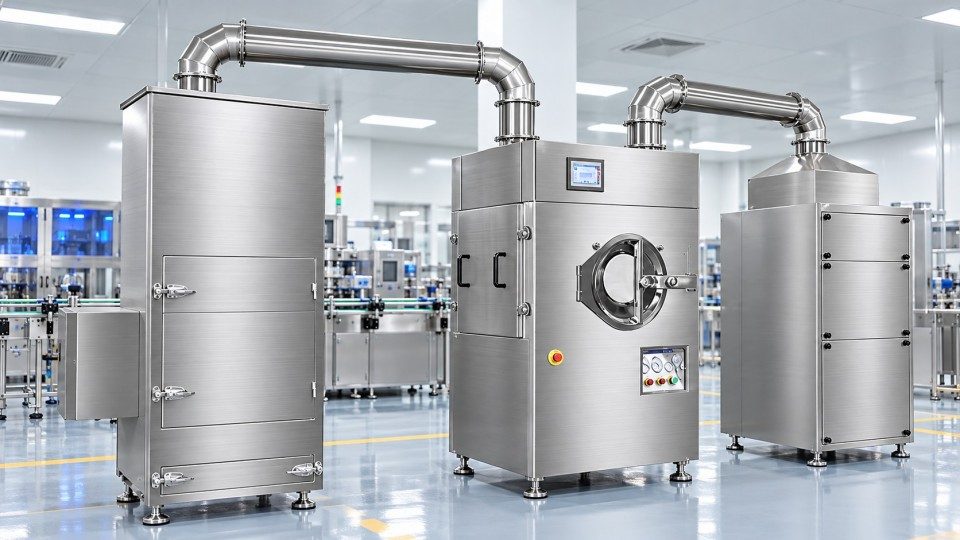
During pan coating, the tablet bed rotates while spray guns distribute coating liquid across moving surfaces. Heated process air removes solvent as the film forms; spraying and drying occur together rather than requiring a separate dryer after every spray pass. Operators balance spray rate, การทำให้เป็นละออง, ความเร็วกระทะ, กำลังโหลด, การไหลของอากาศ, and tablet-bed temperature to achieve even coverage without overwetting or premature droplet drying.
ตัวอย่างเช่น, Ruida Packing's tablet film coating machine combines pan movement, controlled spraying, and hot-air drying to support consistent coating quality and GMP-oriented process control. Its role is to apply a reproducible layer to suitable cores, not to correct an unstable tablet formula. Coating settings still need to be established for the actual batch size, polymer system, and quality target.
Common Defects of Tablet Coating and Quality Inspection
Coating defects often arise from interactions between the core, coating composition, และสภาพการทำงาน:
- Picking or sticking: excessive local wetting, การยึดเกาะที่อ่อนแอ, or insufficient drying can pull material from the surface.
- แฝด: flat-faced tablets may stick together when bed movement or drying is inadequate.
- Cracking or edge erosion: ฟิล์มเปราะ, sharp tablet edges, ความเครียดทางกลมากเกินไป, or weak cores can damage the coat.
- Uneven color or roughness: inconsistent mixing, spray coverage, dispersion, or atomization can leave visible defects.
Troubleshooting should begin by checking the defect pattern and the three possible sources—core quality, สูตรเคลือบ, and machine conditions—rather than changing temperature alone. Quality checks can include tablet breaking force and friability before coating, followed by appearance, weight gain, coating integrity, and the disintegration or dissolution tests required for the specific product. There is no single valid spray temperature, coating weight gain, or hardness target for every tablet.
How Coating, บรรจุภัณฑ์, and Cost Influence the Coated vs Uncoated Decision
Coating changes the condition of the tablet entering packaging, but it does not prescribe one particular packaging machine. Tablet size, surface durability, release requirements, and stability data should determine the handling and pack design.
Counting and Bottling
Uncoated tablets with friable surfaces can generate dust or fragments during vibratory feeding and transfer. That can increase cleaning work and interfere with reliable optical counting. Coated tablets may produce less dust, but a poorly bonded film can also scuff, ชิป, or peel in the same equipment.
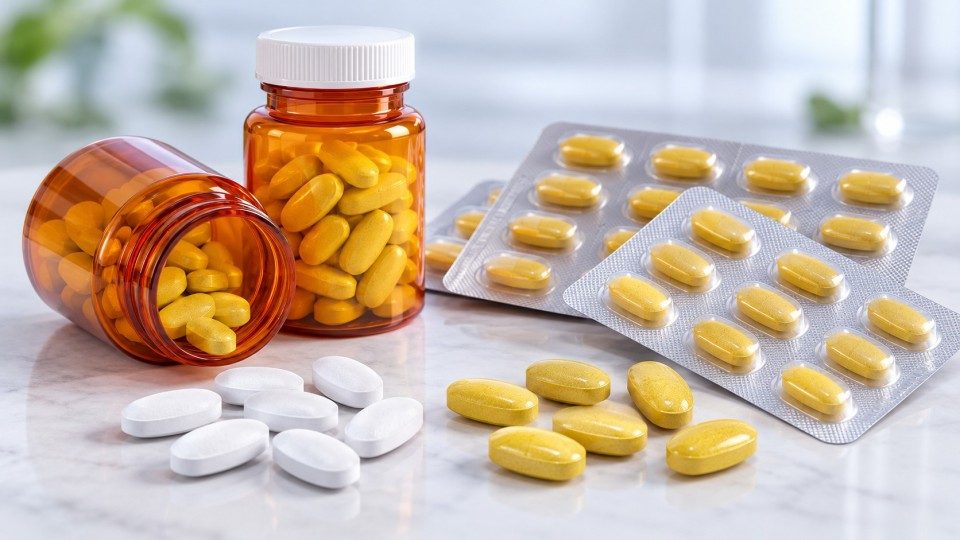
เอ เครื่องนับเม็ดยา must accommodate the actual tablet dimensions and feeding behavior. สำหรับบรรจุขวด, container closure, induction sealing where specified, and desiccant use where justified should be considered alongside tablet stability. A coating does not eliminate the need for proper pack sealing.
Blister Packaging and Barrier Materials
Blister packaging machines must feed tablets into cavities without damaging their edges or coating. Film thickness or a sugar-coated shell may increase the final tablet size, so the cavity must be specified from the finished tablet dimensions rather than the uncoated core. แปรง, คำแนะนำ, and transfer surfaces also need to suit the tablet’s mechanical properties.
Packaging barrier selection is a separate decision. PVC/Alu, enhanced-barrier films, and cold-formed Alu-Alu have different protection and forming characteristics. The correct material depends on moisture and light sensitivity, เป้าหมายอายุการเก็บรักษา, and stability evidence. A functional enteric coating must remain intact through feeding and sealing operations, but its presence does not by itself justify a lower-barrier pack.
Manufacturing Cost and When Coating Makes Sense
Uncoated tablets avoid coating materials, coating equipment time, drying energy, additional cleaning, and coating-related inspection. Coated tablets generally have higher direct processing costs, especially when the formulation needs multiple layers or specialized performance testing. The actual difference depends on batch size, coating yield, production time, rejection rate, และข้อกำหนดด้านบรรจุภัณฑ์; a universal percentage would be misleading.
The simplest decision rule is to add a coating when it solves a defined problem: รสชาติ, การจัดการ, ความมั่นคง, การระบุผลิตภัณฑ์, or release performance. If an uncoated core already meets those requirements, leaving it uncoated can make production simpler without reducing product quality.
บทสรุป
Coated and uncoated tablets are not a ranking from basic to advanced. The right design depends on what the formulation and patient need, how reliably the core can be manufactured, and what protection is required through storage and use. A coating can add valuable functions, but only when its materials, การควบคุมกระบวนการ, quality tests, and packaging are matched to the finished product.
คำถามที่พบบ่อย
Are coated tablets better than uncoated tablets?
Not inherently. Coating is useful when a tablet needs taste masking, extra surface protection, easier swallowing, การระบุผลิตภัณฑ์, or a specific release function. If an uncoated formulation already meets its requirements, coating may add cost without a meaningful benefit.
Do coated tablets dissolve more slowly?
ไม่จำเป็น. A conventional immediate-release film can dissolve rapidly. Enteric coatings delay exposure to acid-stage media, while some controlled-release coatings regulate drug release over time. Uncoated matrix tablets can also provide modified release.
Why are some tablets left uncoated?
An uncoated tablet can meet its mechanical strength, รูปร่าง, รสชาติ, ความมั่นคง, and drug-release targets without an extra coating step. Avoiding that step reduces processing complexity, วัสดุ, and equipment time.
Can coated tablets be split or crushed?
Do not decide from appearance alone. Splitting or crushing can damage an enteric or extended-release system and change how a medicine works. Follow the product’s specific labeling and advice from a qualified pharmacist or prescriber; even some ordinary film-coated tablets are not suitable for splitting.
Are coated tablets more expensive to manufacture?
Usually in direct processing terms. Coating adds materials, coating-machine operation, energy, ทำความสะอาด, and extra inspection. The total economic effect depends on whether coating also reduces damage, improves product acceptability, or meets a necessary stability or release requirement.
เอกสารอ้างอิง
- เรา. FDA —Dosage Forms.
- USP — บททั่วไป <1217>, Tablet Breaking Force.
- Colorcon —Film Coated Tablets: A Guide to the Pharma Coating Process.
- Colorcon —เม็ดเคลือบลำไส้คืออะไร?.
- Colorcon —Tablet Coating Troubleshooting Guide.