その 価格 の tag of a blistering machine can be fixed, yet the silent profit killer in pharmaceutical manufacturing is often hiding right in the 無駄 bin.
When choosing between a roller blister packaging machine and a flat plate system, many buyers mistakenly focus solely on the initial blister packaging machine cost. しかし, the true financial impact lies in long-term blister packaging material cost. A fractional difference in waste per cycle quietly snowballs into an avalanche of annual expenses. In this breakdown, we will explore exactly how much you are paying for unused blister film material and why upgrading your technology might be the most lucrative decision for your production line.
重要なポイント
- The hidden financial drain caused by blister packaging material waste.
- The mechanical differences between a roller blister machine vs flat plate setup.
- A step-by-step calculation of packaging material savings at high production volumes.
- Insights into how to choose between roller blister machine vs flat plate equipment to minimize blister packaging material cost.
1. Flat Plate vs ローラーブリスターマシン: What Are You Really Paying For?
Comparing a roller blister machine vs flat plate equipment requires looking past the surface sheet metal. Evaluating blister packaging machine cost is much like buying a printer, for your blister packaging materials act as a daily tax on your profit margins.
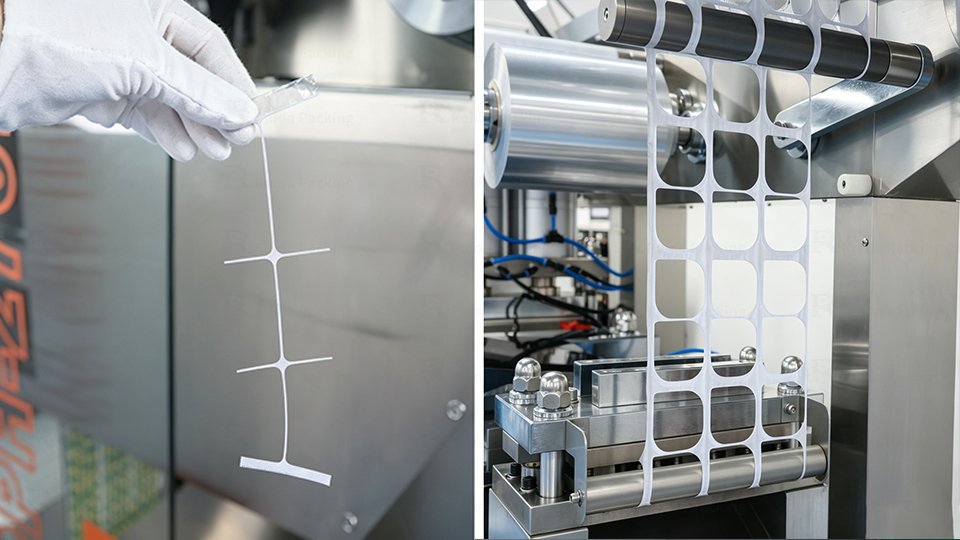
A flat plate machine punches sheets in a grid layout, whereas a roller blister packaging machine utilizes a continuous rotary motion. While flat plates are incredibly versatile for deep-draw items, their grid format naturally leaves wider webbing between cavities. This elevates your overall blister packaging cost because you end up paying for blister pack material that is immediately discarded. Whether you use plastic blister packaging materials or blister pack lidding material, every millimeter of scrap increases your baseline blister material cost.
2. Why Does Blister Packaging Generate Material Waste?
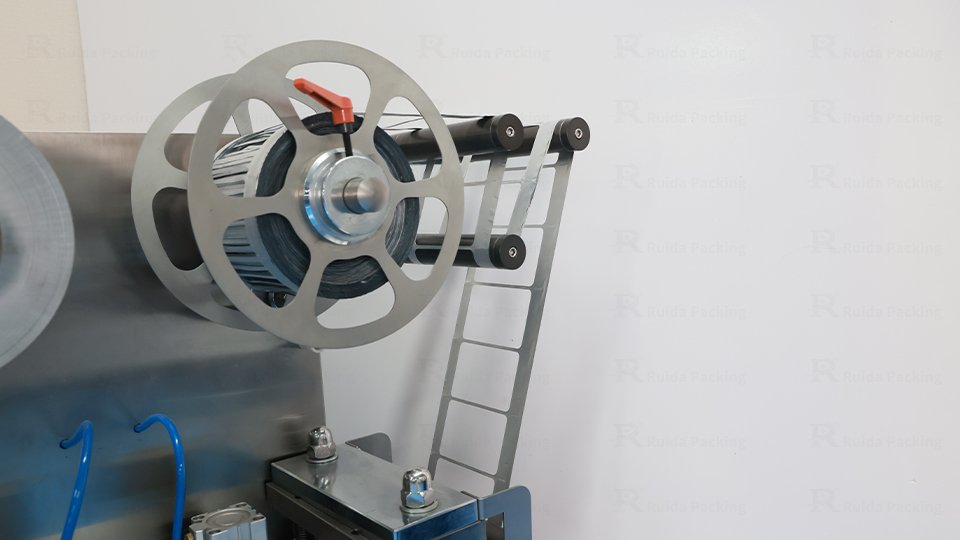
Before addressing solutions, we must ask: what materials are used in blister packaging, and why do they generate waste? Whether a blister packaging material supplier is providing blister tray material, blister base material, or blister lidding foil material, the machine must grip the edges of the web to pull it through the heating and forming stations.
Waste primarily occurs between the formed cavities and the edges. When purchasing pharmaceutical blister packaging materials or pharma blister packaging materials, you are buying by the square meter or kilogram. Every gap between your pill blister pack material punches is money thrown away. According to a 2023 report by Fortune Business Insights, the global pharmaceutical packaging market is heavily driven by material efficiency, with raw materials accounting for up to 60% of variable packaging costs. The true expense of blister packaging isn’t the machine itself, it’s the webbing left behind.
3. How Does a ローラーブリスターマシン Reduce Material Waste?
A roller blister packaging machine tackles this waste through a staggered punching design. Think of it like rolling out dough and cutting cookies: if you use a square grid, you leave wide, unused gaps of dough. A roller system, しかし, nests the cuts closely together like honeycomb cells.
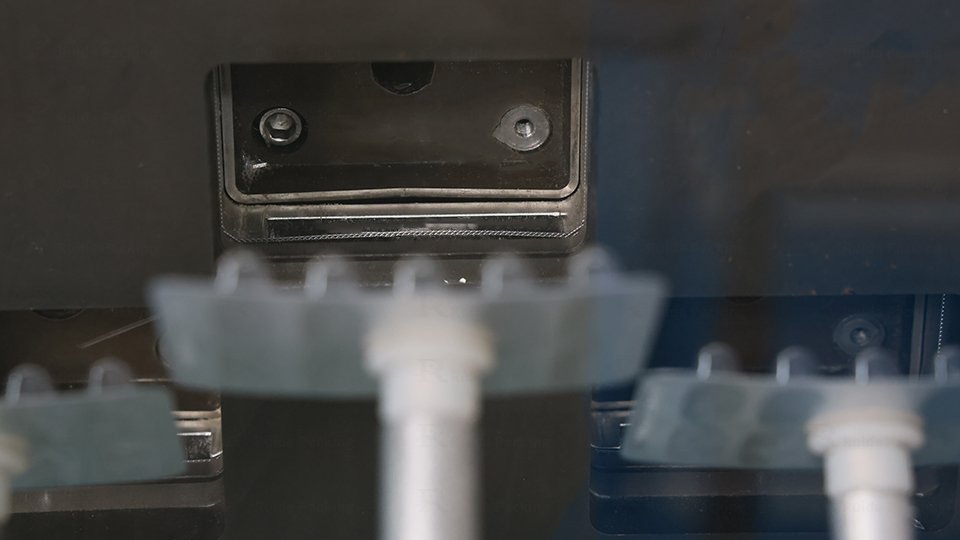
By minimizing the gaps between each cut, the roller blister machine dramatically reduces the consumption of blister pack materials, blister lidding material, and alu alu blister packing material. This efficiency applies to all pharmaceutical blister packs materials. Research from Packaging Gateway indicates that optimizing punching layouts can reduce polymer waste by 12-15% annually. If your blister lidding foil material and blister base material are nested perfectly, your overall blister packaging cost plummets.
4. How Much Can a ローラーブリスターマシン Save on Packaging Materials?
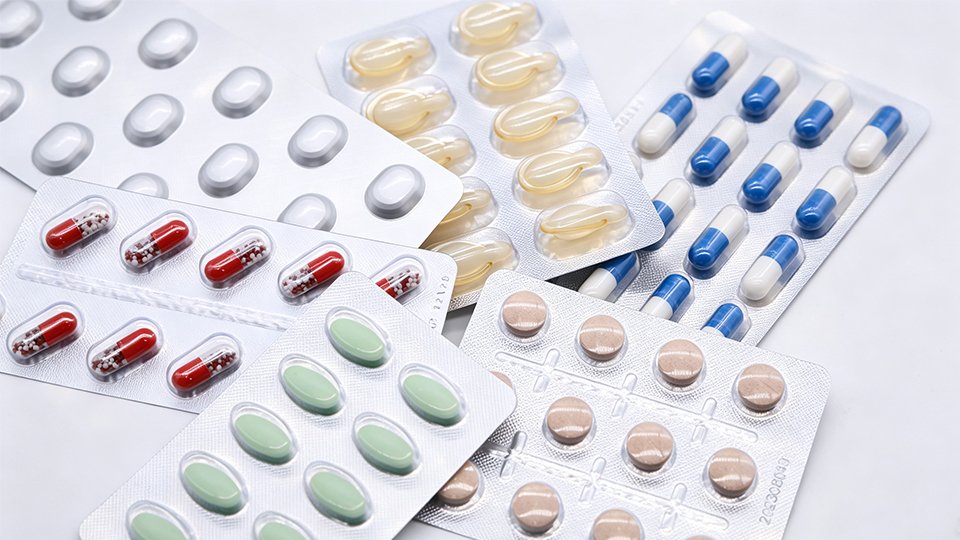
For high volume pharmaceutical and nutraceutical manufacturers, blister packaging material cost can become a significant recurring expense. A small difference in material consumption per blister pack may seem insignificant, but when multiplied by tens of millions of sheets, the annual saving can become substantial.
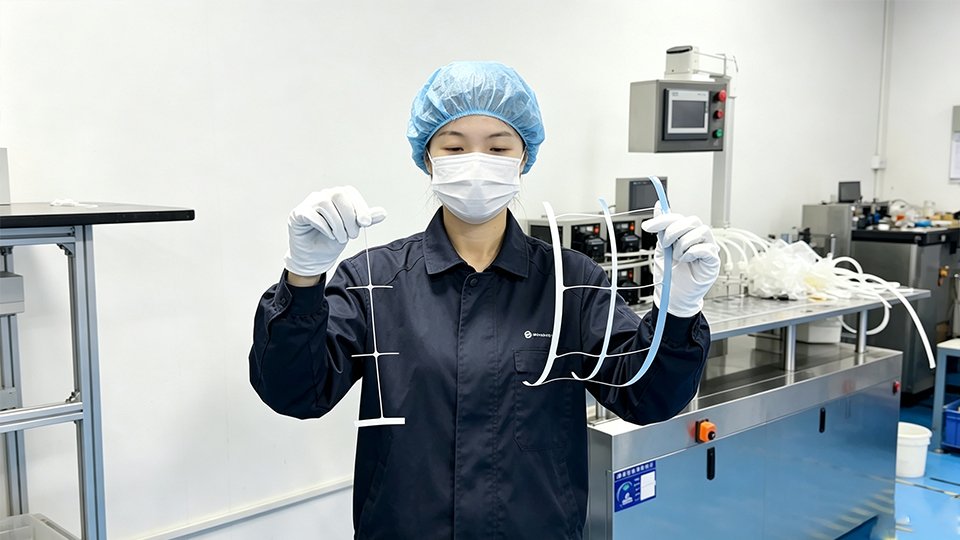
To make the comparison more practical, let us use a 250 μm pharmaceutical PVC blister film material as an example. A publicly listed pharmaceutical blister PVC film has a density of 1.37 g/cm³ and a bulk price of around USD 1.80/kg for large orders.
A simple way to estimate blister packaging material cost is to calculate the amount of blister packing material used for each blister pack.
The basic formula is:
Material Cost per Sheet= Length (dm) × Width (dm) × Thickness (dm) × Material Price ÷ Number of Sheets
初め, convert the material price from USD/kg into USD/dm³:
1.37 g/cm³ = 1.37 kg/dm³
したがって:
1.37 kg/dm³ × USD 1.80/kg = USD 2.466/dm³
Now we can calculate the blister pack material cost per blister sheet.
ステップ 1. Calculate the Material Cost per Sheet
Assume the effective PVC blister tray material used for one blister pack is 100 mm × 80 んん, または:
| パラメータ | Value |
| 長さ | 1.00 dm |
| 幅 | 0.80 dm |
| 厚さ | 250 μm = 0.0025 dm |
| Material Price | USD 2.466/dm³ |
Then using the formula:
Material Cost per Sheet= Length × Width × Thickness × Material Price
それで, the roller machine’s material cost is:
1.00 × 0.80 × 0.0025 × 2.466 = USD 0.00493/pack
Under this example, the material cost is approximately:
米ドル 0.00493 per blister sheet. This is very close to the USD 0.00493/sheet figure used in our internal comparison.
ステップ 2. What Happens on a Flat Plate Machine?
The key difference is material utilization. Because the flat plate punching layout leaves more space between blister packs, the effective material consumption per pack is higher.
To compare a roller blister machine vs flat plate under the same material price and thickness, we can use the flat plate cost of USD 0.00528/sheet from our comparison.
Using the same PVC material price:
米ドル 0.00528 ÷ 2.466 ÷ 0.0025 = 0.856 dm²
That means the flat plate process requires approximately 0.856 dm² of effective material area per sheet, compared with 0.800 dm² for the roller example.
Equivalent to an effective material length of approximately:
0.856 ÷ 0.80 = 1.07 dm (or about 107 mm × 80 mm per sheet).
This difference represents the additional blister packing material consumed because of the less efficient punching layout.
ステップ 3. Calculate the Saving per Blister Pack Meds
Now the comparison becomes straightforward:
| アイテム | Flat Plate Machine | ローラーブリスターマシン |
| Effective material area/sheet | ~0.856 dm² | 0.800 dm² |
| PVCの厚さ | 0.0025 dm | 0.0025 dm |
| PVC material price | USD 2.466/dm³ | USD 2.466/dm³ |
| Material cost/sheet | 米ドル 0.00528 | 米ドル 0.00493 |
したがって:
米ドル 0.00528 − USD 0.00493 = USD 0.00035/sheet
The roller blister machine saves approximately:
米ドル 0.00035 per medication ブリスター パック.
That may sound like a very small number. But the calculation changes dramatically when annual production reaches tens of millions of meds blister packs.
ステップ 4. Calculate the Annual Material Savings
For a pharmaceutical manufacturer producing 70 million blister packs for meds per year:
70,000,000 × USD 0.00035 = USD 24,500
So the estimated annual packaging material savings is:
Approximately USD 24,500 年間. The higher the production volume, the greater the impact:
10 million: 米ドル 3,500
30 million: 米ドル 10,500
50 million: 米ドル 17,500
70 million: 米ドル 24,500
100 million: 米ドル 35,000
For a manufacturer producing 70 million sheets annually, a difference of only USD 0.00035 per sheet can therefore represent almost USD 25,000 in yearly blister packaging material savings. The important point is that this saving comes from better material utilization, not simply from higher machine speed.
What This Means for Pharmaceutical and Nutraceutical Manufacturers
For small production volumes, the blister packaging raw material difference may have a limited financial impact. しかし, for pharmaceutical and nutraceutical manufacturers producing millions of meds blister sheet every year, packaging material efficiency becomes much more important. A manufacturer should therefore compare not only the machine purchase price but also the material cost per blister pack× annual production volume.
5. Beyond Materials: 切り替え, Labor and Energy Savings
Material savings are only part of the total cost advantage. A roller blister machine can also reduce operating costs through faster changeovers and higher production efficiency.
Faster Film and Tooling Changeovers
The roller machine uses a material joining platform to simplify film changes, while its drawer style tooling design allows faster tool replacement.
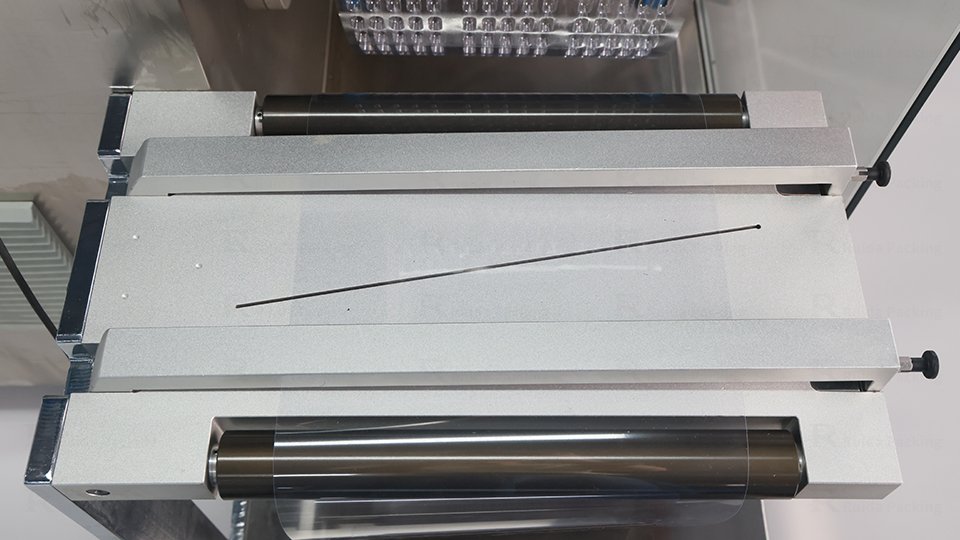
The complete tooling process, from removal and cleaning to installation, can be completed in less than one hour, compared with more than two hours for a conventional machine. This can save more than one hour of downtime per changeover.
For European manufacturers, using an estimated labor cost of around USD 40/hour, one hour saved represents approximately:
1 hour × USD 40/hour = USD 40 labor savings per changeover
With multiple changeovers each year, these savings can quickly add up.
Higher Output with Similar Power
Energy efficiency is another key advantage.
According to our maximum capacity data of the blister machines, a flat plate machine produces approximately 11,200 plates/h at 7 kW, while a roller machine reaches 27,000 plates/h at 24 kW.
For production requirements above 10,000 プレート/時間, a single flat plate machine can already meet the required output at 11,200 プレート/時間, while the roller machine provides a much higher capacity of 27,000 プレート/時間. しかし, the roller machine requires significantly more power, で 24 kW compared with 7 kW for the flat plate machine.
At an electricity price of USD 0.086/kWh and 2,300 operating hours per year, の 17 kW difference would result in approximately USD 3,366 more in annual electricity costs for the roller machine.
For high volume manufacturers, the roller blister machine can therefore reduce total operating costs through three advantages: less blister packaging material waste, faster changeovers, and higher output with lower power consumption per unit of capacity.
6. When Is a ローラーブリスターマシン Worth the Investment?
If your facility handles long, continuous runs using blister plastic material or lidding material blister packaging, the investment pays for itself rapidly. Any facility heavily reliant on blister packaging materials manufacturers for high volumes will see immediate effect.
どうやって Ruida Packing Supports Manufacturers
Ruida Packing specializes in the research and manufacturing of premium pharmaceutical and nutraceutical manufacturing machinery, proudly backed by Dun & ブラッドストリート (D&B). All our equipment strictly complies with CE, cGMP, ISO, and SA international standards. We offer highly customized, whole-line packaging solutions tailored perfectly to your unique facility requirements.
Our roller blister packaging machine features:
staggered punching mechanism designed specifically to drastically reduce blister packaging materials suppliers’ costs. It also boasts a slide-in mold track design for rapid changeovers, full servo traction for millimeter-precise pulling, and a PID temperature control system for uniform, accurate heating. To ensure your long-term success, Ruida Packing provides:
- Three years of free core parts replacement;
- Comprehensive on-site installation, デバッグ, and employee training;
- Full 4Q validation documents provided on demand.
7. 結論は
Under these assumptions, one roller blister packaging machine could save approximately 米ドル 29,500 年間 compared with a flat plate setup.
結局のところ, lowering your core blister packaging material cost requires looking beyond the initial price tag. By switching to a roller blister machine, manufacturers drastically reduce waste, boost operational efficiency, and reclaim lost profits. Stop paying for scrap and start maximizing the long-term value of your blister packaging materials today.
8. よくある質問
Q1: How much can a roller blister machine save compared with a flat plate machine?
In our example, the roller machine reduces material cost by about USD 0.00035 per blister pack. If you are churning out 70 million sheets a year, that easily equals approximately USD 24,500 in annual material savings. It is a smart way to keep your money on the production line, not in the trash.
第2四半期: Why does a blister packaging machine generate material waste?
The main culprit is the unused space—or webbing—left between blister packs after punching. Better material utilization means less blister packaging material is consumed for the same number of finished packs.
Q3: Is the material saving significant for high volume pharmaceutical production?
絶対に! A fraction of a cent per blister pack might look like pocket change, but it snowballs rapidly when production reaches tens of millions of packs. The higher your annual output, the more critical your blister packaging material cost becomes.
Q4: Does a roller blister machine cost more than a flat plate machine?
The upfront purchase price can be higher depending on your chosen configuration and automation level. しかし, smart manufacturers always weigh that initial price against the massive long-term savings in packaging materials, 切り替え時間, and labor.
Q5: What should I compare when choosing between a roller and flat plate blister machine?
Never compare machine price tags alone. You need to look closely at material consumption per sheet, annual material cost, 切り替え時間, and after-sales support to determine your true total cost of ownership.
9. 参考文献
[1] フォーチュン ビジネス インサイト: 医薬品包装市場規模, 共有 & Industry Analysis
https://www.fortunebusinessinsights.com/industry-reports/pharmaceutical-packaging-market-101828
[2] Packaging Gateway: Sustainable Materials and Waste Reduction in Pharma Packaging
https://www.packaging-gateway.com/analysis/sustainable-materials-pharma-packaging
[3] マーケットサンドマーケット: Pharmaceutical Blister Packaging Market – Global Forecast to 2028