
Powder flowability is the ability of a powder or blend to move and refill predictably, and in pharmaceutical manufacturing it is influenced by particle size and distribution, particle shape, υγρασία, πυκνότητα, cohesion, and process conditions. Unstable flow can contribute to incomplete tablet die filling, capsule fill weight variation, hopper bridging, ασυνεπής δοσολογία, σκόνη, and production stoppages. These symptoms do not prove that poor flow is the only cause; χωρισμός, feeder settings, εργαλεία, ιδιότητες σύνθεσης, and machine condition can produce similar effects.
Reliable evaluation therefore connects material properties with flow testing, equipment interaction, and actual production behavior. No single Carr Index, Hausner Ratio, angle of repose, or shear result guarantees machine performance. The practical goal is to identify the likely flow mechanism, apply a targeted correction, and verify the actual formulation on the intended equipment.
What Is Powder Flowability in Pharmaceutical Manufacturing?
Powder flowability describes how consistently a powder moves under defined conditions. A powder falling through a laboratory funnel does not experience the same consolidation, agitation, refill time, wall contact, or mechanical forces as powder moving through a πρέσα δισκίων feed frame, μηχανή πλήρωσης καψουλών, or auger filler.
Flowability is therefore better treated as a material–process interaction than as a fixed property represented by one number. Particle-to-particle friction, cohesion, συσκευασία, powder-to-wall friction, electrostatic effects, and consolidation can all change how the same formulation behaves during storage, μεταφορά, σίτιση, and dosing.
Stable flow supports consistent feeding and filling. Poor or unstable flow can contribute to intermittent discharge, fill-weight drift, incomplete refill, γεφύρωση, rat-holing, dust accumulation, and machine stoppages.
Segregation is related but different. A blend may flow easily and still separate because its components differ in particle size, πυκνότητα, σχήμα, or response to vibration. Improving flow therefore does not automatically improve blend uniformity.
What Factors Affect Powder Flowability?
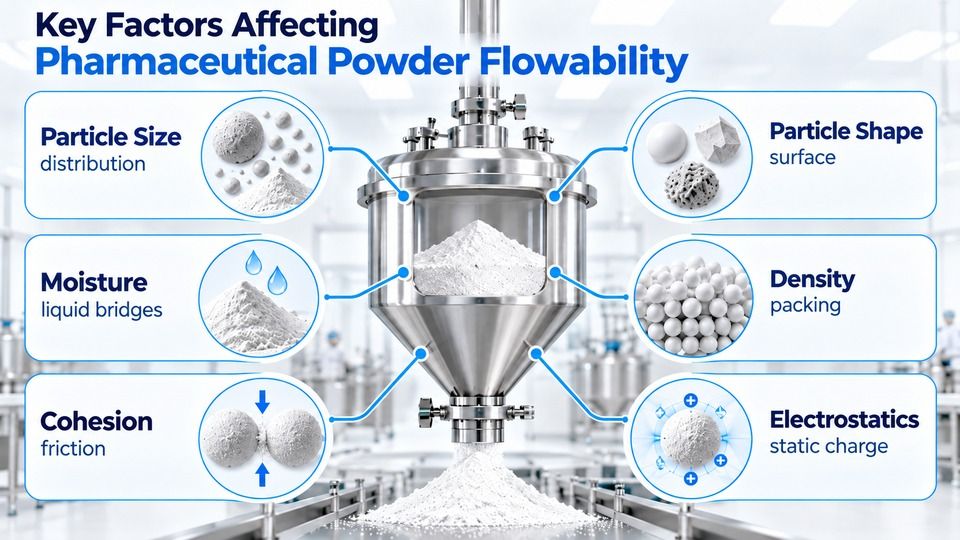
The main factors affecting powder flowability are particle size and distribution, particle shape and surface condition, υγρασία, density and packing, cohesion and friction, electrostatics, and formulation or granule properties. Their importance depends on the powder and the process in which it is handled.
Particle Size and Particle Size Distribution
As particle size decreases, surface-related forces can become more important relative to particle weight. A formulation containing a high proportion of fines may therefore become more cohesive and more difficult to discharge or refill consistently.
Particle size distribution also affects packing and segregation. Fines can occupy spaces between larger particles, alter bulk density, and migrate during handling, while large differences between formulation components can increase segregation risk.
There is no universal particle-size cutoff at which a pharmaceutical powder becomes poorly flowing. Any change to particle size distribution should also be checked for its effects on blend uniformity, συμπιεστό, διάλυση, and downstream processing.
Particle Shape and Surface Characteristics
Rounded particles generally roll and rearrange differently from irregular, flaky, needle-like, or highly angular particles. Surface roughness and porosity can further change friction, προσκόλληση, moisture uptake, and the effectiveness of a glidant.
This explains why two powders with similar particle size can behave differently in the same hopper or feeder. Particle morphology should therefore be considered together with size rather than treated as a secondary property.
Moisture and Environmental Conditions
Moisture can alter liquid bridging, προσκόλληση, agglomeration, επιφανειακή τριβή, and electrostatic behavior. Its effect is formulation-dependent: increasing moisture does not automatically make every powder flow worse.
If flow changes with season, room humidity, storage time, or material exposure, compare moisture content and handling history before changing the machine. Excessive drying can also create new electrostatic problems in some formulations.
Πυκνότητα, Packing and Consolidation
Bulk density describes the mass of an untapped powder occupying a defined bulk volume, while tapped density describes its density after a specified tapping procedure.
The difference between these values indicates how the powder rearranges under tapping and forms the basis of Carr Index and Hausner Ratio. Density is also important in volumetric dosing because:
Delivered Mass ≈ Dosing Volume × Effective Bulk Density
A fixed dosing volume can therefore deliver a different mass if aeration, settling, δόνηση, hopper refill, or consolidation changes the effective bulk density presented to the dosing system.
Cohesion, Friction and Electrostatic Effects
Cohesion resists separation between particles, while particle-to-particle and powder-to-wall friction resist movement. Electrostatic charging can add adhesion, particularly with fine powders and under dry handling conditions.
Στην παραγωγή, these effects may appear as material adhering to hopper walls, unstable feeder refill, deposits on dosing components, σκόνη, or interrupted discharge. The corrective action should match the mechanism; stronger agitation may break some arches but can also increase aeration or segregation.
Formulation and Granule Properties
The final blend behaves as a system. API morphology, excipient properties, αντοχή σε κόκκους, binder distribution, lubricant and glidant conditions, blending sequence, and processing history can all influence flow.
Granulation can improve handling when excessive fines, unfavorable particle structure, or unstable density contribute to the problem. It is not a universal solution. Wet granulation or roller compaction can also change compressibility, χωρισμός, διάλυση, and downstream tablet or capsule performance.
How Is Powder Flowability Measured?
No single powder flowability test represents every condition encountered in pharmaceutical production. USP General Chapter <1174> describes several approaches, including angle of repose, compressibility index/Hausner ratio, flow through an orifice, and shear-cell methods . These methods evaluate different aspects of powder behavior, so laboratory characterization is strongest when complementary tests are interpreted together.
Angle of Repose
Angle of repose measures the slope formed by a powder heap under a defined method. A lower angle is generally associated with easier movement in that test, while a steeper heap can indicate greater resistance to flow.
The result is sensitive to apparatus geometry, powder preparation, περιβαλλοντικές συνθήκες, and how the heap is formed. It is useful for comparative screening but should not be treated as a universal pass/fail limit for production equipment.
Bulk and Tapped Density, Carr Index and Hausner Ratio
Bulk and tapped density characterize powder packing before and after a defined consolidation procedure. They are also used to calculate two common flow indicators:
Carr Index (%) = (Tapped Density − Bulk Density) / Tapped Density × 100
Hausner Ratio = Tapped Density / Χύδην πυκνότητα
Higher consolidation during tapping produces a larger difference between bulk and tapped density. Carr Index and Hausner Ratio are useful for comparative screening, but they are mathematically related and should not be treated as two independent confirmations of machine suitability.
Neither reproduces the dynamic conditions inside a tablet feeder, capsule dosing system, or auger filler.
Flow Through an Orifice
An orifice test evaluates whether and how consistently powder discharges through a defined opening. Depending on the procedure, the output may include flow time, mass flow rate, or minimum opening required for sustained discharge.
The result depends strongly on outlet geometry and test configuration. It can help compare gravity-discharge behavior, but a laboratory orifice result should not be converted directly into a production hopper design.
Shear Cell Testing
Shear-cell testing evaluates powder behavior under controlled consolidation and shear. It can provide information about cohesion, yield behavior, flow function, and powder–wall interaction, making it particularly useful for cohesive materials and hopper or storage problems.
It provides information that simple gravity tests may miss, but actual equipment still introduces different stresses, geometries, refill times, and mechanical interactions.
| Δοκιμή | What It Indicates | Useful For | Main Limitation | Production Relevance |
|---|---|---|---|---|
| Angle of Repose | Heap-forming behavior | Rapid comparison | Method-dependent | Initial screening |
| Bulk/Tapped Density | Packing and consolidation | Material characterization | Not a dynamic flow test | Important for feeding and volumetric dosing |
| Carr Index | Relative consolidation | Comparative screening | Indirect and empirical | Flags materials needing further evaluation |
| Hausner Ratio | Tapped-to-bulk density relationship | Comparative screening | Same underlying data as Carr Index | Similar screening role |
| Orifice Flow | Gravity discharge behavior | Outlet comparison | Geometry-dependent | Relevant to gravity-fed processes |
| Shear Cell | Cohesion and yield behavior | Cohesive powders and hopper evaluation | More complex testing | Useful under consolidated conditions |
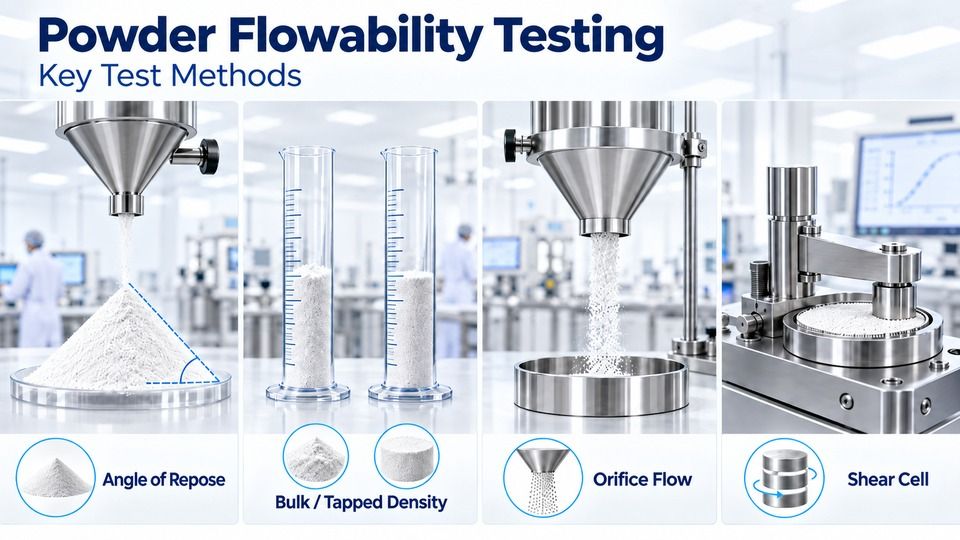
The practical sequence is therefore laboratory characterization → process-relevant testing → actual-machine verification.
How Does Powder Flowability Affect Pharmaceutical Equipment?
Powder behavior changes with equipment because tablet presses, fully automatic capsule fillers, χοάνες, τροφοδότες, and powder dosing systems impose different refill times, stresses, agitation, and consolidation.
Tablet Compression and Die Filling
On a rotary tablet press, the critical path is:
Hopper → Feeder/Feed Frame → Die Filling → Compression
Powder must replenish the feed zone and enter each die consistently before compression. As turret speed increases, the available die-filling time decreases. A formulation that fills adequately at low speed may therefore become unstable at higher output if the powder cannot refill the dies fast enough .
Increasing tablet-weight variability at higher speed can indicate a flow-limited filling process, but weight variation alone does not diagnose poor flow. Feeder settings, βάθος πλήρωσης, εργαλεία, powder-bed density, χωρισμός, and machine condition should also be checked.
Force feeders can improve delivery when gravity refill is insufficient, but paddle speed and feeder geometry may also affect aeration, densification, χρόνος παραμονής, χωρισμός, and die filling. Increasing feeder speed is not automatically a solution.
Capsule Filling and Powder-Bed Replenishment
Γέμιση κάψουλας depends on both powder behavior and the dosing principle. In dosing-disc/tamping systems, the powder bed must replenish dosing cavities between cycles. In dosator systems, powder must enter and be retained within the dosator before transfer into the capsule body.
Slow or inconsistent replenishment can contribute to fill-weight variation, particularly as machine speed, powder-bed depth, πυκνότητα, or packing conditions change. Research on capsule filling has shown relationships between powder-flow parameters and fill-weight performance while also identifying the importance of powder-bed and compression conditions .
When capsule weight varies, evaluate flowability together with bed level, χύδην πυκνότητα, tamping or dosator settings, ταχύτητα μηχανής, ιδιότητες σύνθεσης, and station-to-station weight trends.
Powder Handling, Auger Filling and Volumetric Dosing
Σε sachet filling machines, vial powder filling machines, and other auger or volumetric powder filling systems, reliable dosing depends on a stable material supply to the dosing mechanism.
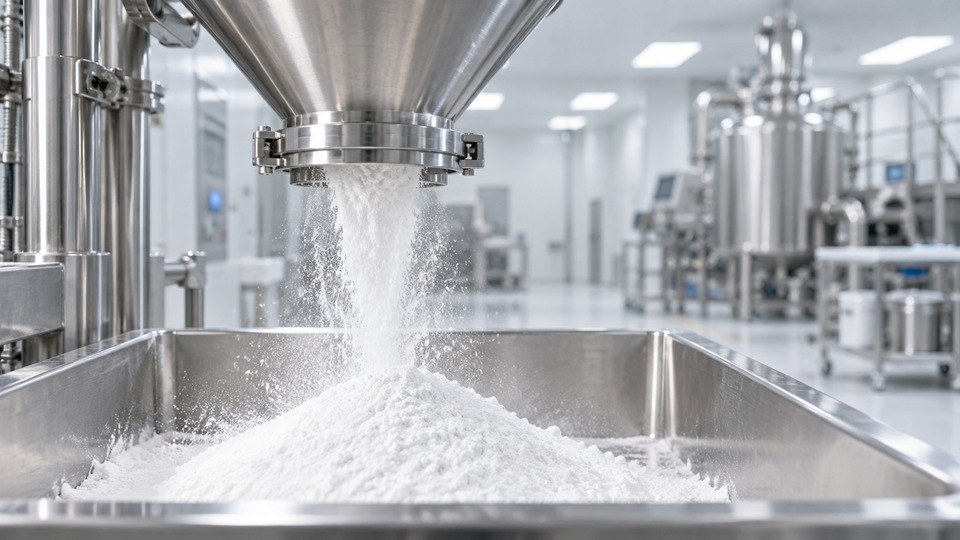
An auger does not automatically solve poor upstream flow. If powder bridges or rat-holes above the auger inlet, the screw can receive an inconsistent supply even while the hopper still contains material. Agitation may help some formulations but can also change aeration, effective bulk density, and segregation.
Volumetric systems are particularly sensitive to density changes. Because delivered mass depends on dosing volume and effective bulk density, settling or aeration can cause weight drift without any change to the nominal dosing volume.
How Can Powder Flowability Be Improved?
The best corrective action depends on the probable cause. A useful sequence is identify the mechanism → make a targeted change → check the trade-off → verify on the process.
Control Particle and Formulation Properties
If excessive fines or an unfavorable particle-size distribution increase cohesion, controlled milling, classification, κοκκοποίηση, or another particle-engineering step may improve handling. The modified material must then be checked for segregation, συμπιεστό, διάλυση, and final product performance.
If environmental exposure changes flow, compare moisture, συνθήκες αποθήκευσης, raw-material lots, and processing history. Avoid assuming that either drying or increasing humidity will improve every formulation.
Colloidal silicon dioxide is a representative glidant used to modify particle interactions in suitable formulations. Its effect depends on formulation composition, concentration, ιδιότητες σωματιδίων, and mixing conditions. Magnesium stearate is primarily a lubricant and should not be treated as a generic flow aid. Reviews of powder-flow improvement methods likewise emphasize that the appropriate approach depends on the underlying mechanism .
Optimize the Hopper, Feeder and Process
If laboratory data appears acceptable but production is unstable, inspect the complete powder path. Check hopper discharge, feeder replenishment, powder-bed level, auger or paddle operation, buildup on contact surfaces, dosing settings, and whether the problem becomes worse at higher speed.
Do not assume a universal hopper angle or agitation setting. Hopper geometry, outlet design, wall interaction, feeder configuration, and agitation should be matched to the material and required flow pattern.
Machine adjustment also has limits. If a cohesive formulation cannot refill the dosing zone within the available cycle time, continuously increasing agitation or reducing speed may only mask a material limitation.
How Should Powder Flowability Be Evaluated Before Production?
Production readiness should be based on the actual formulation and target process rather than a single laboratory flow classification.
Characterize the Final Material
Depending on process risk, useful data may include particle-size distribution, υγρασία, bulk and tapped density, Carr Index, Hausner Ratio, angle of repose, orifice behavior, and shear data.
The purpose is to identify behaviors that may become important during hopper discharge, σίτιση, η γέμιση, capsule dosing, or powder packaging—not simply to obtain a “pass” value.
Test the Actual or Representative Formulation
Placebo powders are useful for mechanical commissioning but cannot fully represent a commercial formulation. API morphology, lubricant, glidant, granulation history, υγρασία, πυκνότητα, and blend composition can all change feeding and dosing.
For an equipment trial, useful inputs include the representative powder or granules, target dose or fill weight, dosage form or package format, planned output, available density or flow data, and known environmental or handling constraints.
Verify the Target Machine and Operating Window
A machine trial should evaluate more than whether equipment runs for several minutes. Observe:
hopper discharge and feeding continuity;
bridging and rat-holing;
feeder or powder-bed refill;
die filling or dosing stability;
fill-weight trends;
adhesion and dust;
rejects and stoppages;
behavior as production speed changes.
The objective is a stable operating window, not simply the highest nominal machine speed.
If the same problematic formulation shows similar failures across multiple suitable machines under controlled conditions, suspicion shifts toward the material or formulation; this is evidence, not proof. If several previously processable materials repeatedly fail only on one machine or setup, suspicion shifts toward the equipment, εργαλεία, feeder configuration, or process settings.
Change one variable at a time where practical and document the result.
Για εξοπλισμός συσκευασίας φαρμακευτικών προϊόντων projects, Ruida Packing can evaluate representative formulation information and sample material together with the required fill weight, δοσολογική μορφή, παραγωγή, and available flow or density data. This allows feeding and dosing behavior to be assessed under relevant machine conditions instead of selecting equipment from a laboratory flow index alone.
Σύναψη
Powder flowability in pharmaceutical manufacturing is controlled by the interaction between material properties and process conditions. Particle size and shape, υγρασία, πυκνότητα, cohesion, τριβή, σχεδιασμός σύνθεσης, and processing history influence how powder behaves, while the equipment determines the flow path, refill time, consolidation, and mechanical stresses it must tolerate.
The practical sequence is material properties → complementary flow tests → equipment interaction → production performance → targeted corrective action → actual-machine verification. Carr Index, Hausner Ratio, angle of repose, orifice flow, and shear testing help characterize risk, but none replaces testing under the intended συμπίεση δισκίου, γέμιση κάψουλας, or powder-handling conditions.
Before final pharmaceutical machinery selection, evaluate a representative formulation with the required fill weight, ταχύτητα παραγωγής, dosage form or package format, and available material data. Ruida Packing can use this information with sample testing to assess feeding, δοσολογία, refill stability, and the practical operating window, reducing the risk of selecting equipment from laboratory flow data alone.
Frequently Asked Questions About Powder Flowability
-
What does flowability mean?
Powder flowability describes how readily and consistently a powder moves under defined conditions. Στη φαρμακευτική παραγωγή, it depends on both material properties and the equipment or process through which the powder is moving.
-
What does a powder flowability test measure?
Each test measures a particular aspect of powder behavior. Angle of repose evaluates heap formation, Carr Index and Hausner Ratio reflect consolidation from density data, orifice tests examine gravity discharge, and shear cells evaluate behavior under controlled stress.
-
How do you check the flow properties of a powder?
Use complementary laboratory measurements on the final powder or blend, then compare those results with feeding, refill, δοσολογία, or die-filling behavior on the intended equipment. A single test should not be used as the only production criterion.
-
What are the flow properties of powders?
Powder flow behavior includes cohesion, τριβή, συσκευασία, consolidation, powder-to-wall interaction, and response to applied stress. These behaviors are influenced by particle size, σχήμα, υγρασία, πυκνότητα, electrostatics, formulation composition, and processing history.
-
What does free-flowing powder mean?
A free-flowing powder moves readily under the conditions in which it is evaluated. The term is process-dependent: easy flow through a laboratory funnel does not guarantee reliable high-speed die filling, capsule dosing, or auger feeding.
-
What does the angle of repose indicate about powder flow properties?
Angle of repose provides a comparative indication of heap-forming behavior. Lower angles are generally associated with easier movement in that test, but the result is method-dependent and should not independently predict machine performance.
-
How can the flow properties of a powder be improved?
Identify the likely cause first. Ανάλογα με το σκεύασμα, improvement may involve particle-size control, κοκκοποίηση, έλεγχος υγρασίας, a suitable glidant, hopper or feeder changes, or process-setting adjustments. Verify every change against downstream product performance.
-
How do you evaluate the flowability and compressibility of granules?
Use particle-size, πυκνότητα, Carr Index, Hausner Ratio, angle-of-repose, and other relevant flow measurements together with process testing. Flowability and compressibility are related to manufacturing performance but are not interchangeable properties.
-
How does powder flowability affect capsule filling?
Flowability affects how consistently the powder bed replenishes the capsule dosing zone. Unstable replenishment can contribute to fill-weight variation, but bed depth, χύδην πυκνότητα, dosing mechanism, ταχύτητα μηχανής, and formulation properties also matter.
-
How does powder flowability affect tablet compression?
Flowability affects powder delivery to the feed frame and die cavities. Reduced filling time at higher turret speed can expose flow limitations, but feeder settings, εργαλεία, βάθος πλήρωσης, χωρισμός, πυκνότητα, and machine condition should be checked before diagnosing poor flow.
Αναφορές
- Φαρμακοποιία Ηνωμένων Πολιτειών. Γενικό Κεφάλαιο <1174> Powder Flow . USP–NF. Rockville, MD: Φαρμακοποιία Ηνωμένων Πολιτειών, 2023. DOI: 10.31003/USPNF_M99885_01_01.
- Tharanon W, Guo Y, Peerapattana J, Sun CC. A systematic comparison of four pharmacopoeial methods for measuring powder flowability . International Journal of Pharmaceutics. 2024;661:124454. DOI: 10.1016/j.ijpharm.2024.124454.
- Tang X, Zakhvatayeva A, Zhang L, Wu ZF, Sun P, Wu CY. Flow behaviour of pharmaceutical powders during rotary die filling with a paddle feeder . International Journal of Pharmaceutics. 2020;585:119547. DOI: 10.1016/j.ijpharm.2020.119547.
- Tan SB, Newton JM. Powder flowability as an indication of capsule filling performance . International Journal of Pharmaceutics. 1990;61(1–2):145–155. DOI: 10.1016/0378-5173(90)90053-7.
- Shah DS, Moravkar KK, Jha DK, Lonkar V, Amin PD, Chalikwar SS. A concise summary of powder processing methodologies for flow enhancement . Heliyon. 2023;9(6):e16498. DOI: 10.1016/j.heliyon.2023.e16498.
- Shah DS, Moravkar KK, Jha DK, Lonkar V, Amin PD, Chalikwar SS. A concise summary of powder processing methodologies for flow enhancement. Heliyon. 2023;9(6). DOI: 10.1016/j.heliyon.2023.e16498.