The wrong feeding system can turn a good formulation into a production headache.
ในการผลิตยาและโภชนเภสัช, the feeding method directly decide if the material can be fed or not. Any stickness, การเชื่อมโยง, or clogging will destroy the whole capsule production. This guide will compare auger and pneumatic feeding, explains where each method fits, and shows why actual material testing is often the best way to choose a capsule filling machine feeding system.
ประเด็นสำคัญ
- How auger and pneumatic feeding work.
- Which materials suit each feeding method.
- The main differences, ประโยชน์, and limitations.
- The material properties that matter before equipment selection.
- Why actual product testing should come before the final decision.
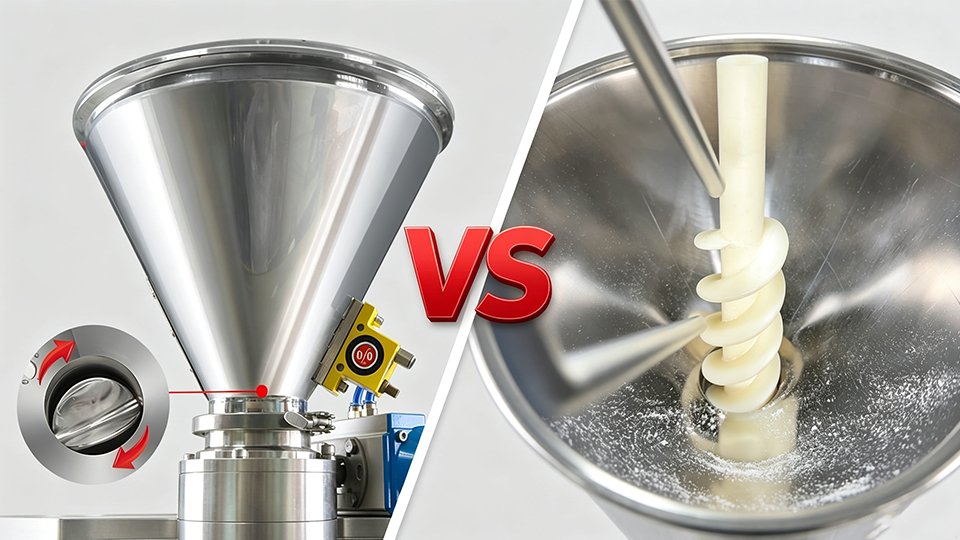
1. What Is Auger Feeding In A Capsule Filling Machine?
How Auger Feeding Works
An auger feeding system uses a rotating screw inside the powder hopper or feeding mechanism. The motor controls screw speed and feeding time, while screw pitch and geometry influence the amount delivered. In a typical process:
Hopper → Auger Screw → Metered Feeding → Capsule
The screw works like a controlled miniature conveyor. It is described as primarily volumetric, with dosing influenced by screw pitch and speed, and powder level in the hopper.
ในทางปฏิบัติ, this makes the auger dosing system particularly useful when a manufacturer needs controlled and repeatable powder delivery rather than relying on gravity alone.
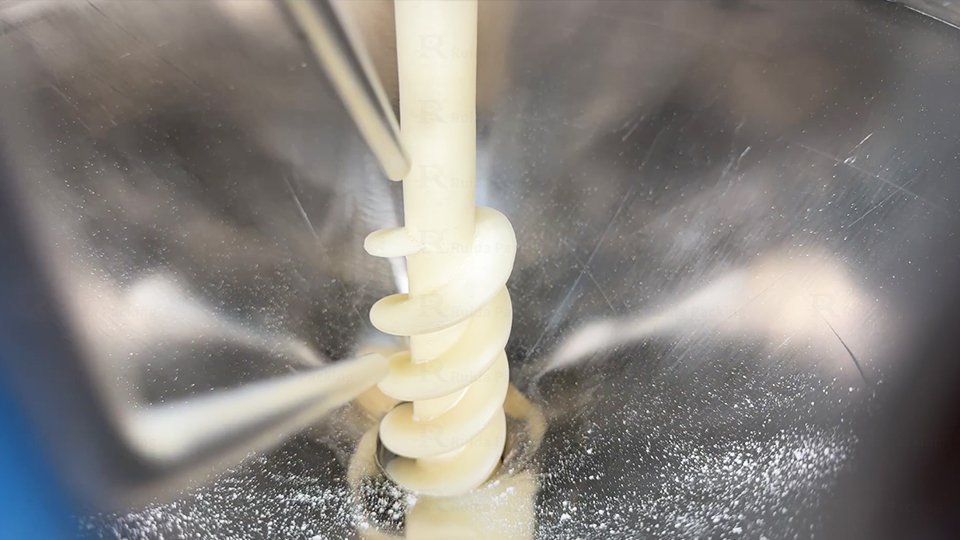
What Types Of Materials Are Suitable For Auger Feeding?
Auger feeding is commonly considered for fine powders, especially materials with poor or inconsistent flow. Smaller particles can develop stronger interparticle forces, making gravity-based discharge less reliable. Research on pharmaceutical powders also shows that smaller particles generally have greater cohesion and adhesion because interparticle forces become more significant.
A low bulk density, such as around 0.3 g/mL, may indicate a light, fluffy powder worth evaluating with an auger. อย่างไรก็ตาม, this value should never be treated as a hard boundary. USP defines bulk density as the mass-to-volume ratio including the void space between particles, meaning how a powder packs also affects the result.
Advantages And Limitations
The main strength of an auger feeding system is control. Operators can tune screw speed and feeding time to achieve stable volumetric dosing.
An auger dosing system can also be combined with agitation to reduce bridging or rat-holing in the hopper. That can be useful when handling fine powders that otherwise tend to settle unevenly.
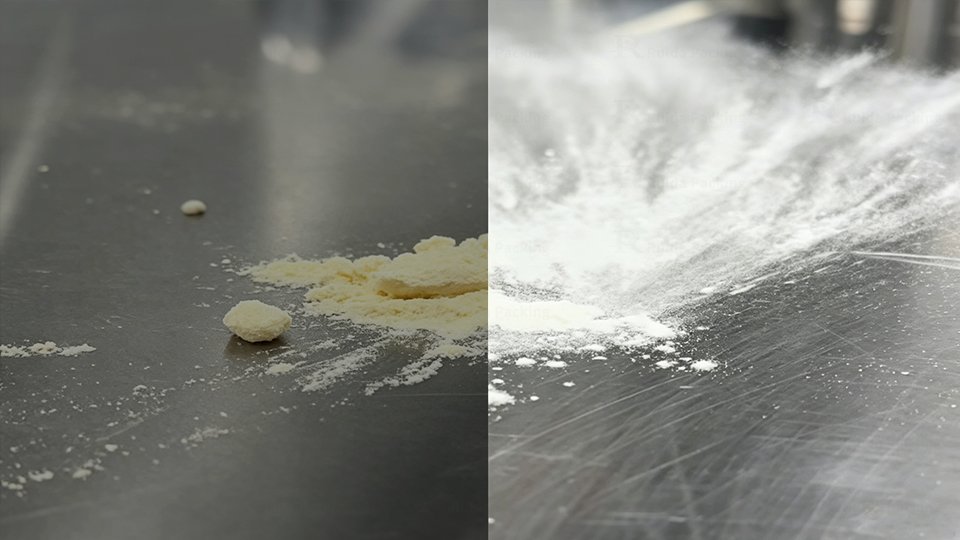
The weak point is severe stickiness. A highly cohesive or moisture-sensitive powder may adhere to the screw, compact inside the flights, or interfere with rotation. In sticky powder capsule filling, a feeder that normally runs smoothly can quickly become the bottleneck.
2. What Is Pneumatic Feeding In A Capsule Filling Machine?
How Pneumatic Feeding Works
The term pneumatic feeding covers several designs. In the capsule filling machine feeding system discussed here, it is more accurately understood as an air-assisted feeding arrangement rather than a pure pneumatically driven mechanism.
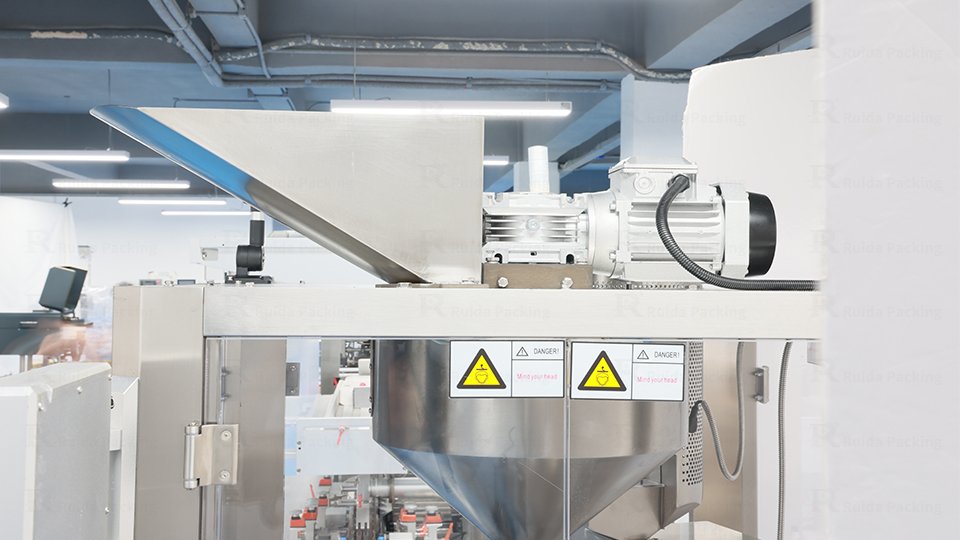
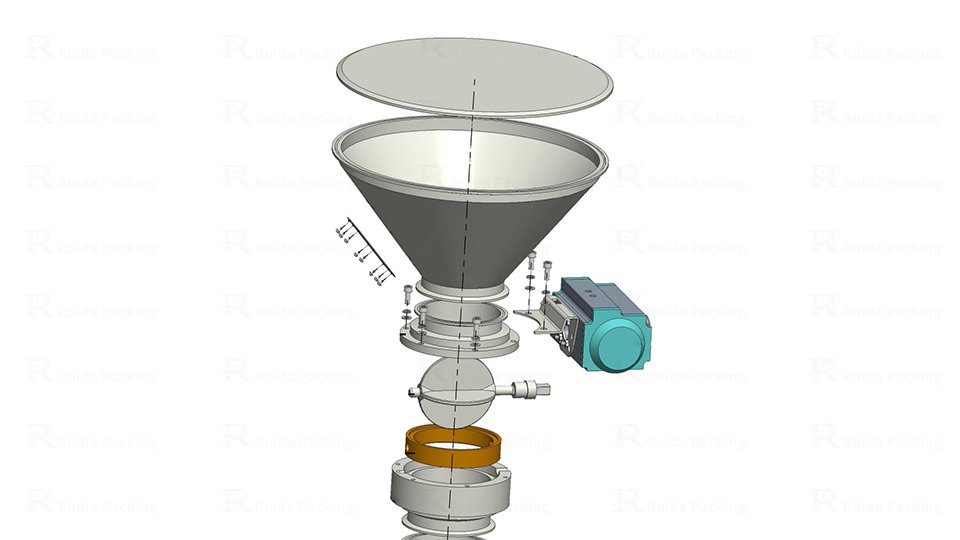
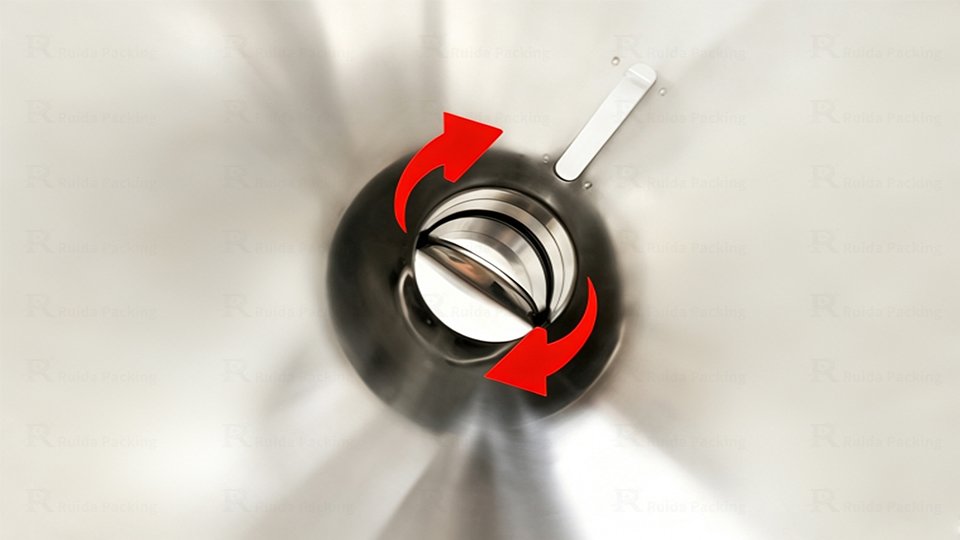
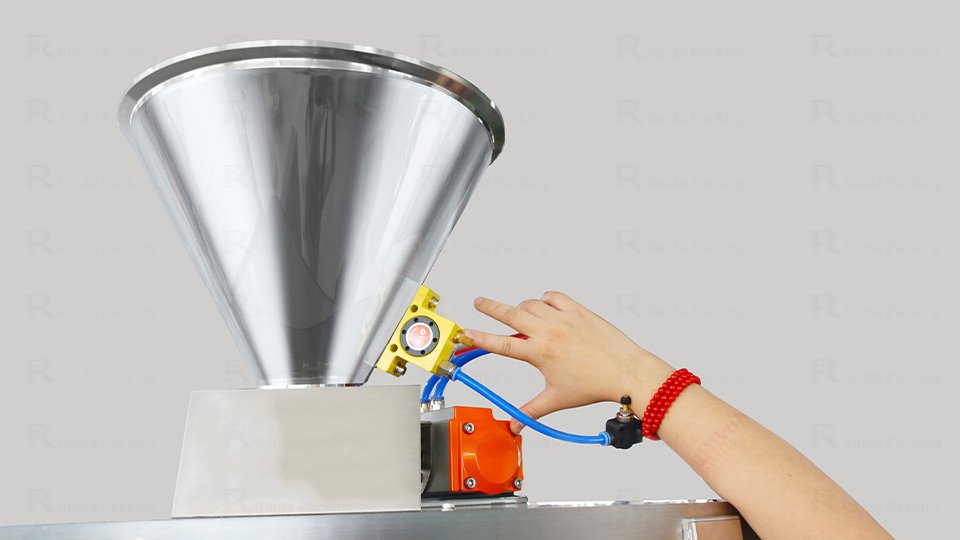
A hopper vibrator helps keep material moving, while a solenoid valve controls the forward and reverse movement of a rotary valve to regulate discharge. The streamline of pneumatic feeding is shown below:
Hopper + Vibrator →Rotary Solenoid Valve → Capsule Filling
This is not simply air blowing powder into a capsule. It is a controlled discharge mechanism in which vibration, valve movement, and air assistance work together.
What Materials Suit Pneumatic Feeding?
A pneumatic feeding system can be attractive for materials with moderate to good flowability, including free-flowing powders, เม็ด, และเม็ด. It can also be considered for mildly cohesive materials that respond well to vibration.
This is especially relevant to pellet filling and granule filling, where the question is not only whether the material will move, but whether it will move without unnecessary mechanical stress. A screw creates continuous contact with the product, while a valve-based route may offer a gentler path for fragile pellets or granules.
FDA guidance recognizes that hard capsules may be filled with powders or beads, supporting the broader use of multiparticulate materials in capsule dosage forms.
Why Consider Pellets And Granules?
For pellet filling, material integrity matters almost as much as material flow.
A screw is an active mechanical component, so fragile pellets or irregular granules can experience more contact and stress than they would in a direct or valve-based path. Differences in particle size can also complicate movement through a narrow screw channel.
That is why a capsule filling machine feeding system for pellets and granules often deserves a design with less mechanical interference when the formulation is sensitive to breakage, รอยขีดข่วน, or shape loss. ดังนั้น, the perfect solution for pellets and granules is the cup filler. This filling cup greatly reduces product blockage and helps preserve the integrity of pellets and granules. Compared with auger vs pneumatic feeding, it is better suited for filling pellets and granules.
Limitation: Poor-Flow Powders
Pneumatic feeding is not automatically better. If a powder has very poor flowability, it may compact in the hopper, form an arch or bridge, and eventually block the outlet.
USP notes that powder flow behavior is multifaceted and can be evaluated by methods including angle of repose, compressibility index, Hausner ratio, ไหลผ่านปาก, and shear testing.
กล่าวอีกนัยหนึ่ง, vibration can help a reluctant powder move, but it cannot always persuade a very cohesive powder to cooperate.
3. Auger vs Pneumatic Feeding: ความแตกต่างที่สำคัญ
As we have understood how auger vs pneumatic feeding work and the basic pros and cons of each other, we can make it much more intuitive with the following table.
Table 1-Differences between Auger vs Pneumatic Feeding
| ปัจจัย | Auger Feeding | Pneumatic Feeding |
| หลักการการทำงาน | Rotating screw | Solenoid rotary valve |
| Best Suited To | Fine and low-density powders | Free-flowing powders, เม็ด, เม็ด |
| ความสามารถในการไหล | Poor to moderate can be workable | Moderate to good preferred |
| Sticky Materials | More sensitive to sticking | Can suit mildly cohesive materials |
| Fine Powder | Often a strong option | More difficult when flow is very poor |
| Pellets And Granules | May damage the particle | Often preferable when integrity matters |
| Main Risk | Screw blockage | Bridging and accumulation |
The key point in auger vs pneumatic feeding is that neither technology wins in every application. The right choice depends on the powder, the required fill weight, the capsule format, and the production target.
Prof. Dietmar Schulze, a specialist in powder flow, emphasizes the importance of material characteristics such as particle size distribution, รูปร่างของอนุภาค, ความชื้น, and temperature. His work supports a simple principle: before comparing capsule filler machines, understand the material.
แล้ว, a question rises: which capsule feeding method suits your material?
4. When Is Pneumatic Feeding A Better Choice?
Pneumatic feeding becomes interesting when the material flows reasonably well but is not perfectly free-flowing. A slightly cohesive powder may benefit from solenoid-assisted discharge, while pellets and granules may benefit from lower mechanical contact.
ตัวอย่างเช่น, when a nutraceutical formulation contains small pellets, preserving their shape may be more important than forcing the material through a screw. In such a case, auger vs pneumatic capsule filling should be treated as a material-testing question rather than a catalogue comparison.
The same logic applies to capsule filling machine feeding system for pellets and granules applications: the gentler route may be preferable when particle integrity is important.
5. Why Powder Properties Matter
Powder flow is more complicated than it looks. A powder may seem free-flowing when poured through a simple funnel but behave very differently inside a hopper, เครื่องป้อน, หรือ เครื่องบรรจุแคปซูล.
In one USP powder-flow classification, an angle of repose of about 25–30° is associated with excellent flow, while values above 66° are classified as very poor flow. These values are useful as reference points because the test method itself affects the result.
Pharmaceutical production also leaves little room for uncontrolled variation. ผง & Bulk Solids reports that pharmaceutical dosage forms are commonly below 500 มก, making even relatively small fluctuations important in dose control.
For powder feeding for capsule filling, that means looking beyond the product name and checking how the actual material behaves.
6. How To Choose A Capsule Filling Machine Feeding System
A practical selection process can start with five questions.
What Is The Bulk Density?
Record the material’s bulk density in g/mL. A value around 0.3 g/mL can indicate a very light powder, but density alone should not determine whether you need an auger feeding system or a pneumatic feeding system.
How Well Does The Powder Flow?
Check powder flowability using suitable methods such as angle of repose, Carr index, Hausner ratio, or shear testing.
Experts explain that flow properties should be established through appropriate testing because it is difficult to predict powder behavior theoretically from every influencing variable.
What Is The Particle Size?
Record average particle size and particle size distribution. Also identify whether the material is powder, เม็ด, เม็ด, bead, or a mixture.
A broad particle-size distribution can change packing and discharge behavior, so two materials with the same average particle size can still behave differently in a powder feeding system.
Is The Material Sticky Or Cohesive?
Ask a simple question: Is the material sticky or cohesive?
Moisture and hygroscopicity can influence adhesion and flow. If material begins building up on the feeder, hopper wall, or screw surface, the problem is no longer simply low flowability; it becomes a production-stability issue.
Can The Actual Material Be Tested?
This is the step that reduces uncertainty the most.
Send the capsule filling machine supplier a representative sample together with:
- ความหนาแน่นเป็นกลุ่ม
- Powder flowability data
- Particle size and distribution
- Moisture or hygroscopicity information
- Stickiness or cohesiveness
- Target capsule size
- Required fill weight
- กำลังการผลิต
A trial on the actual machine can reveal bridging, ติด, unstable discharge, dose variation, or pellet damage that a specification sheet cannot show.
This is why how to choose a capsule filling machine feeding system should always end with material testing rather than a theoretical guess.
7. How Ruida Packing Supports Feeding System Selection
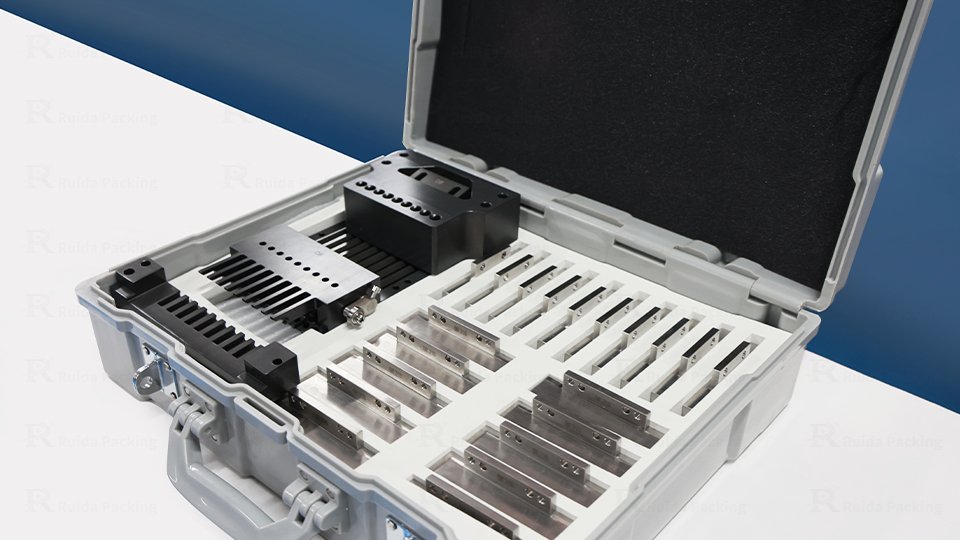
ที่รุยดาแพ็คกิ้ง, the capsule filling machine feeding system is selected around the material rather than the machine name. Customers can send product samples for trial runs so engineers can compare an auger feeding system, pneumatic dosing system, or another suitable configuration under actual conditions.
For pharmaceutical and nutraceutical production, Ruida provides 316L stainless steel product-contact parts and a complete material certification package for the relevant components. Compliant with FDA, CE, and cGMP requirements, we ensure that equipment surfaces contacting materials must not be reactive, หรือดูดซึมในลักษณะที่ทำให้คุณภาพของผลิตภัณฑ์เปลี่ยนแปลงไป.
Ruida Packing also provides a 1-year warranty for the complete machine and 2 years of free replacement of spare parts, together with remote technical support and on-site installation and commissioning services.
This matters because buying a capsule filler is not the end of the project. The real goal is to keep the กระบวนการผลิตแคปซูล stable after installation, during routine production, and when the formulation changes.
8. บทสรุป: Choose The Feeding System Based On Your Material
You can never say which is better when comparing auger vs pneumatic feeding. ในด้านหนึ่ง, auger dosing system is often a strong candidate for fine, low-density, poorly flowing powders that need controlled volumetric dosing. ในทางกลับกัน, pneumatic dosing system can be attractive for reasonably free-flowing powders, เม็ด, และเม็ด, especially when lower mechanical contact is desirable.
The best capsule filling machine feeding system is the one proven with your material. ความหนาแน่นเป็นกลุ่ม, powder flowability, ขนาดอนุภาค, and stickiness are useful starting points, but the final decision should come from an actual machine trial.
9. เอฟAQs
ไตรมาสที่ 1: What Is The Difference Between Auger And Pneumatic Feeding?
Auger dosing system uses a rotating screw to meter material, while pneumatic feeding system combines hopper vibration, a solenoid rotary valve, and air-assisted discharge. In auger vs pneumatic capsule filling, augers are often considered for fine or poorly flowing powders, while pneumatic feeding systems can suit free-flowing powders, เม็ด, และเม็ด.
ไตรมาสที่ 2: Which Feeding System Is Best For Sticky Powder Capsule Filling?
There is no definite answer. Mildly cohesive material may respond well to powder pneumatic feeding, while some sticky powders can still work with a properly designed auger. For the best feeding system for sticky powder betwen auger vs pneumatic feeding, testing the actual material is much safer than relying on a general rule.
ไตรมาสที่ 3: Is Auger Feeding Suitable For Low-Density Powder?
ใช่. Low-density powders, including some around 0.3 g/mL, may be good candidates for auger feeding when their other properties also support it. Bulk density should always be evaluated together with powder flowability, ขนาดอนุภาค, ความชื้น, and cohesiveness.
ไตรมาสที่ 4: Can Pneumatic Feeding Be Used For Pellets And Granules?
ใช่. Pneumatic dosing system can be considered for pellet filling and granule filling, especially when particle integrity matters. The final choice still depends on particle size, รูปร่าง, flow behavior, เติมน้ำหนัก, และการออกแบบเครื่องจักร.
คำถามที่ 5: How Do I Choose A Capsule Filling Machine Feeding System?
Start with bulk density, powder flowability, ขนาดอนุภาค, stickiness, ขนาดแคปซูล, เติมน้ำหนัก, และข้อกำหนดด้านผลผลิต. Then send representative samples for a trial run. The actual test usually gives a more useful answer than choosing a feeder from a material name alone.
เอกสารอ้างอิง
[1] เภสัชตำรับของสหรัฐอเมริกา (USP), บททั่วไป <1174> การไหลของผง.
[2] เภสัชตำรับของสหรัฐอเมริกา (USP), บททั่วไป <616> Bulk Density of Powders.
[3] เรา. Food And Drug Administration, 21 CFR §211.65, Equipment Construction.