A escolha de máquinas de embalagem blister para produção em pequena escala começa com a frequência do lote, trabalho do operador, e requisitos de pacote. O formato do seu comprimido ou cápsula é tão importante quanto a velocidade. Este guia compara seis modelos. Fornecemos o LDPP-140H e o DPP-90R discutidos abaixo.
O que a produção em pequena escala exige?
Um pequeno lote pode ser uma experiência de embalagem ocasional ou um pedido que retorna toda semana. Embora ambos envolvam quantidades limitadas, eles criam demandas diferentes para a pessoa que opera a máquina.
Para trabalho de desenvolvimento, você pode precisar preparar um formato, examine o pacote, e ajuste a próxima execução. Para pedidos recorrentes, você também precisa saber como o lote completo se enquadra no tempo de produção disponível.
Anote a quantidade necessária por execução e com que frequência o formato mudará. Em seguida, identifique o funcionário que irá operar o equipamento e o tempo que essa pessoa poderá gastar carregando produtos ou reabastecendo materiais.
Esses requisitos operacionais precisam de uma especificação de pacote físico junto com eles. Registre as dimensões do comprimido ou cápsula, quantidade por pacote, layout de cavidade pretendido, e materiais de embalagem. Eles estabelecem o formato que a máquina deve realmente produzir.
Para medicamentos sujeitos ao CGMP dos EUA, 21 CFR 211.94 requer recipientes e tampas para proteger o produto sem alterar negativamente a sua qualidade. [1] Defina as necessidades de proteção do seu produto antes de selecionar os materiais de embalagem.
Esses requisitos dizem respeito ao sistema de embalagem do medicamento. A especificação da sua máquina deve então abordar como os materiais escolhidos serão formados, preenchido, e selado.
Com essa informação, você pode fazer a primeira escolha útil: a workflow with separate manual stages, or an automatic sequence supported by an operator. The LDPP-140H and DPP-90R show how those two approaches work in practice.
Manual Or Automatic Blister Packaging Machines?
LDPP-140H For Hands-On Development
The LDPP-140H is our tabletop máquina de embalagem blister de laboratório. Its documentation lists Alu-Plastic and Alu-Alu packaging for tablets and capsules, with a maximum forming area of 110 × 120 milímetros.
Its documented dimensions are 640 × 580 × 700 milímetros, and it weighs 118 kg. Those figures give you a starting point for planning the supporting work surface, with additional room needed for materials and handling.
For a PVC and aluminum-foil pack, you manually pull one end of the PVC into the forming position. Once the pockets are formed, you place the tablets or capsules into them by hand.
You then replace the forming mold with the heat-sealing mold. Place the loaded PVC blister in the sealing position, add the aluminum foil, and press the heat-sealing button. Depois de selar, you manually switch to the cutting station.
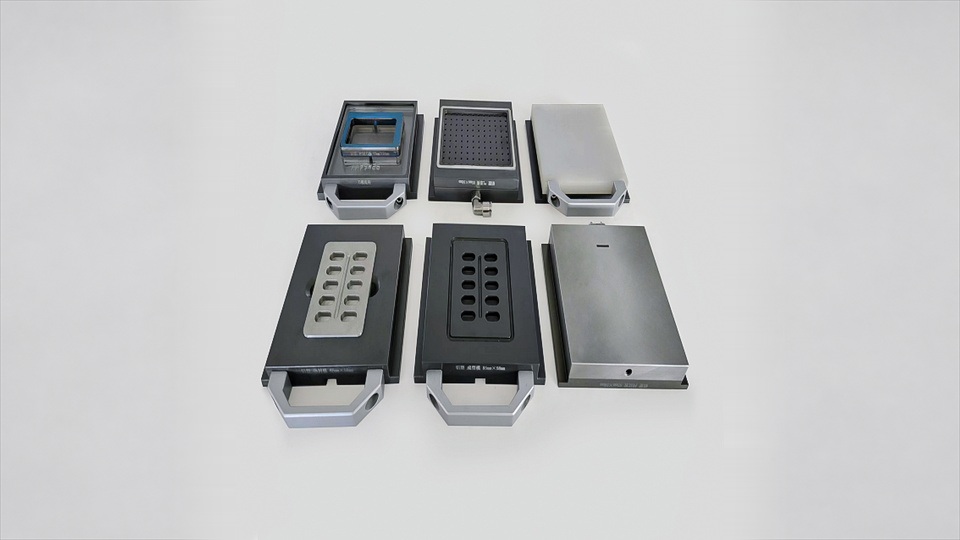
Watch the LDPP-140H demonstration to follow the operating sequence.
This gives you a tabletop workflow for preparing and examining development packs. For a deeper discussion of experiments and laboratory work, see our laboratory blister packaging guide.
The manual stages also show where the operator spends time during each run. As orders become more frequent, it is useful to examine how an automatic sequence changes those tasks.
DPP-90R For Recurring Production
DPP-90R brings automatic forming, carregamento do produto, vedação, and cutting into one sequence. One employee can operate it during normal production, replenishing the product feeder when it runs empty.
Product loading therefore becomes part of the machine sequence, while the employee handles replenishment. When the PVC or aluminum foil runs out, the machine gives an alarm and the operator replaces the exhausted material.
Include these replenishment tasks when setting the production schedule and deciding how much of the employee’s time is needed for the batch.
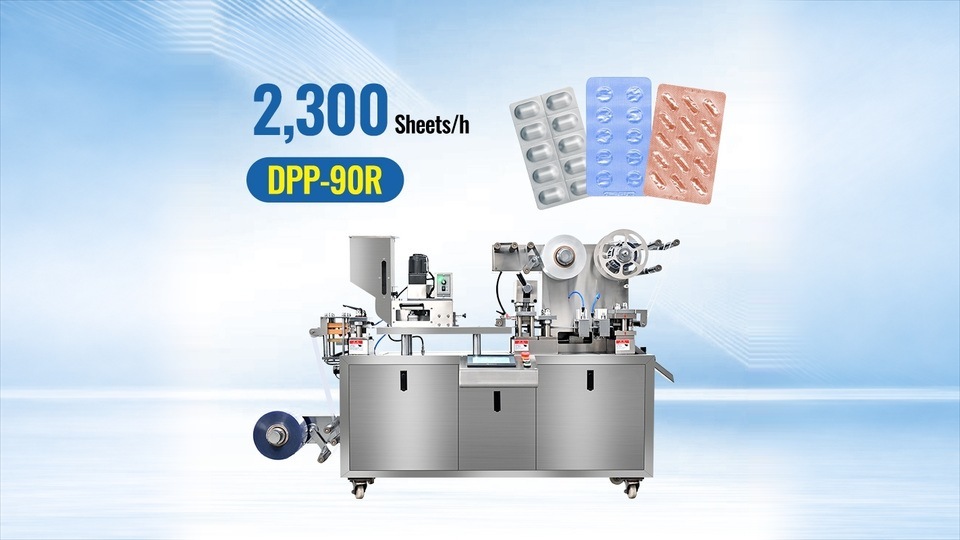
Watch the DPP-90R demonstration to see the equipment in operation.
Our documentation lists a nominal capacity of 2,300 blister plates per hour, with output dependent on the material and application. The standard forming-area specification is 80 × 110 mm with a 15 mm depth; greater depth is a customization.
DPP-90R can also be configured for Alu-Alu packaging, which requires changing the complete tooling and feeding set. The full set belongs in the quotation so that the material choice is reflected in the equipment supplied.
Whichever workflow fits your schedule, it still needs tooling that accommodates the planned pack. That is where the published format specifications become relevant.
How Do Small Blister Machine Specifications Compare?
Start that check with the forming or format area, while keeping the supplier’s terminology intact. A maximum forming area and a usable forming area are different specification labels; neither should automatically be treated as the dimensions of your finished pack.
The table shows the published workflows and area figures for six models. Keep the labels attached to the numbers when you review your proposed format.
| Máquina | Workflow | Published Area Specification |
|---|---|---|
| LDPP-140H | Operator-led forming, hand loading, manual tooling/station changes, and button-start sealing | Maximum forming area: 110 × 120 milímetros |
| DPP-90R | Automatic forming, carregando, vedação, e corte; manual replenishment | Standard forming area: 80 × 110 milímetros, 15 mm depth |
| ACG MINIBLIS PLUS [6] | Intermittent flat forming and flat sealing | Maximum forming area: 156 × 96 milímetros |
| Mactec MT100 [7] | Formando, enchimento, vedação, perfurante, e corte | Approximate forming area: 80 × 95 milímetros |
| Pharmaworks BlisterMate [8] | Semi-automatic thermoforming or cold forming, vedação, and perforating | Usable forming area: 220 × 290 milímetros |
| Sepha EZ Blister [9] | Separate forming, vedação, and perforating/cutting operations | Maximum format area: 180 × 120 milímetros |
The four external entries reproduce manufacturer descriptions and dimensions, without a performance ranking. Sources [6]-[9] were checked on 9 November 2026. Our entries combine company specifications with confirmed operating details.
Use your intended layout to ask how the pockets, sealing area, and cutting arrangement fit within the proposed tooling. This turns a published area figure into a review of the pack you need.
Once the format has been established, the remaining capacity question is how long that configuration takes to deliver a complete batch.
How Much Output Can You Expect Per Batch?
Compare Finished Packs Over The Same Period
Published speed figures count different events. DPP-90R’s nominal figure refers to blister plates per hour. ACG publishes forming cycles per minute, while Sepha’s approximately 200 cycles per hour applies to any single operation.
Those units cannot establish a finished-pack ranking by themselves. Your pocket layout and cutting arrangement determine how a cycle relates to the packs you collect, e operações separadas ainda precisam ser concluídas.
Solicite o número de embalagens acabadas aceitáveis produzidas durante um período de teste definido. Registre o produto, material, layout, e configuração da máquina com o resultado, juntamente com paradas e pacotes rejeitados.
Você pode então relacionar o resultado demonstrado à quantidade necessária. Mantenha um resultado observado separado de uma meta proposta para outro produto ou configuração.
Incluir preparação e reabastecimento
O julgamento também precisa mostrar o trabalho em torno da produção. Incluir preparação, aquecimento, verificações operacionais, liberação, e limpeza ao decidir se um lote se adapta à sua programação.
A orientação farmacêutica da OMS sobre BPF exige liberação documentada da linha antes da embalagem, com a área e equipamentos livres de sobras de trabalhos anteriores. [4] Considere essa tarefa ao agendar um lote farmacêutico, particularly when you change products or printed materials.
For LDPP-140H, account for the manual stages already described. For DPP-90R, include feeder replenishment and PVC or foil replacement. Record active operator time separately from periods when the machine is processing.
This distinction matters if the same employee has other duties. Observe which tasks can overlap and which need to finish before the next operation starts, rather than assigning additional work from the nominal machine speed alone.
The measured batch time and operator work also affect purchasing cost. Use them alongside the required pack format when defining the equipment and options in your quotation.
What Affects Blister Packaging Machine Cost?
Materials And Tooling
Use the intended pack drawing and material combination to specify the tooling. A PVC and aluminum-foil pack and a cold-formed aluminum-based pack require their respective forming arrangements.
FDA’s 1999 container-closure guidance discusses packaging protection, compatibilidade, segurança, e desempenho. [2] Use those considerations to define the pack with your quality team; a machine’s ability to form a material does not establish its suitability for your drug.
For new-drug stability programmes within ICH Q1A(R2)’s scope, section 2.2.4 recommends testing the dosage form in the container-closure system proposed for marketing. [3] Plan the trial materials around that intended pack and the evidence your quality team needs.
For DPP-90R Alu-Alu packaging, the complete replacement set includes the forming mold, alimentador, trilhos guia, heat-sealing mold, and cutting mold. All five items belong in the requested configuration.
Identify the formats required at the start and those you may need later. Ask for the selected materials, alimentador, ferramentas, and requested options to be recorded together so that the quoted scope matches your packaging plans.
Working Space And Safe Access
That configuration also has to fit the working area. Review an installation drawing showing space for product loading, material replacement, tooling access, e limpeza, including any supporting equipment.
For LDPP-140H, use the documented dimensions to begin planning the work surface. Add room for the materials and manual actions around it. For the proposed DPP-90R configuration, check the corresponding installation layout.
Our practical selection priorities are safe operation, a compact working area, e facilidade de uso. During a demonstration, follow the normal operating sequence and ask how you safely approach hot surfaces, replenishment, and tooling changes.
Confirm the electrical supply, ar comprimido, cooling requirements, and other services for the quoted configuration. Record what you need to prepare before delivery alongside the layout and operating instructions.
Equipment Scope And Operating Cost
With the tooling and installation requirements defined, request the base machine, product feeder, partes de formato, and options as an itemized scope. Include supporting equipment where it forms part of the proposal.
Then use your batch observations to assess recurring costs, including packaging materials, startup rejects, trabalho do operador, and the tasks between formats. Apply the same assumptions when reviewing quotations for the same packaging requirement.
A complete proposal should connect the price to the work and configuration you have discussed. The final step is to demonstrate that proposed arrangement with the product and pack it is intended to run.
How Do You Test The Machine Before Buying?
Arrange the trial around your tablet or capsule dimensions, quantidade por pacote, Materiais, and intended layout. Ask what products and packaging materials you need to provide, and agree the required quantities in advance.
Before the run, define the checks your quality team will use for product position, cavity condition, pack dimensions, e vedação. This gives the demonstration an agreed purpose beyond showing that the machine moves.
For projects governed by EU GMP, Anexo 15, sections 7.1-7.2 address packaging-equipment qualification and operating ranges for critical parameters, including temperature, velocidade da máquina, and sealing pressure. [5]
Use that framework to agree the relevant settings and acceptance checks for your packaging process. A supplier demonstration provides evidence for equipment selection; your site’s qualification and validation work remains a separate responsibility.
Follow the batch from setup to the collection of accepted packs. Record the actual configuration, condições de operação, saída, and employee tasks. Where a result depends on a particular material or layout, retain that condition with the record.
Review the result against the batch schedule you established at the beginning. Para trabalho de desenvolvimento, confirm that the manual sequence suits the task. For recurring production, confirm the demonstrated output and the replenishment work the employee needs to perform.
You can then finalize a configuration around evidence from your intended packaging task. With the technical choice established, the remaining purchase questions concern documentation and support; the following answers explain those arrangements.
Perguntas frequentes (Perguntas frequentes)
The following answers describe Ruida Packing’s equipment documentation and service policies.
Which Qualification And Acceptance Documents Can We Provide?
We can provide technical documents for FAT/SAT and DQ, QI, QO, e QP. Agree the document scope and any execution services for your proposed machine and project before ordering.
What Does Our One-Year Warranty Cover?
Our warranty starts when you receive the equipment and lasts one year. Free parts during that period are limited to the applicable wear-parts list, and the buyer pays the freight for replacement parts.
Confirm the list and applicable conditions for your proposed machine before ordering. Keep those terms with your equipment documentation so that the scope is clear when you request support.
Is Remote Installation And Training Support Included?
We provide free remote installation, comissionamento, and training support. After purchase, lifetime technical consultation and remote video advice are also available.
Agree the communication method and the work to be covered for your project. This gives your team a defined route for installation questions, operating guidance, and technical consultation as you use the equipment.
How Is Overseas On-Site Service Charged?
Overseas on-site service can include installation, comissionamento, treinamento, and trial production. The engineer fee is US$200 per working day, starting when the engineer begins work at your factory.
The customer also covers airfare, accommodation, and meals. There is no minimum number of service days under the confirmed policy. Agree the visit arrangements and project scope when reviewing your equipment proposal.
Can We Supply Manuals In Your Preferred Language?
We provide a complete English operating manual, and the language can be customized to your requirements. Discuss the requested language and document scope before ordering so that they are recorded for your project.
Instalação, comissionamento, and after-sales videos are also available. Confirm which materials you need for the staff who will operate and maintain the machine.
Considerações Finais
Choose LDPP-140H when its hands-on workflow fits your development batches, or DPP-90R for an automatic sequence with normal single-employee operation. Share your product, layout do pacote, and batch schedule to discuss the DPP-90R blister packaging machine configuração.
Referências
1. FDA dos EUA / eCFR. 21 CFR 211.94 – Drug Product Containers And Closures. Current text, Title 21 displayed as updated 5 November 2026. Estados Unidos; paragraphs (a)-(d).
2. FDA dos EUA, CDER/CBER. Container Closure Systems For Packaging Human Drugs And Biologics. Poderia 1999, final guidance. Sections III.B.1 and III.G.
3. EU / FDA dos EUA. Q1A(R2) Stability Testing Of New Drug Substances And Products. FDA final guidance, November 2003. Seção 2.2.4.
4. Organização Mundial de Saúde. WHO Good Manufacturing Practices For Pharmaceutical Products Main Principles. WHO Technical Report Series 986, Anexo 2, 2014. Sections 16.25-16.27.
5. Comissão Europeia. Volume EudraLex 4 Anexo 15 Qualification And Validation. Revision dated 30 Marchar 2015, operacional 1 October 2015. União Europeia; sections 7.1-7.2.
6. ACG. MINIBLIS PLUS Official Product Specifications. Undated product page, accessed 9 November 2026.
7. Mactec. MT100 Small Blister Pack Machine. Undated product page, accessed 9 November 2026.
8. Pharmaworks. BlisterMate Semi-Automatic Blister Machine. Undated product page, accessed 9 November 2026.
9. Sepha. EZ Blister Official Product Specifications. Undated product page, accessed 9 November 2026.