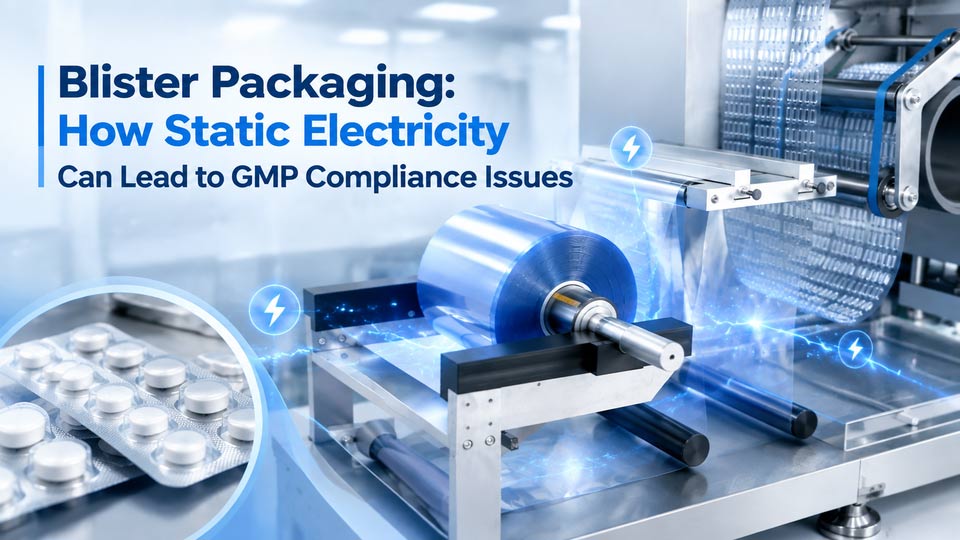
Jak elektryczność statyczna może prowadzić do problemów ze zgodnością z GMP
Wstęp
Have you ever encountered this problem? Your cleanroom meets the required standards, personnel follow hygiene procedures, and PVC film looks clean. Yet, QA inspection still detects dust inside finished blister packs.
Why does PVC blister film attract dust in cleanrooms? One possible cause is static electricity in blister packaging. Contact with rollers and other machine surfaces can generate electrostatic charge during film transport. The charged surface may attract airborne particles and carry them toward forming or sealing stations.
This article explains how static electricity affects a maszyna do pakowania w blistry, how dust contamination can affect product quality and heat sealing, and how to reduce static electricity in blister packaging.
Kluczowe wnioski
- Static electricity in blister packaging can build up on Zabawa z PCV during unwinding, transport, and contact with machine surfaces.
- Charged film may attract airborne particles, creating a potential risk of dust contamination in blister packs.
- Dust trapped between forming film and lidding foil may interfere with sealing contact. Seal integrity testing helps determine the actual impact on blister heat-seal quality.
- A static eliminator or ionizing bar can neutralize surface charge when correctly selected and installed.
- Production teams should compare static measurements, particle findings, and packaging inspection results before confirming whether static electricity contributes to a quality deviation.
Why Does PVC Blister Film Attract Dust During Production?
Static Charge Generation and Dust Attraction
Let’s first understand how static electricity forms.
Think of rubbing a balloon against your hair. The balloon gains an electrical charge and can attract small pieces of paper. A similar process can happen when PVC film contacts and separates from machine surfaces.
During contact, tiny electrical charges can move between two materials. If these charges remain on the PVC film, static electricity builds up on its surface.
The charged film can then attract nearby dust particles. Some particles carry electrical charges, while others respond to the film’s electric field. This is why PVC blister film can attract dust in cleanrooms, even when the film looks clean before production.
Which Blister Machine Stations Are Most Prone to Static Buildup?
Static electricity in blister packaging can develop at several points along the production process. The main areas to inspect are PVC film unwinding, termoformowanie, and tablet feeding.
1. PVC Film Unwinding
As PVC blister film unwinds, it contacts rollers and other machine surfaces. Repeated contact and separation can transfer electrical charges, causing static buildup during PVC film unwinding.
2. PVC Film Thermoforming
During thermoforming, the machine heats PVC blister film and uses compressed air to form blister cavities. As the film contacts the forming mold and separates from its surface, charge transfer may occur. If the electrostatic charge remains on the film, it can attract airborne dust before sealing.
3. Karmienie tabletem
During tablet feeding, static electricity may affect tablet movement along the vibration bowl and feeding tracks. Tablets may shift out of position or fail to enter the blister cavities, causing misaligned or empty cavities. Static can also cause powder from uncoated tablets to stick to the PVC blister film, increasing the risk of visible residue inside blister packs.
Examining these machine sections can help identify where electrostatic charge develops and whether it contributes to packaging problems. Use static charge measurement at relevant points to identify where charges accumulate. This helps determine whether a static eliminator or other static control measure is needed on the blister machine.
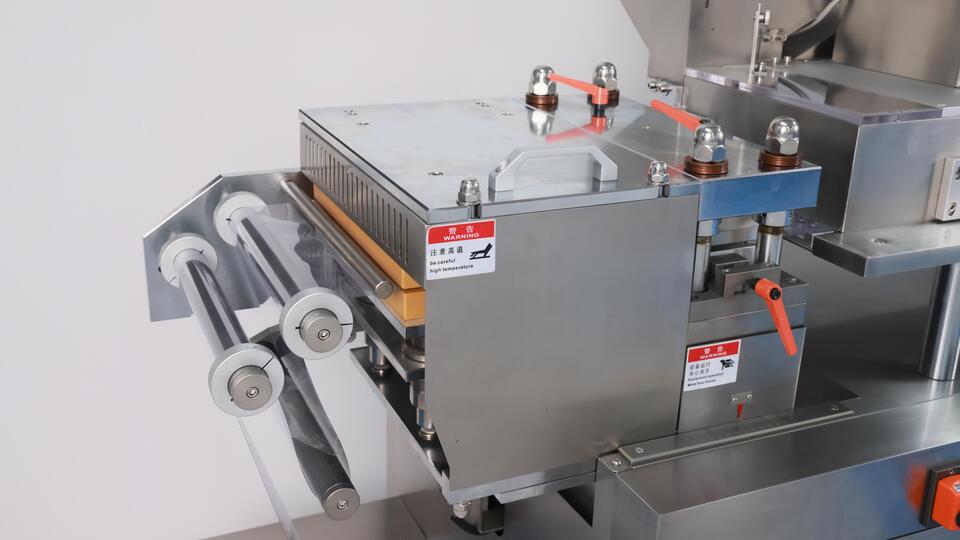
Static electricity is more likely to build up during PVC film unwinding and thermoforming
Can Dust Affect Product Quality and Blister Sealing?
Dust Inside Blister Packs: A Product Contamination Risk
During pharmaceutical blister packaging, charged PVC blister film may attract airborne dust particles before the film reaches the sealing station. Some particles may enter the cavities during forming or tablet feeding and remain inside the finished blister packs.
Visible dust inside blister packs can raise concerns about product contamination i zgodność z GMP, particularly when particles are found near or on the tablets. Production teams should inspect the affected packs, identify the particle source, and assess the findings against applicable quality requirements and contamination controls.
Dust contamination does not automatically indicate a GMP violation or prove that static electricity caused the problem. Investigators should review particle findings, static measurements, and production conditions to determine the cause and assess whether corrective action is required.
Can Powder in the Sealing Area Cause Seal Defects?
During blister packaging, dust or tablet powder may enter the sealing area between the PVC film and aluminum lidding foil. These particles can interfere with direct contact between the two materials, affecting blister heat-seal quality.
If powder remains trapped in the sealing area, może to powodować blister sealing defects and prevent the packs from passing seal integrity testing. Production teams should inspect the sealing area and verify package integrity to assess the impact on blister packaging quality and GMP compliance.
How Can You Control Static on a Blister Packaging Line?
Installing suitable static control equipment can help reduce electrostatic charge on packaging materials. W farmaceutycznym opakowaniu blistrowym, this can lower the risk of dust sticking to PVC film and entering blister cavities.
How Does an Ionizing Bar Neutralize Static on PVC Film?
An ionizing bar is one of the most commonly used devices by blister packaging machine manufacturers to control static electricity. Think of it as a device that sends tiny electrical charges into the air to neutralize static on the film.
An electrically charged PVC film surface can draw airborne particles toward it. The ionizing bar releases positive and negative ions into the air. These ions reach the charged film and neutralize its surface charge, reducing its tendency to attract airborne dust.
This makes an ionizing bar a practical option for static control on a blister packaging machine. Jednakże, it reduces static-related dust attraction rather than removing dust already stuck to the film. Its effectiveness depends on correct installation, operating distance, I regularna konserwacja.
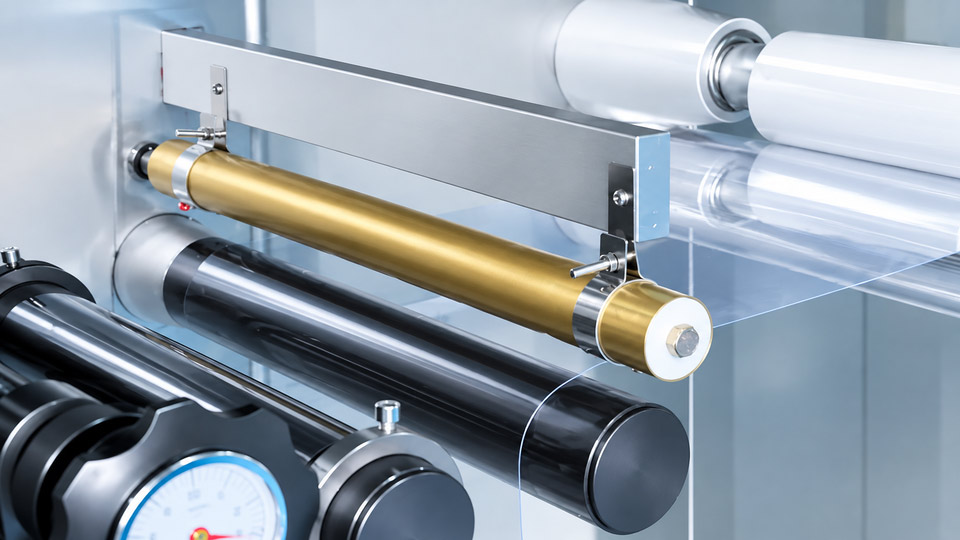
Ionizing Bar for Static Elimination on Blister Packaging Machines
Best Positions for a Static Eliminator Along the Film Path
The installation position of a static eliminator depends on where static charge buildup occurs on the PVC blister film. Before selecting an installation location, assess the film’s movement through the machine and measure charge levels at key positions.
| Installation Point | Why Check This Area? | What to Do |
|---|---|---|
| After film unwinding | Contact and separation between the film and rollers may generate static electricity. | Measure the static level after unwinding. |
| Near the thermoforming station | Contact with the forming mold and subsequent separation may affect surface charge. | Check the static level before and after forming. |
| Other points along the film path | Static may accumulate at different locations depending on the machine layout and operating conditions. | Compare measurements and identify where a static eliminator is most needed. |
How Can You Verify That Static Control Is Working?
After installing a static eliminator, production teams should check whether it reduces static on the PVC blister film. Use a non-contact electrostatic field meter to measure the surface potential at selected points along the film path.
Follow these steps to verify static control during production:
- Select measurement points. Measure the film after unwinding and before and after thermoforming to identify where static charge builds up.
- Keep the distance and angle consistent. Na przykład, hold the sensor 25 mm from the film surface, provided this matches the meter manufacturer’s specified measuring distance. Keep the sensor perpendicular to the film, with a 0° angle from the surface normal.
- Record the readings. Note the measured voltage, polarity, film material, prędkość produkcji, and relevant environmental conditions.
- Compare the results. Measure before and after activating the static eliminator under comparable production conditions. Lower readings indicate reduced surface potential.
- Check packaging results. Inspect the film and finished blister packs for visible dust or powder. Lower static readings do not guarantee that dust contamination has been eliminated.
Consistent static charge measurement helps manufacturers assess whether their static control measures are effective. Always follow the meter manufacturer’s instructions and use safe access points when measuring a running machine.
Wniosek
Static electricity in blister packaging can attract dust to PVC film and contribute to contamination risks. It may also affect tablet feeding and allow powder to stick to the film, potentially affecting blister packaging quality and GMP compliance.
To reduce these risks, manufacturers should identify static buildup points, install a suitable static eliminator, and measure surface potential during production. Regular inspections of finished blister packs remain necessary because reducing static does not guarantee dust-free packaging.
Często zadawane pytania
1. Can Static Electricity Cause Dust Contamination in Blister Packs?
Tak. Static electricity in blister packaging can cause PVC film to attract airborne dust particles. These particles may enter blister cavities and remain inside finished packs. Jednakże, static electricity is only one possible source of contamination. Production teams should inspect the particles and check static levels to identify the cause.
2. Why Does PVC Blister Film Attract Dust in Cleanrooms?
PVC blister film can retain electrostatic charge after contact with rollers, tworząc formy, and other machine surfaces. The charged film can attract airborne particles even in a controlled cleanroom. Cleanroom controls reduce particle levels but do not guarantee that every surface remains free from dust.
3. Can Dust Contamination Affect GMP Compliance?
Tak. Dust contamination may raise concerns about GMP compliance when particles are found inside finished pharmaceutical blister packs. The quality team should investigate the particle source, assess the potential impact on the product, and follow approved procedures. Finding dust does not automatically establish a GMP violation.
4. Can Dust Affect the Heat-Seal Quality of Blister Packs?
Tak. Dust or tablet powder trapped between PVC film and aluminum lidding foil may interfere with sealing contact. This can affect blister heat-seal quality and may contribute to seal defects. Appropriate seal integrity testing is needed to determine whether the package meets its acceptance criteria.
5. Where Should a Static Eliminator Be Installed on a Blister Machine?
The installation point depends on the machine layout and measured static levels. Check the film path after unwinding and around the thermoforming station. Use a non-contact electrostatic field meter to identify areas with higher readings, then follow the equipment manufacturer’s recommendations for positioning the static eliminator.
6. Does Removing Static Electricity Guarantee Dust-Free Blister Packaging?
NIE. Effective static control can reduce the tendency of charged film to attract dust, but it cannot eliminate all contamination sources. Dust may also come from tablets, sprzęt, przybory, or the surrounding environment. Manufacturers should combine static control with cleanroom practices, equipment cleaning, and finished-pack inspections.
Referencje
- NAS. Food and Drug Administration (FDA). 21 Część CFR 211 — Aktualna dobra praktyka produkcyjna dla gotowych produktów farmaceutycznych.
- NAS. Food and Drug Administration (FDA). Walidacja procesu: Ogólne zasady i praktyki.
- Simco-Ion. IQ Power HL Sensor Installation Manual. Guidance on sensor placement, measuring distance, orientacja, and nearby conductive objects.