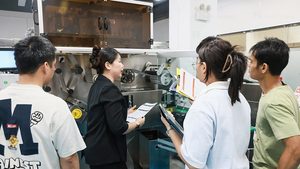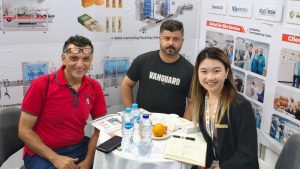
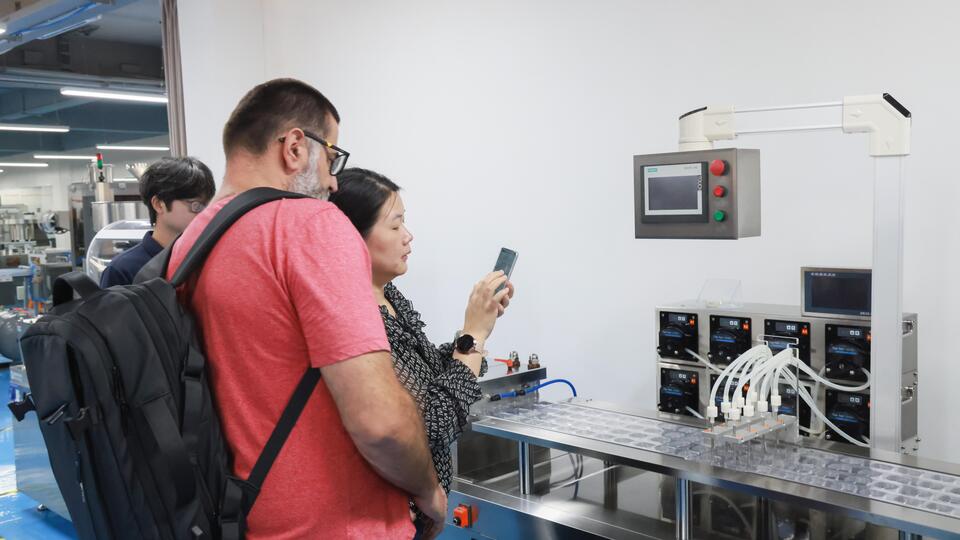
Sales Manager Mary introduces the DPP-270L ketchup blister packaging machine to a Czech pharmaceutical client
A Czech client visited Ruida Packing on September 22 to discuss a blister packaging machine for ketchup. The client’s main production requirement was around 10,000 시간당 블리스 터 팩. Based on this target and the product characteristics, Ruida Packing recommended the DPP-270L blister machine, with a production capacity of approximately 11,200 시간당 블리스 터 팩.
The client’s product is ketchup, a viscous sauce that requires controlled filling before sealing. 방문 중, the client focused on whether the machine could handle the product accurately and consistently.
The technical discussion also covered 316 스테인레스 스틸, insulation for the cooling-water pipes serving the forming and heat sealing stations, and after-sales service for overseas installation and commissioning.
Production Capacity Guides the Blister Machine Selection
Production capacity was the first major requirement discussed during the visit.
The Czech client needed a blister packing machine capable of producing around 10,000 시간당 블리스 터 팩. After reviewing this requirement, Ruida Packing recommended the DPP-270L.
The DPP-270L has a production capacity of approximately 11,200 시간당 블리스 터 팩, providing capacity above the client’s target.
The machine is designed for packaging liquid and semi-liquid products. Its working process includes forming, 충전재, 열 밀봉, 그리고 절단.
For this project, the production target was considered together with the characteristics of the ketchup. Unlike solid products such as tablets and capsules, ketchup needs to be accurately delivered into each blister cavity before the sealing process.
During the factory visit, Ruida engineers introduced the main working process of the blister packaging machine and explained how the DPP-270L could be applied to the client’s ketchup packaging requirements.
The production capacity therefore became the starting point for the machine recommendation, while the filling system became the next key technical point.
Peristaltic Pump for Viscous Ketchup Filling
The viscosity of the ketchup was one of the main concerns raised by the client.
The client was concerned that the relatively thick product could make accurate filling more difficult. Viscous products do not flow in the same way as low-viscosity liquids, so the filling system needs to provide controlled product delivery.
Ruida Packing explained that a 연동 펌프 can be used for the ketchup filling process.
A peristaltic pump moves the product by repeatedly compressing a flexible tube. The ketchup stays inside the tube while the pump controls its movement toward the filling station.
This design can provide controlled and repeatable product delivery for viscous materials. The filling volume can also be adjusted according to the product characteristics and required package size.
For ketchup and similar 토마토 소스 제품, filling consistency is particularly important because each blister cavity needs to receive the required amount of product before heat sealing.
The peristaltic pump therefore provides an option for the client’s high-viscosity product rather than using a standard filling configuration designed for thinner liquids.
This was an important part of the proposed ketchup blister packaging machine solution.
Client Asks About 316 스테인레스 스틸
The client also raised a question about the stainless steel used in the blister machine.
The client asked whether 316 stainless steel was used for the machine. Ruida Packing confirmed that 304 그리고 316 stainless steel are used for the specified stainless-steel components.
Material selection is an important consideration for pharmaceutical packaging equipment. Stainless steel components need to support regular cleaning and long-term operation in pharmaceutical production environments.
For the Czech client, this was part of the technical review of the DPP-270L, alongside its production capacity and packaging functions.
Insulated Cooling-Water Pipes for Forming and Heat Sealing
The client also asked whether the cooling-water pipes for the forming and heat sealing stations were insulated. Ruida Packing explained that the pipes are covered with EPDM rubber insulation, which provides thermal insulation around the cooling-water lines.
The insulation helps reduce heat exchange between the cooling water and the surrounding environment. It also helps prevent condensation from forming on the outside of the pipes when the cooling-water temperature is low.
For the DPP-270L, the forming and heat sealing stations use tap water or circulating water for cooling. The insulated cooling-water lines help maintain stable cooling conditions during continuous blister packaging production.
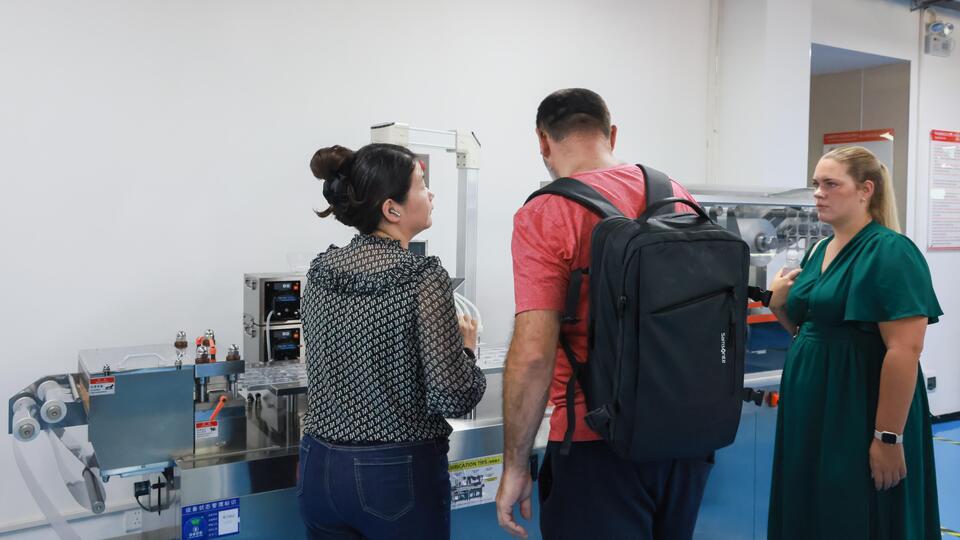
Client observes the DPP-270L blister packaging machine on site
After-Sales Service Is Part of the Project Discussion
After discussing the equipment, the client also asked about after-sales service.
For an overseas pharmaceutical packaging project, machine delivery is only one stage of the process. 설치, 시운전, 훈련, and technical support are also part of equipment implementation.
Ruida Packing introduced its after-sales services, 포함 on-site installation, 디버깅, and training. The company also provides technical manuals, electrical documentation, and other information needed for machine operation and maintenance.
For on-site service, the client is responsible for the engineer’s round-trip airfare, accommodation, meals, and local transportation. 게다가, an engineer service fee of USD 300 per day applies during the on-site service period.
During on-site commissioning, Ruida engineers can assist with machine installation, 매개변수 조정, production testing, and operator training.
This service covers technical support from equipment installation through production preparation and helps the client establish the required operating conditions for the blister packaging machine.
Technical Discussion Supports the Next Project Stage
The September 22 visit covered the main technical and service requirements for the proposed blister packaging project.
The discussion included production capacity, machine materials, cooling-water systems, installation support, 시운전, and on-site training.
Both sides also reviewed the practical conditions involved in equipment installation and future operation. These details will provide a basis for the next stage of technical communication and project planning for the Czech pharmaceutical client.