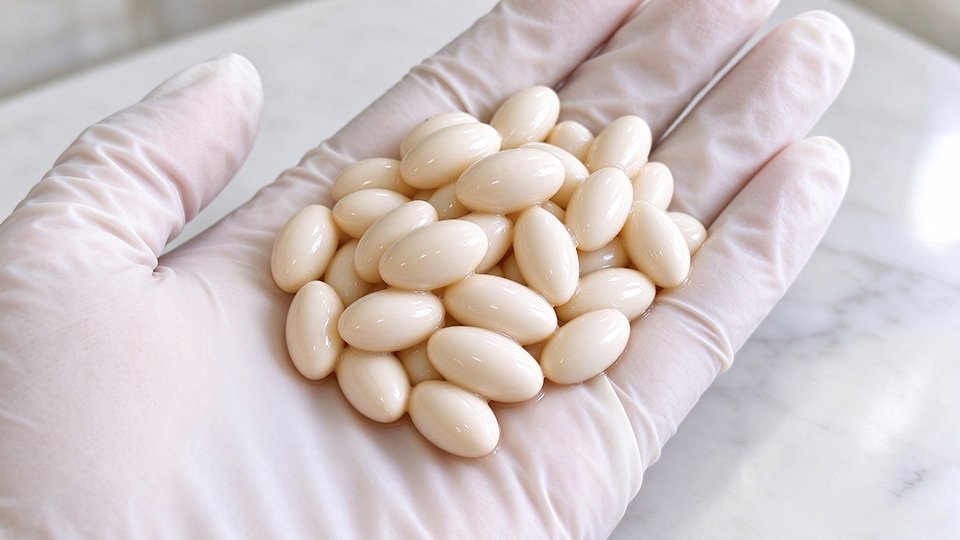
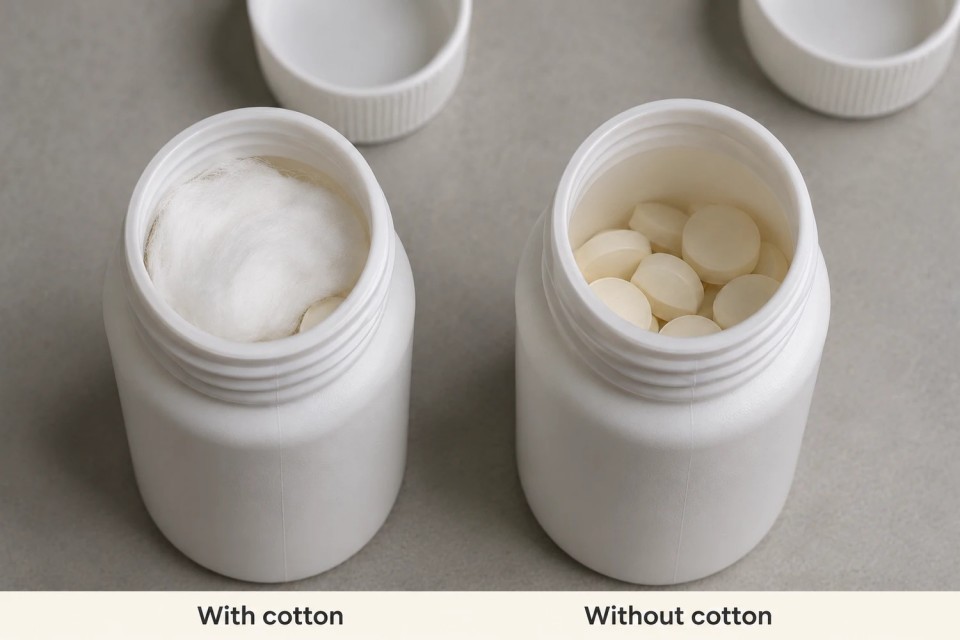
That tuft of cotton inside a pill bottle takes up some of the space above the tablets. It helps limit how much the tablets move and bump into each other during shipping, reducing the chance of chipped edges or broken tablets. Whether a bottle needs cotton depends on how easily the tablets chip and how well the filled bottle protects them in transit. A side-by-side shipping test can help show whether adding cotton makes a difference.
What Does the Cotton in a Pill Bottle Do?
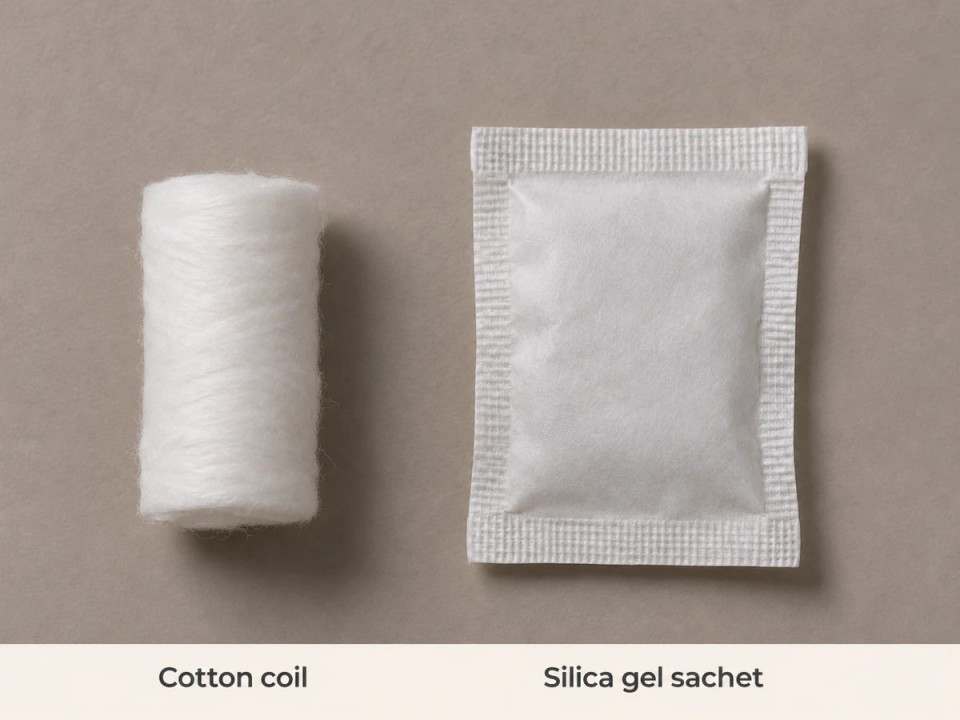
The cotton in a pill bottle helps protect tablets from chipping or breaking during shipping. It takes up some of the space between the tablets and the cap, which gives the tablets less room to shift when the package is moved. Packaging teams call this filler pharmaceutical coil. It can be made from cotton, rayon, or polyester, so the soft material you see when you open the bottle may be another type of fiber. [1, 2]
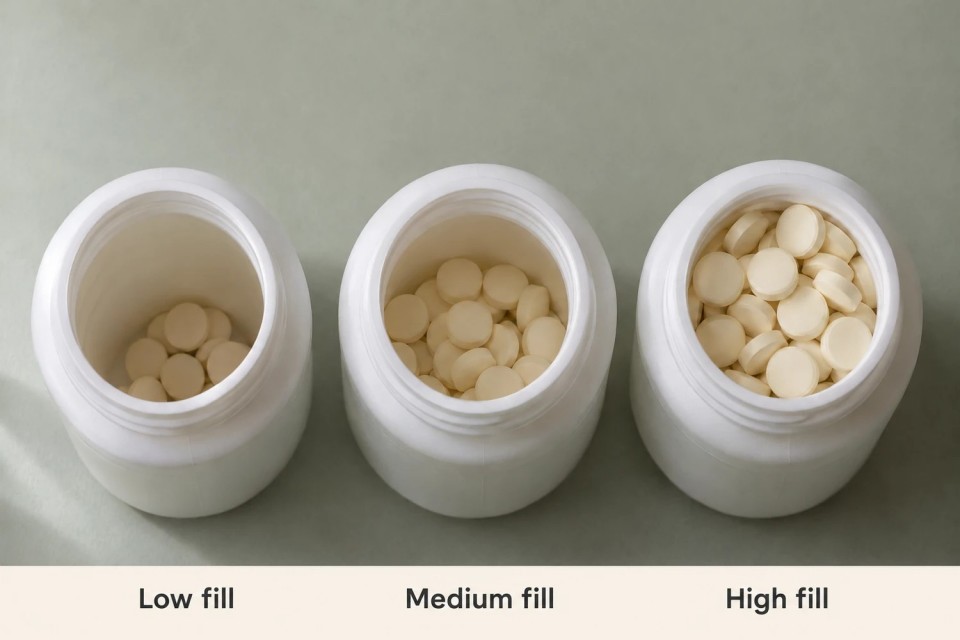
Imagine picking up a bottle with enough room for the tablets to slide from one end to the other. When the bottle tilts, the tablets can bump into each other and the bottle wall. A piece of coil above the tablets takes up part of that space. Whether it makes a noticeable difference depends on how the tablets and the rest of the package respond to handling.
Cotton in a pill bottle mainly cushions the tablets and limits movement during shipping. Cotton can also absorb moisture, but it should not be relied on as a substitute for a desiccant. Desiccants in pill bottles help control moisture. A packaging team can evaluate both functions separately when designing the finished pack.
When Do Pill Bottles Need Cotton?
Consider adding cotton when tablets are prone to chipping or breaking and have enough room to shift inside the bottle. A shipping comparison can show whether the pack needs that extra protection to meet its damage limits. The amount of space in the bottle is a reason to investigate, especially if you have already seen damage after transport.
Three observations can help you decide which pack to test first.
- The tablet chips during handling. If you already see edge damage in samples from production, check how much is present before the tablets go into bottles. That gives you a starting point for judging whether transport adds damage. If the chips are already present, check for tablet compression defects before changing the packaging. Tablet formulation and shape can influence how a tablet responds to mechanical stress. [4]
- One bottle serves several fill counts. Imagine selling the same tablet in 30-count and 90-count packs using the same bottle. The 30-count pack leaves more room above the tablets. It is a sensible candidate to test first, particularly if the tablets are fragile or the product has a history of shipping damage.
- Damage shows up in delivered packs. If returned bottles contain chips or broken tablets, record the bottle size, フィルカウント, and the kind of damage you see. Compare those observations with samples taken before bottling or retained before shipping, when available. Those checks help you decide whether to investigate the tablet, the filling operation, or the way the finished pack is shipped.
If several bottle sizes are under consideration, start with the configuration that prompted the concern. 例えば, if complaints involve only the low-count pack, test that pack with and without coil before changing the high-count pack. The result tells you whether coil helped in the tested configuration. Other bottle sizes, fill counts, or tablet shapes may need their own checks.
How to Test Pill Bottles With and Without Cotton
Run two groups of finished packs under the same shipping conditions, with the proposed coil as the only planned difference. テスト前, agree on what you will count as a chip, 割れ目, or break and what level of damage the product can accept. Record the number of bottles and tablets inspected in each group so the results have a clear basis for comparison.
1. Check the starting condition. Inspect a representative sample from the same batch before packing. If you also want to check for damage during counting and filling, keep a separate sample of filled bottles for inspection before the transport test. This gives you a reference when you open the test packs afterward. If the filled samples contain fragments, check the fill count too, since fragments can contribute to tablet counting errors.
2. Prepare both groups. Use the same tablet batch, ボトル, キャップ, tablets per bottle, and case packing arrangement. Add the selected coil to one group and record its material and length. Keep the case layout consistent so one group has the same packing conditions as the other.
3. Use shipping conditions that match your distribution route. Consider the way the bottles are packed and handled, including whether they ship in individual parcels or cases. A test lab can help select an appropriate distribution simulation. ASTM D4169 covers testing of shipping units, and ISTA publishes procedures for different distribution settings, including parcel delivery. [5, 6]
4. Inspect both groups using the same rules. Count each affected tablet once. If a tablet is both chipped and broken, place it in the more severe category. Record any recurring pattern, such as damage concentrated in a few bottles, alongside the total.
Use this table as a recording template. Fill in the results from your own test.
| チェック | Without cotton | With cotton |
| ボトル, キャップ, and tablets per bottle | Record the configuration | Use the same configuration |
| Coil material and length | — | Record the material and length |
| Shipping carton and test conditions | Record the setup and conditions | Use the same setup and conditions |
| Number of bottles and tablets inspected | Record both totals | Record both totals |
| Tablets with chipped edges | Record the count | Record the count |
| Tablets that cracked or broke | Record the count | Record the count |
| Result against the agreed damage limits | Pass or fail | Pass or fail |
もし both groups pass, the results support leaving cotton out of that pack under the conditions tested. もし only the group with cotton passes, the results support using coil in the tested configuration. もし both groups fail, look at where the damage occurs and revisit the tablet or packaging design. もし only the group without cotton passes, inspect the filled bottles and review how the coil was placed before deciding what to change or retest.
Record damage by bottle as well as across the whole group. Ten chipped tablets in one bottle and ten chips spread across ten bottles point to different patterns worth investigating. If you inspect different numbers of tablets in the two groups, report the count and the percentage for each damage category. Calculate each percentage using the number of tablets inspected in that group. Keep notes on crushed cartons or loose closures alongside the tablet counts so you can investigate those observations separately.
例えば, suppose the tablets in a low-count bottle already show chips before shipping. If the chips increase after transit in the group without coil but remain near the starting level in the group with coil, the comparison helps you separate damage already present at packing from the additional damage that the insert may help reduce. Use the acceptance limits you set before the test to decide whether that improvement is enough.
Where Cotton Insertion Fits on a Tablet Bottling Line
Cotton insertion typically comes after tablet counting and filling and before capping. The inserter feeds a coil, separates a preset length, and places it above the tablets. That puts it between two operations you need to check during a trial. The bottle must leave the 錠剤計数機 with the correct count and reach the capper with the fiber below the bottle mouth so the cap can seat properly. [7]
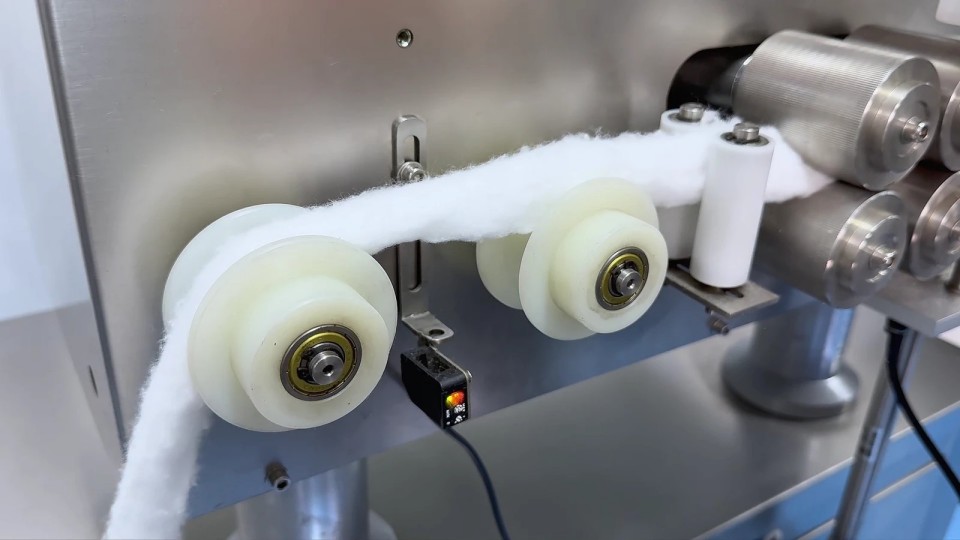
Bring the actual bottles, クロージャ, 錠剤, and proposed coil to a line trial. Give the supplier the bottle opening diameter, the tablets per bottle, and the target bottles per minute. 私たちの tablet counting machine buying guide explains how these details affect equipment selection. If you have several formats, include the bottle with the narrowest opening and the pack with the least room above the tablets among those that will use coil. These formats help you see whether the material enters easily and whether there is enough clearance at the cap.
At the target line speed, check that the coil is placed consistently and that fibers do not protrude from the mouth or get caught under the cap. If the equipment includes insertion detection and rejection, run a controlled missed-insert test. Observe whether the line identifies the correct bottle and whether the configured response works. Detection and rejection features vary by machine and configuration. [7, 8]
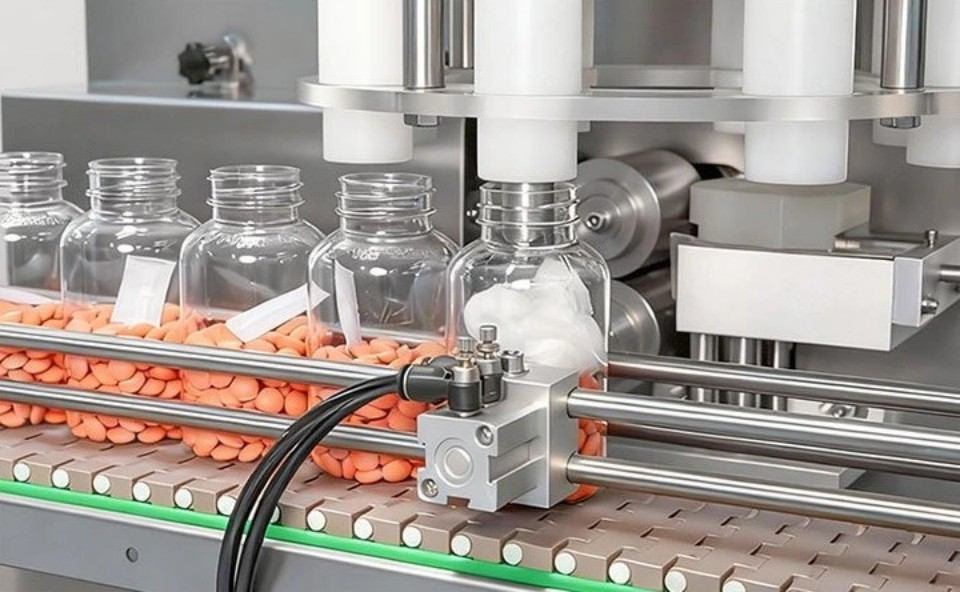
Check what happens when the line pauses and restarts. Inspect the first few bottles through the station after a restart and check the handoff to the キャッピングマシン. If you run several formats, record the bottle guides, coil length, and inspection settings used for each one. That gives the operator a reference for the next run and helps you reproduce the trial conditions when you switch formats.
Keep the two tests separate in your records. The shipping comparison tells you whether the insert helps protect the product. The line trial tells you whether the machine can place that insert consistently in the chosen bottle at the required speed. Carry the same coil specification from the shipping comparison into the line trial so both results refer to the same packaging design.
If you need a quote before testing is complete, ask the supplier to show the cotton inserter as a separate item in the proposed line. Ask what the item includes, such as bottle handling parts, insertion checks, or a reject station. That makes it easier to compare quotes and agree on which functions to check during factory acceptance testing once you have selected the bottle and coil.
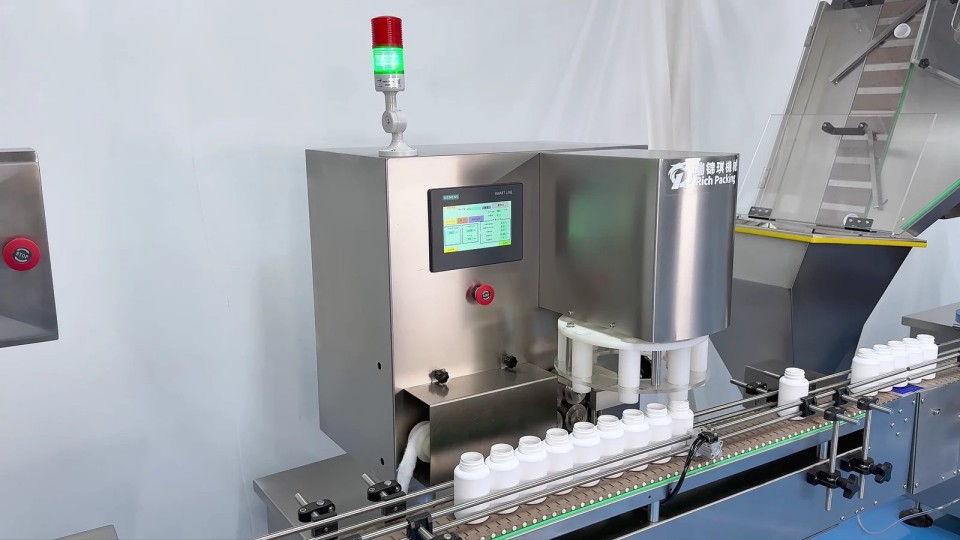
If your shipping test shows that the pack needs cotton, Ruida Packing can help you plan a 錠剤計数および瓶詰めライン with the right cotton inserter between filling and capping. The inserter’s stainless-steel construction and negative-pressure dust extraction support hygienic operation at this stage of GMP packaging.
Final Thoughts
The cotton you find in a pill bottle helps protect tablets from chipping or breaking by limiting how much they move during shipping. To decide whether a pack needs cotton, test it with and without the insert under the same shipping conditions and compare the results against your damage limits.
If the test supports adding cotton, share your bottle size, tablet count, and target speed with Ruida Packing to discuss how cotton insertion could fit into your tablet counting and bottling line.
よくある質問
Should I remove the cotton after opening a medicine bottle?
はい. MedlinePlus advises removing the cotton after opening. Keep the medicine in its original container and follow its storage instructions. Ask a pharmacist if you are unsure what the insert is. [9]
Does every bottle size for the same tablet need the same amount of cotton?
Coil length depends on the space above the tablets. Check it with the actual bottle and fill count so the coil sits below the bottle mouth before capping.
Can a smaller bottle reduce the need for cotton?
It may. A smaller bottle can leave less room for tablets to move. When evaluating tablet packaging options, compare the smaller bottle without cotton against the current pack under the same shipping conditions.
Is a tablet friability test enough to decide whether to use cotton?
A friability test is one of several tablet quality checks before packaging. It measures resistance to tumbling. Use a shipping comparison to evaluate cotton in the finished pack. [5, 10]
Can you add a cotton inserter to an existing bottling line?
はい, if the line can accommodate it. Check space between filling and capping, コンベアの高さ, and bottle spacing. Then trial your bottle and coil at the required speed. [7]
参考文献
1. 私たち. 食品医薬品局. Container Closure Systems for Human Drugs and Biological Products. Draft guidance, 8月 2026.
2. NJM Packaging. Cottoners.
3. 米国薬局方. USP–NF General Chapter 〈670〉 Auxiliary Packaging Components.
4. Singhal M, 他. Exploring the impact of formulation and tablet shape on tablet integrity: A comprehensive investigation using mechanical and imaging techniques. 薬学ジャーナル. 2025;114(7):103832.
5. ASTMインターナショナル. ASTM D4169, Standard Practice for Performance Testing of Shipping Containers and Systems.
6. International Safe Transit Association. ISTA Test Procedures.
7. CVC Technologies. CVC 1118 Cotton Inserter.
8. CVC Technologies. CVC 1117P Cotton Inserter.
9. MedlinePlus. Storing Your Medicines.
10. 米国薬局方. USP–NF General Chapter 〈1216〉 Tablet Friability.