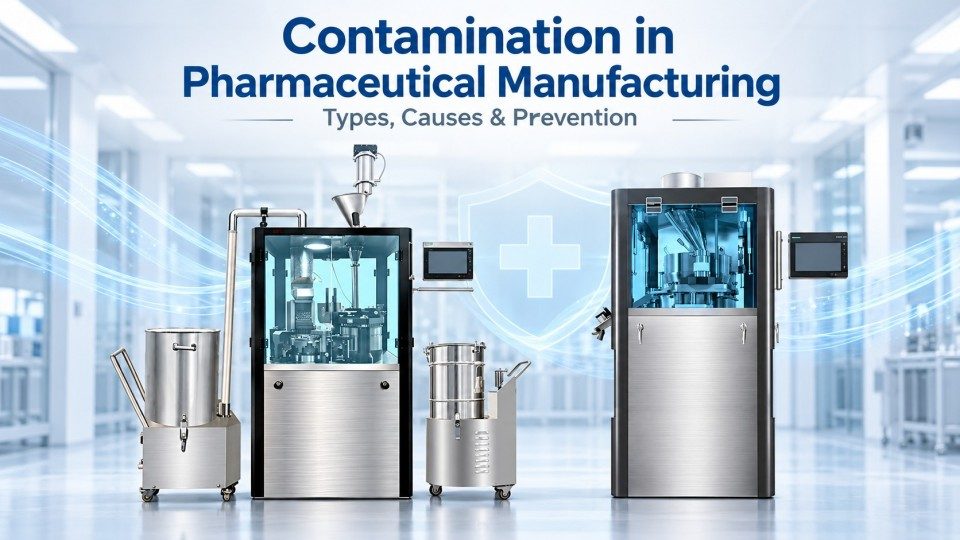
Contamination in pharmaceutical manufacturing occurs when unwanted microorganisms, chemical substances, or foreign particles enter a drug product during production or packaging. In tablet and capsule manufacturing, common sources include contaminated raw materials, airborne API dust, residues on shared equipment, 摩耗したシール, lubricants, and inadequately cleaned product-contact surfaces. Cross-contamination involves material transfer between products, while packaging mix-ups represent a different quality risk.
Prevention requires controlling both contamination sources and transfer pathways. Facility segregation, HVAC airflow control, enclosed powder handling, localized dust extraction, hygienic equipment design, and validated cleaning provide complementary safeguards. Under GMP, these measures must reflect the product, manufacturing process, and assessed contamination risks.
What Are the Main Types of Contamination in Pharmaceutical Manufacturing?
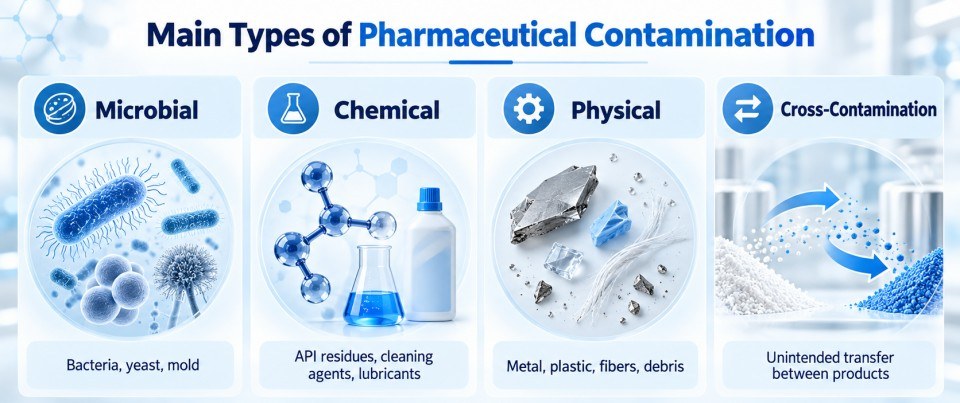
The three practical categories are microbial, 化学薬品, and physical contamination, classified by the nature of the contaminant. Cross-contamination describes transfer from another material or product; 取り違え concern incorrect product or packaging identity. These risks can coexist but require different controls.
Microbial Contamination
Microbial contamination involves unwanted bacteria, yeasts, or molds introduced through raw materials, 人員, 水, 装置, or the processing environment. Nonsterile tablets and hard capsules still have microbiological quality requirements appropriate to their formulation and intended use.
A cleaned powder hopper reassembled while wet illustrates the risk: retained moisture can support microbial survival or growth, particularly at poorly drained joints or seals. A suitable cleaning procedure must therefore address drying, storage before reuse, and inspection—not just visible powder removal. Moisture-sensitive formulations and hygroscopic excipients also require appropriate handling conditions.
Chemical Contamination
Chemical contaminants include residual active pharmaceutical ingredients (API), 洗浄剤, lubricants, coolants, and unintended raw-material impurities. On shared equipment, residues can remain beneath a tablet press feed frame, in capsule dosing components, around hopper outlets, or behind worn gaskets.
If the next formulation contacts those residues, the result may be chemical cross-contamination. A lubricant leaking through a damaged seal presents a different route into the product zone. Neither problem necessarily produces visible debris. Controls therefore depend on cleanable geometry, シールの完全性, effective cleaning, and justified residue acceptance criteria.
Physical Contamination
Physical contamination introduces foreign particles such as metal wear debris, fractured punch or die components, gasket fragments, fibers, プラスチック, or packaging scraps. Likely points of entry include deteriorating machine parts, incorrectly assembled contact components, maintenance work, and exposed product transfer paths.
Component inspection, 予防保守, suitable materials, and risk-appropriate foreign-particle detection address these sources. Pharmaceutical dust needs additional interpretation: a particle carrying an unintended API is also a chemical carryover hazard, even though it is physically a particle.
What Causes Contamination During Pharmaceutical Production?
The principal causes are contaminated incoming materials, powder release, retained residues on shared equipment, uncontrolled personnel or airflow routes, and mechanical wear or lubricant leakage. Risk increases when material escapes its intended path and remains available for later transfer.
原材料, 餌やり, and Airborne API Dust
Incoming APIs and excipients require supplier qualification, 識別, intact containers, suitable storage, and appropriate testing. These controls do not replace prevention during production.
Sampling, weighing, powder transfer, 錠剤圧縮, and capsule filling can generate airborne particles. Fine API-containing dust may escape an open hopper, a feeder-to-hopper joint, a tablet press feed frame, or a capsule dosing interface. It then settles on machine covers, ツール, gloves, or nearby surfaces, creating a residue reservoir that can be disturbed during cleaning, メンテナンス, or the next batch.
粒子サイズ, dustiness, 気流, and process speed affect release. Poor powder flowability can aggravate buildup but does not itself establish contamination.
Residues on Shared Equipment
Product-to-product carryover often begins in geometry that retains powder: tablet press feeders, パンチ, 死ぬ, discharge chutes, capsule dosing discs, tamping-pin assemblies, hopper valves, transfer hoses, and gasket interfaces.
Concealed grooves and assembled joints can retain powder after visible surfaces appear clean. Vibration or startup movement can release it into the next batch. The inspection must cover product-contact and residue-retaining locations, not just the exterior.
Previous-product potency, toxicity, 洗浄性, and the next product’s exposure determine the significance of carryover. A small residue from a highly potent API can pose a greater concern than a larger amount of a lower-risk substance.
気流, Personnel, and Mechanical Sources
HVAC supply air, local extraction, room pressure differentials, and personnel/material traffic determine where airborne powder travels. Neither positive nor negative pressure is correct for every operation: a pressure cascade must match the product-protection and containment objectives. Recycled air from dust-generating areas needs controls appropriate to the process.
Contaminated gloves, gowns, shared tools, and transferred machine parts can move residues even between rooms with otherwise suitable airflow. その間, 摩耗したシール, damaged gaskets, metal abrasion, ベアリング, lubricants, and coolants create mechanical contamination sources. FDA 21 CFR 211.65 specifically addresses the need to keep operating substances from contacting drug products in a manner that affects quality.
| Source and transfer route | Typical tablet/capsule example | Control focus |
| Airborne API dust → surfaces → later batch | Powder escaping a feeder or dosing station | Source extraction, enclosure, クリーニング |
| Residue → shared equipment → next product | Material retained beneath a feed frame or gasket | Disassembly access, validated cleaning |
| Moisture or microbes → product | Inadequately dried hopper or contaminated raw material | 乾燥, 衛生, material controls |
| Wear particles or lubricant → product zone | Damaged seal or worn mechanical component | 検査, メンテナンス, mechanical isolation |
| Personnel/tools → another area | Dust transferred on gloves or tooling | Controlled flow, gowning, dedicated or cleaned tools |
How Can Contamination Be Prevented in Pharmaceutical Manufacturing?
Pharmaceutical contamination is prevented through facility segregation, suitable HVAC control, enclosed powder handling, localized dust extraction, effective equipment cleaning, 訓練を受けた職員, and risk-based verification. Each measure interrupts a different source or transfer pathway; none independently guarantees a contamination-free product.
Segregation, 気流, and Material Routes
Segregate incompatible processes and establish controlled routes for incoming materials, 無駄, 人員, and reusable equipment parts. Where justified, use dedicated rooms, airlocks, physical barriers, or separate handling systems to prevent cross-area transfer.
Air supply and exhaust positions must support containment rather than carry powder toward open products. For solid dosage lines, risk-based checks can include room pressure trends, extraction condition, housekeeping observations, and environmental sampling where justified. Do not automatically apply sterile-manufacturing environmental classifications to nonsterile oral solids.
Powder Containment and Source Extraction
Contain powder where it is generated. Closed transfers and sealed hopper connections reduce release during charging and conveying; enclosed processing zones limit escape around moving mechanisms; localized extraction captures dust near tablet feeders and capsule dosing stations before it disperses into the room.
Check extraction performance against the approved equipment setup, including airflow or differential-pressure indications where provided, blocked ducts, filter loading, 集塵, and visible deposits. A dust collector does not by itself demonstrate high-containment performance for a potent API; such applications need a risk-appropriate containment strategy and demonstrated performance against defined requirements.
クリーニング, 切り替え, and Line Clearance
Cleaning removes product and cleaning-agent residues. Cleaning validation demonstrates that the approved procedure consistently achieves justified acceptance criteria. The procedure must address difficult components, specified dismantling and reassembly, 洗浄剤, rinsing if required, 乾燥, and protection before reuse.
Inspect representative hard-to-clean locations and use appropriate swab or rinse testing where required. A visually clean surface can still contain analytically detectable API residue. 私たちの pharmaceutical cleaning validation guide explains acceptance limits, サンプリング, and evidence in detail.
Line clearance is different: it verifies removal of previous products, ラベル, 書類, and unsuitable packaging materials. The broader pharmaceutical production changeover process combines cleaning, クリアランス, tooling adjustments, and restart checks; this article focuses on why those controls prevent contamination or mix-ups.
Personnel Controls and Ongoing Verification
Train operators to manage material spills, follow defined gowning and tool-cleaning rules, check machine condition, and document abnormalities. Verify seals after assembly, check residue-prone surfaces during clearance, and investigate recurring deposits rather than repeatedly cleaning without identifying their source.
Useful evidence includes cleaning records, residue results, extraction checks, maintenance findings, environmental monitoring where appropriate, and deviation trends. If a failure repeats, review the actual powder path, アクセスの清掃, operator sequence, and equipment condition before changing an acceptance criterion.
How Does Pharmaceutical Equipment Design Help Reduce Contamination?
Equipment reduces contamination risk through sealed processing interfaces, source dust extraction, isolated lubrication, accessible product-contact parts, and geometry that minimizes retained residues. The design must match the specific powder route and be supported by inspection, メンテナンス, and cleaning validation.
カプセル充填: Sealing and Residue Access
で カプセル充填機, powder travels from the hopper into dosing cavities and then the capsule body. The turntable, 投与ディスク, タンピングピン, powder bed, and discharge components create interfaces where fines can accumulate. Powder that passes a turntable seal can enter internal mechanical spaces, where residue is more difficult to locate and remove during changeover.
ルイーダ・パッキング NJP-1500D automatic capsule filling machine is publicly described with turntable sealing and removable components for cleaning access. Its relevant pathway is dosing-zone dust → seal or joint → hidden residue → carryover risk at restart. Worn or misaligned seals can reopen that route.
Inspect seal contact areas, powder deposits around tooling, and removable contact components. Double seals do not mean zero dust or replace cleaning verification.
打錠機: Feed-Frame Dust and Lubrication Separation
あ ロータリー打錠機 repeatedly moves powder through the hopper, feed frame, die cavities, compression zone, and tablet discharge. Turret rotation, feeder movement, and tablet ejection can distribute fines around the die table and lower press area.
A compression enclosure limits escape; local suction captures dust near generation points. Inspect feeder edges, extraction inlets, die-table surfaces, and discharge guides for buildup. Filter loading or poor sealing can reduce capture even when the extractor runs.
Lubrication creates another route. Separate lubrication and product zones, inspect leaks, and replace worn seals.
衛生設計: 材料, Dead Zones, and Disassembly
Cleanable geometry combines compatible contact surfaces, accessible joints, removable feeding parts, and fewer powder-retaining recesses. Critical areas include capsule dosing assemblies, tablet feeders, パンチ, 死ぬ, and discharge paths.
Material grade alone is not a contamination control. 304, 316, and 316L stainless steels are not interchangeable specifications; suitability depends on actual machine documentation, corrosion exposure, 定式化, finish, and cleaning chemistry. Tool-free or modular disassembly may improve access and reduce changeover handling, but cannot establish cleaning effectiveness without a validated procedure.
| Equipment feature | Pathway it limits | What still needs verification |
| Turntable or dosing-area seals | Powder migration into mechanical cavities | Seal condition, フィット, hidden residue |
| Compression enclosure and local extraction | API dust escaping the press area | 気流, filter state, powder deposits |
| Mechanical/lubrication isolation | Oil or grease contacting product | Leaks, シール, maintenance records |
| Removable contact parts and cleanable joints | Powder trapped in inaccessible recesses | Disassembly steps, サンプリング, cleaning results |
| Packaging inspection and reject mechanisms | Wrong carton, missing leaflet or unit | Challenge testing and detection scope—not API carryover |
結論は
Contamination in pharmaceutical manufacturing is controlled by identifying what the contaminant is, where it originates, how it transfers, and which barrier stops it. In tablet, カプセル, and packaging lines, powder containment, シールの完全性, cleanable tooling, 制御された空気の流れ, effective changeovers, and risk-based GMP verification address complementary risks. An enclosure or stainless-steel surface is only one part of the evidence; the real test is whether the complete process can repeatedly protect product quality.
よくある質問
What is contamination in pharmaceutical manufacturing?
It is the unintended presence or introduction of microbial, 化学薬品, or physical contaminants in pharmaceutical materials, 製品, 装置, or processing environments. Risks arise during handling, manufacture, クリーニング, と包装.
What is the difference between contamination and cross-contamination?
Contamination describes unwanted material; cross-contamination specifically involves transfer from another material or product. Previous-product API residue entering a new formulation is an example of both chemical contamination and cross-contamination.
How can cross-contamination be prevented in tablet and capsule production?
Use risk-based segregation, 制御された粉体移動, appropriate extraction, effective seals, cleanable product-contact components, validated cleaning, and changeover verification. The controls must fit the API, プロセス, と設備.
How does pharmaceutical equipment design reduce contamination risk?
Seals restrict powder migration, enclosures and extraction capture dust, isolated lubricants reduce chemical entry, and accessible contact parts enable thorough cleaning. Performance still depends on correct setup, メンテナンス, and verification.
Does GMP require dedicated equipment for every pharmaceutical product?
いいえ. Shared equipment may be acceptable when toxicological and process risk assessments support suitable controls. Dedicated equipment or facilities may be necessary when risks cannot be adequately controlled or demonstrated.
参考文献
- 欧州委員会. EU GMP Chapter 3: 敷地と設備 そして 章 5: 生産, particularly §§3.6, 3.14 and 5.18–5.22.
- 私たち. FDA / eCFR. 21 CFRパート 211, particularly §§211.42, 211.46, 211.63–211.67 and 211.130.
- 欧州委員会. EU GMP 付属書 15: 資格と検証, Section 10.
- 世界保健機関. Points to Consider When Including HBELs in Cleaning Validation.
- 国際調和評議会. ICH Q9(R1): Quality Risk Management.