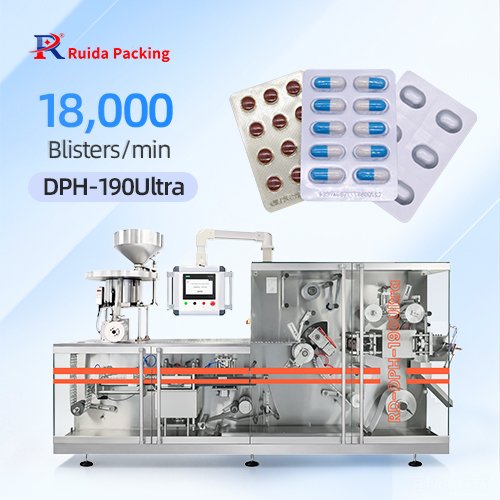

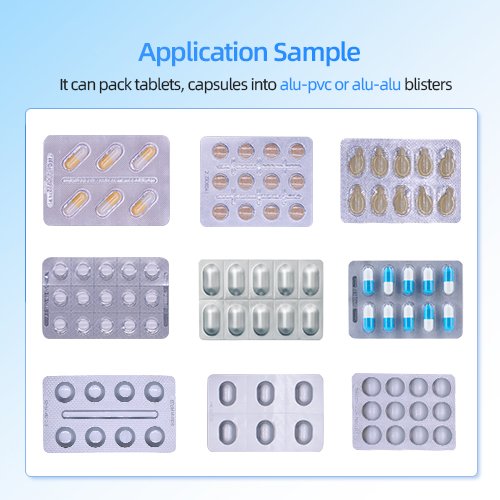

DPH-190Ultra Alu Alu Blister Machine is a high-speed roller-plate blister packaging machine developed by Ruida Packing for pharmaceutical manufacturers seeking higher production efficiency. With an output of up to 300 blisters per minute, it handles both Alu-PVC and Alu-Alu blister packaging for tablets and capsules.
The machine operates through synchronized servo-driven forming, servo-driven forming and indexing, and cutting processes. It forms blister cavities, accurately positions products, seals them with lidding foil, and cuts finished blister packs for consistent packaging quality.
Ideal for pharmaceutical factories, produttori a contratto, and high-volume production lines, the DPH-190Ultra bridges the capacity gap between flat-plate and conventional roller-type blister machines, offering a flexible solution for efficient, affidabile, and continuous blister packaging.
Fino a 18,000 vesciche/minuti
Applicabile per compresse, capsule e medicinali ecc.
Spessore del PVC: 0.25–0.30 mm; PVC width: 170–215 mm
Roll film outer diameter ≤φ400 mm, roll film inner bore φ70–75 mm

| Capacità produttiva | 60–100 strokes/min |
| Massimo. Forming Area & Profondità | 230 × 215 × 12 mm(customzied) |
| Gamma di colpi | 160–240 mm |
| Alimentazione elettrica | 110–410 V,50/60Hz (personalizzabile) |
| Machine Weight | 2,400 kg |
| Overall Dimension (L×W×H) | 3,500 × 950 × 1,800 mm |
High Production Efficiency: Enables fast and continuous blister packaging for increased output, the production output for standard alu pvc blister-packed capsules reaches 18,000 pieces per hour.
Flexible Packaging Formats – Supports different blister sizes, shapes and product configurations with suitable tooling.
Easy Operation and Maintenance – User-friendly controls simplify operation, cleaning and routine maintenance.

The main difference between a flat plate blister packing machine and a roller blister packing machine is how their forming, sigillatura, and material-transport systems operate. A flat plate machine blister machine typically uses reciprocating heat sealing to perform key packaging operations, while a roller blister machine uses Continuous heat sealing for one or more major processes, enabling higher production speeds in suitable configurations.
Per i produttori farmaceutici, this difference affects production capacity, packaging consistency, compatibilità dei materiali, changeover requirements, and operating efficiency.
A flat plate blister packing machine is often suitable for small-to-medium production volumes, flexible production schedules, and applications requiring adaptable forming conditions. A roller blister packing machine is generally better suited to continuous, high-volume manufacturing where production efficiency and output are priorities.
Tuttavia, manufacturers may encounter a gap between the output of a conventional flat plate blister machine and that of a high-speed roller blister packaging machine. The DPH-190Ultra from Ruida Packing is designed to address this intermediate-capacity requirement, offering a maximum output of 300 blisters per minute while supporting both alu-PVC and alu-alu blister packaging.
Understanding the mechanical differences between these two machine types is the first step toward selecting the right equipment for your pharmaceutical production line.
Depending on the alu pvc blister packing machine configuration, the forming material is heated and shaped into blister cavities, products are loaded into the cavities, and lidding foil is applied and sealed before the finished blister cards are cut.
The main processes include:
Material feeding and heating: PVC or another suitable forming film is fed into the machine and heated to the required forming temperature.
Formazione di vesciche: Blows compressed air into the heated, softened PVC within the molds.
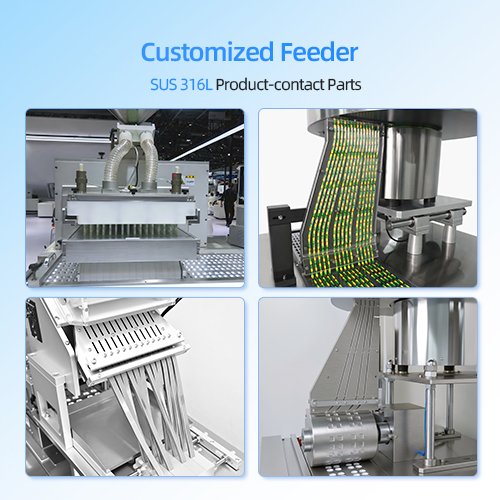
Alimentazione del prodotto: An automatic feeder or product-loading mechanism places the products into the formed cavities. Depending on your requirements, you can choose from a brush feeder, guide rail feeder, or roller feeder.
Sigillatura a caldo: Aluminum lidding foil is positioned over the filled cavities and sealed under controlled temperature, pressione, e tempo di sosta.
Indentation: An expiration date or a tear line can be printed on the blister.
Batch cutting: Cutting tooling separates the completed blister cards into the required formats.
In a intermittent design, the material advances between operating stations, and the machine pauses for certain operations to take place.
Flexible forming conditions. Forming station can provide a relatively long contact period and controlled forming conditions, which may benefit certain cavity geometries and materials.
Adaptability to different products. With suitable tooling and feeding systems, a flat plate blister machine can package different tablet and capsule formats.
Suitable for varied production schedules. Manufacturers producing multiple blister packing in moderate quantities may benefit from the flexibility of flat plate blister packaging machine.
Tooling free changeover and maintenance. La formazione, termosaldatura, scoring, and blanking stations feature an integrated mandrel design with external handwheel adjustment, ensuring accurate alignment and ease of operation; the tooling utilizes a slide-in slot system, allowing the entire mold set to be replaced within 25 minuti.
The main limitation is the production speed achievable with an intermittent operating cycle. Each forming, sigillatura a calore, or cutting operation must be synchronized with material movement, and cycle time can become a constraint as output requirements increase.
Actual output also depends on the number of blister cards produced per cycle, the number of cavities per card, product-feeding reliability, and the complexity of the packaging format.
For manufacturers whose demand is growing beyond the practical capacity of their existing flat plate equipment, upgrading to a higher-speed machine may become necessary.
A roller blister packing machine uses continuous heat sealing in major packaging operations. Depending on the design, formando , continuous heat sealing, and synchronized feeding and cutting mechanisms work together to move packaging materials through the production process.
Roller-type heat sealing enables continuous processing, eliminating the need to pause between sealing operations. This reduces the limitations associated with repetitive reciprocating motion and supports higher production speeds.
Pharmaceutical roller blister packaging process includes:
Continuous or synchronized film feeding: The forming film moves through the machine under controlled tension and alignment.
Servo Forming: Utilizes servo motors, servo drives, and motion control systems to precisely control the movement, posizione, velocità, and operational timing of the forming station, enabling the heated packaging material to undergo blister forming at the designated position.
Servo-driven forming and indexing: A servo motor controls the indexed feeding of packaging material and synchronizes with the actions of the forming station. This ensures that forming films—such as PVC or PVC/PVDC—advance according to the preset distance and cycle, guaranteeing precise positioning for each forming operation.
Automatic product loading: Tablets or capsules are fed into the formed cavities.
Roller heat sealing: Aluminum lidding foil is continuous sealed to the formed film.
Imprinting: Steel type characters can be used to print the manufacturing date and shelf life; alternatively, a Domino laser coder can be selected to print batch numbers in real time.
Servo-driven punching: Servo motors control the position, velocità, stroke, and timing of the punching mechanism, enabling the punching tool to cut the blister material—which has already undergone forming, Riempimento, and heat sealing—according to set specifications, thereby producing blister cards with uniform dimensions and clean edges.
Not every roller blister packing machine uses a fully continuous process at every station. Some designs combine rotary and reciprocating mechanisms. Perciò, buyers should evaluate the actual forming, sigillatura, and cutting architecture rather than relying on the machine category alone.
Maggiore capacità produttiva. Roller-based mechanisms can support faster operating cycles and higher output, making them suitable for large-volume pharmaceutical manufacturing.
Efficient material movement. Coordinated feeding and processing reduce the need for repeated stopping and starting in suitable configurations.
Consistent production at high speeds. Properly synchronized drive systems help maintain accurate material positioning and repeatable packaging results.
Suitability for large-scale production. Roller blister machines are attractive for pharmaceutical manufacturers, contract manufacturing organizations (CMO), and contract development and manufacturing organizations (CDMO) with demanding output targets.
Potential for lower labor cost per blister. When output increases without a proportional increase in staffing, labor cost per packaged unit can decrease.
Tuttavia, high-speed operation requires more than fast mechanical movement. Alimentazione del prodotto, forming quality, sealing performance, cutting accuracy, and rejection systems must all work reliably together.
The following comparison highlights the major factors pharmaceutical manufacturers should evaluate when selecting blister packaging equipment.
| Comparison Factor | Flat Plate Blister Machine | Blister a rulli |
| Operating principle | Intermittent heat sealing | Continuous heat sealing |
| Velocità di produzione | 2000-10000 vesciche/h | 15000-45000 vesciche/h |
| Metodo di formazione | Cam-controlled forming station | Servo control forming |
| Metodo di sigillatura | Intermittent heat sealing | Continuous heat sealing |
Important: These are general design tendencies, not universal rules. A machine’s actual capabilities depend on its engineering configuration, utensileria, material specifications, and validated operating parameters.
Ruida Packing developed the DPH-190Ultra high-speed roller blister packing machine to address a specific equipment-selection challenge: the gap between conventional flat plate blister machines and higher-capacity roller blister machines.
Con una potenza massima di 300 blister cards per minute, the DPH-190Ultra is designed for pharmaceutical manufacturers seeking higher throughput without automatically moving to the capacity level of a larger roller blister machine.
The DPH-190Ultra supports both alu-PVC and alu-alu blister packaging, making it a dual-purpose solution for pharmaceutical manufacturers handling different packaging requirements.
Alu-PVC blister packaging combines a suitable plastic forming film with aluminum lidding foil. It is widely used for tablets and capsules when product protection, visibilità, and packaging cost must be balanced.
Alu-alu blister packaging uses aluminum-based forming and lidding materials to provide a high-barrier packaging structure. It is particularly relevant when products require stronger protection against moisture, ossigeno, e luce.
The suitability of either material depends on the product’s stability data, requisiti di barriera, e specifiche di imballaggio. Buyers should verify material compatibility, utensileria, and operating parameters for their intended formats.
One of the key features of the DPH-190Ultra is its servo motor control system for forming, forming traction, servo punching. Servo-driven systems allow motion parameters to be adjusted electronically and coordinated across operating stations. This provides several potential benefits:
Accurate traction positioning: Helps maintain the required feed distance between processing stations.
Convenient adjustment: Operators can adjust movement parameters through the control system rather than relying entirely on mechanical adjustments.
Synchronized operation: Coordinated motion helps reduce positioning inconsistencies between forming, traction, e taglio.
Repeatable production settings: Stored and controlled parameters can help improve setup consistency between production runs.
Accurate traction is especially important in pharmaceutical blister packaging because misalignment can affect cavity positioning, sealing margins, and cutting accuracy.
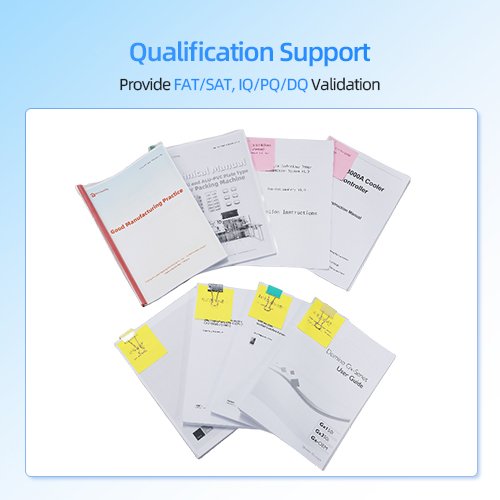
The actual positioning tolerance should be confirmed against the machine’s technical specifications and verified during factory acceptance testing (GRASSO).
According to Ruida Packing’s stated capacity comparison, the DPH-190Ultra can deliver output equivalent to approximately two DPP-270Max flat plate blister packing machines under the relevant comparison conditions. It is also positioned at approximately 75% of the output of the DPH-270Max roller blister packing machine.
These comparisons illustrate the machine’s intended role in the product range: it offers substantially higher throughput than a flat plate blister packing machine solution while remaining below the capacity level of a larger roller blister machine.
Actual output equivalence depends on the blister format, dimensioni del prodotto, tooling arrangement, e condizioni operative. Buyers should request a format-specific production test before using these ratios for capacity planning.
The DPH-190Ultra may be a suitable option for:
Pharmaceutical manufacturers upgrading from conventional flat plate blister machines.
Contract manufacturers handling growing volumes of tablet and capsule products.
Production facilities requiring both alu-PVC and alu-alu packaging capabilities.
Manufacturers seeking a high-speed blister packaging machine with adjustable servo-controlled traction.
Companies that need more capacity than a standard flat plate machine but do not yet require a larger roller machine.
For buyers planning a new blister packaging line, the best choice should be based on required annual output, expected product mix, spazio disponibile, frequenza di cambio, and total cost of ownership.
Before purchasing pharmaceutical blister packaging equipment, evaluate the following factors.
Calculate the number of blister cards required per shift and per year. Include expected demand growth rather than selecting equipment solely for current production.
Confirm whether the machine must process PVC-based films, alu-alu materials, or other approved forming materials. Verify the required heating, formando, e condizioni di tenuta.
Review tablet and capsule dimensions, profondità della cavità, disposizione del blister, product fragility, and feeding requirements.
If the facility produces many SKUs, evaluate tooling replacement time, format adjustment, accesso per la pulizia, and recipe management.
Assess sealing integrity, cavity formation, cutting quality, rejection mechanisms, documentazione, and the suitability of the machine for the site’s applicable GMP and data-integrity requirements.
Compare purchase price, tooling costs, manutenzione, pezzi di ricambio, lavoro, consumo energetico, and expected production utilization. A higher-speed machine is not automatically the most economical choice if its capacity will remain underused.
The key difference between a flat plate blister packing machine and a roller blister packing machine lies in their mechanical operating principles and the production capacity they can support.
Flat plate blsiter machines remain useful for flexible production and moderate output requirements. Roller blister machines generally offer greater throughput potential and are often better suited to large-scale pharmaceutical manufacturing.
For manufacturers facing the gap between these two production ranges, Ruida Packing’s DPH-190Ultra offers a high-speed alternative with a maximum output of 300 blister cards per minute, dual alu-PVC and alu-alu packaging capability, and servo-controlled forming and punching traction.
Selecting the right blister packaging machine requires matching actual production demand with packaging materials, product specifications, quality requirements, and long-term expansion plans.
Looking for a blister packaging machine for tablets or capsules? Contact Ruida Packing to discuss your target output, formato blister, and material requirements. Our team can help you evaluate whether the DPH-190Ultra, a flat plate blister machine, or a higher-capacity roller blister packaging machine is the right fit for your production line.
A flat plate blister machine typically uses reciprocating heat sealing, while a roller blister machine uses continuous heat sealing in major packaging operations. Roller-based designs generally support higher production speeds.
Generalmente, SÌ. Roller blister machines are often designed for higher output, although actual performance depends on machine configuration, disposizione del blister, materiale, and product-feeding efficiency.
Some models support both materials. Compatibility depends on the machine design, utensileria, forming system, and sealing parameters. Always confirm the required configurations with the manufacturer.
The DPH-190Ultra has a stated maximum output of 300 blister cards per minute. Actual production depends on the product, formato blister, materiale, e condizioni operative.
Evaluate required output, tablet and capsule dimensions, materiali di imballaggio, frequenza di cambio, qualità di tenuta, compliance requirements, and total cost of ownership before making a decision.
Neither material is universally better. Alu-alu generally provides stronger barrier protection, while alu-PVC offers product visibility and may have a lower material cost. The appropriate choice depends on the product’s stability and packaging requirements.
Servo motor control enables accurate, adjustable motion and synchronized material feeding. It can improve positioning consistency and make production setup more convenient when properly configured.
Confirm actual production output with your intended blister format, evaluate forming and sealing quality, inspect rejection systems, review changeover procedures, and request a factory acceptance test using representative materials and products.


*Rispettiamo la tua riservatezza e tutte le informazioni sono protette.