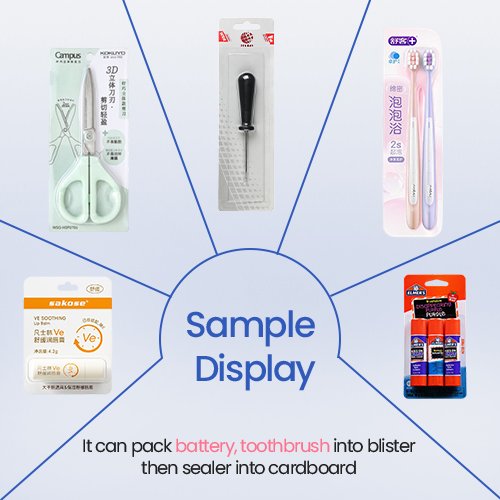
In today’s highly competitive manufacturing environment, packaging is no longer just about protecting products. For industries such as consumer electronics, baterías, tools, suministros medicos, and daily-use products, blister card packaging has become one of the most widely used retail packaging solutions.
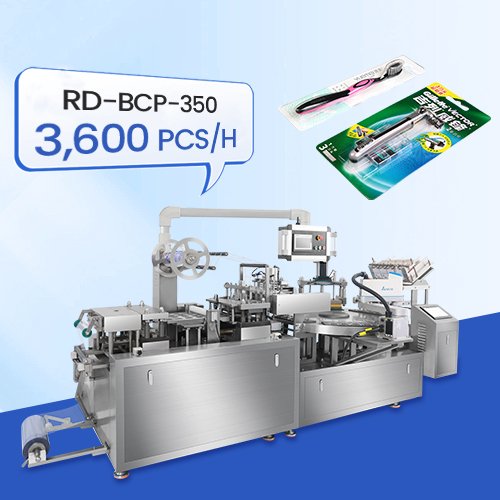
At the heart of this process is the fully automatic blister card packaging machine, sometimes referred to as a paper-card blister packaging line. This advanced production system integrates thermoforming, robotic handling, precise product placement, and heat sealing into a single automated workflow.
This article provides a detailed explanation of how such a system operates, walking through the key stations that make up the complete production line and explaining how modern automation ensures consistent, embalaje de alta calidad.
The Role of Blister Card Packaging in Modern Manufacturing
Blister card packaging combines a transparent plastic blister with a printed paper card backing. The plastic cavity holds the product securely, while the printed card provides branding, instructions, and retail display information.
This packaging format offers several advantages:
Excellent product visibility
Strong protection against damage
Effective anti-theft design
Retail-ready display with hanging holes
High production efficiency when automated
To meet growing market demand, manufacturers increasingly rely on fully automated blister packaging lines capable of handling large production volumes while maintaining consistent quality.
A typical blister card packaging line consists of several integrated stations that operate in precise synchronization under PLC control. Each station performs a specific function within the packaging process.
The Seven Core Stations of an Automatic Blister Card Packaging Line
The entire packaging workflow can be divided into seven main operating stations, each contributing to the transformation from raw material rolls into finished retail packaging.
1. Blister Thermoforming Station
The packaging process begins with the thermoforming stage, where plastic sheets are shaped into product cavities.
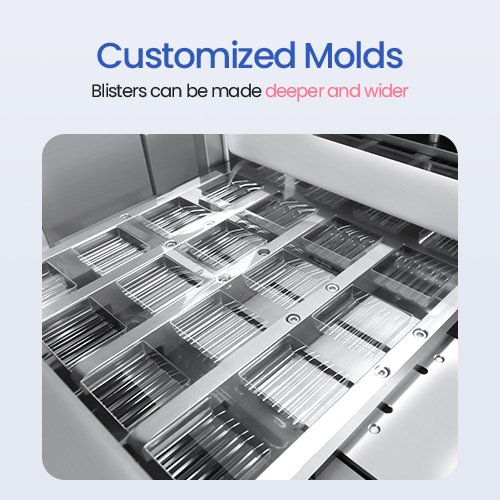
A servo-driven feeding system transports the sheet into a heating unit. The heating plates—often configured with dual upper and lower heaters—soften the material until it reaches the ideal forming temperature. Once softened, the material enters the forming mold where compressed air pressure pushes the plastic against the mold cavity, shaping it into the desired blister structure.
Key characteristics of this stage include:
Forming depths typically up to 40 milímetros
Accurate mold replication
Rapid cooling to stabilize the formed shape
Después de formar, the blister cavities are cooled and hardened to ensure dimensional stability before proceeding to the next stage.
2. Blister Die-Cutting and Pick-Up Station
Después de formar, the continuous plastic sheet contains multiple blister cavities arranged in sequence. The next step is to separate individual blister trays.
At the die-cutting station, an upper and lower cutting mold precisely punches out the blister shapes. This process separates the usable blisters from the surrounding material.
Key functions at this station include: precision die-cutting of blister trays, automatic collection of scrap material, transition from continuous sheet to individual trays.
Waste material generated during cutting is automatically rolled into a scrap collection unit, ensuring a clean production environment.
Once separated, the blister trays are picked up by either: vacuum suction systems, or XYZ-axis robotic arms.
These systems accurately transfer the trays onto a rotary table or conveyor chain, preparing them for product loading.
3. Robotic Product Loading Station
One of the most critical steps in the packaging process is placing products into the blister cavities.
Products such as batteries or small hardware components are often arranged using vibratory bowl feeders. The components align automatically and slide into the blister cavities.
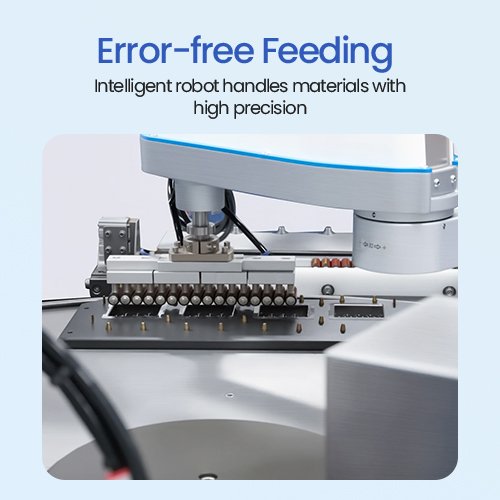
For Irregular or Soft Products Items like: toothbrushes, hand tools, irregular accessories, require more advanced handling. In these cases, manufacturers typically use high-performance parallel robots or robotic arms.
These robots can operate using: vision positioning systems, pre-programmed motion paths. The robot picks the product and places it precisely into the blister cavity. This ensures correct orientation and avoids product misplacement.
The robotic loading station greatly improves: placement accuracy, production speed, product consistency.
4. Automatic Card Feeding Station
Once products are placed in the blister trays, the next step is to introduce the printed paper card backing. The packaging line includes a card magazine system that stores stacks of printed cards. A vacuum suction head extracts the cards one at a time.
To ensure reliable operation, the system is designed to prevent double-card feeding using: vacuum separation technology, feeder alignment systems.
Each card is transported via conveyor or robotic handling and positioned precisely over the filled blister tray.
En este punto, the product is fully arranged and ready for the sealing process.
5. Estación de sellado de calor
The heat sealing stage is the most important step in ensuring packaging integrity. During the stage, the blisters and cards backing are bonded together using controlled heat and pressure. Blister card machines often use: Pulse heating technology or High-frequency welding systems.
The machine precisely controls several parameters:
| Parameter |
Typical Range |
| Temperatura |
0–200°C |
| Heating time |
0–10 seconds |
| Presión |
5–8 kg/cm² |
Achieving the Perfect Seal: Successful sealing requires balancing temperature, time and pressure; If the temperature is too high, the coating on the card may burn or discolor; If the temperature is too low, the adhesive layer will not melt properly, resulting in weak sealing; To address this, advanced machines use PID temperature control systems that maintain precise thermal conditions.
6. Hanging Hole Punching Station
Retail packaging often requires a hanging hole, sometimes called a Euro slot or airplane hole, so the product can be displayed on store racks. After sealing is completed, the packaging moves to the hole punching station.
Aquí, a precision cutting mold cuts the hanging hole at the top of the card. Depending on the machine configuration, this process may use: mechanical punching dies or laser cutting systems.
The punching process is synchronized with the line speed to ensure that each package is accurately aligned before the hole is cut. This ensures the product is retail-ready immediately after packaging.
7. Salida de productos terminados
Once all processing steps are completed, the finished packages are transferred to the output station.
Depending on production requirements, the system may include: automatic stacking units, robotic pick-and-place output systems, conveyor transfer to secondary packaging lines.
Throughout the entire process, a PLC control system synchronizes all stations, ensuring smooth and precise coordination between forming, cargando, sellando, and cutting operations.
The result is a fully automated system that transforms raw material rolls into finished retail packaging with minimal manual intervention.
Advantages of Fully Automatic Blister Card Packaging Machines
Blister card packaging lines deliver several significant benefits for manufacturers.
High Production Efficiency: Automation allows continuous operation with minimal downtime, dramatically increasing packaging throughput.
Consistent Packaging Quality: Precision control of forming, cargando, and sealing ensures uniform packaging quality across large production batches.
Flexible Product Handling: With adjustable molds and programmable robots, the system can accommodate different product sizes and shapes.
Retail-Ready Output: Integrated hole punching and cutting processes allow finished packages to be shipped directly to retailers.
The Future of Automated Blister Card Packaging
As manufacturing continues to evolve toward Industry 4.0, blister card packaging systems are becoming increasingly intelligent.
New developments include: vision-based quality inspection, integration with MES production systems, real-time production monitoring, predictive maintenance systems.
These technologies allow manufacturers to achieve higher productivity, better traceability, and improved packaging reliability.
Conclusión
Fully automatic blister card packaging machines represent a highly efficient solution for modern retail packaging. By integrating thermoforming, robotic loading, precision heat sealing, and automated finishing processes, these systems provide manufacturers with a reliable way to produce high-quality embalaje at scale.
From plastic sheet forming to finished retail-ready packaging, every step in the process is carefully engineered to ensure accuracy, eficiencia, and consistent product presentation.
For manufacturers in industries such as consumer goods, electrónica, tools, and medical supplies, investing in a modern automated blister card packaging line can significantly improve both production efficiency and packaging quality while reducing long-term operating costs.