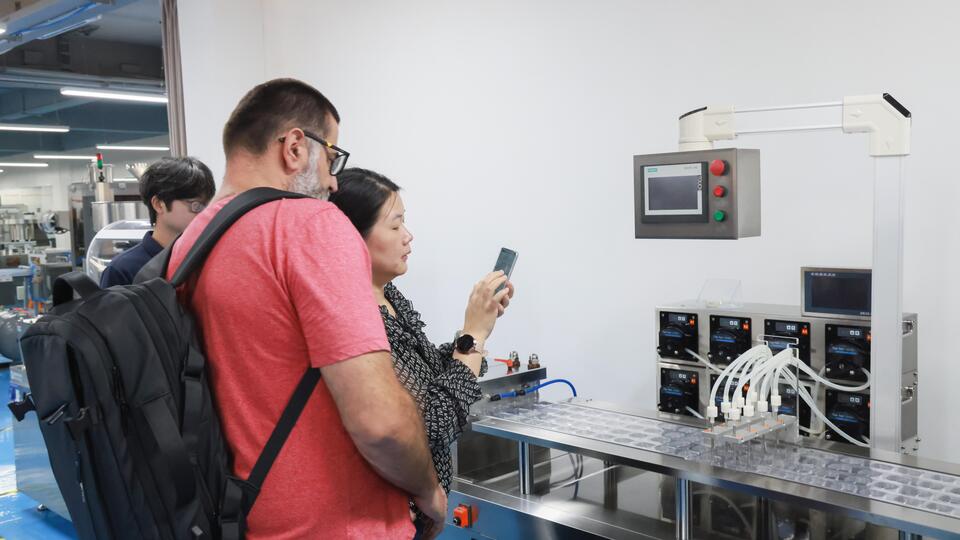
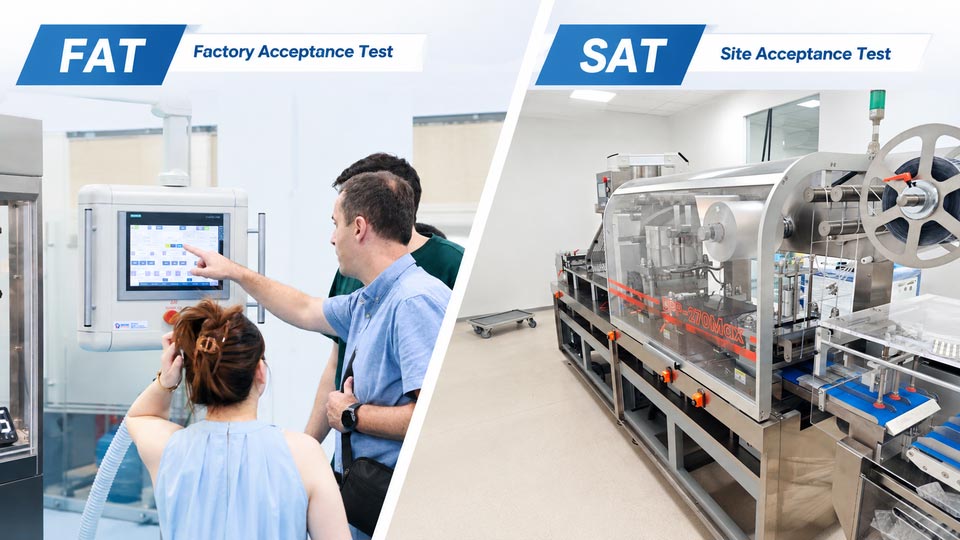
FAT and SAT are both common and important acceptance procedures.
Introducción
When investing in equipos de envasado farmacéutico, clients usually need to complete two key verification stages: Prueba de aceptación de fábrica (GORDO) and Site Acceptance Test (SE SENTÓ). The supplier normally completes FAT at its own facility before arranging equipment shipment to the customer. SAT begins after the equipment has been installed and connected at the customer’s manufacturing location.
Both tests are common steps in pharmaceutical equipment projects. They help confirm whether the machine meets technical requirements, production expectations, and agreed acceptance standards.
Many customers want to understand how FAT and SAT differ during a pharmaceutical equipment project. Why are both tests necessary? Does the client need to attend both procedures? Who should pay for testing, viajar, instalación, and commissioning costs?
This article compares FAT and SAT from several aspects, including testing objectives, inspection scope, involved responsibilities, acceptance requirements, and deviation management.
Principales conclusiones
- Prueba de aceptación de fábrica (GORDO) verifies pharmaceutical packaging equipment functions, presupuesto, and safety requirements before shipment.
- Prueba de aceptación del sitio (SE SENTÓ) confirms equipment performance after installation under actual production conditions.
- A capsule filling machine may require adjustments after installation due to powder characteristics, environment changes, y condiciones de funcionamiento.
- Clear acceptance criteria support pharmaceutical packaging equipment validation and reduce uncertainty during production startup.
- Proper deviation handling helps engineering teams identify equipment issues and complete commissioning records.
What Is a Factory Acceptance Test (GORDO)?
A Factory Acceptance Test (GORDO) is a verification activity completed before delivery, where the supplier and customer evaluate the machine’s performance at the manufacturing facility. It gives clients an opportunity to check whether the machine matches the approved technical specifications and project requirements before shipment.
For pharmaceutical packaging equipment, FAT is completed after manufacturing and assembly are finished. The basic FAT process includes:
- Review equipment specifications and technical documents.
- Check machine appearance, componentes, and configuration.
- Test basic machine functions according to the FAT procedure.
- Record test results and any identified deviations.
- Complete and approve the final FAT report.
What Is a Site Acceptance Test (SE SENTÓ)?
A Site Acceptance Test (SE SENTÓ) takes place after installation at the customer’s factory to evaluate equipment operation under site conditions. It verifies whether the installed equipment meets the agreed acceptance requirements before entering regular production.
For pharmaceutical packaging machines, SAT usually takes place after transportation, instalación, and initial commissioning. The basic SAT process usually includes:
- Confirm equipment installation and connection conditions.
- Check machine operation after installation.
- Test equipment functions under site conditions.
- Record testing results and any deviations.
- Complete and approve the final SAT report.
FAT vs SAT: Key Differences in Acceptance
When purchasing pharmaceutical packaging equipment, clients need to understand that Factory Acceptance Test (GORDO) and Site Acceptance Test (SE SENTÓ) verify different stages of an equipment project.
Purpose Differences Between FAT and SAT
From the customer’s viewpoint, FAT and SAT serve different verification purposes during the equipment lifecycle. FAT focuses on confirming whether the supplier has manufactured the equipment according to the approved requirements. SAT focuses on confirming whether the installed equipment can meet actual production needs at the client’s facility.
Por ejemplo, the PLC system is one of the important items during Factory Acceptance Test (GORDO). A PLC problem found during FAT can be corrected before transportation. Por ejemplo, the machine may stop at an incorrect position because of an error in the motion sequence program.
If these problems are discovered after the equipment arrives at the client’s factory, the impact can become much higher. The client may need additional engineering support, solución de problemas remota, or an on-site service visit. The production installation schedule may also be delayed because the machine cannot complete commissioning until the problem is solved.
Prueba de aceptación del sitio (SE SENTÓ) verifies whether the equipment can operate under the client’s actual production conditions.
A capsule filler may pass FAT using standard test powder. After installation, the client may use production powder with different flow characteristics. The material may affect filling weight variation, powder feeding stability, and machine adjustment. SAT helps confirm whether the equipment can handle these real production conditions.
En términos simples, FAT answers whether the supplier built the equipment according to the agreed requirements. SAT answers whether the installed equipment can produce the client’s products under actual factory conditions. Both tests help clients control risks before starting commercial production.
Testing Scope Differences Between FAT and SAT
The testing scope of FAT and SAT can be understood by first looking at what each procedure checks. FAT focuses on the equipment before shipment, while SAT focuses on the installed equipment at the client’s production site.
What Is Checked During FAT?
A typical Factory Acceptance Test (GORDO) includes the following major areas:
1. FAT Document Preparation
The supplier prepares the FAT documents, while the client reviews the testing requirements. Typical documents include:
- Planos electricos
- Pneumatic diagrams
- Main component lists
- Equipment specifications
- FAT protocol
2. Purchased Equipment Verification
The client confirms that the equipment being tested matches the purchased equipment, including the model, configuración, serial number, tamaño de la cápsula, and selected options.
3. Appearance and Mechanical Structure Inspection
The team checks the machine structure and major mechanical components, such as the frame, guardias, sistema de alimentación, sistema de dosificación, varillas de llenado, and locking station.
4. Electrical and Control System Check
The team checks the electrical cabinet, alambrado, motors, sensores, sistema de control, and other electrical components against the approved configuration.
5. Machine Function Testing
The machine is operated to verify its main functions. por un máquina llenadora de cápsulas, this includes capsule feeding, separación de cápsulas, powder dosing, cierre de cápsula, and capsule discharge.
6. Safety and Alarm Testing
The team verifies emergency stops, safety doors, sensores, alarmas, and other specified safety functions.
7. Production Performance Testing
The equipment is tested against agreed performance requirements, such as production speed, precisión de llenado, calidad del producto, rejection rate, and continuous operation.
8. Cleaning and Changeover Check
If included in the FAT scope, the team checks cleaning access and changeover operations, such as mold replacement and dosing system adjustment.
9. Deviation and Retest
Any failed test item is recorded, corrected, and tested again before the final FAT result is confirmed.
What Is Checked During SAT?
A typical Site Acceptance Test (SE SENTÓ) covers the following major areas after the equipment arrives at the client’s facility:
1. SAT Document and Site Preparation
The supplier and client confirm that the required documents, utilidades, production materials, testing instruments, and personnel are ready.
2. Installation Verification
The team checks the machine installation, posición, leveling, conexiones, and integration with upstream and downstream equipment.
3. Site Utility Verification
The actual factory conditions are checked, incluido:
- Power supply and frequency
- Aire comprimido
- Vacío
- Toma de tierra
- Utility connections
4. Mechanical and Electrical Check After Installation
The team checks whether transportation or installation caused any loose, dañado, displaced, or incorrectly connected components.
5. Machine Function Verification
The team repeats key functional tests at the client’s site to confirm that the machine operates correctly after installation.
6. Actual Production Material Testing
The equipment is tested with the production materials specified in the SAT protocol. For a capsule filler, this can include the client’s capsule shells and actual production powder.
7. Production Performance Verification
The team checks actual production results, including output, precisión de llenado, calidad del producto, rejection rate, and operating stability.
8. Continuous Running Test
The machine runs for the period specified in the SAT protocol. The team records output, alarmas, se detiene, ajustes, and production data.
9. Cleaning and Changeover Verification
The team verifies cleaning and changeover procedures under actual site conditions.
10. Operator Training and Maintenance Check
The supplier trains the client’s personnel and verifies basic operation, limpieza, cambio, y procedimientos de mantenimiento.
11. Deviation, Retest, and Final Acceptance
Site problems are recorded and investigated. After corrective action, the relevant tests are repeated before the SAT report is approved.
After looking at what each procedure covers, the main scope differences become clearer:
- Equipment vs. Production Environment: FAT focuses mainly on the equipment itself. SAT also considers the production environment and connected systems.
- Supplier Conditions vs. Site Conditions: FAT is performed under the supplier’s prepared testing conditions. SAT verifies performance under the client’s actual power, aire comprimido, vacío, and installation conditions.
- Equipment Functions vs. Production Performance: FAT confirms that the designed machine functions work correctly. SAT places more emphasis on actual production output, precisión de llenado, calidad del producto, y estabilidad.
- Test Materials vs. Production Materials: FAT uses the materials and conditions defined for the factory test. SAT focuses more on the materials and conditions required for the client’s production.
- Pre-Shipment Verification vs. Site Readiness: FAT confirms that the equipment meets the agreed requirements before shipment. SAT confirms that the installed equipment is ready for production at the client’s facility.
| Testing Scope | Prueba de aceptación de fábrica (GORDO) | Prueba de aceptación del sitio (SE SENTÓ) |
|---|---|---|
| Main Focus | Equipment design and approved requirements | Actual production application |
| Testing Object | Equipment itself | Equipo + factory conditions + production materials |
| Configuration | Check machine model and selected functions | Confirm installed equipment fits production needs |
| Machine Functions | Verify designed functions | Verify functions during real production |
| Sistema de control | Check HMI, parámetros, sensores, and alarms | Confirm operation with production requirements |
| Utilidades | Limited checking | Verify power, aire, vacío, and site conditions |
| Materiales | Testing conditions or agreed materials | Client’s actual production materials |
| Actuación | Functional confirmation | Production performance confirmation |
Responsibility Differences Between FAT and SAT
The responsibilities of suppliers and clients are different during Factory Acceptance Test (GORDO) and Site Acceptance Test (SE SENTÓ).
Supplier Responsibilities During FAT
During Factory Acceptance Test (GORDO), the supplier is mainly responsible for preparing the equipment and completing the required verification before shipment.
The supplier’s responsibilities include:
- Preparing the FAT procedure, test checklist, and acceptance documents;
- Providing the equipment specifications and agreed testing standards;
- Preparing the testing environment and necessary test conditions;
- Operating the equipment according to the approved FAT procedure;
- Recording test results and handling any deviations found during testing;
- Making adjustments or corrections if the equipment does not meet the acceptance criteria.
Client Responsibilities During FAT
During Factory Acceptance Test (GORDO), the client mainly focuses on review, confirmación, and approval.
The client’s responsibilities include:
- Reviewing the FAT procedure and acceptance criteria before testing;
- Checking whether the equipment configuration matches the purchase requirements;
- Reviewing test results and deviation records;
- Confirming whether the equipment meets the agreed acceptance requirements;
- Approving the FAT report before shipment.
Supplier Responsibilities During SAT
During Site Acceptance Test (SE SENTÓ), the supplier needs to support installation, puesta en marcha, and production verification at the client’s facility.
The supplier’s responsibilities include:
- Supporting equipment instalación y puesta en marcha;
- Checking machine operation after connection with site utilities;
- Adjusting machine parameters according to production requirements;
- Supporting production trials using actual materials;
- Troubleshooting technical issues found during SAT;
- Providing corrective actions and completing deviation handling.
For complex problems that cannot be solved onsite, the supplier should coordinate with its technical team or manufacturing facility for further analysis.
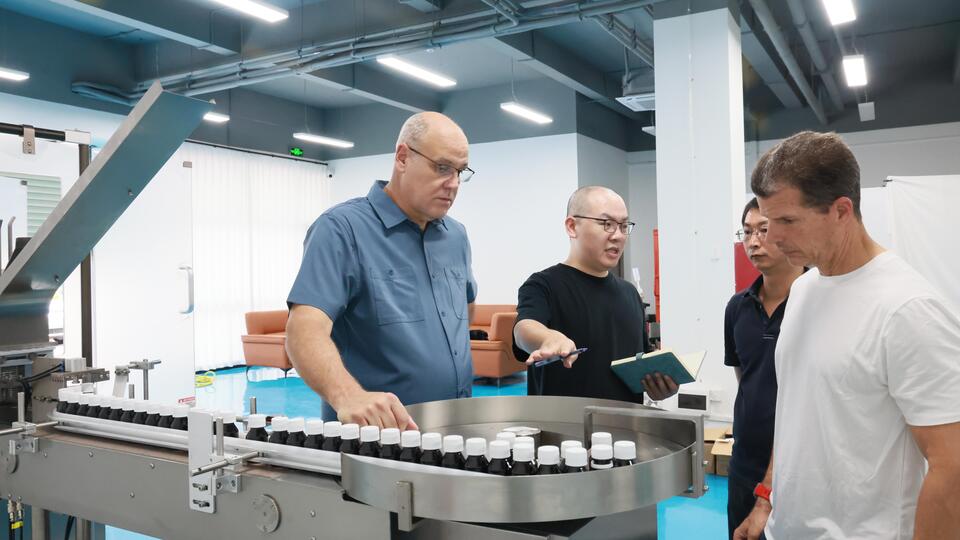
Prueba de aceptación de fábrica (GORDO) is an important equipment validation step for pharmaceutical packaging machines
Client Responsibilities During SAT
During Site Acceptance Test (SE SENTÓ), the client is responsible for preparing the actual production conditions and participating in the verification process.
The client’s responsibilities include:
- Preparing required utilities, such as power supply, aire comprimido, and vacuum;
- Providing production materials and packaging materials;
- Arranging trained operators and production personnel;
- Participating in machine operation checks;
- Confirming product quality and production requirements;
- Reviewing SAT results and approving the final SAT report.
| Responsibility Area | Prueba de aceptación de fábrica (GORDO) | Prueba de aceptación del sitio (SE SENTÓ) |
|---|---|---|
| Test Preparation | Supplier prepares FAT procedure and documents | Supplier and client prepare together |
| Testing Conditions | Supplier provides testing conditions | Client provides factory conditions and production materials |
| Machine Operation | Supplier engineers operate and test equipment | Supplier supports client production operation |
| Apoyo técnico | Supplier handles testing issues | Supplier supports installation and commissioning |
| Result Review | Client reviews FAT results | Client confirms production acceptance |
| Document Approval | Client signs FAT report | Client signs SAT report |
| Main Responsibility | Confirm equipment manufacturing quality | Confirm equipment production readiness |
Acceptance Criteria Differences Between FAT and SAT
The acceptance criteria define the requirements used to determine whether equipment passes or fails during equipment acceptance testing. The criteria are usually agreed before the test starts and are included in documents such as technical specifications, FAT protocols, SAT protocols, and project agreements.
For both Factory Acceptance Test (GORDO) and Site Acceptance Test (SE SENTÓ), two important parts need to be defined clearly: the sampling plan and the acceptance criteria. The sampling plan explains how the test data is collected. The acceptance criteria explain what results are considered acceptable.
Sampling Plan Differences Between FAT and SAT
The sampling plan defines when samples are collected, how many samples are tested, and which parameters are evaluated during Factory Acceptance Test (GORDO) and Site Acceptance Test (SE SENTÓ).
During Factory Acceptance Test (GORDO), the sampling plan is mainly designed to verify equipment performance before shipment.
The supplier normally completes machine adjustment first. Por ejemplo, after the capsule filling machine reaches stable operation, engineers start collecting samples according to the approved FAT procedure.
A typical FAT sampling plan may include:
- Continuous running time: 30–120 minutes;
- Sampling interval: every 10–15 minutes;
- Sample quantity: 20–50 capsules at each sampling point.
During Site Acceptance Test (SE SENTÓ), the sampling plan becomes closer to actual production conditions. The client and supplier evaluate the equipment using the client’s own production environment and materials.
A typical SAT sampling plan may include:
- Continuous production trial: 4–8 hours;
- Sampling interval: every 30–60 minutes;
- Sample quantity: 50–100 capsules at each sampling point.
Acceptance Criteria Differences Between FAT and SAT
FAT and SAT acceptance requirements are generally established from the same approved technical specifications and project agreements.
For a capsule filling machine, both capsule filler FAT and capsule filler SAT may check:
- separación de cápsulas;
- dosing system operation;
- bloqueo de la cápsula;
- precisión de llenado;
- production output;
- rejection rate.
During Site Acceptance Test (SE SENTÓ), the same acceptance items are usually checked again, but the requirements are stricter because SAT focuses on production stability.
Por ejemplo, the capsule filling machine SAT may require a longer sampling plan and a longer production verification period. SAT does not only focus on achieving the target production speed; it also checks whether the equipment can run consistently throughout the required production trial.
The stricter SAT acceptance criteria may include:
- stable production output over a longer testing period;
- consistent filling accuracy;
- acceptable rejection rate;
- limited production interruptions;
- stable machine operation without frequent adjustments.
| Acceptance Criteria | GORDO | SE SENTÓ |
|---|---|---|
| pregunta principal | Is the equipment built according to requirements? | Can the equipment produce correctly at the client site? |
| Standard basis | URS, specification, technical agreement | Requisitos de producción, process requirements |
| Material | Test material | Actual production material |
| Test duration | 30–120 minutes | 4–8 hours |
| Performance focus | Machine capability | Production stability |
| Example for capsule filler | Filling function and machine accuracy | Filling consistency and commercial production |
Deviation Handling During FAT and SAT
During pharmaceutical packaging equipment acceptance, the test result may not always meet the agreed requirements on the first attempt. When the actual result does not match the approved acceptance criteria, the issue should be recorded as a deviation.
Deviation handling is the process of identifying the problem, analyzing the root cause, applying corrective actions, and verifying the result again until the deviation is closed.
How FAT Deviations Are Corrected
During Factory Acceptance Test (GORDO), if the equipment does not meet the agreed requirements, the deviation should be recorded and corrected before shipment.
Por ejemplo, a capsule filling machine FAT may identify a filling weight deviation during testing. If the measured filling weight does not meet the agreed requirement, engineers need to check the possible causes, como:
- dosing system adjustment;
- powder feeding condition;
- filling parameter settings;
- mechanical alignment.
After identifying the cause, the supplier may adjust the filling system, optimize machine parameters, or correct mechanical positions. After adjustments are completed, the capsule filling machine undergoes another test following the approved FAT protocol.
The deviation can only be closed after the retest result meets the agreed FAT acceptance criteria.
The final capsule filling machine FAT deviation record should include:
- deviation description;
- root cause analysis;
- acción correctiva;
- retest result;
- final approval.
How SAT Problems Are Resolved
For SAT, the first step is not to assume that the equipment has a manufacturing problem. The client and supplier engineers need to identify whether the deviation is caused by the machine, installation conditions, production materials, or site utilities.
Por ejemplo, during capsule filler commissioning, the client may find that capsules cannot be separated correctly during SAT.
The same problem may have different causes at different stages.
During FAT, capsule separation problems may be related to:
- machine adjustment;
- capsule separation mechanism;
- component alignment.
Sin embargo, during SAT, the same capsule separation problem may be caused by the client’s production environment, como:
- presión de vacío insuficiente;
- unstable compressed air supply;
- incorrect utility connection.
The supplier engineer needs to check the site conditions, confirm the vacuum and air supply parameters, and identify the actual cause before applying corrective actions.
If the problem can be solved onsite, the supplier engineer and client team can complete the adjustment directly.
If the deviation cannot be resolved by the onsite team, the issue should be escalated to the manufacturer’s technical department. The client and onsite engineers need to provide:
- deviation records;
- machine operating data;
- alarm information;
- test results.
The manufacturer’s engineering team can then analyze the problem and provide further solutions, such as parameter adjustment, technical guidance, software modification, or replacement parts.
Once corrective measures are implemented, the equipment needs to be re-evaluated based on the approved SAT requirements. The deviation can only be closed after the equipment meets the agreed requirements.
Por lo tanto, SAT is a test of the manufacturer’s technical capability. Clients should choose an experienced pharmaceutical packaging equipment manufacturer, como Embalaje Ruida, HAY, Síntegono, and Uhlmann, with strong FAT, SE SENTÓ, and commissioning experience.
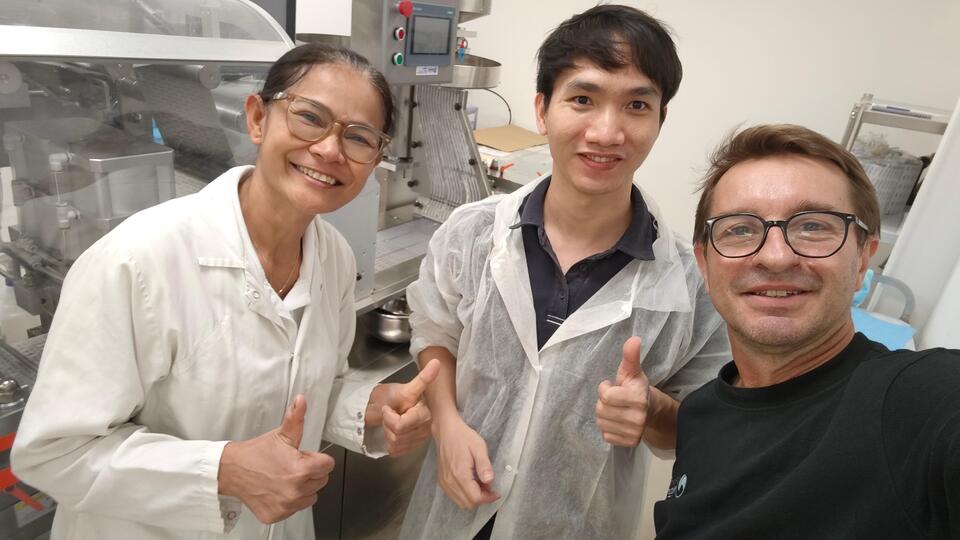
Ruida has extensive experience in Site Acceptance Test (SE SENTÓ) and equipment commissioning
Qualification Documents and Regulatory Requirements for Pharmaceutical Equipment
Once FAT and SAT are completed, pharmaceutical manufacturers still need to perform equipment qualification activities to document that the machine supports their production and quality standards.
For pharmaceutical packaging equipment, common qualification documents include:
- DQ (Calificación de diseño);
- coeficiente intelectual (Calificación de instalación);
- OQ (Calificación operativa);
- PQ (Calificación de desempeño).
During the project, the equipment manufacturer usually provides blank qualification templates, equipment specifications, dibujos, manuales, and technical records. The client’s quality team completes and approves the qualification documents according to its own validation procedures and production requirements.
DQ, coeficiente intelectual, OQ, y PQ: Common Qualification Documents for Pharmaceutical Equipment
DQ (Calificación de diseño) is completed during the equipment design stage before manufacturing starts. It confirms that the equipment design meets the client’s requirements, incluido:
- equipment configuration;
- capacidad de producción;
- requisitos del producto;
- material requirements;
- GMP-related requirements.
coeficiente intelectual (Calificación de instalación) is completed after the equipment arrives at the client’s factory and installation is finished. It verifies that the machine installation complies with the specified project conditions.
IQ documents usually cover:
- equipment model confirmation;
- installation location;
- electrical connection;
- compressed air connection;
- vacuum connection;
- equipment documents.
OQ (Calificación operativa) is completed after installation qualification. It checks whether the equipment functions properly within the defined operating parameters.
OQ documents usually cover:
- machine functions;
- operating parameters;
- alarm functions;
- safety systems;
- control functions.
PQ (Calificación de desempeño) is completed after IQ and OQ when the equipment is ready for production verification. It confirms that the equipment can consistently achieve the required production performance under actual operating conditions.
PQ documents usually evaluate:
- production output;
- calidad del producto;
- precisión de llenado;
- production stability;
- repeatability.
21 Parte CFR 211 Requirements for Pharmaceutical Equipment Used in the US Market
When purchasing pharmaceutical equipment for the US market, buyers need to ensure that the equipment can support their regulatory and quality requirements.
For equipment such as capsule filling machines and máquinas de prensado de tabletas, pharmaceutical companies need to complete their own compliance procedures according to applicable regulations, including FDA cGMP requirements under 21 CFR Part 211.The buyer is responsible for ensuring that its production process, sistema de calidad, and equipment use comply with these requirements.
Conclusión
FAT and SAT are essential verification steps throughout a pharmaceutical packaging equipment project. FAT helps clients verify that the equipment meets the agreed technical requirements before shipment, while SAT confirms that the installed equipment can operate correctly under actual production conditions.
Although FAT and SAT have different purposes, both require clear acceptance criteria, proper testing procedures, and effective deviation handling. A complete acceptance process helps identify potential issues earlier and supports a smoother production startup.
For pharmaceutical equipment such as capsule filling machines and tablet press machines, equipment acceptance is only one part of the complete project process. Qualification documents, technical records, and regulatory support documents also help clients complete their internal validation procedures.
Por lo tanto, when selecting a pharmaceutical equipment manufacturer, buyers should consider not only machine performance and production capacity but also the supplier’s experience in FAT, SE SENTÓ, puesta en marcha, and pharmaceutical equipment validation support. A manufacturer with complete project experience can provide better technical cooperation throughout the equipment lifecycle, from factory testing to final production operation.
PREGUNTAS FRECUENTES
What Is the Difference Between FAT and SAT?
Before the equipment leaves the supplier’s factory, FAT is conducted to review the completed machine and its required functions. The test confirms that the machine configuration, operating functions, and technical requirements are consistent with the approved project documents.
Prueba de aceptación del sitio (SE SENTÓ) takes place once the equipment has been installed at the customer’s production site. The purpose of SAT is to confirm that the installed machine can achieve the required performance in the customer’s manufacturing environment.
Why Is FAT Important for Pharmaceutical Equipment?
A pharmaceutical equipment acceptance test helps clients confirm equipment performance before shipment.
During the FAT procedure, the supplier and client check machine functions, presupuesto, and acceptance requirements. Any issues identified during FAT can usually be resolved at the supplier’s facility before the machine is transported to the customer.
What Should Be Tested During a Capsule Filling Machine FAT?
A capsule filling machine FAT is a formal pharmaceutical equipment acceptance test performed before shipment. It verifies whether the capsule filling equipment meets the agreed specifications, functions, and performance requirements.
The FAT procedure usually includes:
- Reviewing equipment specifications and FAT documents;
- Confirming the machine configuration and main components;
- Checking mechanical structure and electrical systems;
- Testing capsule feeding and capsule separation functions;
- Verifying powder filling and dosing performance;
- Checking capsule locking and finished capsule discharge;
- Testing filling accuracy and production speed;
- Verifying safety functions and alarm systems;
- Recording test results and handling any deviations before shipment.
Why Can Equipment Pass FAT but Encounter Issues During SAT?
Equipment may pass FAT but face problems during SAT because the site conditions are different.
During SAT troubleshooting, engineers check possible causes such as:
- utility conditions;
- production materials;
- configuración de la máquina;
- installation factors.
Proper equipment commissioning helps solve these issues before production starts.
How Do FAT and SAT Support GMP Equipment Qualification?
FAT and SAT provide test records for GMP equipment qualification.
During pharmaceutical equipment validation, FAT records show that the equipment was tested before shipment, while SAT records confirm that the installed equipment works correctly at the client’s site.
Together with DQ, coeficiente intelectual, OQ, and PQ documents, FAT and SAT support the complete equipment qualification process.
Referencias
- A NOSOTROS. Administración de Alimentos y Medicamentos (FDA).
- Sociedad Internacional de Ingeniería Farmacéutica (ISPE).
Good Practice Guide: Commissioning and Qualification.
ISPE Baseline® Guide Volume 5. - Agencia Europea de Medicamentos (EMA).
Volumen EudraLex 4 — Buenas prácticas de fabricación (BPM) Pautas. - Farmacopea de los Estados Unidos (USP).
Capítulo General de la USP <1058> Analytical Instrument Qualification. - Consejo Internacional de Armonización (I).
ICH Q9 Quality Risk Management.