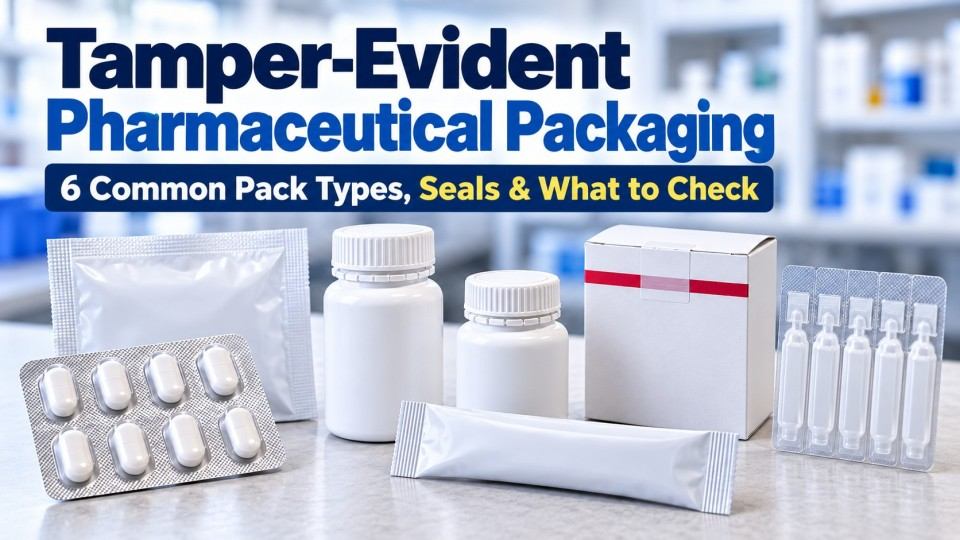
Tamper-evident pharmaceutical packaging is designed to show visible evidence when a medicine pack has been opened or interfered with. This may be ruptured blister foil, a torn induction-sealed liner, a separated bottle-cap ring, or a destructible label across a carton flap. The package need not prevent opening, but access should leave a recognizable trace.
Tamper evidence differs from seal integrity, Kinderwiderstand, and anti-counterfeit identification. This article compares the main packaging formats, explains their sealing technologies and manufacturing processes, and covers quality checks and regulatory requirements.
What Is Tamper-Evident Pharmaceutical Packaging?
A broken cap ring or torn carton label can warn a customer that a medicine pack has already been opened.
Tamper-evident pharmaceutical packaging uses a barrier, Schließung, or indicator to make previous access visible. The feature should be positioned where someone can reach the medicine; a label on the side of a carton does little if its opening flap remains unprotected. A bottle may need an inner liner even when its cap has a breakaway ring, depending on the intended protection.
How Tamper Evidence Works
A push-through blister leaves a hole in its lidding foil when a tablet is removed. An induction liner or destructible carton label can leave similar evidence through a different opening action.
Three conditions determine whether that evidence is useful:
- Cover the access point. Opening the package must disturb the feature, rather than bypass it.
- Leave recognizable evidence. The change may be torn foil, a broken bridge, a damaged label, or a separated closure.
- Resist undetectable restoration. After opening, the feature should not return easily to its original appearance.
A seal can be strong without being tamper-evident. Its actual opening behavior depends on the materials and package construction.
Tamper-Evident vs. Tamper-Resistant, Child-Resistant and Anti-Counterfeit Packaging
A pharmaceutical bottle may combine several protective features, each serving a different purpose:
- Tamper-evident packaging: Shows possible opening or interference through visible changes.
- Tamper-resistant packaging: A related term used in US FDA regulations for certain OTC medicines; it does not mean impossible to open.
- Child-resistant packaging: Makes access difficult for young children while remaining usable by adults.
- Anti-counterfeit packaging: Supports authenticity checks through serialization, security printing, or authentication marks.
- Integrität des Siegels: Describes whether the package maintains its intended barrier against leakage or environmental exposure.
A child-resistant cap, induction foil seal, and serialized carton can therefore work together, but each function requires separate evaluation.
Types of Tamper-Evident Pharmaceutical Packaging
A blister exposes one dose at a time, while a bottle and carton have different access points.
1. Blister and Strip Packs
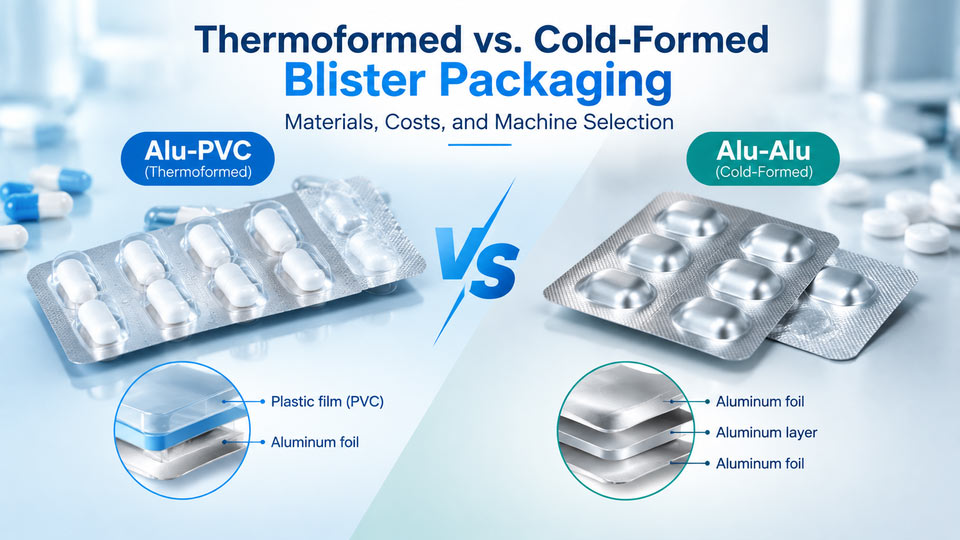
Blister packs hold tablets or capsules in formed cavities covered by lidding material. In a conventional push-through design, removing a dose ruptures the foil. Strip packs instead seal individual doses between two webs.
The foil must remain intact until the patient opens the cavity, so damage caused during machine transfer is especially troublesome.
Vorteile
These formats offer three useful characteristics:
- Individual access points: Previous opening is easier to identify for each dose.
- Remaining-dose protection: Unopened cavities can remain protected after another dose is removed.
- Dose identification: The pack supports printed batch information and individual-dose identification.
Überlegungen
The forming and sealing operations affect that performance:
- Material compatibility: Lidding must suit the forming web and sealing process.
- Opening behavior: Peelable and child-resistant designs require different opening characteristics.
- Production damage: Poor machine adjustment may damage foil and resemble interference.
See our guide to medicine blister packaging for more on forming materials and cavity designs.
2. Pharmaceutical Bottles
A screw cap can often be removed and replaced without obvious evidence. Bottles therefore use induction-sealed foil liners, breakaway cap rings, Schrumpfbänder, or combinations of these features.
The liner bonds beneath the cap; the ring separates during first opening; and the shrink band must be torn or removed to reach the closure.
Vorteile
Bottles offer several production options:
- Produktpalette: Geeignet für Tablets, Kapseln, Pulver, and certain liquids.
- Combined features: Several tamper-evident mechanisms can protect one container.
- Automatisierung: Compatible with counting, Füllung, Verschließen, and sealing lines.
Überlegungen
The bottle and closure must work as one system:
- Component fit: Neck finish, liner construction, and cap application affect sealing.
- Liner contact: Loose caps or unsuitable liners may cause incomplete induction sealing.
- Opening evidence: A liner that lifts off cleanly needs evaluation for recognizable tampering evidence.
A correctly fitted cap does not guarantee that its inner liner has bonded evenly.
3. Pharmaceutical Cartons
A carton flap may be reopened without visible damage unless a feature crosses its opening.
Cartons commonly use destructible labels, perforated opening features, or specially designed closures. A label bridging the flap and adjacent panel tears or damages the carton surface when opened.
Vorteile
Carton features can provide:
- Line compatibility: They can be added to existing cartoning processes.
- Early warning: Interference may be visible before the inner package is reached.
- Identification integration: They can work alongside serialization and product identification.
Überlegungen
Their position and adhesion matter:
- Access coverage: Every relevant opening route needs protection.
- Haftung: Carton coating, Oberflächenzustand, and application pressure affect bonding.
- Feature design: Ordinary glued flaps and standard closure labels are not necessarily tamper-evident.
A label beside the opening seam may look correct yet allow the flap to open untouched. That failure can be missed if inspection checks only for label presence.
4. Beutel, Stick Packs and Pouches
A powder sachet normally opens by tearing or cutting its film or seal.
These flexible heat-sealed formats package powders, Granulat, Flüssigkeiten, and unit doses. Their opening damage can provide tamper evidence when the film and seal are designed accordingly.
Vorteile
Flexible packs provide:
- Individual doses: Suitable for small, separately packaged portions.
- Material efficiency: A compact format with efficient material use.
- Integrated evidence: The film and seal can be designed to show opening.
Überlegungen
Sealing conditions and handling can affect the result:
- Seal contamination: Product trapped in the seal area can weaken the bond.
- Tear design: Easy-tear features must still withstand transport.
- Functional evidence: A conventional heat seal needs evaluation before being called tamper-evident.
Comparison of Common Packaging Types
The table links each opening feature to its manufacturing process and main check.
| Packaging type | Typical opening evidence | Main production process | Critical check |
|---|---|---|---|
| Blister or strip pack | Ruptured or visibly opened lidding | Bildung, Füllung, Keimenversiegelung | Lidding condition and seal quality |
| Flasche | Damaged foil, broken cap ring, torn shrink band | Zählen, Verschließen, Induktionsversiegelung | Cap application and liner bonding |
| Karton | Broken label or damaged opening feature | Cartoning and label application | Label position and adhesion |
| Sachet oder Stickpack | Torn film or visibly breached seal | Form-fill-seal | Seal contamination and consistency |
Choose the format around the medicine’s access point, then confirm that the feature survives production, distribution, and normal handling.
How Do Tamper-Evident Seals, Closures and Labels Work?
A bottle liner creates a barrier at the mouth, while a carton label mainly reveals movement of the flap.
Induction Sealing and Heat Sealing
Induction sealing bonds a liner beneath a bottle cap. An induction field heats its conductive foil layer, activating the sealing material against the container rim.
Four conditions influence the bond:
- Liner compatibility: Match the liner to the bottle material and neck finish.
- Cap application: Maintain suitable liner pressure against the rim.
- Machine settings: Control induction power, Fördergeschwindigkeit, and sealing-head position.
- Cooling and inspection: Allow suitable cooling and inspect the resulting seal.
If the cap is not seated properly, the liner may not make even contact with the rim, leaving a weak bond despite adequate induction power.
The liner can protect the product and show opening, depending on how it behaves when removed.
Heat sealing joins compatible materials in blisters, strips, Beutel, and pouches using heat, Druck, and contact time. Too little heat or pressure creates weak seals; excessive heat can deform film, damage coatings, or change opening behavior. A validated operating window is preferable to maximum temperature.
See Induction Sealing vs. Keimenversiegelung for a closer comparison.
Shrink Bands and Breakaway Closures
A shrink band is fitted around the cap and neck, then heated to conform to the closure. Its perforated tear strip helps removal, while effective coverage prevents undamaged access. A band that can slide over the cap without tearing provides little useful evidence.
Breakaway closures use molded bridges connecting the cap to a retaining ring. First opening breaks the bridges and separates the ring. Cap dimensions, bridge design, and application torque need control: weak bridges may break in handling, while unsuitable geometry may allow opening without separation.
Destructible Labels and Structural Features
A destructible carton label may tear, fragment, or leave a visible pattern when removed.
Check four aspects of its performance:
- Seam coverage: Position the label across the actual opening seam.
- Haftung: Ensure reliable bonding to the carton surface.
- Opening response: Confirm that lifting the flap breaks the label.
- Haltbarkeit: Check performance after storage and distribution.
Perforated tear strips and irreversible opening tabs can provide evidence without labels, but the complete carton design still determines effectiveness.
How Is Tamper-Evident Pharmaceutical Packaging Manufactured?
A material that seals well in a trial can behave differently during feeding, Versiegelung, Schneiden, and transfer on a pharmaceutical production line.
Blisterverpackungsmaschinen
A Blisterverpackungsmaschine normally follows four stages:
- Bilden: Create cavities in a plastic or aluminum web.
- Füllen: Feed and inspect tablets or capsules before sealing.
- Seal: Apply lidding material and bond it to the formed web.
- Finish: Print or emboss required information and cut the cards.
Temperatur, Druck, Verweilzeit, and web registration control the lidding bond. A push-through blister must protect its contents yet rupture as designed when a dose is removed.
Production checks cover lidding alignment, seal uniformity, foil defects, missing tablets, and damage from cutting or transfer. For blister production, Ruida Packing can help match the machine setup to your forming film, Deckelfolie, und Leistungsanforderungen.
Flaschenzählung, Capping and Induction Sealing Lines
A solid-dose bottle line may include bottle feeding, Tablettenzählung, Füllung, liner-equipped capping, Induktionsversiegelung, Beschriftung, und Inspektion.
Three operations need attention:
- Cap application: Incorrect torque or seating affects liner contact with the rim.
- Induction sealing: Liner, container, and sealing conditions must create a consistent bond.
- Inspektion: Detect missing caps, improperly applied closures, and observable sealing defects.
Breakaway rings and shrink bands must also remain intact through capping, vermitteln, und Beschriftung. Visual cap inspection alone cannot confirm the inner seal; inspection methods must address the relevant failure modes.
A vision system may detect a missing cap, but it cannot automatically prove that the liner beneath it is bonded.
Cartoning Machines and Tamper-Evident Labeling
A cartoner erects the box, inserts the product and leaflet, and closes its flaps. A labeling station may then apply a destructible seal across the opening.
Control these operations:
- Carton orientation and flap closure: Keep the opening seam correctly positioned.
- Label placement: Apply the label across that seam.
- Adhesive contact: Ensure bonding to the carton surface.
- Sichtprüfung: Detect missing or misplaced labels.
Even a small placement error can leave the flap accessible without damaging the label. Serialization code inspection and tamper-evident label inspection remain separate functions. If tamper-evident labeling is required, ask Ruida Packing about integration with your cartoning line.
Sachet and Stick Pack Machines
These machines unwind film, form the pack, fill product, heat-seal the material, and cut individual units.
Powder trapped in the seal, Filmfehlausrichtung, inconsistent sealing conditions, Und cutting damage are common risks. The finished pack should show recognizable opening evidence and resist restoration to its original appearance.
Ask pharmaceutical equipment suppliers how they control that feature, not merely whether their machine seals the chosen film.
How Is Tamper-Evident Packaging Quality Verified?
A carton label can look correctly placed yet peel away intact when someone opens the flap.
1. Seal Integrity and Package Testing
Seal integrity testing establishes whether the package maintains its required barrier. Depending on its construction, testing may include seal strength, leak testing, visual examination, or other validated integrity methods.
This is why testing needs to separate barrier performance, visible opening evidence, and durability over the expected lifecycle.
ASTM F88/F88M measures seal strength in flexible barrier materials, but does not by itself establish tamper evidence. A strong seal might lift without visible damage; a visibly destructive feature might not provide adequate product protection.
2. Tamper-Evidence Function Testing
Functional testing examines what happens when someone attempts to access the medicine.
Check four questions:
- Opening response: Does normal opening break or change the feature?
- Visibility: Is the evidence recognizable to the intended user?
- Alternative access: Can another opening route bypass the feature?
- Restoration: Can the feature be removed and replaced without recognizable damage?
Carton trials may include flap opening, label removal, and access through other seams. Bottle trials may cover cap removal, liner removal, and closure reapplication. Test the complete package rather than an isolated component.
3. Visual Inspection and Lifecycle Validation
Transportation simulation, storage or aging studies, and repeated handling checks can expose weaknesses missed at initial inspection. A destructible label that loses adhesion in storage may no longer reveal opening reliably.
Checks after handling help reveal damage that could be mistaken for interference when the package reaches the patient.
Production inspection must distinguish actual defects from acceptable appearance variations. Sampling plans and acceptance criteria should be justified for the product and process.
Tamper-Evident Pharmaceutical Packaging Regulations: FDA vs. EU Requirements
A package intended for different markets may need different safety features and labeling.
US FDA: 21 CFR 211.132
21 CFR 211.132 sets tamper-resistant packaging requirements for specified OTC human drug products intended for retail sale in the United States, subject to stated exceptions.
It covers visible evidence of tampering, distinctive packaging features, and labeling statements. Two limits matter:
- Product scope: It is not a universal rule applying identically to every prescription and OTC medicine.
- Finished-package compliance: A sealing machine alone does not establish compliance with packaging and labeling requirements.
The packaging feature and the labeling statement must therefore be considered together when reviewing the finished retail pack.
Review the regulation alongside product-specific requirements.
EU FMD: Anti-Tampering Devices and Unique Identifiers
Under the EU Falsified Medicines framework, specified medicinal products must carry safety features under applicable rules, einschließlich Delegated Regulation (EU) 2016/161.
The features serve different purposes:
- Anti-tampering device (ATD): Allows verification of whether the outer packaging has been tampered with.
- Unique identifier (UI): Supports identification and authenticity verification.
A serialized code cannot replace an ATD, and a destructible label cannot perform the UI’s identification function. The rules primarily cover specified prescription medicines, with exceptions and additional categories; confirm applicability for the intended market.
How to Select a Tamper-Evident Packaging System
Choose the system in this order:
- Define product and market: Identify dosage form, protection requirements, Vertriebsbedingungen, and regulations.
- Identify access points: Examine bottle openings, Blasenhöhlen, carton flaps, pouch seams, and alternative routes.
- Choose evidence: Decide what must visibly tear, break, separate, or change.
- Confirm machine compatibility: Check materials, closure dimensions, Kontrollen, Liniengeschwindigkeit, and inspection capability.
- Validate the finished pack: Test seal performance, opening evidence, and durability under relevant conditions.
This prevents choosing a sealing technology before confirming that the package actually reveals access.
Abschluss
Blister foil, induction liners, Schrumpfbänder, breakaway closures, and destructible labels can all reveal opening, but each has different material and production requirements.
The suitable system protects access points, produces recognizable evidence, runs consistently, and meets the intended market’s regulations. Before full production, test the actual product and packaging materials to confirm machine compatibility and opening performance.
Looking for a suitable pharmaceutical packaging solution? Share your product samples, Verpackungsmaterialien, and target output with Ruida Packing to discuss the right equipment for your production line.
Häufig gestellte Fragen
1. Are all pharmaceutical blister packs tamper-evident?
Nicht automatisch. Many blister designs show opening clearly, but performance depends on lidding material, Öffnungsmethode, and construction. Evaluate the finished pack.
2. Does induction sealing make every pharmaceutical bottle tamper-evident?
NEIN. Induction sealing bonds a liner to the rim, but opening evidence depends on liner behavior and closure design. Verify seal integrity and tamper evidence separately.
3. Can a pharmaceutical carton be tamper-evident without a security label?
Ja. An irreversible tear strip or specially designed closure can provide recognizable evidence when the carton is opened.
4. Is tamper-evident packaging the same as child-resistant packaging?
NEIN. Tamper evidence indicates possible previous opening; child resistance makes access difficult for young children. Both can be combined but require separate evaluation.
5. What should pharmaceutical packaging manufacturers ask a tamper-evident packaging machine supplier?
Ask about supported materials and closures, controlled parameters, defect detection, and finished-pack testing. Request trials with the actual product and packaging materials when practical.
Referenzen
- US FDA — 21 CFR 211.132: Tamper-Resistant Packaging Requirements for Certain OTC Human Drug Products
- European Commission — Delegated Regulation (EU) 2016/161
- European Commission — Questions and Answers on Safety Features for Medicinal Products
- ISO 21976 — Packaging: Tamper Verification Features for Medicinal Product Packaging