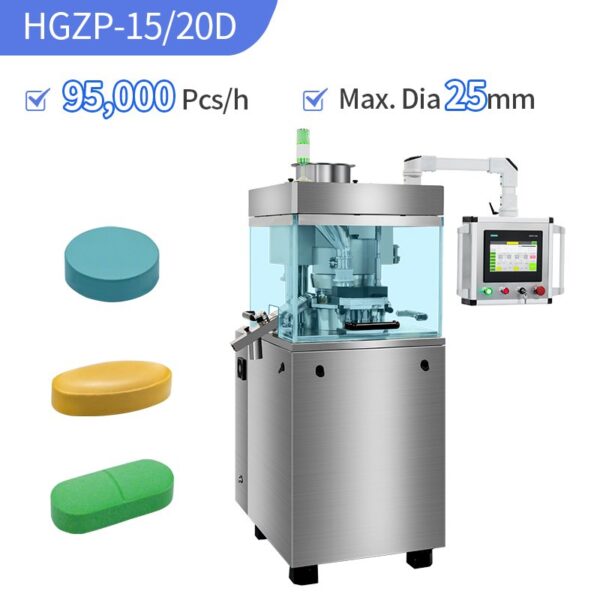
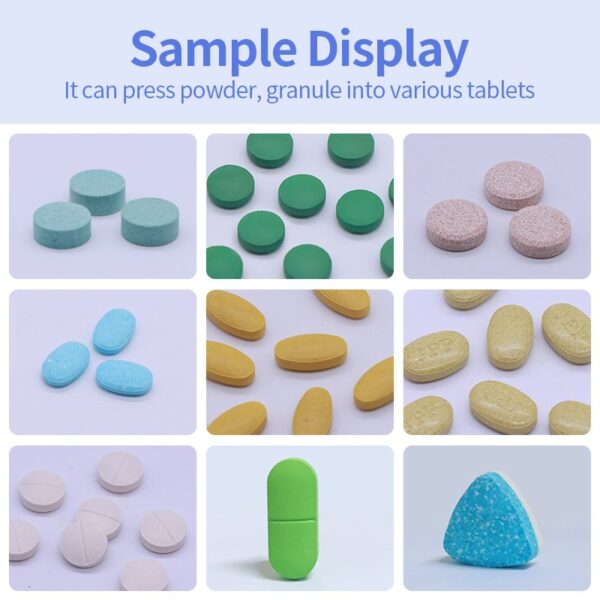
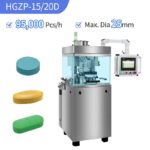
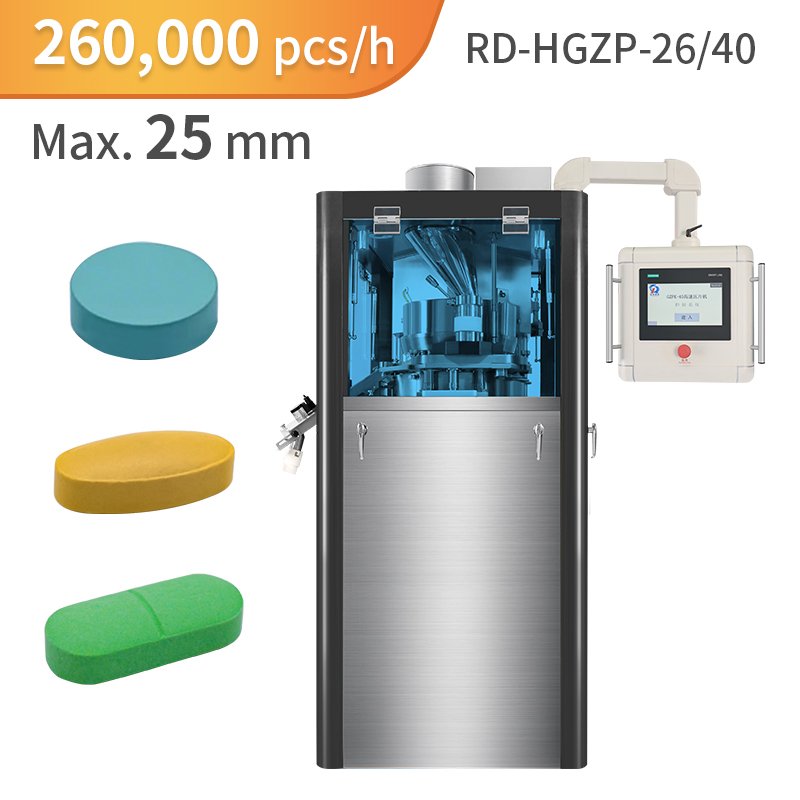
Tablet compression machine is essential equipment for producing solid tablets by compacting powdered or granular materials. Powder or granules enter the double impeller forced feeder, where upper and lower punches apply immense mechanical pressure to compress powder or granules into uniform tablet weight tablets.
The compacted tablet is then ejected vertically by the lower punch, guided to collection via scrapers. HGZP-15/20D rotary tablet presses achieve high-speed production through simultaneous multi-station compression cycles. This automated cycle ensures strict control over tablet weight uniformity, صلابة, and thickness, critical for pharmaceutical efficacy, nutraceutical dosage accuracy, and industrial product consistency.
How is the automatic rotary tablet presses working?
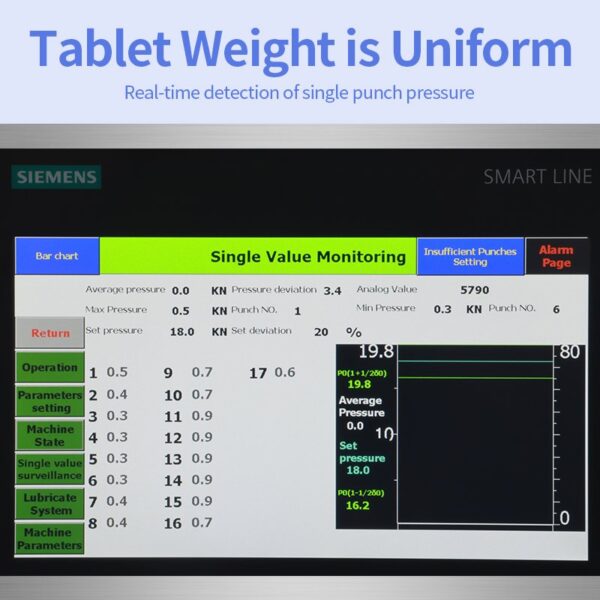
It can continuously and stably compress tablets of uniform weight, mainly by monitoring the pressure of each punch, the tablets that do not meet the requirements are rejected to improve tablets qualification rate.
الميزات الرئيسية
نموذج
HGZP-15D
HGZP-17D
HGZP-20D
Max Production Output
65,000 جهاز كمبيوتر شخصى / ساعة
75,000 جهاز كمبيوتر شخصى / ساعة
95,000 جهاز كمبيوتر شخصى / ساعة
الأعلى. Tablet Diameter
25 مم
16 مم
13 مم
Max Depth of Filling
20 مم
16 مم
16 مم
Max Tablet Thickness
10 مم
8 مم
8 مم
Main Pressure/Pre-pressure
100 كيلوغرام, 12 كيلوغرام
80 كيلوغرام, 12 كيلوغرام
80 كيلوغرام, 12 كيلوغرام
HGZP-15/20D Advantages
The turntable is made of high-strength 2Cr13 stainless steel, it has higher hygiene standards and strong hardness and impact resistance.
Servo motor to control filling cam tracks. This system automatically compensates filling volume according to set parameters, achieving an average tablet weight accuracy of ≤±2%.
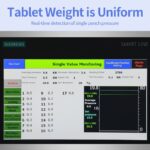
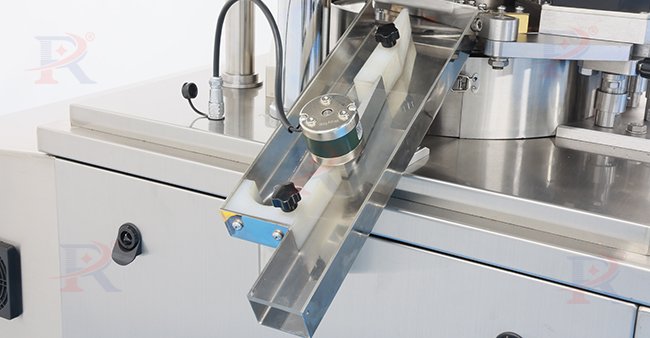
Real-time online inspection and rejection system automatically identifies and rejects non-compliant tablets by weight, and supports both continuous rejection and precise single-tablet rejection.
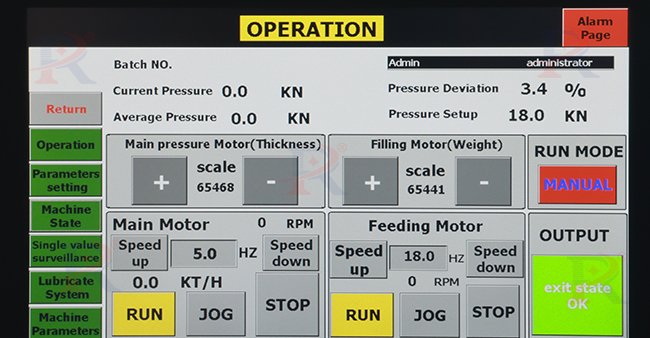
Tablet stability control, compression forces of upper and lower punches are adjustable, with PLC auto-response ensuring stable tablet formation, low noise, and consistent tablet weight.
In pharmaceutical manufacturing, tablet weight uniformity isn’t just a metric—it’s a non-negotiable pillar of cGMP compliance, product safety, and operational efficiency. Conventional tablet press pill press machine often struggle with inconsistent dosing, leading to costly waste, regulatory risks, and batch failures. في Ruidapacking, we’ve engineered a next-generation tablet making machine that eliminates variability through four revolutionary technologies, ensuring error ≤±2% weight uniformity and near-zero rejection rates.
Technological Innovation
1. Auto-Adjusting Weight Control System
Traditional pharmaceutical tablet press machine rely on manual handwheel adjustments—a slow, error-prone process vulnerable to operator fatigue and drift. Our solution:
AI-Driven Servo Motors replace mechanical handwheels, continuously fine-tuning fill depth in real-time.
Closed-Loop Feedback compares each tablet’s weight against target values, making micro-corrections every 0.5 seconds.
Result: Sustained ≤±2% average weight deviation, even with hygroscopic or cohesive powders.
HGZP-15/20D
2. Real-Time In-Line Rejection System
Waiting for QC lab results means thousands of non-compliant tablets enter bulk streams. HGZP-15/20D prevents this proactively:
Precision Ejection Technology removes outliers with surgical accuracy—whether continuous or single-tablet rejection.
Impact: Zero out-of-spec tablets reach packaging, slashing cGMP deviation reports by 99%.
HGZP-15/20D
3. Dual Forced Feeding System
Powder segregation during feeding causes fatal weight fluctuations. We combat this with:
Twin Asymmetric Stirrers: A primary metering stirrer precisely doses powder, while a secondary homogenizing stirrer prevents particle stratification.
Anti-Cavitation Design: Patented agitators maintain uniform bulk density at ≥300,000 tablets/hour speeds.
Outcome: Eliminated weight drift due to material settling or air entrapment.
Hidden variations in punch length or die wear sabotage consistency. Our innovation:
Pressure Sensors on Every Punch Pair: Monitor compression force, ejection profile, and tooling health 200×/second.
Self-Learning Algorithms: Predictively adjust fill depth if force deviations exceed ±5%, compensating for tool wear or powder rheology shifts.
ميزة: 40% longer tooling life and 99.8% first-pass yield rates.
The cGMP Advantage: From Waste to Value
While standard tablet presses hemorrhage $3M/year in wasted APIs and rework (per ISPE data), our technology delivers:
Zero Human Bias: Full automation removes manual sampling errors.
الاستدامة: 90% less raw material waste via near-perfect yield.
“In 2023, FDA warning letters cited ‘tablet weight variability’ in 38% of oral solid dosage form violations. Our high speed tablet press machine turns compliance from a cost center into a competitive edge.”
Why This Isn’t Just “Tablet Pressing Machine”
Legacy machines treat weight control as an isolated function. Our architecture integrates material handling, compression physics, and quality assurance into a unified ecosystem:
Material Science: Dual forced feeders prevent segregation—the #1 cause of weight variability in rotary presses.
Precision Engineering: Servo-controlled fill depth achieves micron-level accuracy unreachable with cam-driven systems.
Pharma 4.0: OPC-UA connectivity exports data to MES for live trend analysis and predictive maintenance.
خاتمة
Tablet weight stability isn’t about adding inspection steps—it’s about designing variability out of the process. By embedding intelligence into every subsystem (تغذية, compression, ejection), our machine guarantees cGMP-compliant uniformity while cutting costs. In an era of shrinking margins and escalating quality expectations, this isn’t luxury engineering—it’s survival.
في >50 RPM turret speeds, fine particles separate from granules due to centrifugal force. Like sugar spinning off a bicycle wheel, powder becomes airborne, coating surfaces.
2. The Scraper Powder Plate Gap Dilemma
Traditional steel scrapers require a 0.5–2mm gap to prevent:
Turret friction damage
Metal particulates contaminating tablets
This unavoidable clearance becomes an escape route for fines.
3. Powder Characteristics
Low-density (<0.4 g/ml), fine (<50 micron), or cohesive powders behave like “pharmaceutical dust,” fluidizing easily under vibration.
Proven Engineering Solutions
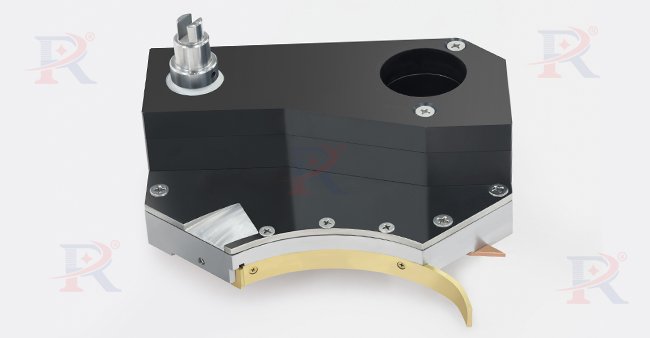
حل 1: PTFE Precision Scrapers
Material Innovation: Polytetrafluoroethylene (Teflon) blades with ultra-low friction coefficient
Gap Optimization: Maintains 0.1–0.3mm clearance—80% tighter than steel scrapers
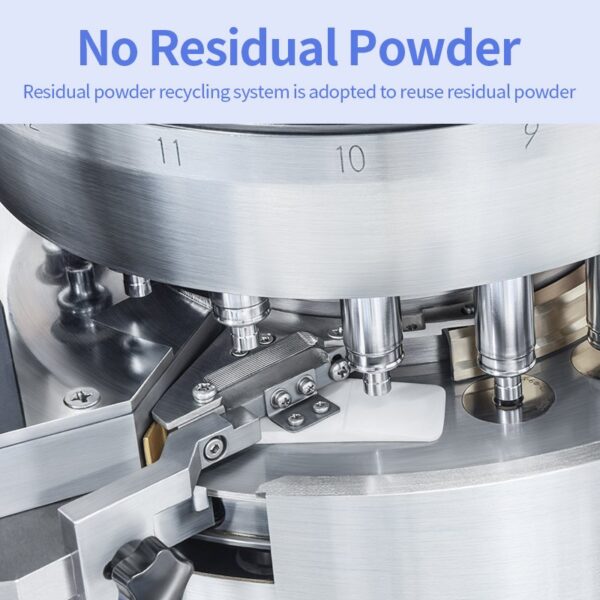
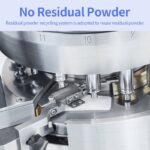
This next-gen rotary press demonstrates residue elimination through three integrated systems:
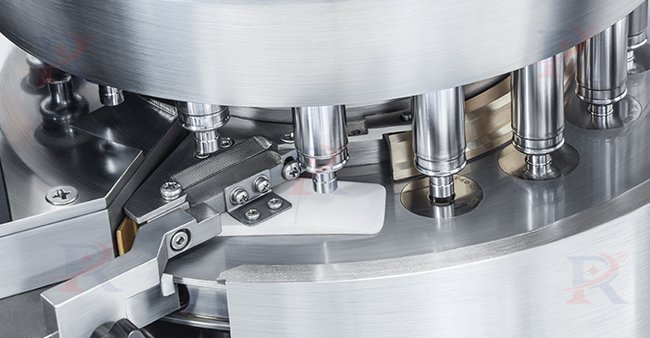
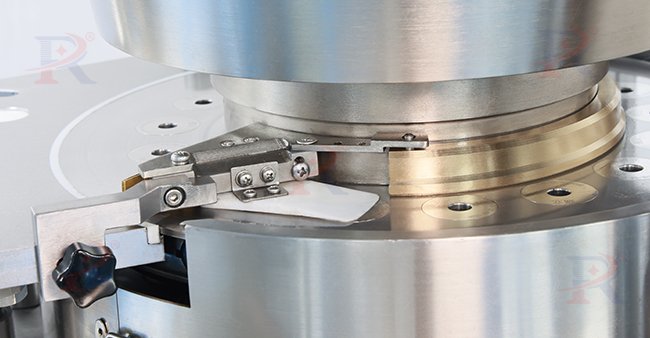
1. PTFE Scrapers
Primary blade: 0.15mm gap for API containment
HGZP-15/20D
2. Turret-Embedded Recovery
Angled collection channels redirect powder to force feeder
Isolation flaps prevent backflow during compression
HGZP-15/20D
3. Self-Cleaning Vacuum Rings
360° suction collar around turret periphery
Result: 0.5% material recovery rate vs. industry average 4–7% loss.
خاتمة
Turret powder residue stems from physics, not negligence. By reimagining scraper technology, implementing closed-loop recovery, and leveraging active suction control, modern presses like Ruidapacking’s HGZP series demonstrate near-perfect containment is achievable. In an era of heightened FDA scrutiny and costly APIs, this isn’t optional—it’s pharmaceutical manufacturing.