Ev

>

Yüksek Hızlı Tablet Pres Makinesi

Yüksek Hızlı Tablet Pres Makinesi
çeşitli tabletler
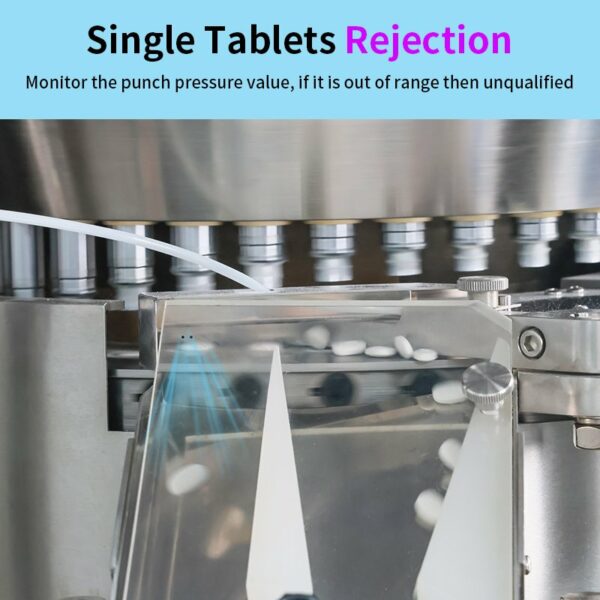
Tek Tablet Reddi
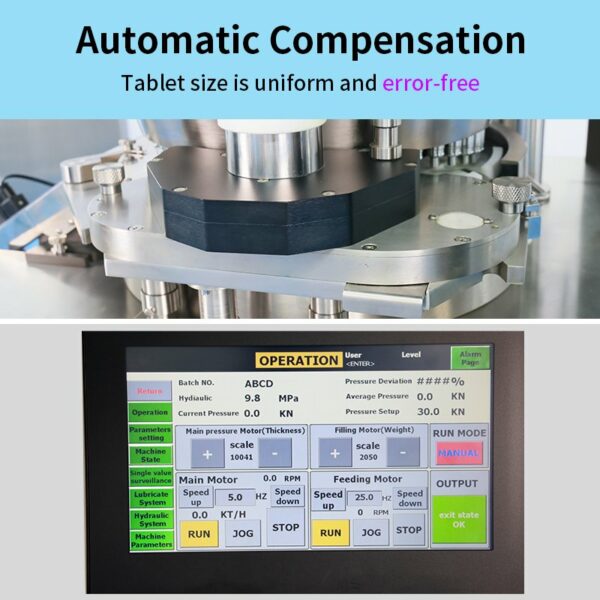
otomatik tazminat
sergi
Yüksek Hızlı Tablet Pres Makinesi
çeşitli tabletler
Tek Tablet Reddi
otomatik tazminat
sergi

Yüksek Hızlı Tablet Pres Makinesi

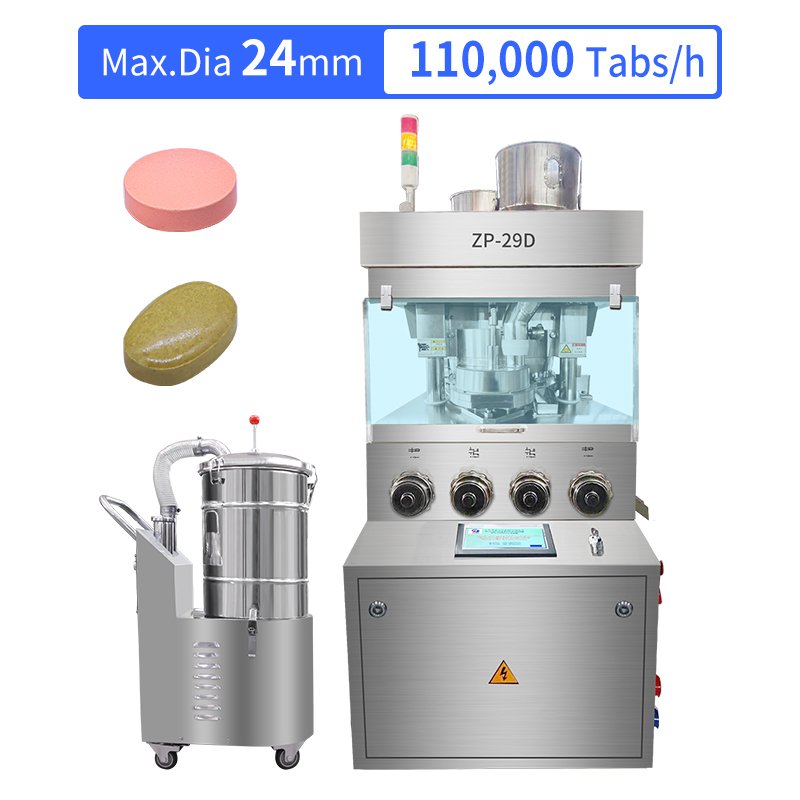
Yüksek Hızlı Tablet Pres Makinesi, bir dizi kesin kontrol edilen adımla toz veya taneli malzemenin tabletlere sıkıştırılmasını içerir..

Material Filling: Malzeme kalıp boşluğuna yönlendirilir, eşit olarak dağıtıldığı yer. Her tabletin doğru ağırlığa sahip olmasını sağlamak için kalıptaki malzeme miktarı kontrol edilir.

Sıkıştırma: Makine, kalıp boşluğundaki malzemeyi sıkıştırmak için hassas zamanlamada inen ve yükselen bir dizi üst ve alt yumruklara sahiptir.. Alt yumruk, üst yumruk aşağı basarken malzemeyi yerinde tutar, Malzemenin sağlam bir tablete sıkıştırılması. The pressure is adjustable, Gerekli tablet sertliğine bağlı olarak.

Çıktı: Sıkıştırmadan sonra, Üst yumruk geri çekilir, Ve alt yumruk, bitmiş tableti kalıp boşluğundan itmek için yükselir. Tablet daha sonra deşarj oluğuna yönlendirilir.

Spesifikasyon:

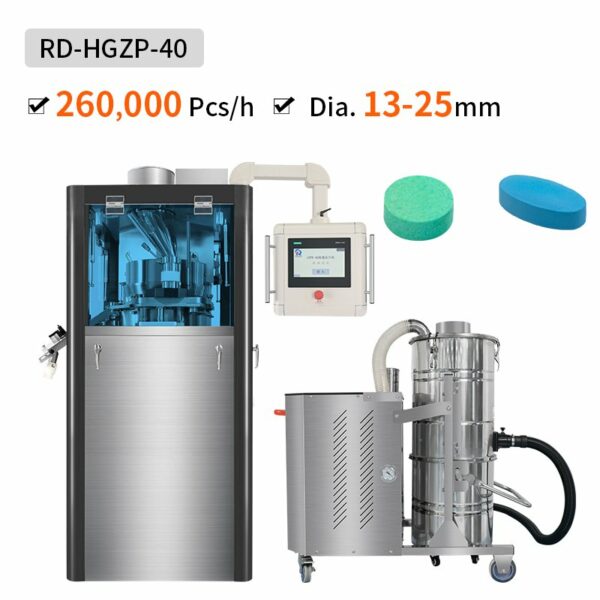
Kadar 260,000 PCS/s

Maksimum. 25mm tablet çapı

Main pressure 100 kN, preload 21kN

Döner Tablet Yüksek Basınç Çalışmaya Nasıl Basın?

Tablet Pres Makinesi Fiyatı, Toz veya Granüle Malzemeleri Sıkıştırarak Birden Fazla Yumruk ve Ölümlü Dönen Bir Taret Kullanarak Tabletlere Sıkıştırılır..

Ana Özellikler

Maksimum. Üretim kapasitesi 260,000 PCS/s
Maksimum. Ki. tablet 25mm
Toz 7.5KW
Gerilim 220V/380V 50Hz(özelleştirilmiş)
Boyut 820× 1.100 × 1.750mm

Atık reddi: Yüksek hızlı tablet presleri, kalite standartlarını karşılamayan tabletleri algılayan ve reddeden bir atık reddetme sistemi ile donatılmıştır., yanlış ağırlık gibi, sertlik, veya görünüm.

Otomatik yağlama: Makinenin hareketli parçaları, Özellikle yumruklar ve ölür, aşınmayı azaltmak ve sorunsuz çalışmayı sağlamak için otomatik olarak yağlanmıştır.

Hidrolik basınç kontrolü: Bazı yüksek hızlı tablet presleri, sıkıştırma sırasında uygulanan basıncı kontrol etmek için bir hidrolik sistem kullanır, Her tabletin gerekli basınçla üretilmesini sağlamak.

Etraflı, Tablet Pres Makinesi büyük miktarlarda tablet verimli ve doğru bir şekilde üretecek şekilde tasarlanmıştır, kitlesel üretim için ilaç endüstrisinde zorunlu kılmak.

Ana bölümler

How High Speed Tablet Press Machine Achieve Consistent Tablet Quality?

High speed tablet compression machine (typically rotary press capable of producing hundreds of thousands of tablets per hour) ensure consistent tablet quality through weight of each tablet is ensured by monitoring the pressure of each punch in real time. The core objective is to maintain uniformity in weight, kalınlık, sertlik, and disintegration for every tablet—even at high production speeds. Below are the key technologies and measures that make this possible.

1. Precision Mechanical Design​​

A robust mechanical foundation is essential—no control system can compensate for poor hardware.

Multi-Tooling Rotary System​​

The tablet press use multiple sets of punches and dies (26, 32, veya 40 stations) arranged in a circular configuration. As the turret rotates, each station sequentially performs filling, compression, and output. High-precision machining ensures uniform dimensions and minimal clearance between punches and dies, reducing mechanical variability.

Pre-Compression and Main Compression​​

Pre-compression: Eliminates air pockets in the powder, minimizing capping and laminating—especially critical for complex formulations.

Main compression: Delivers the final pressure. Main press wheel ensure smooth, even force distribution, preventing punch breakage.

Filling and Output Mechanisms​​

Precision feeders ensure consistent, segregation-free powder flow into die cavities.

Smooth output guides prevent tablet damage during discharge.

2. Advanced Automation & Control Systems​​

Modern high-speed tablet making machine rely on automation for real-time adjustments.

Pressure Sensors & Closed-Loop Control​​

The pressure sensor on the main press wheel monitors the pressure on each punch.

How it works: The system compares real-time pressure readings against a target value. If pressure is too high (indicating excess fill depth), the system reduces it automatically—and vice versa.

This closed-loop feedback operates in milliseconds, ensuring uniform hardness and thickness.

Weight Control​​

Since tablet weight correlates with pressure (assuming consistent powder flow), controlling pressure indirectly regulates weight.

Some advanced models include in-line weighing systems for periodic verification and fine-tuning.

Servo Motor Drive Technology​​

Traditional presses use mechanical clutches, which can cause shock and over-compression during speed changes.

High speed tablet machine employ servo motors for precise turret positioning, acceleration, and deceleration. This enablessoft starts” Ve “soft stops,” reducing mechanical stress and protecting tooling.

Process Analytical Technology (PAT) & Data Logging​​

Human-machine interfaces (HMIs) display real-time metrics like pressure, production rates, and weight deviations.

Compliant with cGMP, all data is traceable for audits.

Advanced systems use machine learning (ML) for predictive maintenance and process optimization.

3. Powder Material Requirements​​

Even the best tablet press cannot produce quality tablets from poor-quality powder.

Flowability​​

Powders must flow uniformly into dies. Granulation (wet, dry, or fluidized bed) or glidants (colloidal silica) can improve flow.

Compressibility​​

The blend must form stable tablets under pressure. Excipients like microcrystalline cellulose or lactose enhance compactibility.

Particle Size Distribution​​

Uniform particle size prevents segregation during handling, ensuring content uniformity.

4. Strict Operational & Maintenance Protocols​​

Tooling Management​​

High-wear-resistant tooling (premium steel) must be inspected and replaced regularly to maintain tablet dimensions.

Cleaning & Maintenance​​

Regular cleaning prevents cross-contamination and residue buildup.

Critical moving parts require lubrication to sustain precision.

Setup & Process Validation​​

Pre-production calibration (fill depth, pressure, speed) must meet IQ/OQ/PQ standards.

Conclusion​​

High speed tablet presses achieve consistent quality by:

Hardware: Precision-machined components parts.

Control: Real-time pressure monitoring controlling the stability of tablet weight.

Drive: Servo motors for smooth, precise operation.

Management: AT-driven monitoring, traceability, and strict maintenance.

Ultimately, this combination of innovations transforms the tablet press process into a digitally controlled, data-driven operation, enabling the production of high-quality tablets at astonishing speeds.

How Tablet Press Prevent Powder Residue on the Turret?

Tablet press machine ensure a clean turret surface—free of residual powder—through the coordinated operation of the feeder, powder pressing plate, and powder recovery system.

Core Principles of Powder Containment

As is well known, the residual powder on the turntable comes from the feeder. As long as the leakage of residual powder in the feeder is controlled, there can be no residual powder on the turntable.

Physical Barriers – Mechanical components confine powder to designated areas (die cavities and feeders).

Efficient Recovery – Escaped powder is captured via vacuum suction or mechanical recycling and returned to the feeder.

1. Feeder System

The feeder is the first and most critical line of defense against powder leakage.

Function & Design

Positioned above the turret, the feeder maintains a minimal gap (typically 10–100 microns) between its base and the turret surface—small enough to block powder but large enough to avoid friction.

Internal counter-rotating paddles agitate and compact powder in the dies, ensuring uniform filling while minimizing dust generation.

Key Features for Powder Control

Precision Gap Control – High-tolerance machining ensures a near-perfect seal between the feeder and turret.

Magnetic Sealing (Premium Models) – Strong magnets embedded in the feeder create an adaptivefloatingseal with stainless steel turrets, compensating for surface irregularities.

Optimized Paddle Design – Blade shape and speed are calibrated to gently guide powder without excessive agitation.

2. Powder Pressing Plate

Often overlooked, the powder pressing plate plays a vital role in residual powder removal.

Function & Design

A polytetrafluoroethylene (Teflon) baffle is installed behind the feeder to guide excess powder overflowing from the feeder into the powder circulation system before the upper punch enters the die.

How It Enhances Cleanliness

Direct Scraping – Removes stray powder, directing it into the recovery system.

Sealed Chamber Formation – Works with the feeder, punch guides, and turret to create a semi-enclosed space, further containing dust.

3. Powder Recovery System

This system collects and recycles scraped powder.

Function & Design

Channels recovered powder back into the feeder for reuse, reducing waste.

Critical for cross-contamination prevention—modern designs feature smooth, detachable, CIP (Clean-in-Place)-compatible components.

Operational Benefits

Closed-Loop Recycling – Prevents powder buildup and re-entrainment.

Batch Changeover Safety – Ensures no residue remains between product runs.

Synergistic Workflow for Maximum Efficiency

These components operate as an integrated containment system:

Primary Barrier – The feeder blocks >95% of powder leakage.

Secondary Defense – The scraper captures residual powder and aids in chamber sealing.

Sustainable Recovery – Collected powder is returned to the feeder, eliminating waste and dust accumulation.

Through thismechanical sealing + active recoveryapproach, modern high-speed tablet presses achieve cGMP-compliant, dust-free operation—even at maximum production speeds.

Teklif isteyin

    *Gizliliğinize saygı duyuyoruz ve tüm bilgiler korunuyor.