
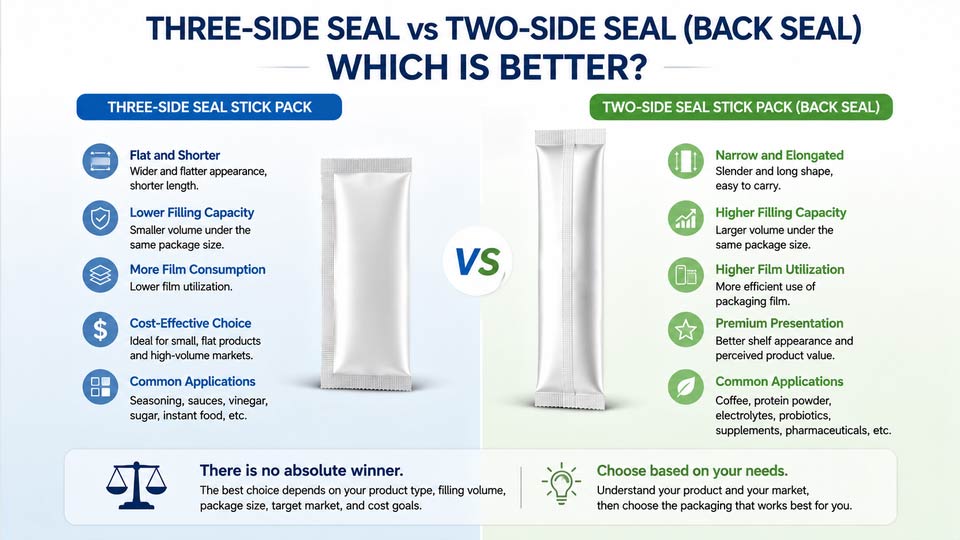
ซีลสามด้านและด้านหลัง
การแนะนำ
Stick pack packaging has gained popularity because its narrow format is portable and easy to use. Coffee, น้ำตาล, อาหารเสริม, and pharmaceutical powders commonly use this format.
Have you noticed that stick pack products can use different sealing structures? A three-side seal pack has seals around three edges. A back seal; also called two-side seal, has a longitudinal seal along the back.
The difference is not limited to film consumption. The two structures create subtle differences in package appearance and product presentation. According to PMMI Business Intelligence market observations, products using back seal packaging can have average selling prices around 20–50 times higher than products using three-side seal packaging in some compared product categories.
This does not mean the seal structure creates the price difference. ประเภทสินค้า, สูตร, การสร้างแบรนด์, and market positioning also play major roles. ดังนั้น, why do manufacturers choose different stick pack structures? This article explains these differences and their production impact.
ประเด็นสำคัญ
- Three-side seal and back seal stick pack structures create different package shapes and visual presentation.
- back seal designs generally provide higher film utilization and more flexibility in package length.
- Different package structures often match different product types, price levels, and market positioning.
- Seal structure affects package capacity, material consumption, รูปร่าง, และ เครื่องบรรจุซองแบบแท่ง การกำหนดค่า.
- The 20–50× price difference is a market observation, not a direct effect of the sealing structure itself.
1.What Are Three-Side and back seal Stick Packs?
บรรจุภัณฑ์แบบแท่ง can use different sealing structures for different products.The difference between the two stick pack structures is easy to see from the finished package. The main visual changes come from package width, ความยาว, and seal position.
How Three-Side Seal Stick Packs Are Formed
A three-side seal stick pack starts with a flat film web. The packaging machine forms the package around the product and seals the required edges.
A three-side seal stick pack has three sealed edges around the package. ด้านบน, bottom, and one longitudinal edge are sealed, while the remaining film forms the package body.
This structure creates a wide and flat appearance. The sealed edges form a visible border around the product, while the front surface provides a broad and shallow package area.
A four-side seal package extends this structure by sealing all four edges. Its appearance is also flat, with a sealed border surrounding the entire package.
The width is more noticeable than the depth. The finished package therefore looks compact and flat rather than narrow and elongated.
How back seal Stick Packs Are Formed
A back seal stick pack uses a different film path. The film forms a narrow tube before the longitudinal back seal closes the rear of the package. The machine then fills the tube and creates transverse seals between individual packs. Cutting separates the finished stick packs from the continuous film.
A back seal stick pack has two transverse seals and one longitudinal back seal. The longitudinal back seal extends from the top to the bottom of the package. It is also known as a fin seal.
The film forms a narrow tube before the longitudinal seal closes the rear. The top and bottom transverse seals then separate each individual package.
This structure creates the familiar narrow and elongated stick pack appearance. The package is generally much longer than it is wide.
From the front, the package has a narrow rectangular shape. From the back, the longitudinal back seal is clearly visible along the center or rear surface.
The difference becomes easier to see when the two formats are compared directly. Three-side seal packaging looks wider and flatter, while back seal packaging looks narrower and longer.
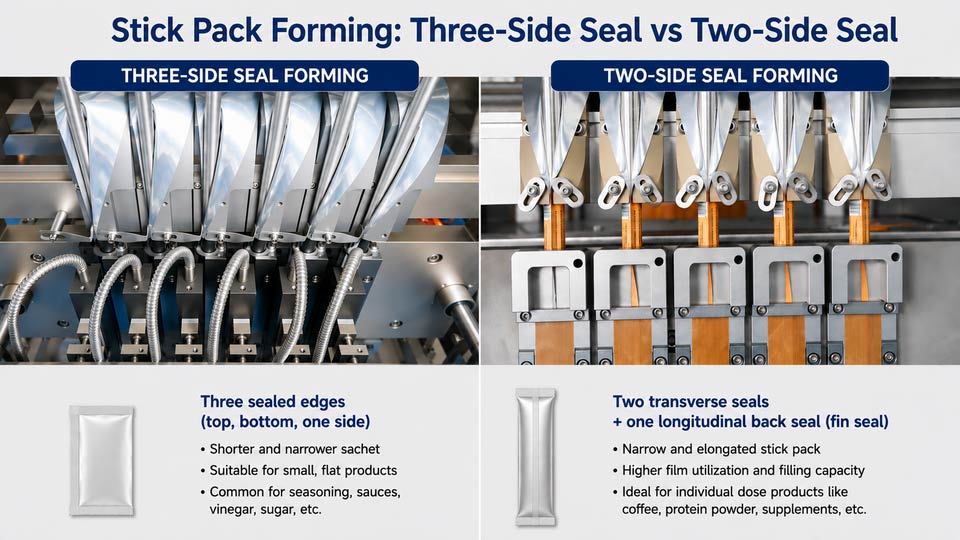
Stick Pack Forming: Three-Side Seal vs Back Seal
2.Which Products Work Best in Each Stick Pack?
The choice between three-side seal and back seal often starts with the product itself. Product shape, เติมปริมาตร, package size, and market positioning all affect the final package format.
Three-side and four-side seal sachets are common for small, flat products. Instant noodle seasoning is a typical example. The powder can spread across the wider package without requiring much filling height.
Takeaway vinegar packets and chili oil packets follow a similar format. Their small liquid volumes fit a flat package well. Disposable plastic gloves also use flat sachets because the product itself requires more surface area than filling depth.
These applications often focus on low unit cost and high-volume consumption. The flat package is practical for products that are used quickly and discarded after one use.
โดยการเปรียบเทียบ, back seal stick pack packaging is more common for products sold as individual doses. The narrow shape is portable and gives the finished product a distinct appearance.
According to PMMI Business Intelligence market data, products using back seal stick pack packaging can have average selling prices around 20–50 times higher than comparable products using three-side or four-side seal sachets in some product categories. The seal structure itself does not account for the entire price difference. ประเภทสินค้า, สูตร, การสร้างแบรนด์, and market positioning also contribute.
Powder and Granule Stick Pack Applications
Coffee stick pack is a common example of this packaging format. A coffee stick pack can hold one serving in a narrow package. The long shape also makes the product easy to carry and pour directly into a cup.
Electrolyte powders, ผงโปรตีน, and probiotics can use the same format. An electrolyte stick pack can provide a defined serving, while a protein powder stick pack can package a larger single dose.
The same structure fits probiotic stick pack and dietary supplement stick pack applications. These products are often sold around individual dosing and portability rather than simple bulk distribution.
Pharmaceutical powders can also use this format. A pharmaceutical stick pack can separate each dose into an individual package. This format can support products that require controlled dosing and convenient use.
Flat sachets remain suitable for many powder products. Coffee sachet, sugar sachets, seasoning packets, and instant food ingredients can use the wider package when a narrow bag is not required.
Both structures can handle powders and granules, so the choice involves more than the product material. The key consideration is whether the product requires a flat package or a narrow format for individual dosing.
Liquid and Semi-Liquid Stick Pack Applications
Liquid products also use both packaging structures. น้ำผึ้ง, ซอส, vinegar, อาหารเสริมที่เป็นของเหลว, and some pharmaceutical liquids can be packed in small sachets or liquid stick pack formats.
Flat sachets work well for small liquid portions. Vinegar and chili oil packets are familiar examples. The wider package provides a short path between the two sides and keeps the package compact.
A honey stick pack uses a different presentation. Its narrow shape can make the package easier to carry and dispense. The same format can work for liquid supplements and other single-use products.
Liquid products place greater demands on sealing control. The product must stay away from the sealing area during filling. Any liquid contamination can affect seal strength and increase leakage risk.
For pharmaceutical liquids and supplements, package integrity becomes even more important. The selected sachet packaging or stick pack packaging structure should match the product volume, film structure, sealing requirements, and intended market position.
3.How Do the Two Stick Pack Structures Compare?
The two stick pack structures differ in more than their sealing positions. Their package geometry affects material use, filling capacity, รูปร่าง, and product applications.
Sealing Performance and Pressure Resistance
Both structures can provide strong seals when the film and sealing parameters match the product. Stick pack sealing depends on film compatibility, อุณหภูมิการปิดผนึก, ความดัน, เวลาอยู่, and seal-area cleanliness.
A three-side seal uses sealed edges around the package. A back seal uses a longitudinal back seal with transverse seals at the package ends. The sealing layout changes the position and length of the sealed areas.
For liquid products such as honey stick pack and liquid supplements, leakage control requires particular attention. Product entering the seal area can reduce seal strength and create leakage paths.
Powder filling presents a similar sealing risk. Fine particles may reach the seal area during the filling process. The filling and sealing process must keep the seal area clean.
Pressure resistance does not depend on seal structure alone. Film strength, laminate construction, seal width, and sealing conditions also affect the finished package.
Film Utilization and Package Capacity
Film utilization differs between the two structures because their package geometries are different. A three-side seal package has a wider and flatter shape. Its film must form this wider package and provide the required sealing edges.
A back seal stick pack forms a narrow and elongated package. Its back-seal structure can use the film more efficiently for this package shape. This makes film utilization an important consideration when comparing the two formats.
Package capacity shows another clear difference. Under the same film width and package length, a back seal stick pack can provide a higher usable filling capacity than a three-side seal package.
The reason comes from the package geometry. The back-seal structure creates a narrower and deeper filling space. The product can occupy more of the available package area instead of spreading across a wider, flatter bag.
This difference matters when the same packaging material width is used. A manufacturer can obtain a higher fill volume from the back seal structure without simply making the package wider.
For protein powder stick pack, electrolyte stick pack, and pharmaceutical stick pack applications, this additional capacity can be useful. This provides greater flexibility for matching the required dose with the package dimensions.
บทสรุป
There is no absolute winner between three-side seal and back seal stick pack packaging. The better choice depends on the product, package size, filling capacity, material use, and market positioning.
| การเปรียบเทียบ | Three-Side Seal | back seal / Back Seal |
| Package Shape | Wider and flatter | Narrower and longer |
| Seal Structure | Three sealed edges | Two transverse seals + one longitudinal back seal |
| Film Utilization | Generally lower for narrow formats | Generally higher for narrow formats |
| Filling Capacity | Lower under the same film width and length | Higher under the same film width and length |
| Product Appearance | Flat and compact | Long, narrow, and more like a stick pack |
| ผลิตภัณฑ์ทั่วไป | Seasoning, vinegar, chili oil, disposable gloves | Coffee, อิเล็กโทรไลต์, ผงโปรตีน, โปรไบโอติก |
| Product Positioning | Often practical and cost-focused | Often associated with individual-dose and portable products |
| Packaging Cost Focus | Suitable for high-volume, low-unit-cost products | More suitable when package format and capacity are important |
| Key Consideration | Flat package and simple product presentation | Narrow package, higher capacity, and distinctive presentation |
The differences between these two structures are clear, but neither structure is inherently better. A three-side seal can be the right choice for a flat, low-volume product, while a back seal stick pack can be better when the product needs a narrow shape and higher filling capacity. The correct choice should start with the product and production requirements, not the sealing method itself.
คำถามที่พบบ่อย
Is a back seal the same as a back seal?
ใช่. ในบทความนี้, back seal refers to the structure commonly called a back seal or fin seal. The package has two transverse seals and one longitudinal seal along the back.
Which has higher filling capacity, three-side seal or back seal?
Under the same film width and package length, a back seal stick pack can provide higher usable filling capacity. Its narrow and deeper package geometry allows more product space within the same material width.
Which stick pack uses less packaging film?
The back seal structure can provide higher film utilization for narrow package formats. The actual material consumption still depends on package dimensions, film structure, and sealing requirements.
What products commonly use three-side seal sachets?
Three-side and four-side seal sachets are commonly used for flat, small-volume products. Examples include instant noodle seasoning, takeaway vinegar, chili oil, น้ำตาล, and similar sachet products.
What products commonly use back-seal stick packs?
Coffee stick pack, electrolyte stick pack, protein powder stick pack, probiotic stick pack, and pharmaceutical stick pack are common applications. The format suits products sold as individual doses with a narrow package shape.
Is back seal always better than three-side seal?
เลขที่. There is no absolute better or worse structure. The choice depends on product type, เติมปริมาตร, package dimensions, material consumption, รูปร่าง, and market positioning.
Does the seal structure determine the product price?
เลขที่. PMMI Business Intelligence market data shows that some products using back seal packaging can have average selling prices around 20–50 times higher than comparable three-side or four-side seal products. This is a market observation, not a direct effect of the sealing structure. ประเภทสินค้า, สูตร, การสร้างแบรนด์, and market positioning also contribute.
เอกสารอ้างอิง
1. PMMI — Pharmaceutical Manufacturing Trends and Packaging Industry Insights
2. FDA — Packaging and Labeling Requirements for Drug Products
3. ASTM International — Standard Test Method for Seal Strength of Flexible Barrier Materials
4. Healthcare Packaging — Pharmaceutical Packaging Industry Trends
5. Packaging World — Flexible Packaging and Packaging Machinery Applications
6. ILPRA — Stick Pack Packaging Machines
7. Mespack — Stick Pack and Sachet Packaging Solutions