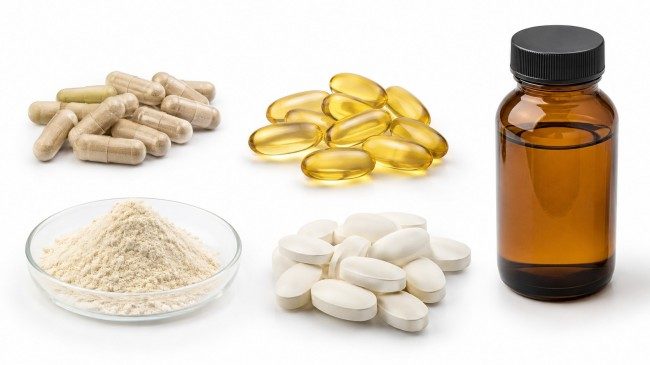
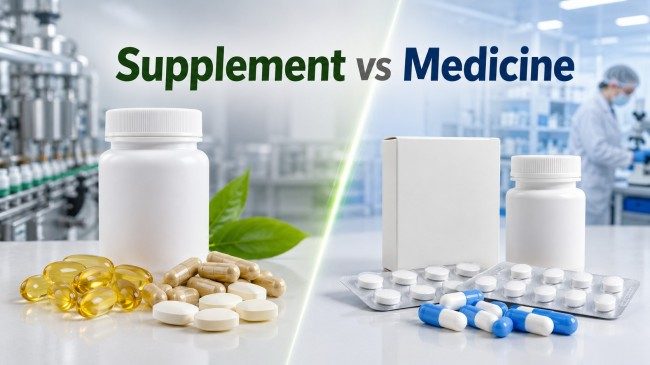
Dietary supplements and medicines often come in the same forms. Walk through a pharmacy or supplement store and you will find tablets, 단단한 캡슐, 소프트젤, 분말, and liquids in both categories. Their appearance alone tells you very little about how the finished product is regulated or manufactured.
메인 supplement vs medicine difference is what the product is intended to do. Supplements add dietary ingredients such as vitamins, 탄산수, amino acids, or botanicals to the diet. Medicines are used to prevent, treat, relieve, or manage diseases and medical conditions.
That difference reaches far beyond the formulation. It affects product claims, 라벨링, manufacturing controls, 테스트, 선적 서류 비치, and sometimes the packaging used to bring the finished product to market.
1.Supplement vs Medicine: What Are They?
What Is a Dietary Supplement?
에이 건강보조식품 is designed to add specific nutrients or other dietary ingredients to a person’s regular diet. In the United States, dietary ingredients can include vitamins, 탄산수, amino acids, herbs and other botanicals, as well as certain extracts, concentrates, metabolites, and related substances. These dietary supplements are available as tablets, 캡슐, 소프트젤, 구미, 분말, 액체, and other common forms.
A multivitamin tablet, fish oil softgel, botanical capsule, and protein powder can therefore all be dietary supplements even though their ingredients and production methods are very different.
The category is defined by the finished product and how it is marketed, not by whether it comes as a tablet or capsule.
미국에서는, FDA regulates dietary supplements but generally does not approve them before they enter the market. Manufacturers and distributors are responsible for making sure their products satisfy the safety, 라벨링, and manufacturing requirements that apply to them. Additional notification requirements apply to certain products containing a new dietary ingredient.

What Is Medicine?
Medicine refers here to products used to prevent, treat, relieve, or manage diseases and medical conditions.
They include both prescription and nonprescription products. Their path to market varies by product. Many require an FDA-reviewed application, while certain nonprescription products can be marketed under an applicable OTC monograph rather than through an individual premarket application.
This distinction matters because a vitamin capsule and a medicine capsule can have the same physical format while following different rules for claims, 생산, 품질 관리, 라벨링.
A quick comparison makes the main differences clearer:
| 영역 | Dietary Supplement | 약 |
| Main use | Supplements the diet with dietary ingredients | Prevents, treats, relieves, or manages diseases and medical conditions |
| Common forms | 정제, 캡슐, 소프트젤, 구미, 분말, 액체 | 정제, 캡슐, 액체, and other dosage forms |
| 우리를. premarket route | Generally no FDA preapproval; some new dietary ingredients require advance notification | Route depends on the product; applications or an applicable OTC monograph can be used |
| Claims | Health, nutrient content, and structure/function claims are subject to specific rules | Claims must fit the permitted use and labeling for the medicine |
| Label | Supplement Facts and other required supplement information | Product-specific medicine labeling |
| Manufacturing framework in the U.S. | 21 CFR 부분 111 | 21 CFR Parts 210 그리고 211 |
| 포장 | Selected around stability, use, 라벨링, and any product-specific requirements | Selected around stability, use, 라벨링, and product-specific safety requirements |
The key point is that the physical dosage form can overlap while the requirements surrounding the finished product do not.
2.How Do Use, Claims, and Labeling Differ?
The clearest difference appears in what a company can say the product does.
Product Purpose Changes the Claims
Dietary supplements can make several types of label claims in the United States. FDA identifies health claims, nutrient content claims, and structure/function claims as major categories. Different requirements apply to each.
예를 들어, a structure/function claim can explain how a nutrient helps support a normal body structure or function. Where the required conditions are met, a supplement can say that a nutrient “supports” a normal body function.
What it cannot do is present itself as a product that treats, prevents, or cures a specific disease while continuing to be marketed as a dietary supplement. FDA states that a product represented for treatment, prevention, or cure of a specific disease falls outside the dietary supplement category.
Medicine labeling follows a different route because the claimed use is tied to the conditions under which the product can legally be marketed.
This is why two products containing similar ingredients are not automatically the same category. How the finished product is formulated, presented, and marketed matters.
What Is Supplement Facts?
그만큼 보충 사실 panel is one of the easiest ways to recognize a dietary supplement sold in the United States.
With limited exceptions, FDA requires the Supplement Facts panel to list the serving size, number of servings per container, dietary ingredients, and the quantity of each dietary ingredient provided in one serving. Daily Value information is included where required.
Ingredients that are not declared in Supplement Facts are normally listed separately as Other Ingredients. These can include substances such as gelatin, starch, stabilizers, 방부제, 풍미, and other formulation ingredients.
제조업체의 경우, label development therefore begins well before a bottle reaches a labeling machine. The formula, 서빙 크기, ingredient declaration, 주장, and package format all affect the information that must fit onto the final label or carton.
Medicine labeling contains different information according to the type of product and its marketing pathway. The practical difference is not simply the name of the label panel: the label has to match the requirements established for that specific finished product.
3.How Does Manufacturing Differ?
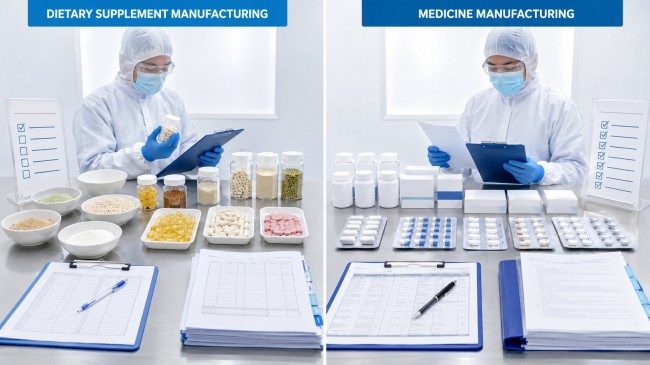
Dietary supplements and medicines can share familiar manufacturing operations. Powder blending, 육아, 캡슐 충전, 태블릿 압축, 코팅, 점검, and packaging appear across both industries.
The manufacturing framework around those operations is where the difference becomes more important.
Dietary Supplement Manufacturing
Dietary supplements produced for the U.S. market are subject to the CGMP requirements in 21 CFR 부분 111, which address manufacturing as well as packaging, 라벨링, and holding operations.
The requirements address areas such as personnel, 시설, 장비, 품질 관리, 명세서, master manufacturing records, batch production records, laboratory operations, 포장, 라벨링, and recordkeeping. Production equipment needs to match the process it is used for and be kept in appropriate working and clean condition throughout operation.
This means dietary supplement manufacturing is not simply a matter of blending ingredients and placing them in capsules or tablets. Manufacturers need specifications and controls that help ensure the finished product has the expected identity, 청정, 힘, composition, 그리고 품질.
Pharmaceutical Manufacturing
Finished pharmaceuticals in the U.S. operate under the CGMP framework in 21 CFR Parts 210 그리고 211.
부분 211 sets requirements across the pharmaceutical production system, from facilities, 장비, and material control to manufacturing processes, laboratory testing, 포장, 라벨링, stability programs, 및 생산 기록.
The useful comparison is not that one system is “good” and the other “better,” or that one is regulated while the other is not. They are separate manufacturing frameworks written for different product categories.
That difference affects how manufacturers establish specifications, document production, control materials, handle deviations, release finished batches, and maintain records.

What Does This Mean for Production Equipment?
The difference between supplement and medicine manufacturing does not necessarily require completely different machine categories.
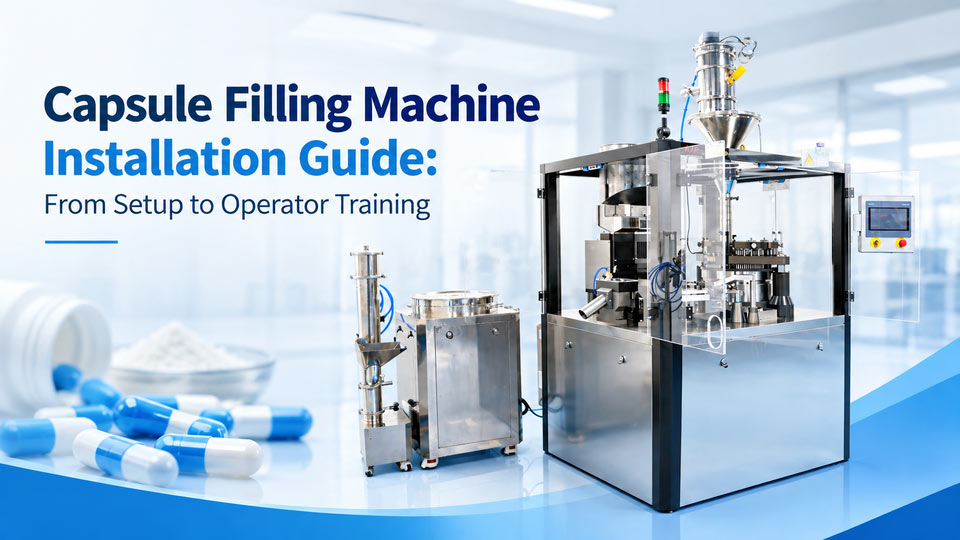
에이 rotary tablet compression machine is still used to compress prepared material into tablets. 안 자동 캡슐 충전기 still meters a formulation into capsule shells. Whether the finished product is a supplement or medicine changes the requirements around the process rather than the basic mechanical purpose of the machine.
The formulation remains central to machine configuration.
A free-flowing vitamin blend behaves differently from a sticky botanical powder. Capsule fill weight, 분말 흐름, compression characteristics, dust generation, 필요한 출력, and cleaning needs all influence the equipment setup regardless of the product category.
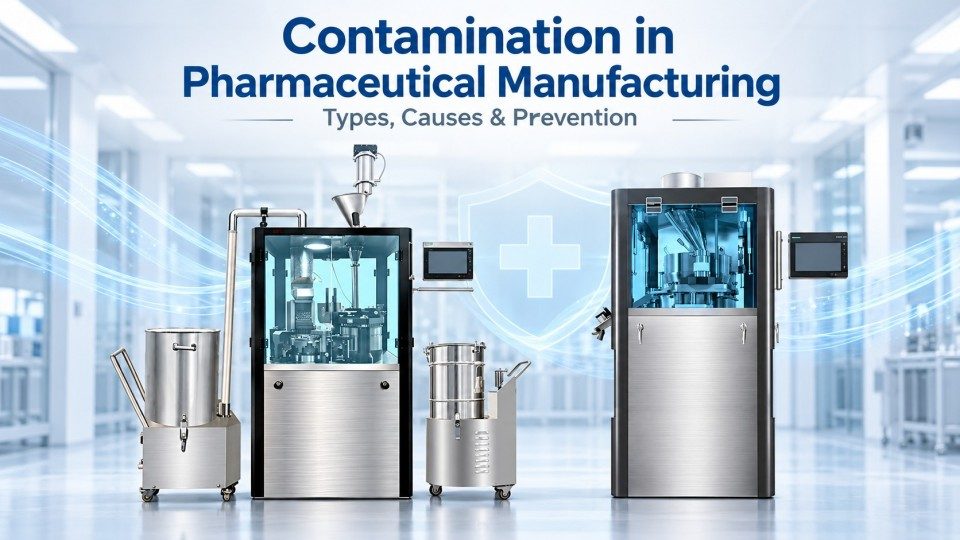
Equipment design can support controlled production through suitable product-contact surfaces, accessible cleaning areas, enclosed processing, process monitoring, and repeatable controls. Those features are part of a larger manufacturing system; they do not make the entire production process compliant by themselves.
This is the point where equipment selection and manufacturing requirements meet without becoming the same question.
4.How Does Packaging Differ?
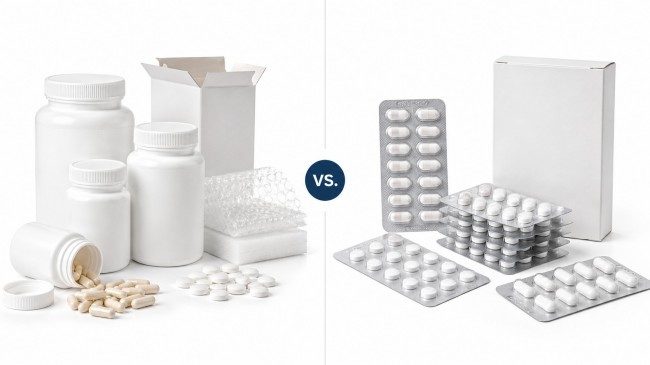
There is no universal rule that supplements belong in bottles while medicines belong in blister packs.
Both categories can use bottles, 물집, 향낭, 파우치, 그리고 판지. The right packaging starts with the characteristics of the finished product.

Product Protection Comes First
수분, 산소, 빛, 온도, and physical damage can affect product stability. Packaging materials and closure systems therefore need to provide the level of protection established for the formulation.
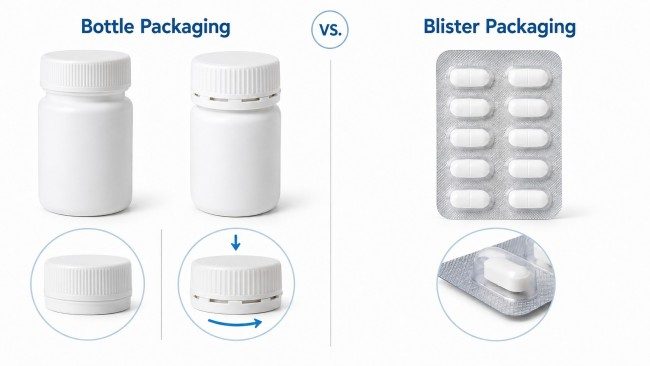
A moisture-sensitive capsule may need a high-barrier container and a desiccant. Another tablet formulation may remain stable in a simpler bottle system. Blister packaging can separate individual units and provide a different barrier structure depending on the forming and lidding materials selected.
These decisions are based on the actual product rather than the word 보충 또는 medicine printed on the package.
For bottles, ㅏ 정제 캡슐 계산 병입 라인 can count and fill solid products before capping and labeling. When required by the product, the line can also include desiccant insertion, 밀봉, 그리고 포장하기.
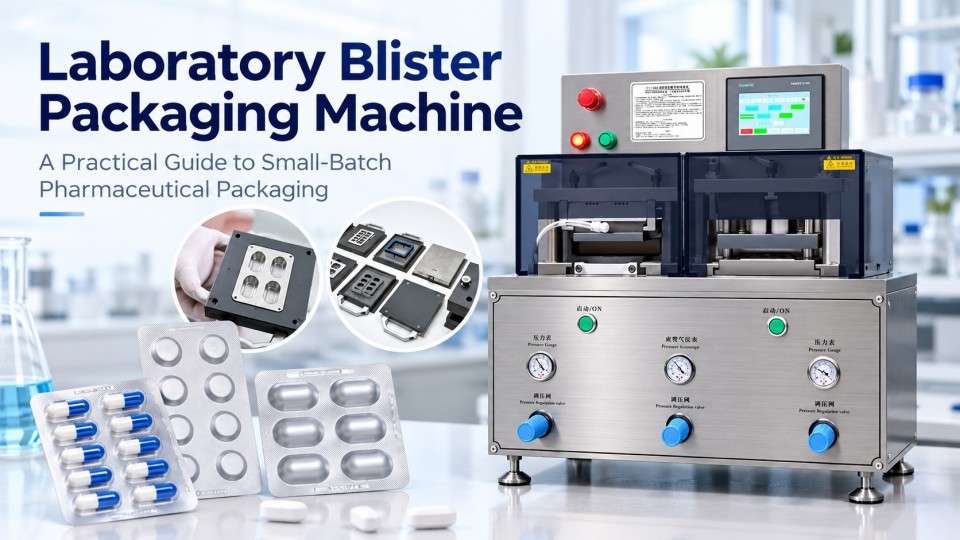
For unit-dose formats, ㅏ 블리스터 포장기 주머니를 형성하다, loads the tablets or capsules, and seals the package. The selected blister structure must match the protection needed by the formulation.
The same packaging technologies can therefore appear in both markets.
Safety Requirements Can Be Product-Specific
Where packaging begins to differ more clearly is in product-specific safety and regulatory requirements.
예를 들어, 우리를. regulations include tamper-evident packaging requirements for certain nonprescription medicines. 부분 211 also contains dedicated controls for pharmaceutical packaging and labeling operations.
Child-resistant packaging cannot be reduced to a simple rule that “medicine needs it and supplements do not.”
Some dietary supplements are also subject to child-resistant packaging requirements. Iron-containing supplements are a clear example. A U.S. Consumer Product Safety Commission recall announced in April 2026 involved several iron-containing dietary supplements packaged without the child-resistant protection required for those products.
That example shows why package specifications should be based on the product contents and target market instead of broad assumptions about the category.
Labeling space, tamper features, closure type, barrier protection, lot information, and secondary packaging can all influence the final packaging line.

5.What Do These Differences Mean for Manufacturers?
For a manufacturer producing only one established product, the distinction can appear straightforward. It becomes more practical when the same facility handles multiple formulations or plans to expand from supplements into pharmaceutical products.
Four areas deserve attention.
첫 번째, confirm the product category and market requirements before designing the process. A tablet or capsule format alone does not provide enough information to establish the required controls.
두번째, build production around the formulation. 분말 흐름, ingredient characteristics, 제형, 배치 크기, 필요한 출력, and in-process controls determine how blending, 압축, 캡슐 충전, or other manufacturing steps are configured.
제삼, plan cleaning and changeover around the actual products being handled. Residue, allergens, potent ingredients, 착색제, 유화, and sticky powders create different cleaning challenges. The cleaning approach should match the materials and contamination risks involved.
네번째, finalize the package before configuring the complete packaging line. Bottle size, count per container, 폐쇄, 건조제, blister structure, 상표, and carton determine which packaging operations are required.
In equipment projects, Ruida Packing typically starts with the dosage form, 재료 특성, 출력 목표, 청소가 필요하다, and final package before recommending a machine configuration. This avoids treating every supplement tablet or medicine capsule as if it has the same production requirements.
The result is a more useful question than “Is this a supplement machine or a medicine machine?” The better question is whether the equipment and process are suitable for the product being manufactured.
결론
그만큼 supplement vs medicine difference begins with the purpose of the finished product. That purpose then shapes the claims, 라벨, manufacturing controls, and market requirements surrounding production.
Similar tablets and capsules can pass through similar types of equipment, and both categories can use bottles or blister packs. What matters is whether the manufacturing process and package are designed around the actual formulation, 용도, and requirements of the market where the product will be sold.
FAQ About Supplement vs Medicine
-
Are Dietary Supplements Regulated by the FDA?
예. FDA regulates dietary supplement products and ingredients, inspects manufacturing facilities, reviews certain notifications, monitors the market, and can take enforcement action when products violate federal requirements. Dietary supplements simply operate under a different regulatory framework from medicines.
-
Do Dietary Supplements Require FDA Approval Before They Are Sold?
일반적으로, 아니요. FDA does not approve dietary supplements before marketing in the same way it reviews many medicines. Certain products containing a new dietary ingredient require an advance notification with supporting safety information.
-
Can the Same Ingredient Appear in a Supplement and a Medicine?
The ingredient alone does not answer the classification question. The finished product’s intended use, 공식화, 주장, 라벨링, and regulatory status all matter. An ingredient used in one context should not be assumed to have the same regulatory role in another.
-
Can Supplements and Medicines Use the Same Type of Manufacturing Equipment?
자주, 예. Tablets from either category can require tablet compression, while hard capsules can require capsule filling. Equipment suitability still depends on the formulation, 제형, 청소 요구 사항, 산출, 프로세스 제어, and other production needs.
-
Do All Dietary Supplements Require Child-Resistant Packaging?
아니요. Child-resistant requirements depend on the product and market. Some supplements do require it; iron-containing dietary supplements are one U.S. 예.
참조
1. 우리를. Food and Drug Administration — Questions and Answers on Dietary Supplements
2. 우리를. Food and Drug Administration — Label Claims for Food & Dietary Supplements
3. Electronic Code of Federal Regulations — 21 CFR 부분 111
4. 우리를. Consumer Product Safety Commission — April 2026 Iron Supplement Recall