
परिचय
Probiotic packaging does more than hold the product. यह भंडारण के दौरान स्थिरता की रक्षा करने में मदद करता है, परिवहन, और दैनिक उपयोग. कई पूरकों के लिए, packaging is mainly about containment, सुविधा, and presentation. For probiotic products, it also has a closer link to shelf life because storage conditions can affect how well the product holds up over time. Reviews and industry guidance consistently point to water activity, storage temperature, and protection from moisture and light as important factors in probiotic survival.
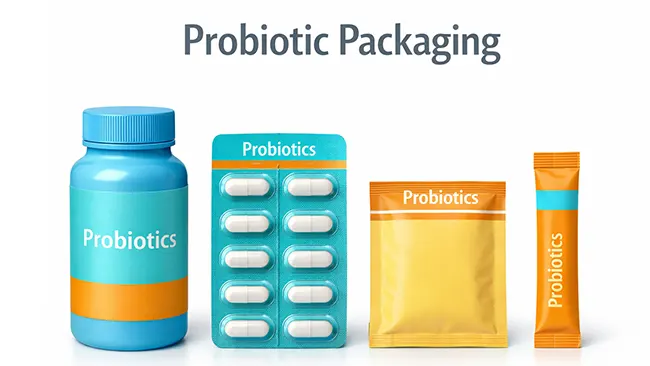
That is why bottle, छाला, पाउच, and stick pack formats are not interchangeable in probiotic packaging. Each one creates a different exposure pattern during storage and use, which can influence both probiotic stability and the final packaging route.
Why Probiotic Packaging Needs More Protection Than Standard Supplement Packaging
Many supplements mainly need packaging that supports storage, shipping, and retail use. Probiotic packaging often needs to do more than that. The package also helps control how much moisture, ऑक्सीजन, रोशनी, and ambient air the product meets across its shelf life. That makes packaging part of product protection, not only part of final presentation.
A second difference is repeated exposure after opening. A multi-dose bottle may be practical, but it also changes the storage environment each time the pack is opened. A blister keeps each unit sealed until use. A sachet or stick pack can do the same for probiotic powder packaging. The format therefore affects not only convenience, but also how often the product is exposed during daily use.
This is why probiotic supplement packaging is usually judged more carefully than standard supplement packaging. A bottle route may still work well for some products, especially when closure design and moisture control are strong enough. In other cases, छाला, पाउच, or stick pack formats provide a better protection profile and a better fit for shelf-life goals.
What Can Reduce Probiotic Stability During Storage?
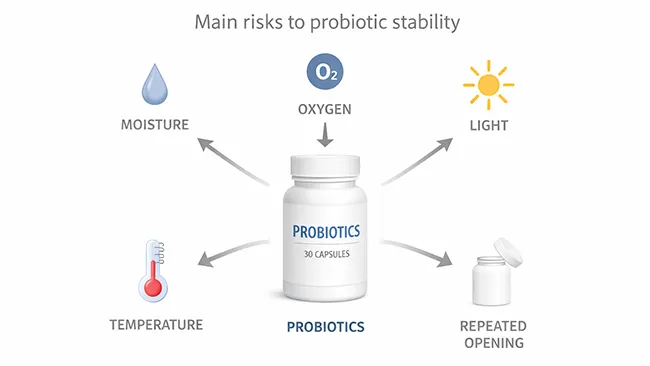
Most probiotic packaging decisions come back to the same storage risks. The first is moisture. Reviews on probiotic product stability consistently identify water activity as one of the main factors affecting survival over shelf life, which is why moisture control sits at the center of many packaging decisions.
The second is temperature. A probiotic product that looks stable in a controlled environment may behave differently after warehousing, shipping, and retail storage. Published studies show that higher storage temperatures can accelerate viability loss, while cooler and better-protected conditions can help preserve microbial counts more effectively.
The third is oxygen exposure. Some formulas tolerate it better than others, but oxygen remains an important stress factor for probiotic survival. That is one reason barrier performance, seal integrity, and closure design matter so much in probiotic supplement packaging.
Light and repeated opening also matter. Light protection is part of the packaging guidance used in probiotic products, and repeated opening changes the environment around the product each time a pack is used. A format that is technically acceptable at filling can become less protective once daily consumer use begins. (probi.com)
Bottle vs Blister Packaging for Probiotics
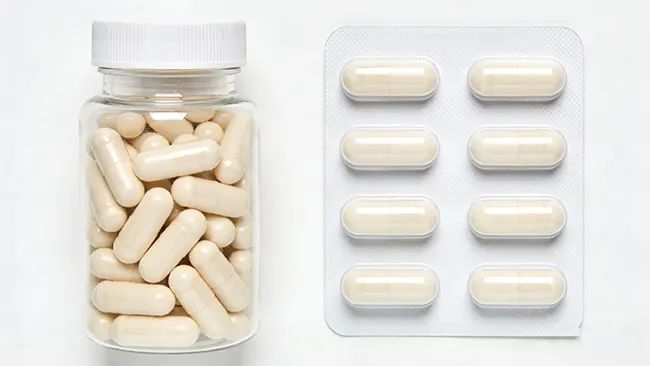
For capsules and tablets, the most common comparison is bottle vs blister packaging for probiotics. The decision is not only about appearance or retail preference. It is mainly about how the format handles exposure over time.
Bottle packaging is familiar, flexible, and practical for count-based SKUs. It works with multiple pack sizes. When the product is stable enough for a multi-dose route and the closure system is designed well, a bottle can be the right answer. Probiotic packaging guidance also notes that desiccants are often used in the lid, in the bottle, or inside the package to help manage moisture.
Blister packaging changes the protection model. Instead of reopening one container repeatedly, each dose remains sealed until use. That can make blister packs attractive when controlling repeated exposure matters more than bulk convenience. For more sensitive capsule or tablet products, that difference can be more important than the pack’s outward appearance.
The better question is usually not which format is better in general. It is which format matches the product’s shelf-life target, distribution conditions, and daily use pattern better. A bottle may suit a familiar retail routine. A blister may offer a stronger fit when dose-by-dose protection matters more.
| Format | Typical product type | Protection focus | Exposure after opening | Best-fit use case | Later line direction |
| बोतल | Capsules, गोलियाँ, some powders | Closure quality, moisture control, optional desiccant | Higher in multi-dose use | Count-based retail packs | Counting and bottling, desiccant insertion, कैपिंग, लेबलिंग |
| Blister | Capsules, गोलियाँ | Dose-by-dose sealed protection | Low per unit | Products where repeated opening is a concern | Blister packaging, मुद्रण, कोडन, cartoning |
| पाउच | पाउडर | Sealed single-use protection | Low per sachet | Daily portioned powder products | Sachet packing, मुद्रण, secondary packing |
| Stick pack | पाउडर | Single-dose protection with portable format | Low per pack | On-the-go probiotic powder products | Stick pack filling, मुद्रण, cartoning |
Are Sachets or Stick Packs Better for Probiotic Powders?
For powders, the comparison usually shifts to sachet vs stick pack. That is because probiotic dietary supplements are commonly sold as freeze-dried powder products in capsules, गोलियाँ, and powder in stick packaging or sachets, often under ambient storage conditions. Shelf-life performance still matters, but the packaging question is now tied more closely to dose format and user handling. (MDPI)
Sachets are often the simpler route. They work well when the goal is sealed single-use portioning, compact secondary packaging, and broad compatibility with powder products. They also make sense when the product is taken as a one-time serving rather than from a multi-dose container.
Stick pack formats usually make more sense when portability, narrow pack shape, and quick daily use are part of the product concept. For probiotic powders meant to be poured directly into the mouth or mixed with water, stick packs can be a cleaner fit. This is also where the lower-priority term probiotic pack can appear naturally, since a single-dose probiotic pack may refer to either a sachet or a stick pack depending on the final format.
The technical decision is still about protection, but the commercial decision also includes convenience. A format may provide adequate barrier properties and still feel wrong for the intended user routine. In practice, powder probiotics often need both a stable protection profile and a clear daily-use format.
Do Probiotics Need Desiccants or High-Barrier Packaging?
हमेशा नहीं, but many products need the question answered early.
Desiccants mainly help with moisture control. They do not solve every stability issue, but they can support a more controlled environment inside the pack when moisture is a major risk. That is why many probiotic packages include desiccants either in the lid, inside the bottle, or elsewhere in the package.
High-barrier packaging becomes more important when the formula is more sensitive, the target shelf life is longer, or the storage and distribution conditions are less forgiving. Probiotic stability guidance also notes that different materials provide different protection levels, with aluminum generally offering stronger protection than less-protective alternatives in certain formats.
Some products also benefit from active packaging. Industry coverage of advanced probiotic packaging describes systems that can control moisture, scavenge oxygen, and create a more favorable microclimate around the product. That does not make active packaging necessary for every SKU, but it does show that standard packaging is not always enough when stability targets are tight. (nutritionaloutlook.com)
How to Choose Probiotic Packaging for Shelf Life and Daily Use
The product format is the first filter. Capsules, गोलियाँ, and powders do not create the same packaging questions. Powders are more likely to lead to sachet or stick pack packaging. Capsules and tablets more often lead to a bottle or blister decision. That matches the way probiotic dietary supplements are commonly commercialized today.
The second filter is shelf life. Consumers expect probiotic dietary supplements to contain the viable count specified on packaging throughout the product’s entire shelf life, not merely when it leaves the factory. That makes the packaging decision more than a finishing choice. It becomes part of the stability plan.
The third filter is daily use. A format intended for repeated opening creates a different protection profile from a sealed single-dose route. Travel use, dose accuracy, and consumer handling can all shift the answer even when the formulation itself stays the same.
The fourth filter is distribution reality. Ambient storage may be common for many probiotic supplement formats, but shipping conditions, warehouse dwell time, and humid markets still change the demands placed on the package. A format that works well in one supply chain may be less forgiving in another.
How Probiotic Packaging Choice Connects to Machine and Line Selection
Once the packaging route is clear, the machine route becomes much easier to define.
A bottle route for probiotic capsules or tablets usually points to a probiotic counting and bottling line, followed by a desiccant insertion machine, कैपिंग मशीन, लेबलिंग मशीन, और कार्टनिंग मशीन. That is the logical path when the product is sold as a multi-dose count-based SKU.
A blister route changes the line structure. At that point, the main focus becomes cavity formation, unit sealing, कोडन, and downstream cartoning. In practical terms, that is where a ब्लिस्टर पैकेजिंग मशीन (or blister packing machine) becomes relevant.
Powder products packaged as sachets or stick packs move in a different direction again. ए पाउच पैकिंग मशीन (or stick pack machine) becomes part of the line decision only after the product has already been matched to a single-dose powder format.
That sequence matters. The pack style should come first, because it determines the protection model. The equipment choice follows from the packaging route rather than replacing it.
निष्कर्ष
Probiotic packaging is part of product protection, not just final presentation. The right format depends on how the product handles moisture, ऑक्सीजन, रोशनी, तापमान, and repeated opening across shelf life.
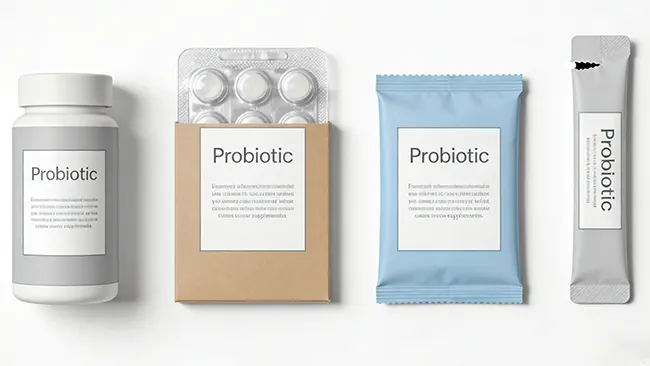
That is why bottle, छाला, पाउच, and stick pack formats should not be treated as interchangeable. Each one creates a different exposure pattern, a different user routine, and a different downstream line direction. With this understanding, identifying a packaging route that aligns with both product specifications and production capabilities becomes more straightforward.
अक्सर पूछे जाने वाले प्रश्न
Is blister packaging better than bottles for probiotics?
Not in every case. Blister packs can reduce repeated exposure because each unit stays sealed until use, while bottles may still work well for count-based products when closure and moisture control are strong enough.
Do probiotics always need a desiccant?
नहीं. But many products need moisture control to support shelf life, and desiccants are commonly used when moisture is a major packaging risk.
Are sachets a good option for probiotic powders?
हाँ. Sachets are a common route for powder probiotics, especially when sealed single-use portioning and reduced repeated exposure matter.
Can probiotics stay shelf-stable at room temperature?
Many supplement formats are sold under ambient conditions, but stability still depends on the formulation, storage conditions, and packaging system.
Why does repeated opening matter for probiotic products?
Because it changes the environment around the product over time. A multi-dose container can be exposed to ambient air and humidity again and again, while sealed unit-dose formats reduce that pattern of exposure.
How does packaging choice affect packaging machine selection?
Bottle formats generally lead to bottling, कैपिंग, लेबलिंग, and desiccant-handling routes. Blister formats lead to blister sealing and cartoning. Sachet and stick pack formats lead to single-dose flexible-pack lines.
संदर्भ
Probi. What you should know about probiotic product stability. (probi.com)
Aguinaga Bósquez JP, et al. Characterization and Viability Prediction of Commercial Probiotic Supplements. MDPI. (MDPI)
Advanced probiotic packaging designs protect potency and stability. Nutritional Outlook. (nutritionaloutlook.com)