Effervescent tablets are one of those dosage forms that feel simple to use—drop one into water, watch it fizz, drink the solution—but they’re surprisingly “sensitive” products behind the scenes. The same chemistry that creates a clean, satisfying fizz also makes these tablets highly vulnerable to moisture during storage and production. That’s why Herstellung von Brausetabletten is often treated as a packaging-and-process problem as much as a formulation problem—and why the Tablettenpresse is where “stability” starts, long before the tube is sealed.
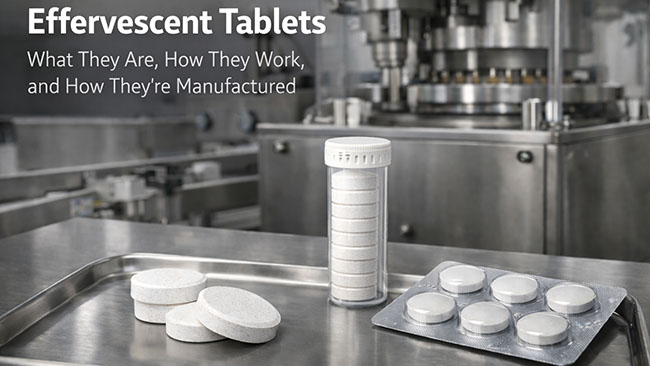
What are effervescent tablets
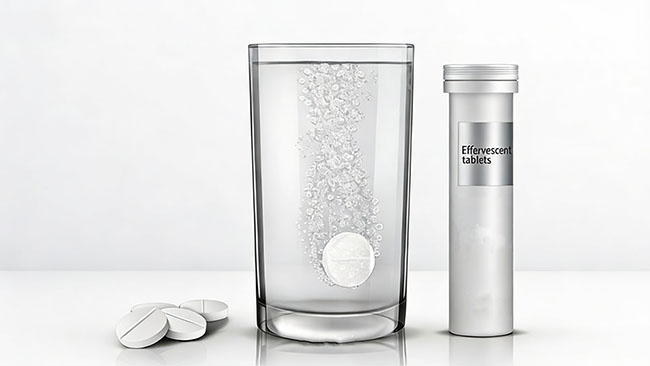
Effervescent tablets are tablets designed to dissolve in water and release carbon dioxide (CO₂) bubbles, creating a fizzy solution you drink rather than swallow as a solid. They’re typically formulated with an acid source and a carbonate or bicarbonate source that stay stable while dry, but react quickly when water enters the tablet. The tablet format gives a familiar “dose-per-unit” convenience, while the effervescent reaction makes the user experience feel fast, active, and easy to consume—especially for people who dislike swallowing pills.
In the market, you’ll most often see effervescent tablets as large, round tablets packed in protective tubes (using an effervescent tablet tube filling machine), or in high-barrier Blisterpackungen (made on an blister packing machine). That packaging isn’t just a branding choice; it’s part of the product’s stability strategy. If moisture leaks in, the tablet can start reacting early, lose strength, develop cracks, or dissolve slowly with more residue. In other words, the tablet’s performance in the glass is linked directly to how well it stayed dry before the consumer ever opened it.
As for what goes inside, effervescent tablets are commonly used for vitamins and minerals (such as vitamin C, B-complex blends, magnesium, zinc), electrolytes for hydration, and functional ingredients that consumers want to take in a drink format. In OTC applications, the same idea can apply to products intended for rapid dispersion in water. The “tablet” here is less about compact swallowing and more about controlled dissolution, taste masking, and a clean, measured serving.
One important point for beginners: these tablets are generally designed to be dissolved first. Their size and composition are optimized for water dispersion, so “dry swallowing” is not what the dosage form is built for. From a manufacturing standpoint, that design choice drives everything that follows—disintegration behavior, tablet size, porosity, hardness targets and the exact way the blend must compress to stay strong in the tube yet dissolve quickly in water.
How effervescent tablets work
The “fizz” is a controlled acid–base reaction. When water penetrates the tablet, an acid (often citric acid, sometimes tartaric or a blend) meets a carbonate/bicarbonate (commonly sodium bicarbonate). That reaction produces carbon dioxide gas (CO₂). The bubbles you see are CO₂ escaping the solution, and the pressure and agitation help the tablet break apart and disperse ingredients evenly.
A good effervescent tablet doesn’t just fizz—it dissolves predictably. Users notice three things immediately: how fast it disperses, how clear the drink becomes, and whether any gritty residue remains at the bottom. All three are influenced by how the tablet is built internally: its porosity (how easily water can move through it), its mechanical strength (so it survives shipping), and how uniformly the active ingredients are distributed. That’s why, even for a “simple” product, the way the blend is prepared and how it is compressed on a tablet press can change the experience in the glass.
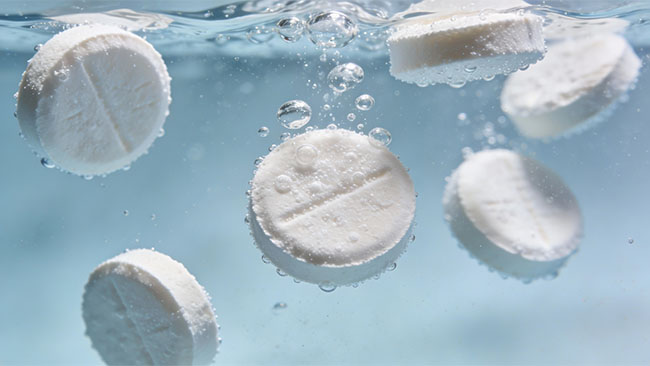
If a effervescent tablet fizzes weakly, dissolves slowly, or leaves heavy sediment, it’s usually not a mystery. It can be moisture exposure (partial pre-reaction), over-compression that reduces porosity, poor granulation that creates dense regions, or inadequate lubrication/flow that produces inconsistent structure from tablet to tablet.
Benefits and common uses
Effervescent tablets remain popular because they solve practical problems in a user-friendly format. They offer pre-measured dosing without the need for scoops, and many people find a flavored drink easier than swallowing large tablets or capsules. The solution format can also feel “faster,” even when the absorption profile is similar, because the act of dissolving signals immediacy to the consumer.
Common uses include vitamins and mineral blends, electrolytes and hydration formulas, and functional ingredients positioned for convenience (travel tubes, gym bags, desk drawers).
Why effervescent tablets are harder to manufacture than “normal” tablets
Effervescents behave like a tablet and like a reaction system at the same time. That is why effervescent tablets manufacturing demands tighter environmental control and more disciplined handling than normal tablet manufacturing.
Moisture is the obvious enemy. Even small humidity exposure can trigger partial reaction at particle surfaces, creating weak points that later cause crumbling, Risse, or slow dissolution. But moisture also changes flow and compressibility: powders can agglomerate, stick to tooling, and become inconsistent batch-to-batch, especially in warm environments.
The second challenge is that many effervescent blends are high in bicarbonate/citrate salts and mechanically brittle. They may not compact smoothly like classic tablet excipients. That can lead to problems that appear on the tablet press as sticking and picking, soft tablets that can’t survive packaging, or lamination/capping when trapped air and elastic recovery aren’t managed.
Endlich, packaging is inseparable from product performance. A conventional tablet can tolerate modest humidity swings and still look fine. An effervescent tablet might look fine yet lose fizz strength, dissolve unevenly, or fail prematurely once moisture creeps in. That’s why tubes with desiccants, high-barrier blisters, and well-controlled seals are not optional details—they’re part of the dosage form.
How effervescent tablets are manufactured
Most factories start with controlled material handling. Ingredients are stored and transferred in sealed containers when possible, and many lines run in a low-humidity room or a dehumidified enclosure around the critical steps. Teams typically track humidity as a process variable because it directly influences flow, sticking, and stability.
Next comes blending Und, depending on formulation, granulation. Some effervescent formulas can run via direct compression, but many benefit from dry granulation (such as roller compaction) to improve flow and reduce segregation without adding water. When wet granulation is used, it demands strict drying and careful process timing, and many plants prefer to avoid it for effervescents unless there’s a clear reason.
After sizing and final blending, lubrication becomes a critical “when and how” decision. Over-lubrication can weaken tablets and slow dissolution; under-lubrication can cause sticking and picking. The goal is consistent ejection and clean tablet faces without destroying the tablet’s internal bonding.
Compression happens on a tablet press machine, and effervescents often require a thoughtful balance: strong enough to survive handling and packaging, porous enough to dissolve fast. On many lines, A Rotationstablettenpresse is used because it offers stable feeding, repeatable compression profiles (the same pressure curve—pre-compression, main compression, and dwell time—on every tablet), and continuous production. In early development, teams may validate compression behavior on a lab/mini tablet press machine before committing to higher throughput, then scale to a production rotary tablet press once the “sweet spot” is understood.
Nach der Komprimierung, tablets may pass through dedusting and inspection steps, then go straight into moisture-protective packaging. Tubes with desiccants are common; high-barrier blister packs can also work well when the lidding and forming materials provide strong moisture barriers. In der Praxis, the packaging line is where a lot of effervescent failures are prevented—or created—depending on seal integrity and how quickly tablets are protected after they leave the tablet press.
Tablet press basics for effervescents
In factories, a tablet press may be called a pill press or a “tablet making machine,” but for effervescents it’s doing more than shaping tablets. It controls critical tablet properties—including weight variation, Bröckeligkeit, porosity, and mechanical strength—as well as performance metrics like disintegration time and water penetration consistency. These factors are direct drivers of dissolution behavior. For example, Ruidapacking’s HGZP-26/40D tablet press uses a fully enclosed compression chamber with transparent acrylic panels to reduce moisture pickup/contamination and make cleaning easier.
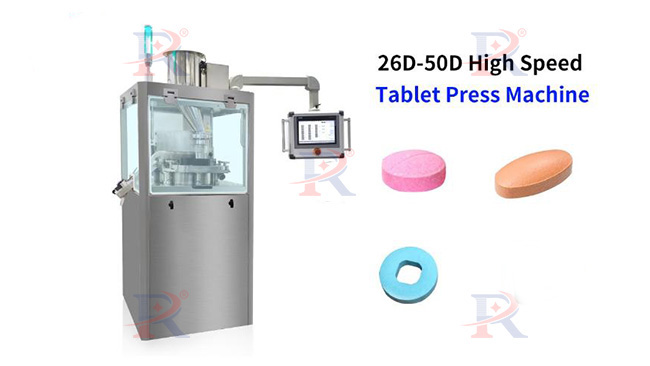
How a Tablette press makes one tablet
On a rotary tablet press machine, each tablet forms in a repeating cycle: die fill (powder/granules flow into the die as the turret rotates), weight control/metering (the fill depth is set by punch position, with excess leveled off by the feed frame/scraper), Vorkomprimierung (a light squeeze to vent air and stabilize the bed), main compression (the blend is compacted to the target strength and porosity), decompression (elastic recovery occurs—excess rebound and trapped air can contribute to capping/lamination), then ejection and take-off (where defects like sticking/picking or edge chipping may become visible).
What changes for effervescents: the few knobs that matter most
Effervescent blends are often brittle, salt-heavy, and moisture-sensitive, so the “right” settings are about a stable compression profile, not just higher force. A meaningful pre-compression step plus controlled main compression can hit strength without crushing pores (which would slow dissolution).
Speed is a trade-off. A high speed rotary tablet press machine boosts output, but shorter dwell time can worsen air-release and bonding issues. Many plants get better real throughput by running at a stable speed with low scrap and consistent dissolve.
Feeding consistency and ejection are equally critical. Early trials may use a lab/mini tablet press machine, but the final window must be proven on production equipment because feeder dynamics change with scale. Tooling matters: tablet press tooling (punches and dies)—on Ruidapacking’s tablet compress machine, the tooling uses GCR15 steel for higher hardness and better corrosion resistance—, face finish, tragen, and cleaning discipline often decide whether sticking and picking appear mid-run.
Quality tests that matter for effervescent tablets
Effervescents need the usual tablet checks, but the “functional” outcomes are often more visible and more tightly linked to the user’s experience.
In-process checks typically include weight variation, Dicke, and hardness targets appropriate for the packaging and distribution path. Friability or edge-chipping resistance matters because these tablets are often larger and more fragile if over-porous. Visual checks help catch cracks, lamination lines, and face defects early.
Functional performance is where effervescents stand out. Disintegration time (how quickly the tablet breaks apart in water), dissolution behavior (how evenly ingredients disperse), clarity (whether the solution is acceptable to the consumer), and the consistency of CO₂ release all shape perceived quality. A tablet that survives shipping but dissolves slowly with heavy sediment is “mechanically good” but commercially disappointing.
Packaging integrity checks deserve a place next to tablet tests. Tube seals, cap fit, desiccant presence, blister seal strength, and moisture ingress risk must be validated because a perfect tablet can still fail at the consumer level if the pack lets humidity in.
Common problems—and how manufacturers fix them
Effervescent defects often have multiple causes, but the fixes are usually found in the same few areas: Feuchtigkeitskontrolle, granule design, lubrication timing, compression profile, and tooling condition. Here’s a factory-friendly view:
| What you see | Most likely cause | What to adjust in manufacturing |
| Slow dissolve / weak fizz | Moisture exposure, over-compression, dense granules | Tighten humidity control, reduce excessive compression, adjust granulation route for porosity |
| Soft tablets / crumbling in tube | Under-bonding, over-lubrication, weak granules | Rebalance lubrication, improve granule strength (often via dry granulation), refine compression profile |
| Capping / lamination | Trapped air, fast turret speed, elastic recovery | Add/optimize pre-compression, reduce speed, tune dwell time and compression curve |
| Sticking / picking on punch faces | Moisture, unzureichende Schmierung, worn/dirty tooling | Improve drying/handling, adjust lubrication timing, clean/inspect tooling, consider surface treatments |
| High weight variation | Poor flow, segregation, inconsistent die fill | Improve granule size distribution, feeder setup, reduce segregation risk during blending/transfer |
| Tablets look fine but fail later | Moisture ingress after compression | Improve tube/blister barrier, seal checks, reduce time between compression and packaging |
Notice that many fixes are about “control” rather than a single magic setting. The best operations standardize environmental checks and recipe-based tablet compress machine settings so that a stable run can be repeated shift to shift. If your tablet making machine controls support consistent parameter recall and quick re-setup after cleaning, it becomes easier to keep the process within a narrow, repeatable window.
Häufig gestellte Fragen
Are effervescent tablets meant to be swallowed whole?
Most are designed to be dissolved in water first. Their size and formulation target dispersion, schmecken, and fizz performance rather than easy swallowing.
What makes an effervescent tablet fizz?
The reaction of an acid source and a carbonate/bicarbonate in the presence of water produces CO₂ gas, creating bubbles and agitation.
Why do effervescent tablets need tubes or high-barrier blisters?
Because moisture exposure can trigger premature reaction, weaken tablets, and degrade dissolution performance. Packaging plus desiccants (when used) helps keep the product dry.
Which manufacturing step causes the most failures?
Moisture exposure across handling and packaging is the most common root driver. On the rotary tablet press, unstable flow, over/under compression, and tooling condition are frequent contributors.
Direct compression or dry granulation—which is more common for effervescents?
It depends on the formula, but many manufacturers favor dry granulation for better flow and reduced segregation without introducing water.
What pill press settings most influence capping and sticking?
Vorkompression, turret speed (dwell time), lubrication strategy, and tooling condition are the usual levers—especially when humidity control is tight.
Referenzen
- FDA guidance and resources on cGMP expectations for finished pharmaceuticals
- USP / Ph. Eur. general chapters and methods commonly used for tablet tests (disintegration, dissolution, Bröckeligkeit, uniformity)
- Standard tablet compression references covering dwell time, Vorkomprimierung, and common compression defects
- Packaging engineering references on moisture barrier performance and seal integrity testing